

It’s late March. Again.
Your friends are posting photos in group chats of Match Day, champagne bottles, group hugs with PDs. Again.
You’re staring at that same NRMP screen. “You did not match to any position.” The second year in a row. And now a much nastier question shows up in your head:
“How bad does this look to program directors? Am I done?”
Let me tell you exactly how PDs and selection committees actually think when they see a second consecutive unmatched cycle. Not the sanitized NRMP brochure version. The closed-door meeting version.
The First Thing PDs Do When They See Two Unmatched Years
Here’s what really happens in the review room.
A coordinator or junior faculty opens your ERAS file on a projector. For a reapplicant, the first words you’ll often hear in the room are something like:
“This is their second time applying. Unmatched last year as well.”
Instant mental shift.
One unmatched year = “maybe bad luck, maybe weak spots, maybe timing.”
Two consecutive unmatched years = “we need an explanation.”
Nobody just shrugs and moves on. They either dig in or they pass. Fast.
The thought process is usually:
- Is there a clear reason this person didn’t match twice?
- Did they actually do something intelligent between cycles?
- Does their pattern suggest future problems if we bring them here?
They’re not just judging your numbers anymore. They’re judging your trajectory, your insight, and whether you can learn from failure.
The second unmatched cycle puts a giant red arrow on your file that says:
“Explain this or reject me.”
The Five Big Questions PDs Ask About a Two-Time Unmatched Applicant
Faculty won’t say this to your face, but behind closed doors, these are the exact questions they’re asking.
1. “Did they actually change anything?”
This is the biggest one. I’ve watched PDs scroll your application side-by-side with last year’s version.
Literally: two windows open, old ERAS on the left, new ERAS on the right.
They’re looking for evidence of growth, not motion-for-the-sake-of-motion.
They ask:
- Did they add meaningful U.S. clinical experience or just observerships?
- Did they fix red flags (Step 2 taken, CS equivalent if old cycle, more recent LORs)?
- Did they aim for a realistic specialty this time, or just roll it back again with minimal adjustments?
- Did they improve the application narrative or just copy-paste essays with a new date?
If your second-cycle app looks like 1.1 instead of 2.0, you get dismissed quickly. I’ve heard this exact line:
“They didn’t really change anything. If it didn’t work last year, why would it work this year?”
2. “Did they pivot to a realistic plan… or cling to a fantasy?”
Multiple unmatched years often scream one of two stories to PDs:
- Story A: “I was naïve the first time. I learned, I recalibrated, I grew.”
- Story B: “I refuse to accept reality and keep doing the same thing.”
Guess which one they’re willing to invest an interview slot in?
If you went 0/0 in Ortho or Derm last year with marginal board scores, minimal research, and no home-advocacy, then apply again to the same ultra-competitive field with almost no substantive change, most PDs are done with your file in under a minute.
They’re reading your specialty choice as a proxy for judgment.
Now contrast that with a candidate who:
- Applied to Gen Surg last year, didn’t match
- Spent the year in a surgical prelim + strong ICU rotations
- Realizes the long-term is better in Anesthesia/Internal and re-applies smartly with new letters, solid Step 3, and a clear personal statement explaining the change
That person tells a story PDs respect: “I adjusted course after reality smacked me.” That’s maturity.
3. “What did they actually do with the lost year?”
This is where a second unmatched cycle can be survivable or fatal.
PDs have a basic internal ranking here:
| Activity Type | Typical PD Reaction |
|---|---|
| ACGME Prelim / Transitional Year | Strongly positive |
| Full-time U.S. clinical / research fellowship with output | Positive |
| Paid non-clinical but medical-adjacent (QI, education, admin) | Neutral to cautious |
| Pure observerships / shadowing only | Weak |
| “Studying” at home / vague gap | Very negative |
They want to see structure. Accountability. Someone else trusted you enough to put you on a schedule, sign evaluations, and let you own patient care or projects.
A year spent as a prelim, a full-time research fellow at a known academic center, or as a hospitalist scribe with strong PD-level letters — that can rescue you.
A year labeled as “independent study,” “self-directed research,” or vague tutoring with no products and no supervisors? That’s where PDs start suspecting avoidance, depression, poor initiative, or simply lack of opportunities (which they interpret as: no one else was willing to vouch for you).
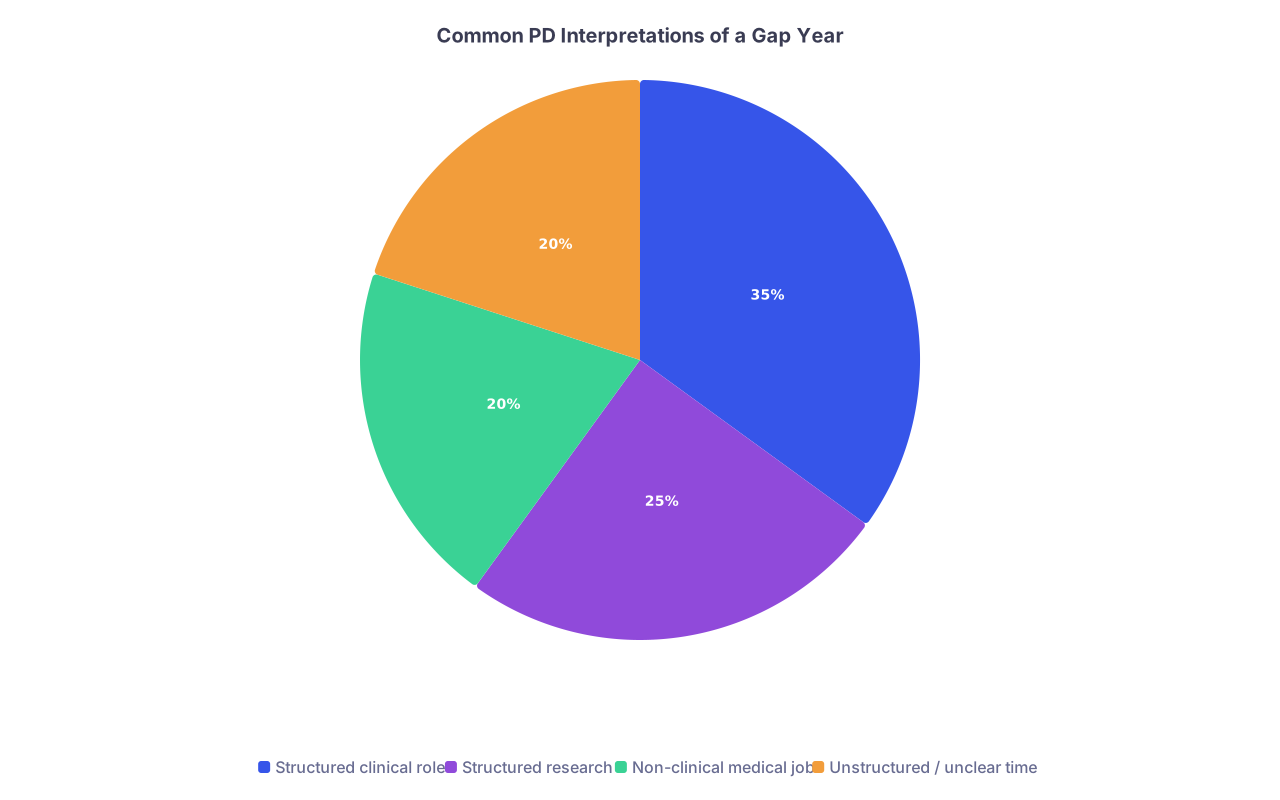
| Category | Value |
|---|---|
| Structured clinical role | 35 |
| Structured research | 25 |
| Non-clinical medical job | 20 |
| Unstructured / unclear time | 20 |
4. “Is there a time-decay problem here?”
Two unmatched cycles usually means age + time-from-graduation issues come into play, especially for IMGs.
Most PDs won’t say this explicitly on paper, but in conversation they will:
- “They graduated in 2018. It’s 2026. That’s a long time out.”
- “Skills rust. Clinical currency matters.”
They’re thinking about:
- How much re-training you’ll need
- Whether you’ll adapt to EMR, orders, night float, ICU pressures after years in low-acuity or observership roles
- How you’ll compare to fresh grads in raw speed and learning curve
The second unmatched cycle pushes you further from graduation, and every added year raises the bar you need to clear.
For U.S. grads it’s softer, but still real. For IMGs, it can quietly become the nail in the coffin.
5. “Can this person recover from setbacks… or are we importing a chronic problem?”
This is the uncomfortable psychology piece no one talks about.
PDs are trying to screen out future headaches: people who crumble when they fail Step, struggle with feedback, or can’t bounce back from a bad eval. A second unmatched year screams “major professional failure.”
Your application either:
- Shows you processed the blow, regrouped, sought feedback, and rebuilt.
or - Shows you froze, hid, and then re-applied because you had no other plan.
Programs want residents who get hit and get back up strategically, not just emotionally.
If your personal statement, experiences, and letters show resilience, insight, and concrete changes — you can actually turn the two unmatched cycles into a narrative asset.
If your file reads like a rerun, it becomes a liability.
How Different Specialties React to a Second Unmatched Cycle
Let me be very blunt here: specialty choice massively affects how two unmatched cycles are perceived.
Competitive Surgical Fields (Ortho, Plastics, ENT, Neurosurg)
Second unmatched cycle here, with no major upgrade (top-tier research, strong advocacy, new Step 3, meaningful clinical role at a big-name program) = almost always a dead end.
What PDs think:
“If they couldn’t match in two cycles, in a market this tight, why would we take a risk when we’re choosing between 260s with first-author papers?”
Most of these PDs expect you to pivot. To General Surg, Anesthesiology, maybe PM&R, even IM. If you’re still trying to brute-force your way in on round two with marginal stats, they’ll question your realism.
Core Fields (Internal Medicine, Family, Peds, Psych)
Here it’s more nuanced. A second unmatched cycle still hurts, but it’s not automatically terminal.
An Internal Medicine PD at a mid-tier academic program might say:
“They didn’t match twice, but they did a solid prelim year, have new letters from U.S. IM attendings, and passed Step 3. Let’s at least interview them.”
These fields care more about:
- Current clinical performance
- Reliability
- Communication skills
- Adaptability
If your second-try application screams “I fixed the holes,” you’re not dead. But you must show clear upgrades.
Transitional Year / Prelim Programs
These PDs see more “wounded” candidates. They’re used to folks who missed categorical and are trying to get in the door.
Second unmatched cycle here is still dangerous, but if you show that you’d be a safe, hardworking prelim who could help them run their service and maybe re-apply later, they may give you a shot — especially in less desirable geographic locations or smaller community hospitals.
Typical Red Flags PDs Look for in Two-Time Unmatched Files
Let me spell out what sets off alarm bells when PDs see repeat applicants. I’ve watched these conversations more times than I can count.
Red Flag #1: No explanation anywhere
If you’ve been unmatched twice and your personal statement, MSPE (if updated), and letters say nothing about:
- What you learned,
- Why this happened,
- How you adapted,
then PDs fill the gap with their own stories. And they rarely fill in your favor.
They’re not asking for a pity novel, but they want some acknowledgment that you’re aware of the pattern.
Red Flag #2: Same personal statement, same letters, same strategy
This one gets mocked out loud.
Faculty will recognize a recycled statement. Coordinators will recognize the same letter from that community doc you shadowed for a month three years ago.
The unspoken conclusion: “They didn’t take this seriously enough to overhaul their application.”
Red Flag #3: No new meaningful letters from the “lost year”
If you had a full year and you don’t have at least one strong letter from someone who supervised you recently, PDs assume:
- You didn’t do anything substantial.
- Or you did, and no one wanted to write you a strong letter.
Both are bad.
Red Flag #4: Scattershot, desperate application pattern
Applying to 3 completely different specialties twice (e.g., Psychiatry, Surgery, Radiology) with no coherent narrative? That looks like desperation, not thoughtful career exploration.
PDs don’t mind pivots. They mind chaos.
Red Flag #5: Longer, unfocused CV with no deeper responsibility
If your “experiences” section just gets longer every year, but not deeper, that’s a problem. Ten observerships don’t equal one solid, supervised clinical job with evaluations.
Faculty can smell resume-padding.
What Actually Impresses PDs After a Second Unmatched Cycle
Now for the good news: I’ve seen double-unmatched applicants get in and thrive. It’s possible. It just requires a level of honesty and strategy most people avoid because it hurts.
Here’s what quietly impresses committees.
1. A brutally honest, concise narrative
Not a sob story. A professional, direct explanation.
Something like:
“I applied broadly in General Surgery in 2024 and did not match. After receiving feedback about my limited U.S. clinical experience and lack of strong home program support, I pursued a surgical prelim year at [Hospital]. During that year, I realized my strengths and long-term goals aligned more with Internal Medicine, particularly critical care and complex inpatient management. I have since focused my career path accordingly…”
This tells a PD:
- You’re not in denial.
- You sought feedback.
- You’ve re-aligned with a field you can justify.
2. Real, current clinical performance with strong letters
A prelim IM intern who shows:
- Consistent “exceeds expectations” evaluations
- A letter from their prelim PD that basically says, “If I had a categorical spot, I’d keep them”
- A Step 3 pass with a decent score
That person can absolutely convert to a categorical spot somewhere.
Same for a research fellow with a major attending vouching for them as hardworking, reliable, and clinically competent on call or in clinics.
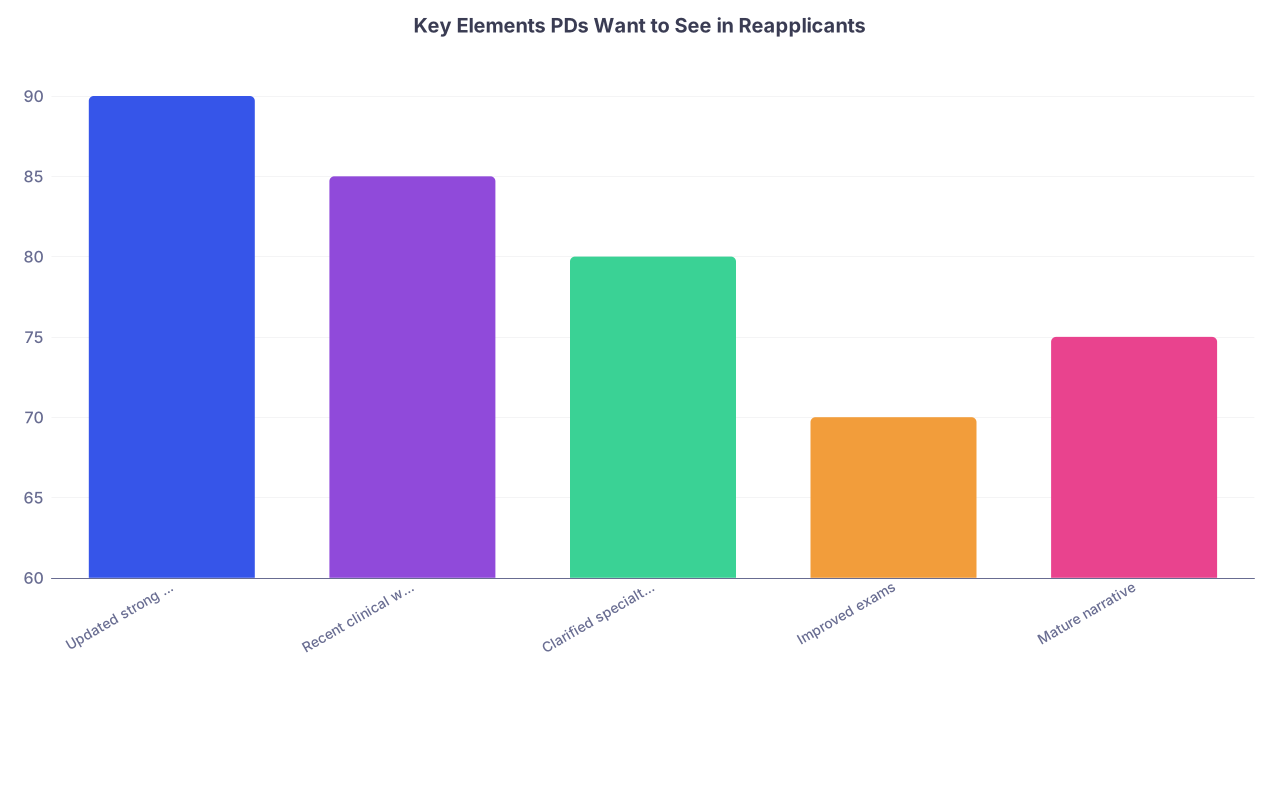
| Category | Value |
|---|---|
| Updated strong LORs | 90 |
| Recent clinical work | 85 |
| Clarified specialty choice | 80 |
| Improved exams | 70 |
| Mature narrative | 75 |
(Values represent approximate % of PDs who call each factor “very important” when discussing reapplicants in internal meetings.)
3. Step 3 as a strategic weapon
For a second unmatched applicant, passing Step 3 is not optional anymore in many PDs’ eyes. It becomes:
- Proof of current knowledge
- One less risk for the program
- A sign you’re serious and planning ahead
I’ve seen PDs say, “If they haven’t taken Step 3 by now after two unmatched cycles, what are they doing?”
You want that box checked, with a solid score. It won’t save a disastrous file. But it will tip a borderline application in your favor.
4. A clear, narrowed-down target list
Spraying 200+ applications in year two screams panic. PDs talk about it when they see applicants hitting every program under the sun across three specialties.
The candidates who eventually get in do something smarter:
- They pick one realistic specialty.
- They identify a tier of programs where their profile truly fits (often lower- to mid-tier community or smaller academic).
- They build real connections there — emails, away rotations, outreach to APDs, showing up for virtual open houses consistently.
One quiet secret: PDs talk to each other. If a respected PD calls or emails and says, “I had this person as a prelim. They’re excellent. Please look at them,” your two unmatched cycles suddenly matter a lot less.
How PDs Think About Risk: Why Two Unmatched Years Matters So Much
At the core, this is about risk.
Bringing in a resident who has already accumulated failure and delay means:
- Higher chance they burn out or leave early
- Higher chance they’re carrying academic deficiencies
- Higher chance of visa/board/credentialing complications (for IMGs)
- Higher chance they’re behind their peers in speed and efficiency
PDs are risk managers with limited slots and limited patience from faculty.
A two-time unmatched applicant must convince them of one thing:
“Yes, I’ve struggled… but I am currently high-functioning, reliable, and trending up, not down.”
If your story points up — structured year, new support, improved exams, stronger clarity about specialty — they can justify taking the risk.
If your story is flat or pointing down, they will not.
Where This Leaves You: Reality and Next Steps
If you’re sitting on a second unmatched year, you are not automatically done.
But you are out of “I’ll just try again and hope it works” territory. That delusion is how people burn 5–6 years circling around the match and end up with nothing.
You need to treat this like a salvage operation with a hard clock.
You have to:
- Get into a real, structured, evaluated role (prelim, research fellow with clinical work, hospital-based job)
- Earn new, powerful letters from current supervisors
- Take and pass Step 3 if you haven’t
- Decide one primary specialty and build a narrative and portfolio around it
- Be willing to downshift prestige expectations to actually get in somewhere
If you cannot realistically do those things, then the harsh truth is: future PDs will likely view you as an ongoing risk, and you need to start planning parallel careers now. Not three years from now. Now.
It’s not about whether you “deserve” to be a doctor. The system doesn’t care about that. It cares if you reduce risk for a program that has 100+ solid options for every seat.
Because years from now, you won’t remember every individual rejection email or every time a PD quietly passed over your file in a committee meeting. You’ll remember whether you faced the truth early enough to choose your path, instead of letting the match choose it for you.

| Step | Description |
|---|---|
| Step 1 | Second Consecutive Unmatched |
| Step 2 | Prelim / Research / Hospital Job |
| Step 3 | Seek Alt Careers Now |
| Step 4 | Reapply to One Realistic Specialty |
| Step 5 | Continue Building Profile or Exit |
| Step 6 | Targeted Interviews and Match Chance |
| Step 7 | Serious Plan B Discussion |
| Step 8 | Structured Role Available? |
| Step 9 | New Strong Letters & Step 3? |
| Step 10 | Meaningful Interest from Programs? |

FAQs
1. Does a second unmatched cycle automatically disqualify me from matching in the future?
No, not automatically. But it raises the bar significantly. PDs will expect substantial changes: structured clinical or research work with strong new letters, a passed Step 3, and a mature, focused narrative around one realistic specialty. Without those, your chances drop to near-zero at most programs, even if nobody writes that rule publicly.
2. Should I switch specialties after failing to match twice?
If you’ve applied twice to a highly competitive field without major objective strengths (top scores, landmark research, strong insider advocacy), then yes — staying the course is usually stubbornness, not strategy. Switching from an ultra-competitive field to IM, FM, Psych, Peds, or Anesthesia with a coherent story and real preparation often gives you a better shot. If you’re in a core field already, a specialty switch is less often required than a quality upgrade of your experience and letters.
3. Is doing another unpaid observership enough to improve my chances?
No. Not for a second unmatched cycle. PDs have seen hundreds of applications padded with observerships. At this stage, you need evaluated roles with responsibility and documented performance — prelim positions, research with real output and clinical exposure, hospital-employed roles where physicians directly supervise you and will write strong letters. Another observership by itself is a weak signal and rarely changes a PD’s mind about a two-time unmatched applicant.


