
What if the “any SOAP spot is better than none” advice you keep hearing is actually wrong for you?
Everyone gets very brave with other people’s careers during Match Week. Attendings who graduated in 1998. Classmates who have no data but lots of opinions. Family members who think “a residency is a residency, right?”
They all repeat the same line:
“Just take anything in SOAP. You can always switch later.”
Let me be blunt: that sentence has wrecked careers.
Not because SOAP is bad. SOAP is a lifeline for some people. But “any SOAP offer is better than waiting” is a lazy, fear-driven rule that ignores actual outcomes data and how hard it really is to undo a bad fit later.
You’re not choosing between “residency” and “doom.”
You’re choosing between very different probability trees. With very different endpoints.
Let’s walk through what actually happens to people who:
- Take any SOAP offer.
- Decline SOAP and reapply (or use a structured gap year).
- Land in a mismatched specialty or toxic program and try to “switch later.”
What the Data Actually Says About SOAP Outcomes
There’s not a single NRMP line item that says, “Did taking a random SOAP spot ruin your life?” But we do have several pieces of hard data we can stitch together:
- NRMP Main Match outcomes (filled vs unfilled positions, specialty competitiveness).
- NRMP “Charting Outcomes” (especially for reapplicants).
- NRMP “Out of Match” and SOAP reports.
- Published switching data (e.g., residents changing specialties, attrition).
Put together, they tell a consistent story:
- SOAP is not a clean “backup lane” into the same outcomes as the Main Match.
- Switching specialties after starting residency is possible but statistically rare and brutally work-intensive.
- Some SOAP choices trap you more than others.
Let’s compare a few paths.
| Path | Short-Term Security | Long-Term Flexibility | Reapplication Chance | Burnout/Attrition Risk |
|---|---|---|---|---|
| Take any SOAP spot | High | Low–Medium | Low | Medium–High |
| Targeted SOAP or reapply plan | Medium | High | Medium–High | Medium |
| Start, then try to switch | Medium | Low | Very Low | High |
That “any SOAP” path looks safe in March. It often isn’t safe five years later.
Myth #1: “Any Residency Is Better Than No Residency”
This is the line I hear constantly in group chats and panic calls on Wednesday of Match Week.
Reality:
“Any residency is better than no residency this year” is sometimes true.
“Any residency is better for your career than waiting” is often false.
Here’s why.
1. Some specialties are far easier to re-enter than escape
SOAP spots cluster in specific areas: prelim medicine, prelim surgery, family medicine in rural locations, psych in struggling programs, community internal medicine, transitional year (fewer of these now).
If you SOAP into:
- A categorical community IM program with decent training and support.
- A solid family medicine or psych program where you can see yourself staying.
Then yes, taking the offer often makes sense.
But if your only SOAP options are:
- A known malignant prelim surgery year with a 40–60% pass rate on ABSITE.
- A geographically isolated program with chronic ACGME citations and constant faculty turnover.
- A categorical in a specialty you actively dislike and have zero interest in practicing.
“Any residency” starts to look like “high burnout plus mediocre outcomes” masquerading as safety.
2. Non-match doesn’t automatically equal “you’re done”
Look at NRMP’s own reapplicant data:
- Reapplicants in competitive fields (derm, ortho, plastics) have much lower match rates when they reapply to the same specialty without fixing the core issue (scores, research, letters).
- But reapplicants who:
- Re-strategize their specialty choice,
- Strengthen their application (often with a structured research year),
- Apply more broadly and realistically
can and do match.
I’ve seen:
- An unmatched US MD who did a gap year research fellowship + MPH and matched IM at a respectable academic program the next year.
- A DO who didn’t SOAP into EM, took a structured hospitalist scribe + research role, pivoted to IM and matched well on the second try.
- An IMG who bypassed awful SOAP prelim options, did a strong US research year with publications, then matched into neurology.
Non-match isn’t a sentence. It’s a diagnostic signal. If you treat it like a diagnosis and not a death sentence, your second attempt can be much smarter.
3. The “lost year” narrative is exaggerated
People dramatize a gap year as if you’re going to vanish into a black hole. Programs don’t actually think like that.
What they care about:
- Did you use the year intentionally?
- Did you stay clinically or academically relevant?
- Can someone credible vouch for you from that year?
A year of structured research, a chief year, a prelim year at a decent place, or even a well-done clinical job (scribe in an academic ED, hospital-based research coordinator, etc.) is not a black mark. It’s often a plus if you frame it correctly.
“Any residency” is only clearly better than waiting if:
- You would truly be content long-term in that specialty/location and
- The program isn’t so dysfunctional that it risks your health, board passage, or ability to practice.
Those are not small “ifs.”
Myth #2: “You Can Always Switch Later”
The most damaging half-truth in this space.
Yes, people switch. I’ve seen surgery to anesthesia, peds to psych, IM to radiology. But they are the exception, not the rule.
The data and reality:
- NRMP and specialty organizations estimate specialty switching in low single digits percent.
- Internal transfer spots are scarce and almost never advertised.
- You’re asking PDs to take a risk on someone who already “failed” once (in their eyes), versus a fresh grad.
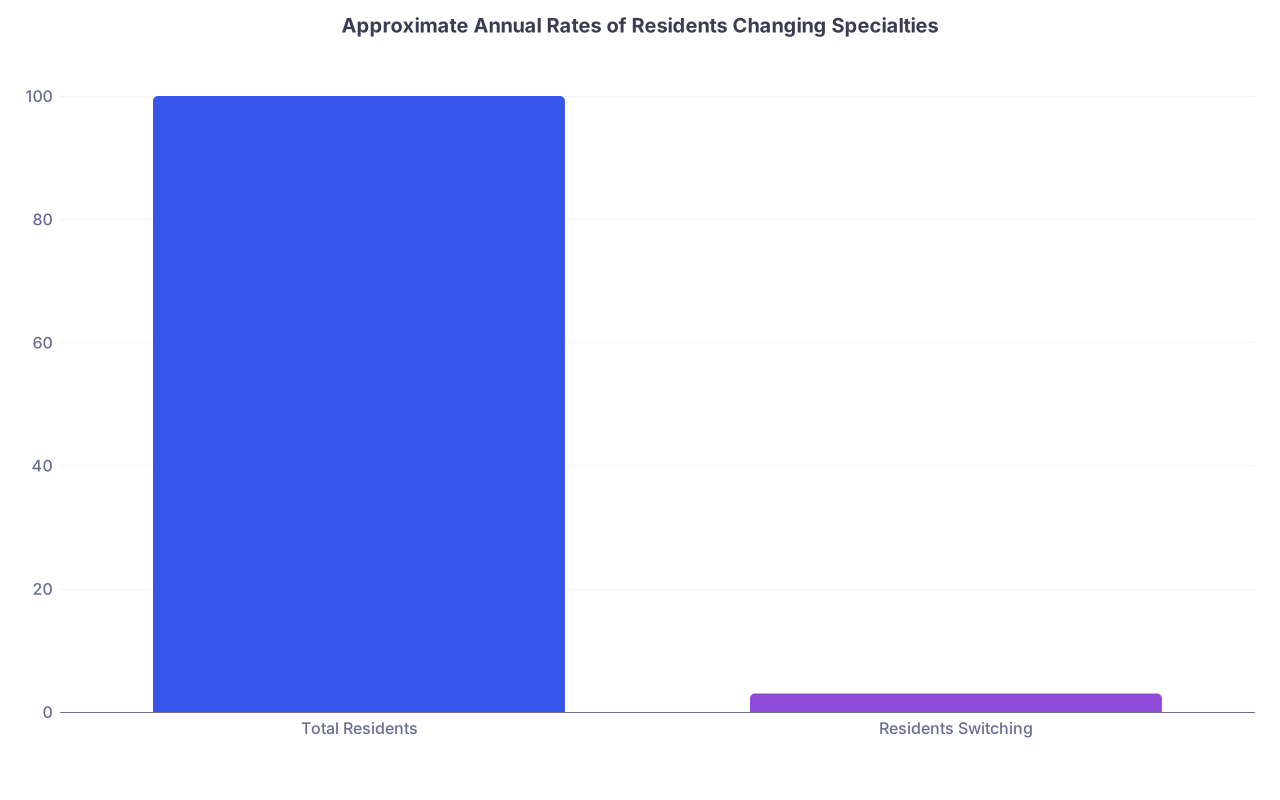
| Category | Value |
|---|---|
| Total Residents | 100 |
| Residents Switching | 3 |
That bar labeled “3” is your lifeboat. You don’t want to count on it.
Why switching is so hard in practice
Let’s say you SOAP into:
- A categorical family medicine program but really wanted EM.
- A prelim surgery year but dreamed of anesthesiology.
You think: “I’ll work hard, get great letters, then apply to PGY‑2 spots.”
Here’s what you’re up against:
- You have:
- Less time to assemble a stand-out application while working 60–80 hours/week.
- Limited access to research, leadership, or away rotations.
- A PD who may or may not support you leaving (many don’t).
- Your competitors:
- Fresh grads straight from med school.
- People who were top applicants the first time and just needed a year of something else.
Could you still win? Sure. People do. But the odds are nowhere close to the casual “you can always switch later” fantasy.
If you know you don’t want the specialty you’re SOAPing into and are already telling yourself a “switch later” story, that’s a giant red flag to pause, not an argument to auto-accept.
Myth #3: “If You Don’t SOAP, You’ll Never Match”
This one is fear talking, not statistics.
Let’s separate two groups:
- Applicants with systemic barriers:
- Very low scores with multiple failures.
- Severe professionalism issues.
- Immigration/visa constraints.
- Applicants with fixable barriers:
- Applied to too few programs.
- Applied to an unrealistic list (e.g., 5 derm programs, no backup).
- Weak letters or no recent clinical experience.
- Late application.
For group 2, reapplication with a structured plan works. Not guaranteed, but absolutely viable.
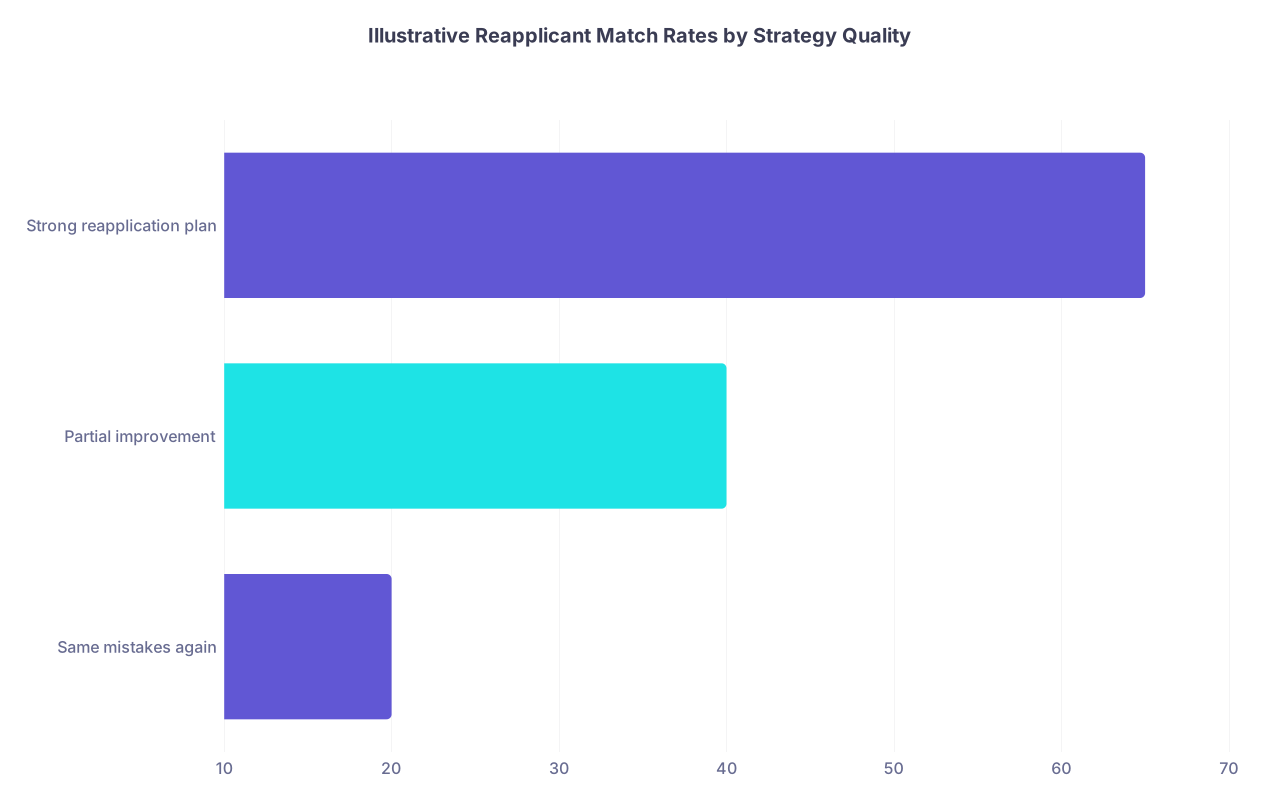
| Category | Value |
|---|---|
| Same mistakes again | 20 |
| Partial improvement | 40 |
| Strong reapplication plan | 65 |
These numbers are conceptual, but they reflect a pattern in NRMP “Charting Outcomes” and in what PDs say out loud when they think students are not listening.
Repeating the same strategy = low odds.
Reapplying with a serious, targeted repair plan = far better odds than Reddit fear posts suggest.
What absolutely tanks your flexibility is locking into a specialty or program that you:
- Hate.
- Can’t physically or mentally sustain.
- Can’t credibly explain later (“So you started in prelim surgery at a malignant program you knew you didn’t want—why?”)
When Taking a SOAP Offer Is Usually Better
Now the part people misquote. I’m not anti-SOAP. I’m anti-lazy SOAP.
You should seriously consider accepting if:
- It’s a categorical offer in:
- Internal medicine, family medicine, psych, peds, or neurology
and you can imagine practicing that field.
- Internal medicine, family medicine, psych, peds, or neurology
- The program:
- Has decent board pass rates.
- Isn’t drowning in ACGME citations.
- Doesn’t have a reputation for malignant culture among current residents.
- You:
- Are flexible on specialty and just want to be a practicing physician.
- Do not have the finances or visa leeway to realistically wait and reapply.
- Have already done one or more unsuccessful cycles and your application ceiling is largely fixed.
These are the folks for whom “a bird in the hand” often really does beat another cycle in the wild.
A solid community IM or FM SOAP spot, even if it’s not glamorous, can absolutely lead to a good life:
- Hospitalist work.
- Outpatient practice.
- Fellowship (cards, GI, pulm/crit, etc.) if you hustle.
The key is that these paths are aligned with something you can live with. Not your fantasy from M1. Your actual adult self.
When Waiting Might Be the Smarter Move
Here’s where the contrarian answer really bites: there are cases where declining SOAP and reapplying is the better percentage play.
Consider waiting if most of the following are true:
- Your only SOAP options are:
- Toxic prelim years with legendary burnout.
- Specialties you actively dread.
- Programs with red-flag reputations or clear dysfunction.
- You have a realistic path to strengthening your application:
- US MD/DO with passes on boards, decent but not stellar scores.
- Willing and able to do a funded research year, chief year, or structured clinical position.
- You’re open to pivoting to a less competitive but aligned specialty next year.
- You don’t need a visa next July no matter what.
- You’re actually willing to do the work in the off-cycle year, not just sulk.
This is not a free pass to avoid discomfort or chase a fantasy specialty you have no realistic shot at. It’s a calculated decision that “no now, better later” beats “yes now, trapped for years.”
How to Decide in Real Time (Without Panicking)
You don’t have weeks. You have hours.
Here’s a simple mental flow that beats the generic “take anything” script:

| Step | Description |
|---|---|
| Step 1 | SOAP Offer |
| Step 2 | Strongly consider accepting |
| Step 3 | High risk - compare vs reapply |
| Step 4 | Consider as bridge year |
| Step 5 | Serious reapply plan |
| Step 6 | May need to accept or change goals |
| Step 7 | Categorical in tolerable specialty? |
| Step 8 | Program reasonably functional? |
| Step 9 | Prelim/TY at decent program? |
| Step 10 | Can you improve and reapply? |
And when I say “reasonably functional,” I mean:
- Board pass rates not catastrophic.
- Enough faculty to support training.
- Current residents don’t universally say “run” when you find them on Doximity/WhatsApp.
The One Question You Must Answer Honestly
Forget everyone else’s slogans for a minute.
Ask yourself:
“If I wake up five years from now and I’m practicing in the specialty and environment this SOAP offer represents, would I be able to look back and say I made a defensible decision?”
Not “ecstatic.” Not “my M1 dream.”
Just: “defensible.”
If the honest answer is yes, even if it stings your ego, then accepting is very likely reasonable.
If the honest answer is a hard no—“I’d feel like I panicked myself into a life I never wanted”—then you owe yourself at least a serious conversation about structured waiting and reapplying.
People remember the emotion of Match Week for a long time. But what actually shapes their careers is what they did in those panicked 48 hours when everyone around them was screaming “just take anything.”
Years from now, you won’t care about SOAP vs non-SOAP as a label. You’ll care whether you chose the path that gave you the best shot at a life you can stand waking up to.
Make that your metric, not the volume of the advice around you.