
You did not match. Money is tight. You cannot “just do a research year at Hopkins” or pay for 12 away rotations. Fine. Then you out-plan everyone else.
This year can either quietly kill your career or become the most productive, strategic 12 months you have ever had. The difference is not money. It is structure.
I am going to walk you through a gap-year plan that works for someone with almost no cash and no institutional safety net. Step by step. No fluff. No fantasies about fully funded research fellowships magically appearing.
Step 1: Get Brutally Clear on Your Constraints and Targets
You cannot build a plan until you know two things:
- What you are aiming for.
- What you absolutely cannot do.
A. Define your realistic target specialty (for this cycle)
If you are completely open to changing specialties, you have more options. If you are dead set on something ultra-competitive (derm, ortho, plastics, ENT, optho, some anesthesia/EM markets), you need to treat this like a multi-year campaign.
Ask yourself:
- Did I get any interviews in this specialty?
- 0–1 interviews = programs are not taking you seriously yet. You probably need:
- Stronger Step 2 / COMLEX 2
- US clinical experience with letters in the specialty
- A reconsideration of specialty competitiveness.
- 0–1 interviews = programs are not taking you seriously yet. You probably need:
- Did I get several interviews but no rank success?
- That points more to:
- Red flags
- Interview skills
- Application strategy, not raw stats.
- That points more to:
Do not dodge this. If you apply to the same highly competitive specialty again without significant new value, you are almost guaranteeing a second unmatched year.
If you have limited funds, you lean toward specialties with:
- More spots (internal medicine, family medicine, peds, psych, prelim/transitional year)
- Community programs
- States with high resident need (Midwest, South, some rural regions)
You can still pivot back later. But you need to get into the system first.
B. Spell out your money and life constraints in hard numbers
Write this down:
- Current savings: $____
- Monthly income (if any): $____
- Monthly fixed expenses (rent, food, insurance, minimum loan payments, phone, etc.): $____
- How many months you must survive before you are in real trouble: ___ months
Then:
- Decide how many hours per week you must realistically devote to income:
- 0–10 hrs/week (lucky, but rare)
- 10–20 hrs/week
- 20–30+ hrs/week (common if you have no family support)
This dictates everything else. If you need 30 hours a week just to stay afloat, your plan must be:
- Near home or fully remote
- Flexible
- Focused on 2–3 high-yield activities, not 10 scattered ones.
Step 2: Establish a Minimal Survival Budget and Income Plan
If you ignore money and just “focus on applications,” you will end up scrambling for work mid-year and killing both productivity and mental health.
A. Build a survival budget
Cut it down to bare bones for 12 months. Not forever. Just now.
- Housing: cheapest safe option: roommates, parents, extended family
- Food: basic groceries, no eating out as routine
- Transportation: public transit or reliable used car only
- Discretionary: near-zero; you can reintroduce sanity later
You want a monthly “survival number” that is as low as you can reasonably tolerate.
B. Pick income streams that align with your application story
Yes, you can do Uber or DoorDash. But it does nothing for your CV. If you can, choose work that gives you:
- Clinical exposure
- Letters
- USCE (for IMGs)
- Or at least stability and mental space
High-yield, low-cost options:
- Medical assistant / scribe / clinical research coordinator
- Call center for a hospital system / telehealth intake
- Nursing home, hospice, rehab center support roles
- Lab assistant / phlebotomist (if you can train quickly)
These jobs:
- Pay enough to cover essentials.
- Can often be part-time or flexible.
- Give you recent US clinical or healthcare-related experience.
| Role | Money Impact | CV Impact |
|---|---|---|
| Medical Scribe | Medium | High |
| Clinical Research Coord. | Medium | High |
| MA/Patient Care Tech | Medium | Moderate |
| Telehealth Intake/Call Ctr | Medium | Low-Mod |
| Uber/DoorDash | Medium | Low |
If you truly cannot find a healthcare-adjacent role, fine. Get whatever stable work you can. Then you will compensate with smarter hours outside the job.
Step 3: Choose 3–4 Core Gap-Year Pillars (Not 10)
You do not need 20 activities. You need 3–4 pillars you can sustain.
Your low-cost, high-impact options:
- Clinical exposure / USCE
- Letters and mentoring relationships
- Scholarly work (research / QI / case reports)
- Test improvement (Step 2 / COMLEX 2, or OET/IELTS if needed)
- Targeted application rebuild (personal statement, program list, interview prep)
Pick three as primary. The rest become secondary or opportunistic.
Step 4: Design a Weekly Structure You Could Actually Live With
A plan you cannot follow is useless. Let us build something realistic.
Assume you need ~20 hours/week of paid work.
Sample structure:
- 20 hours – income (scribe / MA / non-clinical work)
- 10–15 hours – clinical volunteering / observership / free clinic
- 5–10 hours – research / QI / writing projects
- 5 hours – exam prep or application work (depending on your needs)
- 1–2 hours – networking emails / calls / follow-up
- 1 block of time – rest and exercise (yes, mandatory; this prevents burnout in month 3)
Does this look heavy? It is. But you are trying to repair a failed match with limited money. This is not vacation.
Step 5: Secure Low-Cost Clinical Experience and Letters
You need fresh clinical experience and letters that say:
- “This person shows up.”
- “This person works hard.”
- “I would trust this person as an intern.”
A. Target local, cheap, or free options first
You are not paying $3,000 for a month-long observership. Those programs prey on desperation.
Priority list:
- Local community hospitals
- Federally Qualified Health Centers (FQHCs)
- Free clinics
- Private practices
- Hospitalist groups
How to approach:
- Start with email + in-person follow-up if local.
- Use direct, respectful subject lines:
- “Unmatched MD seeking volunteer clinical role”
- “Recent graduate seeking pro bono clinical observership”
Your email should be short and concrete:
- Who you are
- Where you trained
- What you are asking (specific days/times, how you can help)
- That you do not require payment or academic credit; you want experience and letters
- That you understand HIPAA, professionalism, and will not be a burden
And you follow up once weekly for 3–4 weeks. Most people quit after one email. Do not.
B. Turn every clinical role into a letter opportunity
Once you secure any clinical role:
- Show up early. Always.
- Ask for feedback.
- Offer unglamorous help: follow-up calls, chart prep, calling pharmacies, patient education.
- At 6–8 weeks, ask directly:
- “Dr. X, I am reapplying this fall and a letter from you would be extremely helpful. You have seen my work regularly for the past 2 months. Would you feel comfortable writing me a strong letter of recommendation for internal medicine residency?”
If they hesitate, do not push. You want “strong” letters, not vague “they rotated here” junk.
Step 6: Build Low-Cost Research / Scholarly Work That Actually Finishes
You do not need an NIH-funded fellowship. You need:
- 1–3 things you finish.
- Posters, abstracts, case reports, or QI projects with your name on them.
A. Start hyper-local
Where can you realistically get access?
- The attending you shadow at the clinic (“Are you working on any QI projects?”)
- Your old medical school faculty (email them with a concrete ask)
- Community hospitals (QI is everywhere, and under-published)
You can propose:
- Simple QI (reducing readmissions, improving follow-up, vaccine uptake)
- Chart reviews on common conditions
- Case reports (especially in underrepresented pathologies / complications)
These require more work than brilliance.
B. Focus on projects with a 3–6 month completion horizon
This is critical. Do not get seduced by giant, sexy projects that will not finish before ERAS opens.
High-yield low-cost projects:
- Case reports: can be done with one patient, one attending, and a cheap open-access or low-fee journal.
- Retrospective chart review: if you can get IRB access and a mentor, this becomes a poster or abstract.
- QI projects with built-in presentation at hospital QI day.
You want submissions on your CV before applications, not “currently working on a large project.”
Step 7: If Your Scores Are Weak, Fix That First
If Step 2 or COMLEX 2 is poor, you cannot “buffer” that purely with volunteering. You must clean it up.
You are broke, so you are not dropping $3,000 on a fancy prep course.
A. Build a low-cost exam recovery plan
Use:
- Question banks as your primary tool (UWorld, Amboss; share subscription if needed and allowed by TOS)
- NBME or COMSAE practice exams strategically
- Free resources:
- Online question explanations
- Free Anki decks
- Free high-yield videos
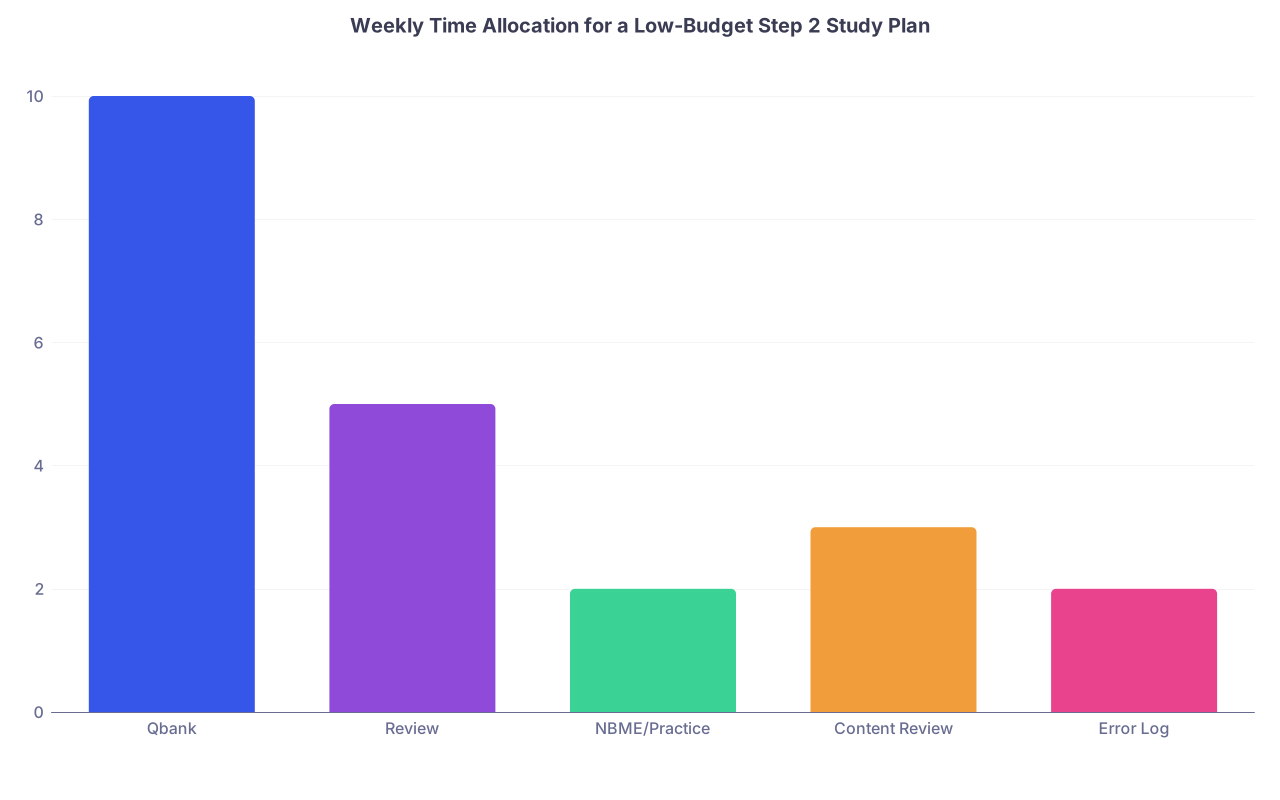
| Category | Value |
|---|---|
| Qbank | 10 |
| Review | 5 |
| NBME/Practice | 2 |
| Content Review | 3 |
| Error Log | 2 |
If you are working 20–30 hours/week, aim for:
- 2–3 hours/day on questions + review, 5–6 days/week
- One practice exam every 3–4 weeks after initial ramp
If your score is already taken and cannot be improved (no retake options), then you double down on:
- Clinical performance
- Letters
- Program selection
Step 8: Attack the “Soft” Failures: Strategy, Personal Statement, Interview Skills
I have seen plenty of applicants with reasonable stats fail to match because they:
- Applied to 40 programs in a competitive specialty instead of 120–150.
- Only applied to big-name academic centers.
- Wrote bland, cliché personal statements.
- Interviewed poorly.
These are fixable. At low cost.
A. Rebuild your application strategy
Do this on paper, not in your head:
- Number of programs you applied to last time.
- Distribution: academic vs community, geographic spread.
- Where you actually got interviews.
- Where you got silence.
Commit to:
- More volume, especially in community and mid-tier programs.
- Casting wider geographically (yes, even places you would never have considered living in before).
- Having at least one “backup” specialty if your primary remains highly competitive.
B. Fix the personal statement without paying $800
You do not need overpriced editing services.
You need:
- One clear story: what you want to do, why, and how your gap year fits it.
- Zero clichés about “ever since I was a child I wanted to help people.”
- Evidence: specific experiences, not vague adjectives.
And then have:
- One faculty member
- One co-resident or senior resident
- One non-medical friend (for clarity)
…read it and shred it.
C. Get real interview practice
If you bombed interviews:
- Use free or low-cost:
- School career services (even if you are alumni)
- Peers who matched
- Residents on social media willing to mock interview
Record yourself. You will hate it. That is the point.
Focus on:
- Your “tell me about yourself” answer. It should not be 6 minutes of rambling biography.
- Your “why this specialty?” answer. Needs actual content.
- Your “why this program/geography?” answer. Needs more than “diversity and research opportunities.”

| Step | Description |
|---|---|
| Step 1 | Unmatched Result |
| Step 2 | Assess Weakness |
| Step 3 | Focused Exam Prep |
| Step 4 | Rewrite PS & CV |
| Step 5 | Mock Interviews |
| Step 6 | Retake/Improve Score |
| Step 7 | Rebuild Program List |
| Step 8 | Stronger Reapplication |
| Step 9 | Main Issue? |
Step 9: Build a Ruthless Networking System (That Costs You $0)
“Networking” sounds like schmoozing at conferences. You do not have money for that. Fine. You do focused, one-on-one relationship building instead.
A. Start with your existing network
List:
- Every attending who liked you in med school.
- Every resident who told you “You’d be a great [specialty].”
- Any program coordinator who was kind to you.
- Classmates who matched where you want to go.
Contact them with specific asks:
- “Can you introduce me to anyone at X program?”
- “Do you know any community IM programs that are FMG-friendly?”
- “Could I do a short observership or research project with you or your colleagues?”
B. Cold email, but do it correctly
Target:
- Community program PDs
- Hospitalist group leaders
- Chief residents
- Clinic directors
Your email should be:
- 6–8 sentences max.
- Personal, not generic.
- Clear ask: mentorship call, observership, or feedback on your profile.
Follow-up schedule:
- Initial email
- Follow-up 7–10 days later
- Final follow-up 2–3 weeks after that
Then you stop. No spamming.
C. Document every contact
You are building a mini-CRM:
- Name
- Role
- Institution
- When you reached out
- How they responded
- Next steps
This is how people end up with “unofficial” pre-application advocates at programs. They were professional, consistent, and useful.
Step 10: Map Your Gap Year on a Timeline (Not Just a Wish List)
You cannot just say “I’ll do research and clinical stuff this year.” That is vapor. Put dates on everything.
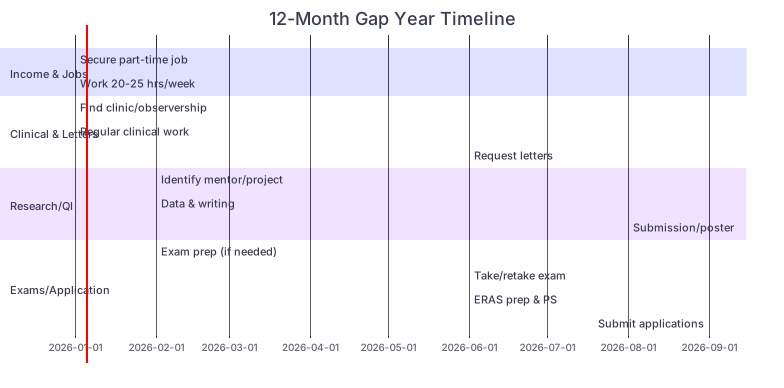
| Task | Details |
|---|---|
| Income & Jobs: Secure part-time job | a1, 2026-01, 1m |
| Income & Jobs: Work 20-25 hrs/week | a2, after a1, 11m |
| Clinical & Letters: Find clinic/observership | b1, 2026-01, 1m |
| Clinical & Letters: Regular clinical work | b2, after b1, 10m |
| Clinical & Letters: Request letters | b3, 2026-06, 2m |
| Research/QI: Identify mentor/project | c1, 2026-02, 1m |
| Research/QI: Data & writing | c2, after c1, 5m |
| Research/QI: Submission/poster | c3, 2026-08, 2m |
| Exams/Application: Exam prep (if needed) | d1, 2026-02, 4m |
| Exams/Application: Take/retake exam | d2, 2026-06, 1m |
| Exams/Application: ERAS prep & PS | d3, 2026-06, 3m |
| Exams/Application: Submit applications | d4, 2026-09, 1m |
You adjust the months to your reality, but the structure stays:
- Months 1–2: stabilize income, secure initial clinical role, start networking.
- Months 3–6: deepen clinical work, start and advance research/QI, exam prep if relevant.
- Months 7–9: finalize letters, submit abstracts, polish ERAS, submit early.
- Months 10–12: interview season, maintain clinical and work responsibilities, track every contact.
Step 11: Know When to Pivot Specialty vs. Double Down
You cannot just “keep trying” the same thing forever. At some point, you must decide whether you are:
- Reapplying in same specialty with significant new strength.
- Pivoting to a more attainable field.
A. Hard questions to answer honestly
- Did you have zero interviews last cycle?
- Are your exam scores below typical cutoffs for your desired specialty?
- Do you have red flags (failures, professionalism issues, big gaps) that this specialty tends to avoid?
If you are an IMG with:
- Step 1: Pass
- Step 2: < 225
- No USCE
- Applying to derm, ortho, or neurosurgery
You are not “one more year” away. You are in the wrong war.
B. Use data, not hope
Pull up NRMP and specialty data. Look at:
- Average Step 2 scores for matched applicants.
- Percentage of IMGs in that specialty.
- Number of positions vs applicants.
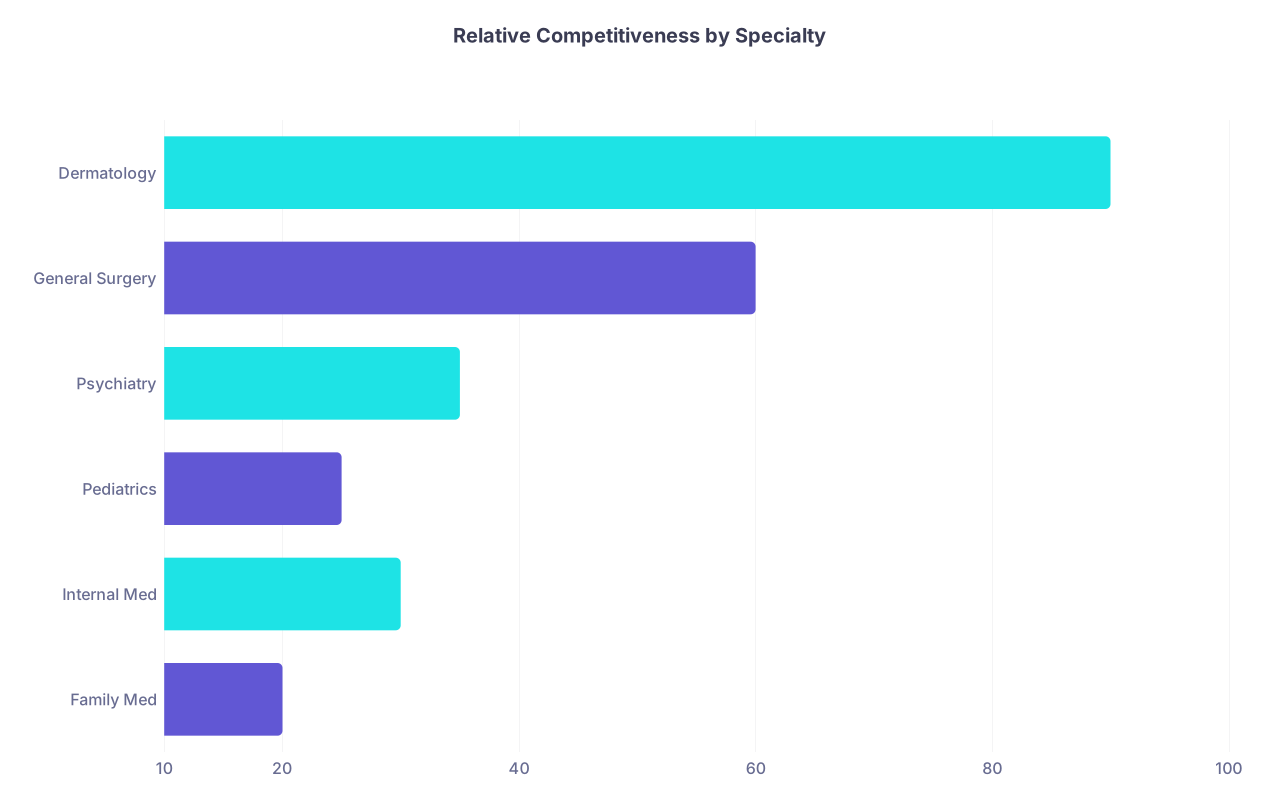
| Category | Value |
|---|---|
| Family Med | 20 |
| Internal Med | 30 |
| Pediatrics | 25 |
| Psychiatry | 35 |
| General Surgery | 60 |
| Dermatology | 90 |
If your profile is wildly outside the matched range and you have limited funds and time, a strategic pivot may be the correct move. Not a failure. A correction.
Step 12: Protect Your Mental Health Without Spending Money You Do Not Have
If you pretend this is not emotionally brutal, you will end up frozen or self-sabotaging.
You do not need a $200/session therapist to do basic maintenance (though if you can get low-cost therapy, do it).
Low-cost strategies:
- Use your school’s counseling services or alumni resources if available.
- Join small, moderated online communities of unmatched applicants where the goal is problem solving, not doom-scrolling.
- Build a weekly routine that includes:
- One full unplugged half-day (no ERAS, no UWorld, no networking)
- Physical movement (walking, basic workout, anything)
- One small non-medical activity that reminds you you are still a person, not just an application.
The goal is not to feel great. The goal is to stay functional and consistent for 12 months.
Step 13: Keep Receipts: Document Everything for ERAS
Do not trust your memory. Programs love specifics. You need:
- Exact dates and durations of:
- Clinical roles
- Research projects
- Work experience
- Concrete outcomes:
- “Submitted abstract to X Conference”
- “Poster presented at Y”
- “QI project reduced no-show rate by 15%”
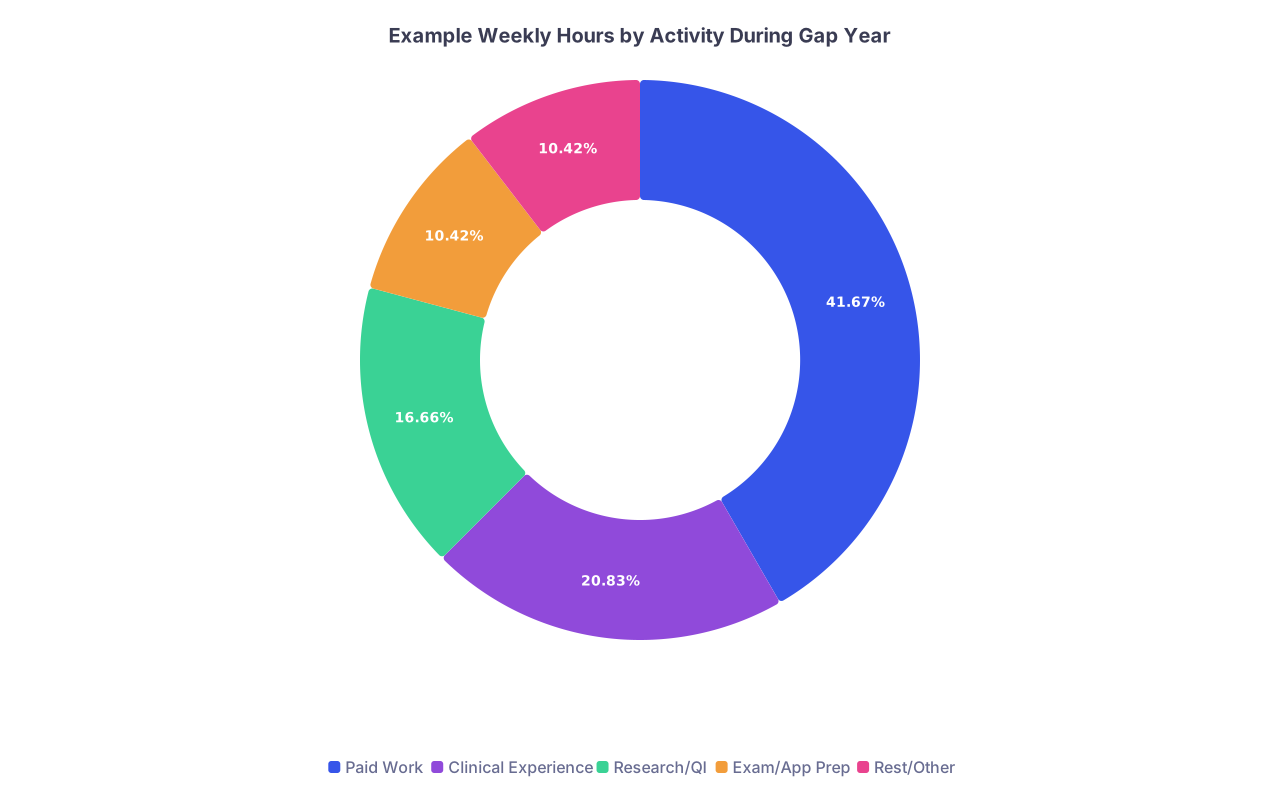
| Category | Value |
|---|---|
| Paid Work | 20 |
| Clinical Experience | 10 |
| Research/QI | 8 |
| Exam/App Prep | 5 |
| Rest/Other | 5 |
This data goes straight onto your ERAS in a clean, credible way. It also lets you answer interview questions like:
- “What did you do during your gap year?”
- “How did you improve your application?”
With specifics instead of vague generalities.
Step 14: Contingency Planning: What If You Still Do Not Match?
Harsh reality: even with a strong plan, some people need more than one cycle.
You prepare for that possibility without surrendering.
Contingency steps:
- Build skills that are transferable long-term:
- Research methods
- QI methodology
- Data analysis basics
- Teaching/tutoring experience
- Keep a list of non-residency but medically adjacent career paths that you could tolerate if you had to:
- Clinical research
- Public health roles
- Medical writing
- Industry roles (med affairs, safety, etc.)
You do not jump there yet. You just know what the lifeboats look like if the ship really does not come back.
The Bottom Line
Three things matter most if you did not match and you are broke:
Structure beats vibes. You cannot wing a gap year. You lock down income, then deliberately build 3–4 pillars: clinical work, letters, scholarly output, and exam/application repair.
Finish small, high-yield things. A case report submitted, a QI poster presented, and two strong fresh letters beat “I was loosely attached to a big research project that might publish in 2028.”
Face reality and adjust. If your scores, specialty choice, or prior strategy were out of sync with reality, you do not double down on denial. You pivot, strategically, while stacking experiences that keep doors open.
You are not out. You are just out of shortcuts. Now you need a plan that is tight, disciplined, and brutally honest.