

The most dangerous mistake after not matching is drifting for weeks without clear decision points. You do not have that luxury.
You’re not just dealing with “what now?” You’re dealing with hard cutoffs: SOAP deadlines, reapplication cycles, program start dates, and the real shelf-life of your MS4 letters and exam scores. If you’re considering switching specialties after a no match, you need a timeline, not vibes.
Below is a structured, time-based guide: what to do this week, this month, and by each key cutoff if you’re thinking of changing specialties.
Big Picture: Your 12-Month Window After No Match
Let’s anchor the year first. Then we’ll zoom into week-by-week.
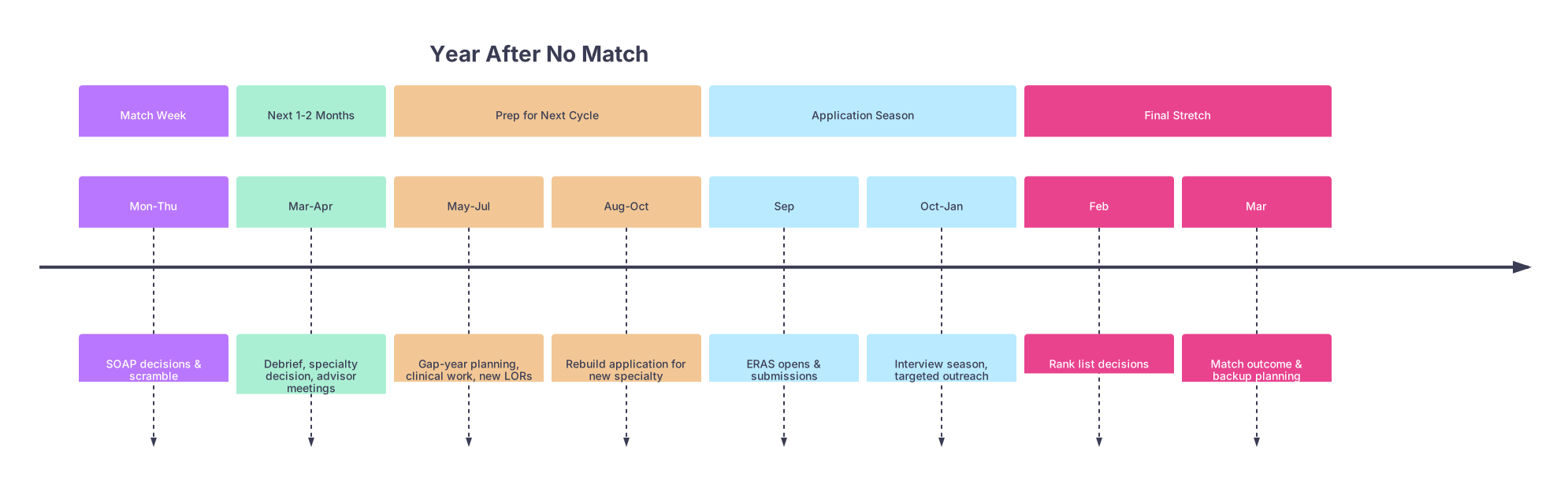
| Period | Event |
|---|---|
| Match Week - Mon-Thu | SOAP decisions & scramble |
| Next 1-2 Months - Mar-Apr | Debrief, specialty decision, advisor meetings |
| Prep for Next Cycle - May-Jul | Gap-year planning, clinical work, new LORs |
| Prep for Next Cycle - Aug-Oct | Rebuild application for new specialty |
| Application Season - Sep | ERAS opens & submissions |
| Application Season - Oct-Jan | Interview season, targeted outreach |
| Final Stretch - Feb | Rank list decisions |
| Final Stretch - Mar | Match outcome & backup planning |
At every stage, you’re deciding between three basic paths:
- Stay in the same specialty and reapply
- Switch to a different specialty and reapply
- Pursue a formal non-residency year (research, prelim, transitional, etc.) to reposition
Switching specialties compresses your timeline even more because you’re rebuilding your narrative from scratch. So your decision points come earlier and are less forgiving.
Match Week: 0–7 Days After You Don’t Match
This is not when you decide your future specialty. This is survival mode.
Match Week: Monday–Thursday (SOAP Week)
At this point, you should:
Commit to SOAP first, specialty-switch thoughts second.
Trying to pivot specialties during SOAP is usually a mess. Programs see through desperate, last-second “lifelong passion” stories.With your dean/advisor, set a SOAP priority order:
- Positions in your original specialty (if any reasonable fit)
- Closely related or acceptable backup specialties
- Prelim or transitional spots that keep the door open
Make a hard rule: you don’t burn bridges in your original specialty during SOAP. No angry emails. No drama. You might come back.
At this point, your “specialty switching” thinking is just noting:
- How many SOAP spots exist in your original specialty?
- How many in reasonable alternatives (IM, FM, psych, peds, prelim surgery, prelim medicine, etc.)?
- Do you get any honest comments from advisors like:
- “Your application is fundamentally uncompetitive for this specialty” vs
- “You were close; another year would likely do it”?
That distinction matters a lot later.
End of Match Week: Friday–Sunday
When SOAP is over and if you’re still unmatched:
At this point, you should:
Capture data while it’s still fresh:
- Number of interviews you had
- Where they were (community vs university, geographic spread)
- Any informal feedback you got: “Scores on the lower end,” “Research not strong enough,” “Late application”
Schedule two meetings for the next 1–2 weeks:
- Your dean/Student Affairs or GME office
- A trusted faculty mentor in your current specialty
You’re not deciding to switch yet. You’re collecting ammo for that decision.
Weeks 1–4 After No Match: The Decision Zone for Staying vs Switching
You have about one month to get brutally honest. By the end of this period, you should know:
- Am I reapplying to the same specialty?
- Am I switching specialties for the upcoming cycle?
- Am I taking a “rebuild year” and applying the following cycle?
Week 1–2: Debrief and Reality Check
At this point, you should:
Do a structured post-mortem of your application.
Break it down:- Exams: Step 1 (P/F), Step 2 CK, COMLEX scores
- Clerkship grades / AOA / class quartile
- Number of away rotations in the specialty
- Number and strength of specialty-specific letters
- Research output in the field (abstracts, posters, pubs)
- Geographic preferences (too restrictive?)
Ask your specialty advisor very specific questions:
- “If I reapply to this specialty, how would you categorize my chances: low, moderate, high?”
- “What exactly needs to change in 6–9 months to make me competitive?”
- “If you were me, would you consider switching to X or Y?”
Get a second opinion from someone outside your current specialty:
- Internal medicine PD
- Family medicine PD
- Psych PD
- Hospitalist or chief who knows multiple programs
If both say, “You’re pretty far off for this specialty,” that’s your first big switching signal.
Key Early Cutoffs in Weeks 1–4
By the end of Week 2, you should:
- Have a realistic written assessment of your competitiveness in:
- Original specialty
- One or two alternative specialties
By the end of Week 4, you should:
- Decide one of three paths:
- Reapply same specialty in the next cycle
- Switch specialty and apply in the next cycle
- Take a year to strengthen (research, prelim year, MPH, etc.) and apply in 2 cycles
This isn’t theoretical. If you waffle past Week 4, you blow the prep window for letters, research, and rotations in your new specialty.
Months 2–4 (April–June): If You’re Switching, This Is Build Phase
Now we’re assuming you chose: Switch specialty and reapply in the upcoming cycle.
Your job from April to June is to transform yourself from “tourist” to “legitimate candidate” in the new field.
Month 2 (April): Commit and Map the New Specialty
At this point, you should:
Lock in your new target specialty.
Not “maybe psych or peds or IM.” One choice. Programs can smell indecision.Create a gap year structure:
- Research position in the new specialty
- Clinical job (research coordinator, prelim year option, scribe in the field, etc.)
- Or mix: half research, half clinical volunteering
Identify 3–4 potential letter writers in the new specialty:
- Department chair or vice-chair
- Program director or associate PD
- Research PI in that field
- Clinic or ward attending you can work with consistently
You’re racing the calendar now. Those people need months, not weeks, to get to know you.
Month 3 (May): Secure Positions & Start Showing Up
At this point, you should:
Have something official in the new specialty:
- A signed research job
- A commitment to a structured clinical experience
- A prelim/transitional year contract if you scrambled into one
Start regular in-person presence in the department:
- Go to weekly didactics or grand rounds
- Join journal club
- Hang around the residents (and be useful, not clingy)
Begin at least one research or QI project:
- A chart review with a resident
- A QI project with the PD
- Case series or case report if that’s what’s available
Momentum matters more than prestige here.
Month 4 (June): Letters and Narrative Start to Take Shape
By the end of June, you should:
- Have at least one strong letter writer in the new specialty who’s agreed verbally.
- Be able to tell a clean story about why you’re switching:
- Trigger experiences (real, not generic: a specific rotation, a patient, a mentor)
- What you’ve done since no match that aligns with the new specialty
- How your old experiences still add value (e.g., surgical interest helps in EM, IM → heme/onc path, etc.)
This is also when you start drafting a new personal statement for the new specialty. Not a re-edit. A rebuild.
Months 5–7 (July–September): ERAS Deadlines and Hard Cutoffs
Here’s where most unmatched applicants screw up: they underestimate how early they need to be ready.
Early July: Final Decision Cutoff to Apply This Cycle
By early July, you should have made your last reversible decision:
- If you’re still waffling between:
- Same specialty vs new specialty
- Or new specialty A vs B
At this point, you should stop. Decide. Because:
- ERAS opens for applicants in late May.
- Program access to applications and interview planning rev up by September.
- You need your entire new-story package locked before then.
Mid–Late July: Application Materials Nearly Done
By the end of July, you should:
Have nearly final versions of:
- Personal statement for the new specialty
- CV updated with your post-match work
- List of programs (broad and realistic)
Have 3–4 letters lined up:
- Ideally 2–3 from the new specialty
- 1 from your old specialty or a core clerkship to show consistency and professionalism
August: Polish, Program List, and Backup Strategy
At this point, you should:
Finalize your program list:
- Mix of community, university-affiliated, and a few academic if appropriate
- Aim broad. After not matching, narrow lists are suicidal.
Strategically choose dual-application scenarios if needed:
- Example: Applying to IM and FM, or IM and Psych, when you’re on shaky ground
- If you do this, you must have:
- Separate personal statements
- Thoughtful, not contradictory, narratives
Decide your geographic flexibility:
- If you refuse to leave one metro area, accept you may be unmatched again
- Post-no-match, most people should go “anywhere I can train safely and competently”
September–January: Interviews and Ongoing Narrative Management
September: ERAS Submission
You don’t submit late. You’ve already lost one cycle.
By early–mid September, you should:
Submit ERAS with:
- New specialty clearly highlighted
- Post-match experiences front and center
- No confusing signals that you’re still half-in your previous specialty
Start polite outreach emails to:
- PDs where you have connections
- Faculty in your new specialty who know you
- Programs where you’re physically present (research site, clinical site)
These messages should be short, specific, and grounded in your story.
October–December: Interview Season
At this point, you should:
Be ready to directly address the no-match and specialty switch in every interview:
- What happened (without whining or blaming)
- What you learned
- Concrete steps you took during your gap year
- Why this new specialty fits better long-term
Watch for red flags in your strategy:
- Zero interviews by late November → you need a backup plan
- Only prelim offers → consider accepting and planning a 2-year trajectory
Use December to quietly revisit your worst-case scenario:
“What will I do if I don’t match again?”
February–March: Rank List and Second No-Match Contingency
February: Rank List Strategy
At this point, you should:
Rank every program where you could realistically train.
Prestige chasing after a no-match year is delusional.If you have a mix of categorical and prelim:
- Rank all categorical at the top
- Include prelims you’d actually be willing to complete as part of a longer-term plan
Revisit your 2–3 year roadmap:
- If matched in new specialty → how do you explain your switch during residency interviews/fellowship?
- If matched prelim only → what’s your plan to reapply again from a prelim year?
- If unmatched again → what non-residency path are you prepared to take?
March: Match Day (Again) and Hard Reality
If you match into your new specialty:
The switching decision was validated. You move on.
If you match into a prelim/transitional year only:
You’re now on a multi-cycle timeline. You’ll:
- Use that prelim year to secure powerful letters
- Decide whether to keep aiming for the new specialty or pivot again
- Apply during or immediately after the prelim year (timelines depend on the pattern of your rotations and PD support)
If you do not match again:
- At this point, you should:
- Stop repeating the same strategy
- Consider:
- Non-residency careers (research, industry, consulting, MBA, MPH, informatics)
- DO → MD bridge options (rare, messy)
- International options (also messy, often oversold)
- Have a brutally honest conversation with 2–3 PD-level people about long-term viability
Switching specialties a second time after multiple no-matches is usually a sign that the larger problem isn’t the field. It’s your competitiveness or constraints.
Quick Reference: Key Decision Points & Cutoffs
| Timeframe | Decision / Action |
|---|---|
| Match Week (SOAP) | Focus on SOAP; no final specialty switch yet |
| Week 2 Post-Match | Clear assessment of competitiveness |
| Week 4 Post-Match | Decide: same specialty vs switch vs rebuild |
| April–June | Build credibility in new specialty |
| Early July | Final cutoff to commit to target specialty |
| Sept (ERAS) | Submit full, coherent new-specialty app |
| Category | Value |
|---|---|
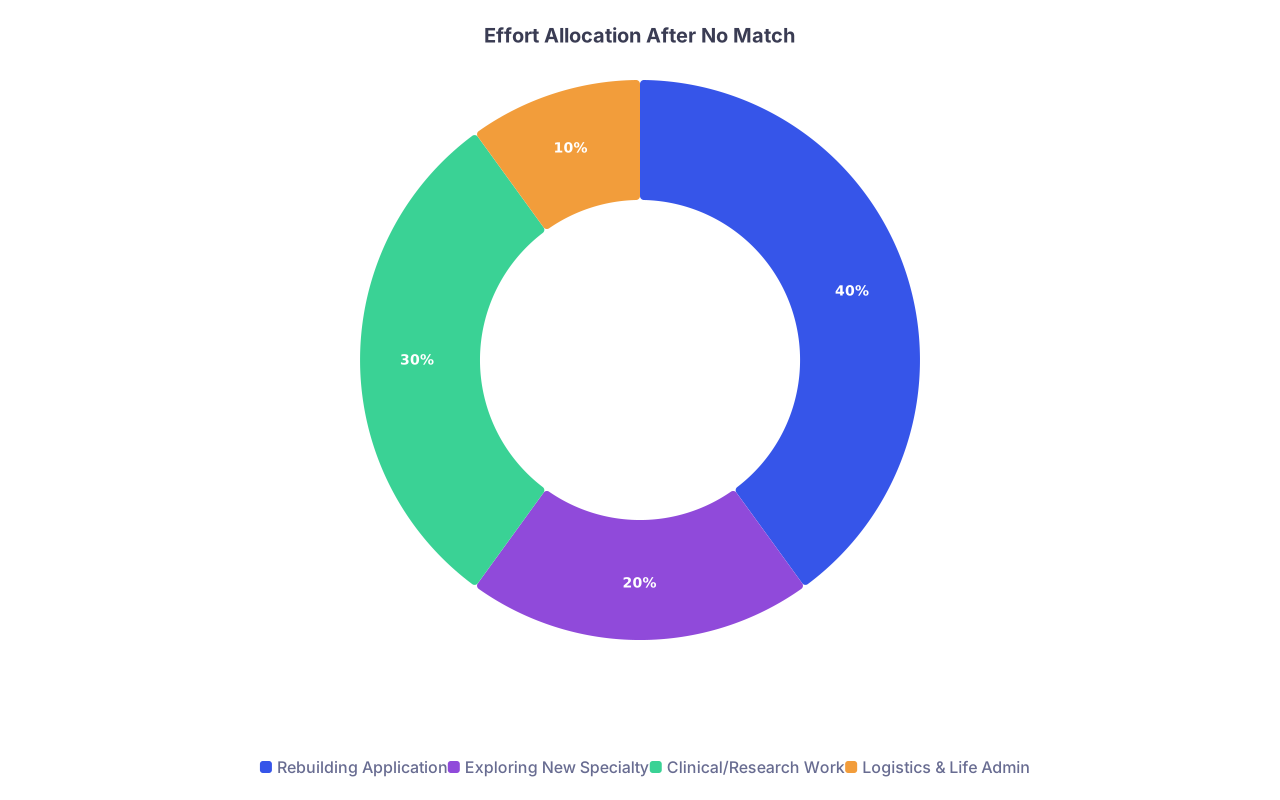
| Rebuilding Application | 40 |
| Exploring New Specialty | 20 |
| Clinical/Research Work | 30 |
| Logistics & Life Admin | 10 |
A Few Situations Where Switching Makes Sense (and Where It Doesn’t)
Reasonable to Switch
You applied to an ultra-competitive field (e.g., derm, ortho, plastics) with:
- Middle-of-the-pack scores
- Weak research
- Late application
- Minimal interviews
When you talk to multiple advisors, you hear some version of:
- “You’re an excellent candidate…for IM/FM/psych/peds/EM, but not for this field.”
You do a post-match experience in another specialty and it clicks—and you can prove it with attendance, work, and letters.
Bad Reasons to Switch
Panic after a single no-match without fixing obvious problems (late apps, poor PS, weak interview skills).
Assumption that IM/FM/psych is “easier” and you won’t need to change anything except the dropdown in ERAS.
You have no plan to build new letters, experiences, or narrative in the new specialty before September.
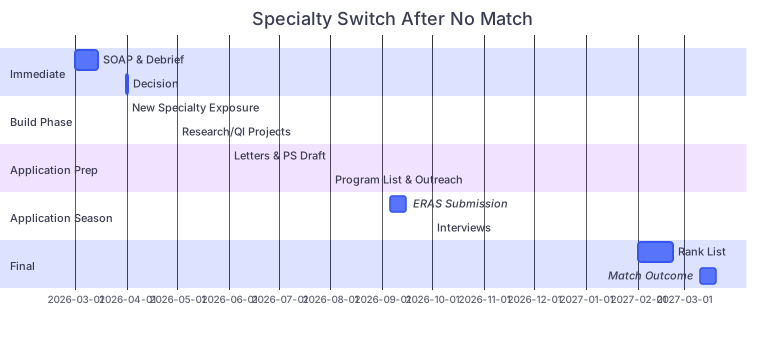
Visual: One-Year Gantt Chart for Specialty Switch After No Match
| Task | Details |
|---|---|
| Immediate: SOAP & Debrief | a1, 2026-03, 2w |
| Immediate: Decision | Stay/Switch:milestone, 2026-04-01, 1d |
| Build Phase: New Specialty Exposure | a2, 2026-04, 3m |
| Build Phase: Research/QI Projects | a3, 2026-05, 4m |
| Application Prep: Letters & PS Draft | a4, 2026-06, 3m |
| Application Prep: Program List & Outreach | a5, 2026-08, 2m |
| Application Season: ERAS Submission | milestone, 2026-09-10, 1d |
| Application Season: Interviews | a6, 2026-10, 4m |
| Final: Rank List | a7, 2027-02, 3w |
| Final: Match Outcome | milestone, 2027-03-15, 1d |

Summary: What You Should Remember
- You have about 4 weeks after a no-match to decide whether to switch specialties for the upcoming cycle. Past that, you’re recycling a weak application with a new label.
- Switching only works if you deeply commit to the new specialty by April–June—real work, real mentors, real letters, not just a rewritten personal statement.
- Your timeline has hard cutoffs—July for final commitment, September for a complete, coherent application. Respect those, and switching can rescue your path. Ignore them, and you’re almost guaranteed to repeat the same outcome.


