

Your phone is face down on the coffee table. Their phone just buzzed with the “Congratulations!” email. They’re crying from relief and excitement; your ERAS portal is still showing “No match.” And you’re sitting there trying to be a supportive partner while your own career just stalled out.
If that’s you right now, I’m going to talk to you like someone who’s been in those rooms, heard those fights through thin walls, watched couples either get stronger or blow up. You need a plan for both your relationship and your career—not one or the other.
Step 1: Stabilize the Next 72 Hours (Before You Say Something You Regret)
First priority isn’t “fix the match.” It’s: do not burn your relationship down in the first 3 days.
You’re running on:
- Shock + humiliation
- Jealousy (yes, that too, even if you love them)
- Fear about debt, visas, timelines, all of it
They’re running on:
- Relief + guilt
- Fear you’ll resent them
- Pressure to “be happy” and “not overshadow your pain”
That cocktail leads to nasty, unfiltered comments if you’re not careful.
Ground rules for the first few days
Tell your partner, out loud, something like:
“I’m really proud of you and I want to celebrate you. I’m also hurting a lot right now. I may be quiet or distant and it is not because I’m not happy for you. I just need a little space to process.”
That single speech buys you a ton of grace.
Then:
Time box “match talk.”
For the first 72 hours, limit serious life-planning conversations to 20–30 minutes max at a time. The rest of the time: food, sleep, basic logistics, short walks. Your brain is not in decision-making mode.Avoid three landmines:
- “I ruined everything.” (Self-blame spiral—drags them down with you.)
- “This is so unfair, you’re just lucky.” (Instant guilt + distance.)
- “Maybe we should just break up now.” (You might get there, but don’t decide in a stress fog.)
Decide on a short script for family/friends.
You will get texts. Decide with your partner what you’re saying:- “X matched at [program]. I’ll be reapplying next cycle and figuring out a good plan for the year.”
Copy-paste that. Do not over-explain.
- “X matched at [program]. I’ll be reapplying next cycle and figuring out a good plan for the year.”
Right now, the goal is: no big decisions, no permanent damage.
Step 2: Get Clear on the Actual Constraints
You can’t make “relationship-smart” choices if you are guessing about what’s possible. You need concrete facts.
Here’s what you figure out in the first 1–2 weeks (not the first 24 hours).

| Step | Description |
|---|---|
| Step 1 | No Match |
| Step 2 | Check SOAP/Options |
| Step 3 | Short-term plan near partner? |
| Step 4 | Gap year / reapply plan |
| Step 5 | Discuss distance vs same city |
| Step 6 | Agree on 1-year relationship plan |
| Step 7 | Any SOAP or prelim spot? |
Your side: career options
You need to quickly but calmly figure out:
-
- If yes: any offers? Where? Specialty?
- If no: why not? Strategic or you got screened out?
Are prelim/TY spots realistic?
- Talk to your dean or advisor. Ask directly:
“Given my scores (Step 1 pass, Step 2 ___), grades, and attempts, what’s realistic this cycle and next? Prelim IM? Transitional? Research year with strong letter?”
- Talk to your dean or advisor. Ask directly:
-
- Any home-country options worth considering for 1 year?
- Any research fellowships that are known pipelines (e.g., big academic internal medicine departments, onc, cardiology)?
Do not do this alone in your head. At least:
- Call your school’s career office or the GME office if you’re a grad.
- Email 1–2 faculty who actually know you and ask for a 20-minute blunt discussion.
- Ask specifically: “If I want to increase my odds next cycle, what is your top recommendation for this year?”
Their side: residency realities
You also need their details:
- Where did they match (city, program, schedule intensity)?
- Is it categorical or prelim?
- Is the program rigid on geographic presence? (Most are. Remote is fantasy.)
Ask them to pull up duty hour expectations and rotation sites. You’re not interrogating, you’re mapping.
Now you can lay out what’s really on the table:
| Option Type | Example Setup |
|---|---|
| Same city, both training | You SOAP into nearby prelim |
| Same city, one training | You do research/job in that city |
| Different cities, both training | You reapply elsewhere |
| Different cities, one training | You work remotely/from home |
| Break up/indefinite pause | You each prioritize careers |
No option is “perfect.” You’re choosing trade-offs, not fairy tales.
Step 3: Choose Your 1-Year Relationship Strategy (Not Your Forever Strategy)
You don’t need a 5-year plan. You need: “What do we do from this July to next July?”
There are four main plays couples in your position actually run.
Option 1: Same city, you find something there
This is usually the least emotionally destructive, if you can swing it.
You move to their residency city and you:
- Take a research assistant or clinical coordinator job in a department that will help your reapplication.
- Pick up a nonclinical job that pays your bills while you reapply (scribing, teaching, tutoring, tech, anything).
- If you’re lucky, grab a prelim year or SOAP spot nearby.
When this works well, it looks like:
- You get local mentors and letters for the next cycle.
- You and your partner actually see each other on their rare days off.
- The relationship is not playing out on FaceTime at 11 p.m. when they are post-call.
When it fails, it’s usually because:
- You move there with no plan, get stuck unemployed for months, resent them, and your whole identity becomes “the unmatched partner who left everything.”
- You accept a random job that has nothing to do with medicine, then realize it didn’t help your application at all.
If you do this, be intentional. Email departments before you move. Ask your partner’s new PD or chiefs (through your partner) if there are research positions or observerships.
Option 2: Long-distance for 1 year while you rebuild
Sometimes you cannot or should not move:
- Visa issues
- Family/childcare obligations
- A strong research/job opportunity where you are now
- They matched in a tiny town with zero options for you
Then you treat the year like a temporary deployment.
You both agree on:
- How often you’ll see each other (realistic: once a month or once every 6–8 weeks, not every weekend).
- Communication rhythms (one “real” call a week where both are awake and not post-call, plus async texting/voice notes).
- Ground rules about visiting:
- You don’t visit on their ICU nights.
- You don’t expect them to entertain you on post-call days when they can barely shower.
This works when both of you mentally commit: “This is a 1-year grind, not permanent.” It fails when:
- One person treats it like an open-ended vague thing with no endpoint.
- You secretly think distance means “relationship on autopilot” with no effort.
Option 3: You pause or end the relationship
I’ve seen this more than people admit publicly.
Sometimes the most “relationship-smart” choice is allowing both of you to prioritize career and not cling out of guilt. Especially if:
- The relationship was already shaky.
- You’re not aligned on long-term goals (kids, geography, specialty lifestyle).
- One of you is staying “for stability” or fear, not because you really see a shared future.
Here’s the mistake: using the no-match as a weapon.
“Since I didn’t match, you should at least consider ranking closer to my home next time” – too late.
“If you really loved me, you’d consider leaving your spot” – that’s not happening, and you know it.
If you’re leaning toward ending it, have one honest, non-accusatory conversation:
“Our lives are clearly pulling in different directions. I care about you a lot, and that’s exactly why I think we need to be honest about whether we’re both willing to do what a long-distance med relationship requires. I don’t want to resent you, and I don’t want you to feel trapped.”
Hard, yes. But not cruel.
Option 4: You stay “ambiguous” and pay the price
This is the worst, but common:
- No clear plan about living arrangements.
- Vague “we’ll see how it goes.”
- You postpone every serious talk until the last possible moment, then rush decisions under pressure.
That’s how people end up:
- Moving last minute into a city they hate.
- Taking a meaningless job because it’s the only thing they found in 2 weeks.
- Fighting constantly over whose career “mattered more.”
So pick one of the first three. On purpose.
Step 4: Don’t Sabotage Your Future Self While Supporting Your Partner
You’re at high risk for self-sabotage in this exact scenario. Because you feel ashamed and behind, it’s easy to shrink your world around “supporting them,” with no parallel track for you.
You must do both:
- Support them enough that the relationship isn’t poisoned.
- Build a concrete, selfish-in-a-healthy-way plan for your career.
Split your effort: 70/30 or 60/40
Rough dose:
- 60–70% of your mental energy: fixing your own path (studying, research, job applications, meeting with mentors).
- 30–40%: being deliberate about not withdrawing completely from the relationship.
If that sounds cold, I’ll be blunt: if you sacrifice your career entirely to be their emotional crutch, two things happen later:
- You resent them.
- They feel guilty and trapped.
No one wins.
What “supportive” actually looks like
Being supportive is not being endlessly available or cheerleading on demand. It’s more like:
- Showing up for their big milestones (orientation, white coat/PGY-1 welcome, maybe a small match celebration you can tolerate).
- Asking a few questions about their new responsibilities when they want to talk.
- Not punishing them emotionally for enjoying residency.
You’re allowed boundaries, like:
“I want to hear about your day, but I can’t do a 2-hour deep dive into your new attendings right now. I’ve got Step 2 prep to focus on.”
That’s reasonable. That’s what two adults with careers do.
Step 5: Make an Honest Reapplication / Next-Step Plan
This is “Match Alternatives” category for a reason. Your relationship strategy has to align with your realistic next move.
Here are the most common post-no-match paths and how they intersect with the relationship.
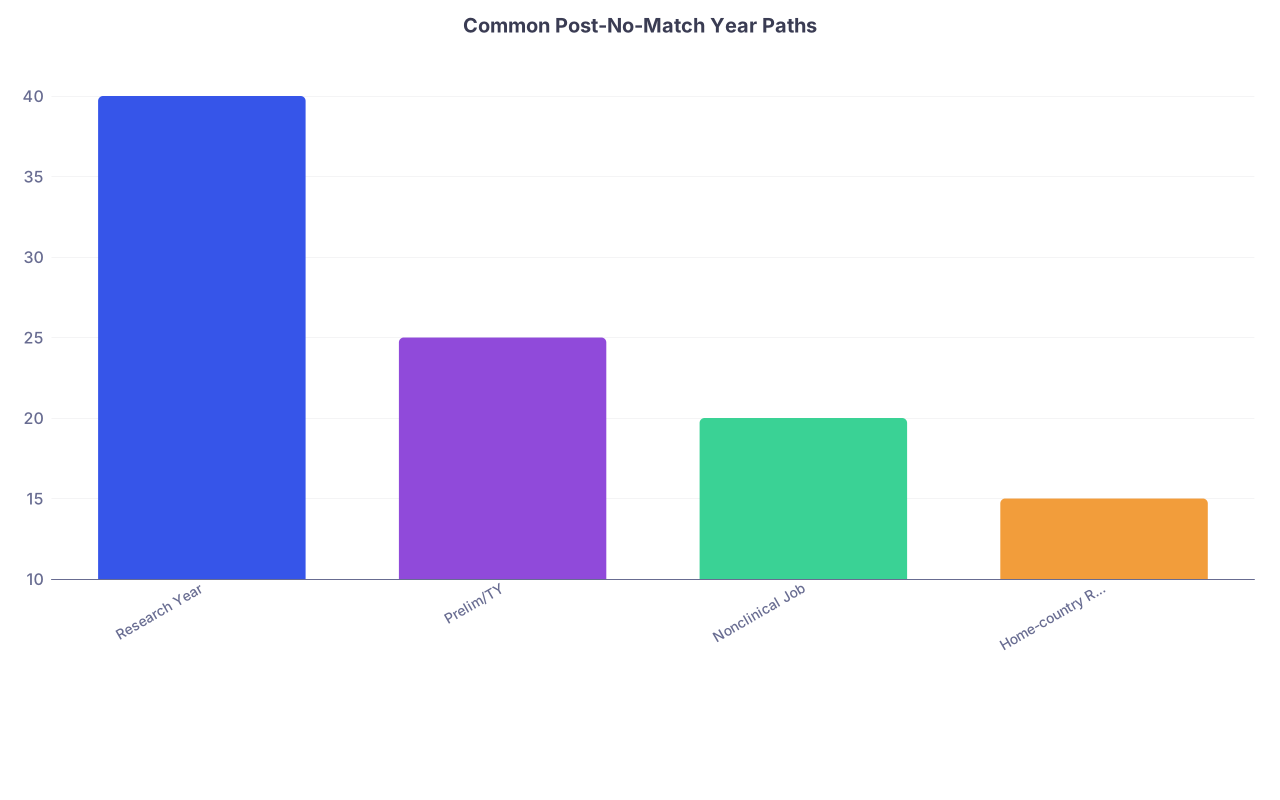
| Category | Value |
|---|---|
| Research Year | 40 |
| Prelim/TY | 25 |
| Nonclinical Job | 20 |
| Home-country Residency | 15 |
(Values are illustrative, not official stats.)
Research year (US or where your partner is)
Best combined with: moving to your partner’s city, if there’s an academic center.
Smart moves:
- Target departments aligned with your specialty choice.
- Ask specifically about authorship potential and letters from recognizable faculty.
- Clarify if it’s paid or volunteer before moving.
Bad move: taking a random “research” gig that’s actually just data entry with no mentorship.
For the relationship: you’ll have more flexible hours than they do. That’s both a blessing and a temptation to lean too hard on them socially. Build your own life there—friends, gym, hobbies, not just “waiting at home.”
Prelim / TY year
Best combined with: being in the same or nearby city, if geography allows.
This is high-stress; now both of you are in training.
For the relationship:
- Expect exhaustion on both sides.
- Schedule time together like you schedule call days. Truly. Put it in the calendar.
- Do not assume that being in the same city means you’ll spontaneously hang out all the time. You won’t.
This path can actually equalize the power dynamic a bit—you’re both residents, just at different levels/programs.
Nonclinical job while reapplying
Maybe you need money. Maybe you’re burned out. Maybe no research or prelim spots landed.
Then pick a job that:
- Pays the bills.
- Does not crush your soul so much you can’t study or apply again.
- Preferably still gives you some kind of narrative thread (teaching, healthcare-adjacent work, analytics, etc.).
For the relationship, this can get weird when:
- They’re drowning in patient care and exams, and you have relatively “normal” hours.
- You feel like you’re not “in medicine” anymore and start avoiding med-related talk entirely.
Keep a small, visible connection to medicine—shadowing once a month, volunteering, or ongoing CME/self-study. Partly for your application, partly for your identity.
Home-country path (for IMGs)
If you go back home for training or a job, and they stay in the US:
- Accept that this is not a 1-year plan; you’re looking at multi-year distance or eventual separation.
- Have the brave talk: is either of you open to migrating long-term (you to US later, them to your country, or meeting in a third location)?
If the honest answer is “probably not,” then you’re clinging to a fantasy, not a relationship.
Step 6: Schedule the Hard Conversations, Don’t Drift Into Them
Do not have “what are we even doing” fights at midnight after their call shift.
Pick times. Name the topics. Be grown-ups about it.
Three conversations you need over the next 1–2 months:
Logistics conversation
- Where will each of us live from July to next June?
- How often can we realistically visit?
- Who is paying for what (moves, flights, rent)?
Career priority conversation
- Are we both okay with each person independently maximizing their career this year, even if it pulls us apart geographically?
- If we hit a direct conflict (e.g., your best research year is 2000 miles away from their program), what is our tie-breaker?
Future horizon conversation
- Are we aiming for being in the same city by X year? Or are we accepting that we might train in different regions and figure it out later?
- Are we both still seeing marriage / long-term partnership as a goal with each other, or are we being honest that it’s uncertain?
If that sounds uncomfortable, it is. But it’s less destructive than slow resentment and vague assumptions.
Quick Reality Checks You Need to Hear
- Your partner did not “steal your spot.” Their success is not your failure, even if it stings.
- You are allowed to be genuinely happy for them and gutted for yourself at the same time. That’s not hypocrisy; that’s being human.
- Sacrificing your entire trajectory to avoid one year of distance is usually stupid. You’re talking about a 30–40-year career.
- Staying in a relationship only because “we’ve already been through so much” is sunk cost fallacy with emotions.
- You are not “behind in life” because you didn’t match on the standard timeline. Plenty of physicians have crooked paths and still end up where they want to be.
FAQs
1. Is it reasonable to ask my partner to switch or give up their residency spot for me?
No. That’s not reasonable, and it almost never happens. Programs expect commitment; giving up a matched spot is a gigantic red flag that can nuke their career. If you catch yourself thinking this, recognize it as grief talking, not strategy.
2. How long should I wait before deciding on long-distance vs moving with them?
Roughly 1–2 weeks post-Match is enough to gather information and get past the raw shock. Don’t drag it out for months. Aim to have a clear plan by early April so you both can arrange housing, jobs, and travel with some sanity.
3. I feel jealous of my partner’s success. Does that mean the relationship is doomed?
No. It means you’re a human who just experienced a major loss while someone next to you got what you wanted. The key is what you do with that jealousy. If you acknowledge it, own it, and still choose to show up for them, you can get through it. If you deny it and let it leak out as sarcasm, criticism, or constant withdrawal, then yes, it’ll corrode the relationship.
4. Will programs judge me for prioritizing being near my partner when I reapply?
If you handle it well, no. “Couples considerations” are normal. The mistake is making your application only about geography. Frame it as: strong fit with the program + bonus that your partner is nearby. Also, do not sound like you’re applying just to be close to a significant other; programs want residents who care about the actual training.
5. What if I’m not even sure I still want medicine after not matching?
Then you owe it to yourself—not your partner—to pause and reassess. It’s better to spend 3–6 months honestly exploring other paths, talking with mentors, maybe getting therapy, than to reapply on autopilot out of shame. Your partner’s path is theirs. You’re allowed to decide that after seeing the cliff, you might want a different mountain.
Key points to walk away with:
- Separate the immediate emotional crisis (first 72 hours) from the strategic decisions (next 1–2 months).
- Choose a 1-year plan for both your relationship and your career—same city, distance, or parting ways—on purpose, not by drift.
- Do not disappear into being “the supportive one” and forget your own trajectory. Your relationship survives best when you’re building something for yourself too.


