

The most dangerous thing in Year 2 after going unmatched is drifting. Not rejection. Not your CV gap. The drift. The “I’ll see how this year goes” mindset. That is how people quietly end up three, four, five years out with no clear path.
You are in Year 2 post‑unmatched. That means you are on a clock. You can absolutely still match. But you no longer have the luxury of vague plans. At this point you need a time map—month‑by‑month signals that tell you when to persist on the residency path and when to pivot hard to something else.
I am going to lay it out chronologically: starting July of your second unmatched year, running through Match week, and then through the brutal “what now?” months after. You will see where decisions actually need to be made, not when people like to think about them.
Big Picture: What Year 2 Really Means
Before we go month‑by‑month, anchor three truths.
Your story now matters as much as your stats.
Two years post‑grad, PDs obsess over “What have you been doing?” If your answer is fuzzy, you lose.Linear persistence beats scattered hustle.
I have watched people do observerships in three specialties, random research, and a part‑time scribe job “to keep options open.” Those applications read unfocused and desperate.There are hard time thresholds where a pivot is rational, not “giving up.”
You need to know those thresholds before you hit them so you are not making panicked, emotional calls.
Let us map the year.
July–September (Application Year –1): Lock Strategy, Not Feelings
You are ~9 months from Match Week and just entering what will likely be your second ERAS cycle post‑unmatched (or you are debating whether to try again).
At this point you should:
- Decide your primary specialty (and whether you will add a backup).
- Decide whether you are all‑in on residency for at least one more full cycle, or if this is your “last serious attempt.”
This is not a time for “seeing how it feels.” It is a time for explicit decisions.
Step 1: Brutal Self‑Audit (Early July)
Pull out your current CV and last cycle’s ERAS.
At this point you should:
Write down, honestly:
- Step 1: ___ (P/F or score)
- Step 2: ___
- Attempts / failures: ___
- YOG: MD/DO year, or IMG graduation year
- Number of prior attempts at Match: ___
- Number of interviews last cycle: ___
Categorize your competitiveness for your target specialty:
| Factor | Strong Signal | Yellow Flag | Red Flag |
|---|---|---|---|
| Step 2 CK | ≥ 240 US / ≥ 245 IMG | 230–239 | < 230 or multiple attempts |
| YOG | ≤ 2 years | 3–4 years | ≥ 5 years |
| Prior Interviews | ≥ 7 in cycle | 3–6 | ≤ 2 |
| US Clinical Experience | ≥ 6 months, recent | 3–5 months, mixed recency | ≤ 2 months or very old |
| Research in target | ≥ 1 ongoing, 2+ pubs/abstracts | Some older work | None or irrelevant |
If you are mostly in the “red flag” column for a competitive field (derm, ortho, ENT, plastics, neurosurg), the Year 2 question is not “Can I still do it if I believe hard enough?” The question is: Do I pivot specialties this year, or do I pivot out of the Match entirely?
Step 2: Choose: Persist in Same Specialty, Pivot Specialty, or Pivot Out
By July 15, you should have one of three explicit plans:
Persist in the same specialty
Reasonable if:- You had ≥ 3–4 interviews last cycle, or
- You have meaningful new upgrades (Step 2 improvement, fresh USCE, a strong new letter, research in the field).
Pivot to a less competitive but acceptable specialty
Reasonable if:- You had 0–2 interviews after a full attempt, and
- You can live with (not just tolerate) a different field like FM, IM, psych, peds, pathology, neurology, etc.
Pivot out of the Match pathway entirely (at least temporarily)
Reasonable if:- You are 2+ cycles in with minimal interviews, and
- Your financial, family, or immigration realities make more “wait and chase” years dangerous.
There is no heroic award for banging your head against the same closed door for 5 years.
August–September: Build the “This Year Is Different” File
Once you have decided your direction, the clock accelerates.
At this point you should be:
- Finalizing ERAS personal statement(s) and experiences.
- Securing fresh letters.
- Locking in a structured role (research job, prelim year, teaching, clinical role).
The “This Year Is Different” Checklist (By September 1)
If you are persisting with another Match attempt, your file must clearly answer: “Why should PDs look at you differently than last year?”
By September 1, you should have at least two of these:
- A new Step 2 CK score that is clearly stronger, or Step 3 taken with a decent score.
- New, recent USCE in your chosen specialty (≥ 1–2 months) with at least one strong letter.
- A structured position:
- Research fellow in that specialty.
- Full‑time clinical job adjacent to that specialty (hospitalist scribe, clinical research coordinator, etc.).
- Well‑documented gap coverage:
- Teaching role.
- MPH/MPH‑like degree.
- Meaningful non‑clinical work with leadership / responsibility.
If you do not have at least two, and you are still aiming at the same hard specialty, you are not “persisting.” You are re‑submitting the same losing ticket.
October–December: Live in Two Time Zones (This Match + Next Life)
Once ERAS is submitted and interview invites start (or do not start), the psychology gets noisy. This is where people waste months waiting for emails rather than building their escape ramps.
You must live in two time zones:
- Present: Doing everything to maximize this Match cycle.
- Future: Preparing for the very real possibility that it fails.
October: Monitor Interview Volume Realistically
At this point you should:
By Halloween, count your interview invitations.
- If you have:
- ≥ 6–8 interviews in primary care or IM → Serious shot at matching. Persistence is justified.
- ≥ 4–5 interviews in moderately competitive fields → Still in the game.
- 0–2 interviews by late October → You are in trouble, especially if this is not your first cycle.
- If you have:
Begin a parallel file:
- Updated CV for:
- Non‑residency clinical roles (NP/PA‑like support roles, scribe lead, clinical research).
- Industry roles (pharma, consulting, medical education).
- List of visa realities if you are IMG (how long can you actually stay or reapply?).
- Updated CV for:
This is not pessimism. It is risk management.
November–December: Decide Your Thresholds
By December 1, you should have written down answers to questions most people avoid:
If I receive fewer than X total interviews, I will:
- Treat this as my last Match attempt and plan a pivot if unmatched.
- Or commit to one more final cycle with specific upgrades (Step 3, new specialty, etc.).
If I go unmatched again, I will:
- Apply again next cycle ONLY IF:
- I achieve __ (specific measurable improvements) by next September.
- Or exit the Match path and pursue:
- ___ (public health, industry, teaching, home country training, etc.).
- Apply again next cycle ONLY IF:
Write this down. Share it with one trusted person who will call you out when you start moving the goalposts in March.
January–February: Pre‑Match Reality Check
Interviews are mostly done. Rank list season starts. This is when self‑deception spikes.
At this point you should:
- Reassess your rank list with clear eyes.
January: Rank List and Probability
Ask yourself three blunt questions:
- How many interviews did I actually attend?
- Did any PD or faculty directly signal strong interest?
- “We rank people we interview,” while nice, is not the same as “You will be ranked to match.”
- How many cycles have I already attempted?
Rough, conservative rule:
In primary care / IM:
- 10+ interviews → High likelihood.
- 6–9 → Medium.
- 3–5 → Real risk.
- 0–2 → Very high risk of going unmatched.
In more competitive fields:
- 8+ → Competitive.
- 4–7 → Uncertain.
- 0–3 → High risk.
If you are in any high‑risk band and this is your second or third cycle, you must start concrete pivot planning now, not after Match.
February: Build Concrete Pivot Tracks
By February 15, you should have at least two concrete pivot tracks partially built, not hypothetical.
Example pivot tracks:
Track A: One More Match Attempt
- Commit to:
- Taking Step 3 by ___.
- Doing a 1‑year research fellowship starting July.
- Switching to a less competitive specialty.
- Start emailing now for:
- Research positions.
- Non‑ACGME fellowships.
- Prelim or transitional year openings.
- Commit to:
Track B: Non‑Residency Clinical / Industry Path
- Draft tailored CV for:
- Clinical research coordinator jobs.
- Medical writer roles.
- Pharma MSL associate or clinical trial associate.
- Health tech, epidemiology, or hospital admin fellowships.
- Draft tailored CV for:
Do not wait for Match week to think about this. By then, the best positions will have already been discussed and sometimes informally promised.
March (Match Week): Pivot vs Persist Decision Point
This is the moment everyone imagines; it is not where most people fail. They fail in the months before when they never defined what “pivot” or “persist” actually mean.
SOAP Week (If Eligible)
If you go unmatched and are SOAP‑eligible:
At this point you should:
- Treat SOAP as your last‑minute specialty pivot window, not just a scramble for anything.
If this is your second unmatched year, be brutally clear:
If you SOAP into any accredited residency, and the specialty is at least tolerable, strongly consider taking it.
Two unmatched cycles shrink your future options significantly. A bird in the hand, etc.If you fail to SOAP a second time:
- That is a loud signal. Not an absolute barrier, but a signal that your current application profile is not working in the present market.
Post‑SOAP: The 72‑Hour Rule
By 72 hours after SOAP ends, you should:
Decide whether you will:
- Attempt one more Match cycle, or
- Pivot out of the residency path for at least 3–5 years (often permanently).
Write a one‑page Next 12 Months Plan, including:
- Your primary path (e.g., research fellowship + Step 3 + switch from surgery to IM).
- Your non‑Match backup (e.g., full‑time clinical research or industry role).
- Concrete monthly milestones (applications, exams, networking).
Do not sit in a fog of “processing emotions” for 3 months. Process, yes. But act in parallel.
April–June (Year 2 Post‑Unmatched): The True Fork in the Road
By now you are solidly in your second year post‑unmatched. This is where long‑term trajectories diverge.
Persist Path: One More “All‑In” Attempt
If you chose to persist, at this point you should:
Have a full‑time, CV‑upgrading role by May 1:
- Research position in your new or existing specialty.
- Non‑ACGME clinical fellowship.
- Dedicated USCE with known letter writers.
Have a test plan:
- Schedule Step 3 (if not already done) with enough time to retake if needed before ERAS.
- If IMGs: consider OET and other credential needs locked down early.
Have one clear specialty identified (even if it is a pivot).
- If you are switching from something like surgery → IM in Year 2, it is not “giving up.” It is finally matching your profile to reality.
Strong sign you should still persist:
- You now have:
- A stronger test portfolio (Step 3 or improved Step 2).
- Clear letters from US faculty saying, “I would rank this person.”
- A coherent story: “Here is what I did in these 2 gap years, and here is how it prepared me to be a better resident.”
Pivot Path: Accepting a Different Career
If you chose to pivot away from chasing residency, at this point you should:
- Stop treating non‑residency roles as “temporary until I match.” Employers can smell that.
- Commit for at least 2–3 years to a new direction:
- Clinical research career.
- Academic / teaching roles.
- Public health, policy, or administration.
- Pharma / biotech / device company work.
- Telehealth or non‑US residency options (home country, different system).
By June 30, you should:
- Either be in (or about to start) a stable full‑time role.
- Or be enrolled in further training that clearly leads somewhere (MPH, MBA, etc.), not random certificates.
If you are still in loose observerships, unpaid shadowing, or “preparing to apply again” without a paycheck in Year 2, your risk of long‑term career and financial damage is high.
Visual Time Map: Year 2 Decision Flow
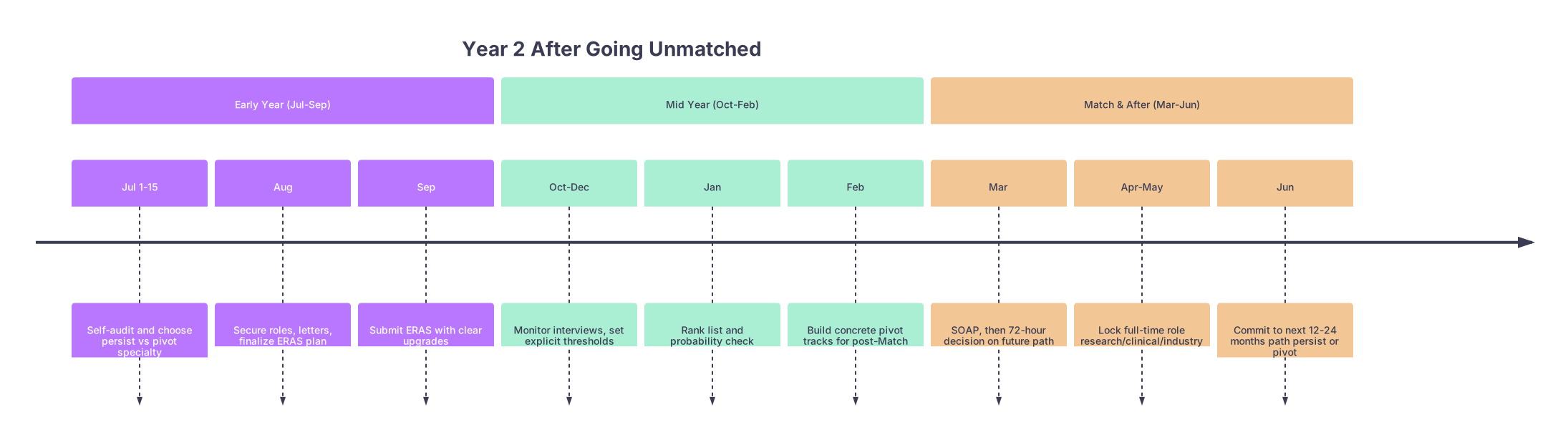
| Period | Event |
|---|---|
| Early Year (Jul-Sep) - Jul 1-15 | Self-audit and choose persist vs pivot specialty |
| Early Year (Jul-Sep) - Aug | Secure roles, letters, finalize ERAS plan |
| Early Year (Jul-Sep) - Sep | Submit ERAS with clear upgrades |
| Mid Year (Oct-Feb) - Oct-Dec | Monitor interviews, set explicit thresholds |
| Mid Year (Oct-Feb) - Jan | Rank list and probability check |
| Mid Year (Oct-Feb) - Feb | Build concrete pivot tracks for post-Match |
| Match & After (Mar-Jun) - Mar | SOAP, then 72-hour decision on future path |
| Match & After (Mar-Jun) - Apr-May | Lock full-time role research/clinical/industry |
| Match & After (Mar-Jun) - Jun | Commit to next 12-24 months path persist or pivot |
When You Should Definitely Pivot (Hard Lines)
Let me be explicit. You should strongly consider pivoting away from further Match attempts when:
You are 3+ years out of graduation, have:
- Gone unmatched twice, and
- Had ≤ 3 interviews each time, and
- Have no realistic way to change your academic profile (cannot retake Steps, etc.).
You are visa‑limited, and:
- Extending your stay requires large financial sacrifice without strong Match prospects.
Your mental health or finances are collapsing.
- Massive debt, supporting family, or severe burnout from endless uncertainty. Another year “trying” is not noble if it breaks you.
That is not failure. That is reading the environment correctly.
When You Should Definitely Persist (At Least Once More)
On the other hand, persisting makes sense when:
You had a reasonable interview count but clustered rejections late.
- Often fixable with better interviewing, more focused letters, and clearer story.
You now have a major new credential:
- Strong Step 3.
- 1‑year focused research fellowship with committed letter writers.
- Change to a more appropriate specialty.
Your gap years now look structured and purposeful, not like wandering:
- Teaching, leadership, research, and clinical involvement aligned to the specialty.
If that is you in Year 2, one more serious, strategically upgraded cycle is not irrational. It is unfinished business.
Quick Comparison: Persist vs Pivot in Year 2
| Choice | Good Signs It Fits You | Bad Signs You Are Forcing It |
|---|---|---|
| Persist | Multiple interviews, new upgrades, clear specialty fit | Repeating same application with no changes |
| Pivot | Chronic low interviews, 2+ cycles, better fit in new path | Choosing out of panic in the week after Match |
FAQ (Exactly 2 Questions)
1. If I am in Year 2 after going unmatched, is it “too late” to match into any residency?
No, it is not inherently too late, especially for less competitive specialties, if you can show meaningful, recent clinical or academic engagement. I have seen people match in Year 3 or 4 post‑grad after doing a strong research fellowship, earning powerful letters, and pivoting to fields like IM, FM, psych, or pathology. What does not work is simply reapplying with the same profile, or drifting in loosely defined observerships without responsibility or structure. The later you are from graduation, the more your application needs a clear, cohesive explanation of your gap years and demonstrable value to a program right now.
2. Should I consider switching to a much less competitive specialty in Year 2, even if it was never my “dream”?
Yes, you should at least consider it seriously. By Year 2 post‑unmatched, stubborn attachment to an ultra‑competitive specialty (ortho, derm, neurosurgery, etc.) despite weak metrics is usually a bad strategy. Many physicians end up very satisfied in fields they initially viewed as backups once they experience the day‑to‑day reality. If a switch gives you a genuine chance to train and practice medicine versus staying stuck outside the system indefinitely, that is not failure. That is a rational, adult recalibration of goals in response to real‑world constraints.
Key points: In Year 2 after going unmatched, drifting is the enemy. By specific dates—July, October, February, and especially the week after Match—you must force real decisions, not vague intentions. Persist if you have clear, concrete upgrades and realistic odds; pivot when repeated cycles and low interview numbers tell you the market is not buying your current application.


