

The idea that matching outside your dream specialty slams the door forever is a myth—and a lazy one.
Yes, the Match is high stakes. Yes, some doors get harder to open. But the clean, binary story you hear (“you matched IM, surgery is dead; you matched FM, derm is over”) just does not line up with what actually happens on the ground or in the NRMP data.
Let me be very clear:
You did not ruin your career by matching into the “wrong” specialty.
You did, however, change the terrain. Now you need to play the new game, not the imaginary one.
The Myth: “If I Didn’t Match My Dream Specialty, It’s Over”
This myth comes from a toxic mix of:
- Rank-list absolutism (“if it’s not ortho, what’s the point?”)
- Social media highlight reels (everyone posting their dream match, nobody posting their pivots)
- Attendings who trained 20–30 years ago and still talk like Step 1 = destiny
What you actually see in real life:
Residents switching fields. People going back for second residencies. Folks carving out niche careers that look very close to their original dream, just via a different route.
You just never hear about them on Instagram, because “PGY-2 who quietly shifted into GI/heme-onc/sports med” doesn’t go viral.
Let’s start with what the data and real-world patterns actually show.
What The Data Actually Shows About Switching
The NRMP does not publish a glossy “how many people changed specialties and were fine” brochure, but there are clues:
- Every year, programs fill spots with prior residents.
- There are explicit NRMP rules and pathways for residents changing specialties.
- Boards and ACGME have established credit-transfer rules between related specialties.
If it almost never happened, there wouldn’t be this much infrastructure around it.
And if you talk to program directors in IM, FM, surgery, psych, EM, you’ll hear the same things:
- “We get an application or two every year from someone switching in.”
- “We’ve had residents leave us to go into something else.”
- “It’s not common, but it’s definitely not unheard of.”
That is the reality.
Is it easy? No.
Is it impossible? Also no.
To cut through hand-wavy generalities, here’s a rough sense of how different fields relate—for both switching and ending up where you functionally wanted to be.
| Initial Match | Paths to Shift Toward Subspecialty/Dream | Relative Flexibility* |
|---|---|---|
| Internal Medicine | Cards, GI, Heme/Onc, Pulm/CC, Endo, Rheum | Very High |
| Pediatrics | Peds cards, NICU, PICU, allergy, heme/onc | High |
| General Surgery | Plastics, vascular, surg onc, trauma/CC | Moderate–High |
| Family Medicine | Sports, addiction, OB-heavy, urgent care | Moderate |
| Psychiatry | Addiction, consult-liaison, forensics, child | High |
*“Flexibility” here means number and realism of upstream/downstream paths, not competitiveness of each one.
Your Match result is not a prison cell. It’s a starting point on a map. Some starting points have more connecting roads. Your job is to recognize which map you’re now on.
The Iron Triangle: Time, Difficulty, and Alignment
When people ask, “Can I still get into X?” they’re really asking three questions:
- How long will it take?
- How hard will it be?
- How close can I get to what I originally wanted?
There are three broad categories of outcomes after matching “off-target”:
- Direct Switch – Change into the dream specialty outright
- Adjacent Pivot – Use your current specialty to land in a niche that’s 70–90% of the dream
- Rebuild and Reapply – Repeat application cycle, possibly with a gap year or preliminary year
Let’s go through each without the usual sugar-coating.
1. Direct Switch: Changing Specialties After You’ve Matched
This is the one everyone fantasizes about: “I matched IM but I still want anesthesia/derm/rads—can I jump later?”
Sometimes, yes. But it depends intensely on:
- How competitive the target field is
- How early you realize you want to switch
- How your current PD feels about you leaving
And that third one is massive. You cannot treat your current PD like a disposable NPC and expect them to go to bat for you.
Typical realistic flow for a direct switch:

| Step | Description |
|---|---|
| Step 1 | Start PGY1 |
| Step 2 | Realize poor fit |
| Step 3 | Strong performance and evaluations |
| Step 4 | Talk to mentors |
| Step 5 | Meet current PD |
| Step 6 | Apply to other programs |
| Step 7 | Limited options |
| Step 8 | Interviews |
| Step 9 | Offer and transfer |
A few grounded examples I’ve personally seen or reviewed in application files:
- Categorical IM → Anesthesiology PGY-2
- General surgery prelim → Radiology PGY-2
- Psychiatry PGY-1 → Neurology PGY-2
- FM PGY-1 → IM categorical PGY-2
Things you almost never see: FM → Derm. Categorical IM → Ortho. Those aren’t “no way ever” in the laws-of-physics sense, but you’d be betting your life on a lottery ticket.
What actually matters to PDs when you try to switch
Not your sob story. Not “I’ve always dreamed of X.”
They care about:
- Performance where you are – Are your evals strong? Any professionalism flags?
- Letters from people they know/trust – PD-to-PD calls matter far more than your personal statement.
- Evidence of real interest – Electives, research, prior experience consistent with the target field
- Timing – Earlier is better. By late PGY-2 in a 3-year program, your bargaining power drops.
If you’re even thinking about a switch, you need to:
- Crush your current rotations. No half-hearted slacking because “this isn’t what I want.”
- Quietly line up mentors in the target field for honest feedback.
- Approach your PD professionally with a concrete plan, not vibes.
2. Adjacent Pivot: Getting 80% of Your Dream From Where You Are
This is the boring, grown-up answer that almost nobody on Reddit wants to hear. It’s also the path that quietly works for a ton of people.
You wanted ortho, matched FM. That stings. But what did you actually want?
- MSK medicine
- Procedures
- Sports/adolescent athletes
- Ortho-adjacent clinics
Can you get a version of that out of FM? Yes. Does it require work and intentionality? Also yes.
Concrete “adjacent pivot” examples
- Wanted Cards, matched IM → Cards fellowship is literally the standard path. Problem solved.
- Wanted GI, matched IM → Again, this is the GI pipeline. Your task now is to become a killer IM resident.
- Wanted Sports Ortho, matched FM → FM + Sports Med fellowship + MSK-heavy practice + ultrasound + injections. You won’t be plating fractures in the OR, but your day-to-day might be 70% exactly what you dreamed about.
- Wanted Derm, matched IM or FM → Med-derm combined programs (if you can switch early), or build a strong outpatient practice with a heavy derm panel. Add procedures, biopsies, cosmetic collaborations. No, you’re not a board-certified dermatologist. But you also don’t have to do full-scope inpatient derm consults.
Here’s the part students don’t like: many “dream specialties” are actually “dream lifestyles” or “dream patterns of work.”
You need to separate:
- The board certification label
vs. - The actual daily work you want to be doing
Once you do that, adjacent pivots become obvious.
3. Rebuild and Reapply: Taking a Second Shot
Then there’s the nuclear option: accept a non-dream spot, or even SOAP/prelim, then rebuild and reapply.
This is common enough that PDs roll their eyes when you act like you’re the first to consider it.
Typical version:
- You matched prelim surgery, want categorical surgery or rads
- You SOAPed into a one-year transitional year, still want anesthesia
- You matched FM but are hellbent on EM
Does this ever work? Yes.
Does it often work into hyper-competitive fields? Rarely.
The candidates who successfully re-match into a more competitive specialty usually have:
- A seriously upgraded application: new research, publications, new letters, new Step 2 score
- Demonstrated excellence in their prelim year: “the resident we never want to lose”
- A coherent story that makes sense (not “I got bored”)
Let’s be clear on risk:
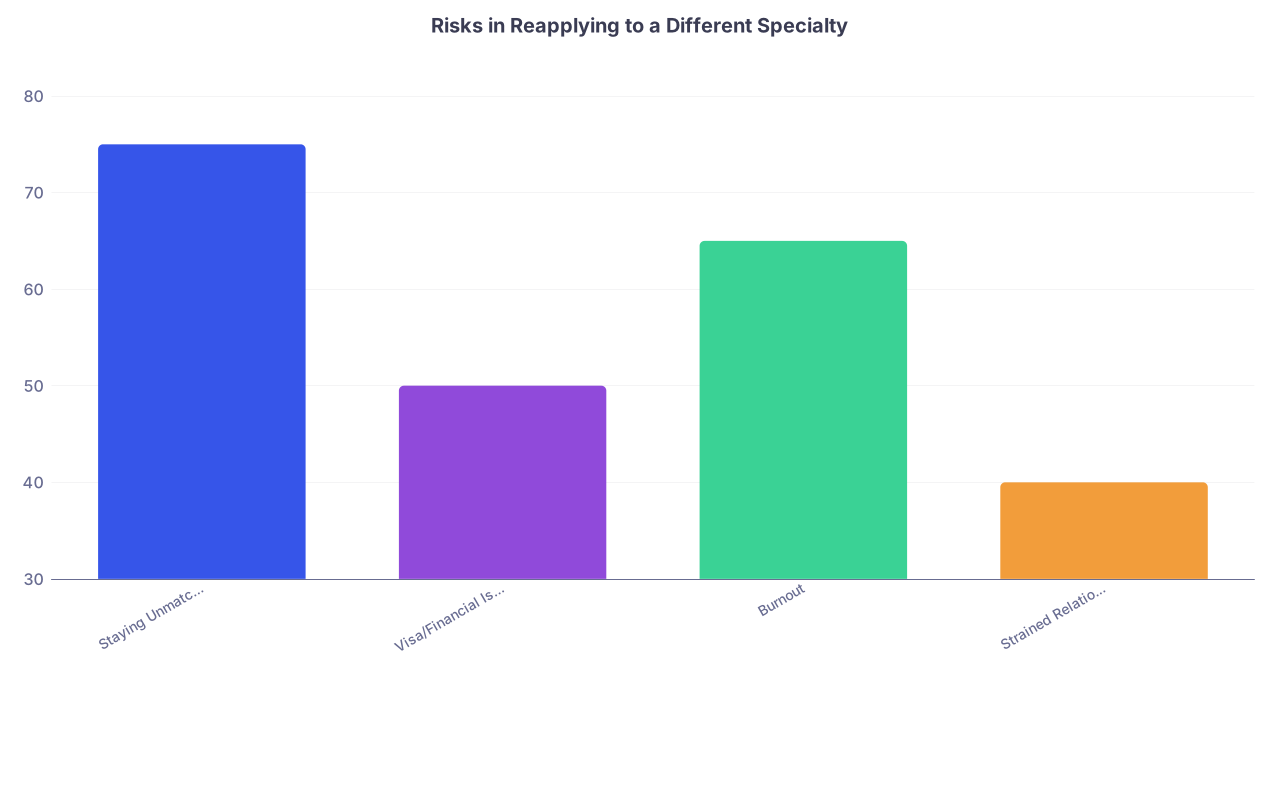
| Category | Value |
|---|---|
| Staying Unmatched | 75 |
| Visa/Financial Issues | 50 |
| Burnout | 65 |
| Strained Relationships | 40 |
Those numbers are illustrative, but the idea stands: reapplying ups your risk profile. No income, visa clocks, burnout from endless uncertainty.
Sometimes it’s still the right call. But it’s not a casual “I’ll just try again” move. It’s an all-in, eyes-open decision.
The Harsh Truth: Some Doors Do Get Very Hard to Reopen
Let’s kill the overly-optimistic myth from the other side: “You can always switch into whatever you want if you work hard enough.”
No. You can’t.
Fields where matching later is very rare from an unrelated specialty:
- Dermatology
- Plastic surgery (especially integrated)
- Neurosurgery
- Ortho
- ENT
- Urology
Do people ever go IM → Derm? Occasionally. But what you’re seeing then is not a “normal option.” It’s an outlier.
So if you matched IM and are still telling yourself, “I’ll definitely go into derm later,” you’re not planning—you’re gambling.
Instead of living in fantasy-land, you need to:
- Get honest about base rates
- Decide if you’re willing to accept a low probability, high-effort campaign
- Make peace with a Plan B that you could actually like
That’s not defeat. That’s strategy.
Where You Actually Have Leverage Now
Most residents waste their early PGY years mourning what they didn’t get instead of exploiting what they do have.
Here’s what you can actually control in the next 12–18 months:
- Your reputation – Are you the resident everyone trusts on call, or the one who disappears? PDs talk. Across specialties.
- Your clinical strengths – Dial in on what your current field offers that overlaps with your interests: procedures, consults, clinic time, critical care, psych comanagement—whatever.
- Your mentorship network – This is the real currency for switching or pivoting. Not your Step score.
- Your paper trail – Research, QI, teaching, leadership. If you reapply or subspecialize, this matters.
Think of it as building “option value.” You may never exercise every option, but you don’t want to be the PGY-3 who suddenly decides to pursue a competitive fellowship with zero track record.
What People Who Successfully Pivot Actually Do Differently
Let me outline the common pattern I’ve seen in residents who land on their feet after a non-dream match.
They:
- Stop catastrophizing in public. They vent privately, then switch to problem-solving. PDs and faculty have no interest in sponsoring someone who spends all year whining about “being stuck.”
- Get clinically excellent fast. Their evals say: dependable, prepared, team player, good to patients. No drama.
- Target mentors intentionally. Not just “my attending was nice,” but “this person has real influence in GI/cards/sports/anesthesia and is willing to advocate for me.”
- Articulate a clear narrative. Not “I hate FM,” but “I discovered I really love X-type patients, Y procedures, Z environment, and specialty A aligns better with that.”
- Stay flexible about the form, rigid about the function. Maybe they don’t become “a neurosurgeon,” but they end up in neurocritical care, stroke neurology, or interventional neuroradiology. Functionally, they’re living 80–90% of that original vision.
You can do that from almost any starting point.
A Reality Check on Happiness and “Dream Specialties”
Here’s the part nobody wants to say out loud: a ton of people who matched their “dream” specialty end up miserable.
I’ve seen:
- EM gunners burned out, leaving for urgent care or admin within 3–5 years
- Surgical residents who loved the OR but hated the lifestyle enough to bail to radiology after internship
- Derm residents who loved the competitiveness chase but don’t actually enjoy clinic volume and cosmetic expectations
Your M4-year fantasy of a field is often wildly inaccurate. You met a few charismatic attendings, liked a rotation where you weren’t responsible for real outcomes, and locked in your identity around that.
Then real life happens.
The inverse is also true: people who “settle” for IM, FM, psych, peds, anesthesia, etc. and later realize, “Oh. This actually fits me really well.”
So the right question is not:
“Did I get my dream specialty?”
It’s:
“Can I build a career from this starting point that matches the work, lifestyle, and identity I want?”
That’s a much more solvable problem.
What To Do In The First 6 Months After an Off-Target Match
Here’s a concrete, non-theoretical plan if you just matched into something you’re not sure about:
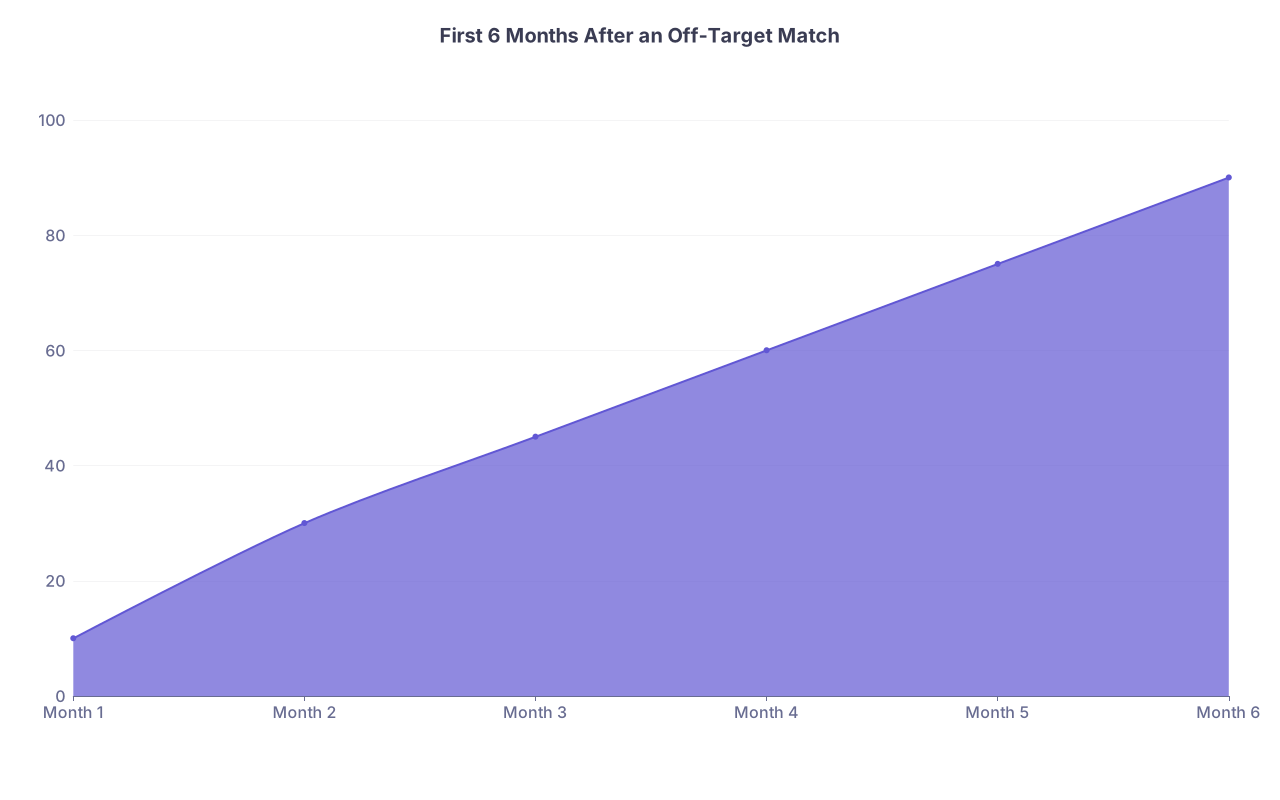
| Category | Value |
|---|---|
| Month 1 | 10 |
| Month 2 | 30 |
| Month 3 | 45 |
| Month 4 | 60 |
| Month 5 | 75 |
| Month 6 | 90 |
Think of that curve as your “clarity and leverage” over time—if you do the right things, not if you just stew.
Month 1–2:
- Shut down the doom spiral. Give yourself time to feel what you feel, but keep it off the permanent record.
- Learn your new program, new hospital, new EMR. Don’t be the intern who’s both bitter and incompetent.
Month 3–4:
- Identify what you like and hate about the work specifically, not “I hate IM.” Is it the inpatient pace? Lack of procedures? Lack of continuity?
- Start having quiet conversations with trusted faculty about your questions and long-term goals.
Month 5–6:
- Decide if your dissatisfaction is:
a) transitional (new role shock),
b) structural (this field really does not fit you), or
c) misplaced (you’re grieving a fantasy, not reacting to reality). - If it’s truly structural, begin exploring switch or pivot strategies with mentorship, not in isolation.
Bottom Line
Three key points and we’re done:
No, most doors are not “closed forever” just because you matched outside your dream specialty. Some doors get much harder to reopen, but adjacent paths and even direct switches happen every year for people who perform well and plan strategically.
Your leverage now comes from excellence and relationships, not from nostalgia about what might have been. Crush your current role, build mentors, and get clear about what you actually want your work and life to look like—not just the label on your badge.
You don’t need the perfect specialty label to build a great career. You need alignment between your day-to-day work, your personality, and your long-term goals. There are multiple routes to that—even if Match Day did not go the way your MS4 brain scripted it.


