
Most new interns spend more time confused by onboarding than by their first H&P. That is a problem.
Let me walk you through how this actually works: licensure, NPI, and hospital credentialing. What really gets done, by whom, and on what timeline. Because if you misunderstand this, you can very literally show up in July and not be allowed to touch a patient.
Big Picture: What “Onboarding” Really Means
Everyone talks about “GME onboarding” like it is one thing. It is not.
You are dealing with three separate but interlocking systems:
- Licensure – your legal permission from a state to practice medicine in some form
- NPI – your federal identifier as a healthcare provider for billing and data purposes
- Hospital credentialing and privileging – the hospital’s internal process to verify who you are and what they will let you do
Each is controlled by a different entity:
- State medical board → license
- CMS / NPPES → NPI
- Hospital medical staff office / credentialing office → credentials and privileges
- GME office sits in the middle, herding cats
If something is late or wrong in any one of these buckets, your start date can get messy very quickly. I have seen:
- Interns doing “shadow shifts” for 2 weeks because their training license was not issued
- Residents locked out of the EMR because their NPI did not match what payroll submitted
- New PGY‑1s barred from prescribing even Tylenol because pharmacy did not see them as credentialed prescribers yet
So, let us take these in order and strip out the mystery.
Licensure: Training vs Full License, and Why Timing Is Brutal
The advice you got in med school about “not worrying yet” about licensure is usually incomplete. You need to know exactly what license you need, when, and what the hidden traps are.
1. What type of license do you actually need?
There are three common scenarios:
- Training (intern/resident) license only
- Either training or full – program / state dependent
- Full license required at a specific PGY level (often PGY‑2 or PGY‑3 for certain specialties)
Most categorical interns in large academic centers start with a training license. But:
- Some states do not have a distinct “training” license category. You go directly to a limited or full license.
- Some fellowships require a full unrestricted license, even if the state “allows” training licenses.
- Combined programs (Med‑Peds, EM/IM, etc.) may handle this differently by institution.
Your GME welcome packet should state this clearly. If it does not, ask your program coordinator directly:
- “Do interns hold a training license, full license, or both?”
- “What license type do I need in place by July 1?”
- “Which state(s) should I apply in if we rotate at more than one site?”
2. Core requirements most state boards will look for
State boards are annoyingly similar but not identical. In practice, for a training or initial license you will usually be asked for:
- Official med school transcript
- Diploma (or letter of expected graduation if applying before you walk)
- Dean’s letter or verification of your education
- Proof of passing USMLE / COMLEX steps required by that state (often Step 1 and 2 at least)
- Notarized application with photo and signature
- Background check (state and/or FBI) and fingerprints
- Letters of good standing from any other training/licensing body (for transitions, not for PGY‑1)
Some boards still want things mailed directly, sealed envelopes, wet signatures. I know — it is 2026 and we are still pretending faxes are cutting edge.
Where people get burned:
- Assuming they can apply after graduation. Some boards take 8–12 weeks. Your program cannot override that.
- Not realizing that fingerprints / background checks are often the rate‑limiting step.
- Ignoring “deficiency” emails from the board because they went to a school email account you stop checking after Match.
| State Group | Typical Processing Time | Notes |
|---|---|---|
| Fast (best case) | 2–4 weeks | Clean file, everything ready |
| Average | 6–8 weeks | Minor back-and-forth |
| Slow / Problematic | 10–16+ weeks | Background or missing docs |
3. How timing interacts with Match Day and graduation
Here is the rough flow:
- March: You match. GME sends onboarding instructions, often including licensure guidance and board links.
- March–April: You start assembling documents and initiating the license application.
- April–May: Board processes your file. They send “deficiency” notices if anything is missing.
- May–June: Graduation, diploma issued, final verifications sent to board.
- June: License number issued, often right before you start orientation.
If your board will not accept an application until after graduation, your program usually knows this and times everything accordingly. But for many states, you can start the process using a letter from your dean saying you will graduate on X date.
If you want to be safe, you:
- Read the exact state board instructions the week after Match
- Start every task that does not require graduation immediately: fingerprints, photo, getting your USMLE transcript sent, etc.
- Track your application weekly with the board’s online portal or via email / phone once it is submitted
4. Common “red flag” issues that slow licensure
If any of these apply to you, build in even more time and talk to your program / GME early:
- Prior criminal charge, even if expunged
- Past academic probation, dismissal, or leave of absence
- Failed USMLE / COMLEX attempts
- Prior license in another country or state with any disciplinary action
These do not automatically block you. But they do trigger extra review, and boards move on bureaucratic time.
NPI: The Most Misunderstood Number You Own
The National Provider Identifier is the 10‑digit number that follows you your entire career. It is not your hospital ID. It is not your state license. It is a federal identifier used for billing, quality tracking, and data reporting.
Too many residents treat this like an afterthought. Then they wonder why EPIC will not let them sign an order or their prescriptions bounce back.
1. NPI basics: Type 1 vs Type 2
You care about one thing right now: Type 1 NPI (individual provider).
Type 2 is for organizations (group practices, hospitals, etc.). Ignore this for residency.
For a resident:
- You should have ONE Type 1 NPI for your entire career.
- You can (and should) keep the same NPI as you move states, specialties, jobs.
- You only ever apply once; you update the record when your training or location changes.
If your program tells you to “apply for an NPI,” clarify: do they mean “get one if you do not already have it”? Some students got NPIs as M4s due to moonlighting or research billing. Multiple NPIs is a mess for credentialing.
2. When and how to apply
GME will usually instruct you to do this between Match and orientation. Sometimes they even send you a direct link with instructions.
The application is via NPPES (National Plan and Provider Enumeration System). Online is fastest.
You will need:
- Your legal name exactly as on your Social Security card (if applicable)
- Date of birth, SSN, contact info
- Your taxonomy code – for residents, this is typically the general “Student in an organized health care education / training program” or the specialty you are entering, depending on institutional preference
- Your practice location – often the main hospital address, per program guidance
Do not freelance on practice address or taxonomy if they gave you explicit instructions. Your hospital’s billing department wants this formatted consistently.
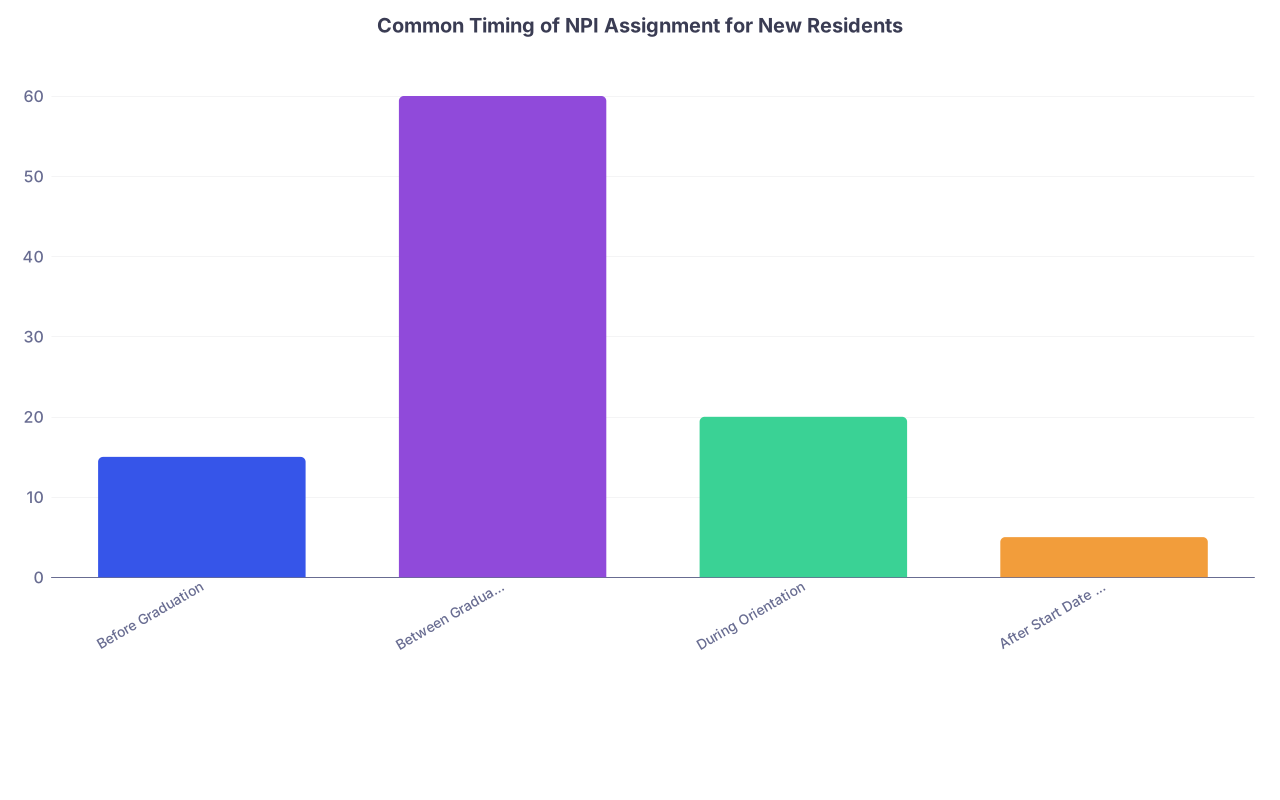
| Category | Value |
|---|---|
| Before Graduation | 15 |
| Between Graduation & Orientation | 60 |
| During Orientation | 20 |
| After Start Date (problem) | 5 |
3. Linking NPI, license, and EMR
Here is where people get confused.
Your NPI is federal. Your license is state. Your EMR is institutional. The credentialing office and IT try to match all three with:
- Same legal name
- Same DOB
- Same NPI number
- Current license number and state
If any of the above is wrong or inconsistent:
- Your prescribing privileges may not turn on in the EMR
- Pharmacy may not recognize you for controlled substance ordering
- Claims might reject if you start moonlighting or billing under your own name
Concrete example I have seen: Resident used a nickname in the EMR (“Kate”) but full legal name (“Katherine”) on NPI. Billing started flagging “provider not found” for some interfaces. It took weeks to untangle.
So:
- Use your legal name consistently for NPI and licensure
- Tell your credentialing office if you already have an NPI
- If you change names (marriage, etc.), update NPPES and notify GME and medical staff office immediately
Hospital Credentialing and Privileging: The Part That Can Actually Block You
This is the one that bites residents hardest because they assume “GME handles it.” GME pushes paperwork, yes. But medically, you are part of the hospital’s medical staff. That staff has its own rules, bylaws, and committees.
1. Credentialing vs privileging – they are not the same thing
Credentialing = verifying you are who you say you are and that your training/licensure is real.
Privileging = specifying what the hospital will actually allow you to do, under what level of supervision.
For a PGY‑1:
- Credentials: med school degree, passed steps, training license issued, identity verified, etc.
- Privileges: intern core duties (admit patients, write orders, perform basic procedures under supervision defined by program and hospital policy).
These privileges are not optional. You do not just “be a doctor” in a hospital. You have a defined privilege set that is periodically renewed and can be modified if there are performance issues.
2. The credentialing packet: what you are really signing
Most new residents see a terrifying PDF or online portal with:
- Demographic info
- Training / education history
- Malpractice history disclosures
- Licensure data
- Health / impairment attestation
- Professional references (sometimes just your program director)
- Consent to release information
Let me be blunt. Lying or “softening” anything here is how careers derail.
The hospital will:
- Verify your med school graduation directly with the school
- Verify USMLE / COMLEX outcomes
- Run background checks
- Cross-check any licenses you claim in other jurisdictions
- Confirm with your program and school if there were professionalism or impairment issues if you hint at them
You are usually asked multiple pointed questions:
- Any prior disciplinary actions?
- Any limitations of privileges?
- Any substance use treatment, mental health issues affecting ability to practice, or other impairments?
This is where people get anxious. Two key points:
- Many hospitals distinguish between “history” vs “current impairment.” Past, successfully treated issues often do not block credentialing. Hidden, undisclosed issues sometimes do.
- Some residents over‑confess vague “stress / burnout” in a way that spooks risk management. Answer the question asked, honestly, precisely. Not a therapy session, not a lie.
If you are unsure about how to answer a particular question, talk to your program director or GME office before submitting.
3. How credentialing interacts with Match Day timelines
Typical sequence:
- March–April: Credentialing office sends you a request to complete an application through their vendor (e.g., Cactus, MD-Staff).
- April–May: You submit; they chase down verifications.
- May–June: Credentials committee or delegated authority reviews and grants temporary / initial privileges.
- June–early July: IT, pharmacy, radiology, etc., all update your access and order-writing permissions based on your privileges.
If you sit on the application until June because “orientation is not till the 28th,” you are gambling that a process that normally takes 6–8 weeks will miraculously complete in 10 days. It will not.
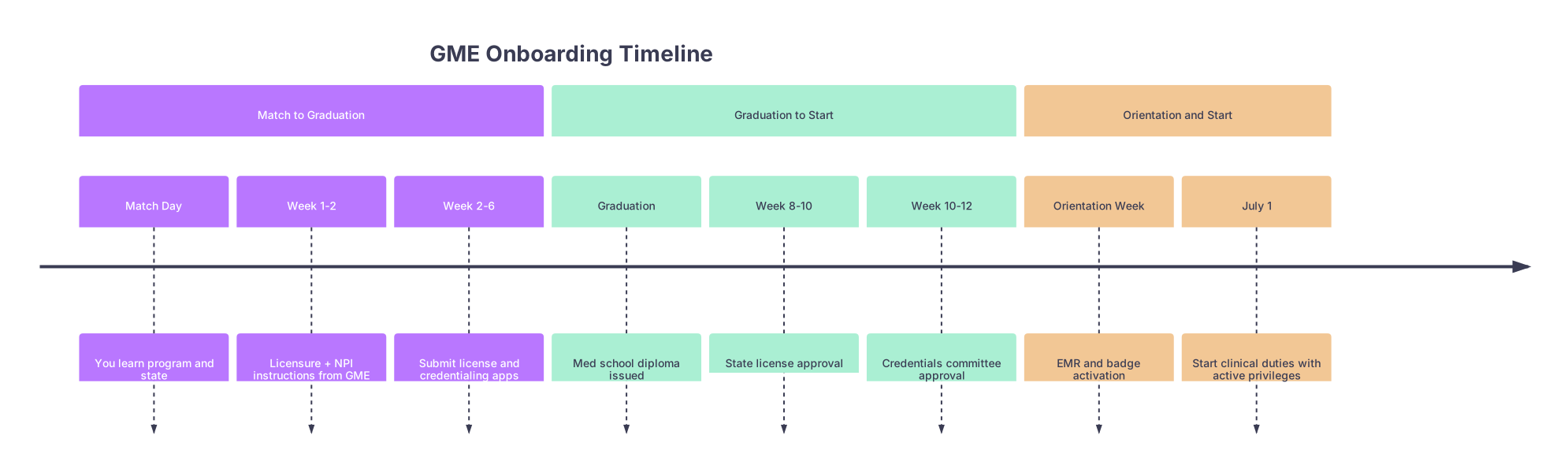
| Period | Event |
|---|---|
| Match to Graduation - Match Day | You learn program and state |
| Match to Graduation - Week 1-2 | Licensure + NPI instructions from GME |
| Match to Graduation - Week 2-6 | Submit license and credentialing apps |
| Graduation to Start - Graduation | Med school diploma issued |
| Graduation to Start - Week 8-10 | State license approval |
| Graduation to Start - Week 10-12 | Credentials committee approval |
| Orientation and Start - Orientation Week | EMR and badge activation |
| Orientation and Start - July 1 | Start clinical duties with active privileges |
4. Multiple hospitals, one resident – how cross-credentialing works
If your program spans more than one hospital (very common in IM, surgery, EM, OB, etc.), you may need:
- Separate credentialing applications for each system
- Different badges, access portals, and even different EMRs
- Different sets of privileges if some hospitals allow more procedures than others for interns
You do not have much control over this, but you do need to:
- Respond to each hospital’s credentialing office separately
- Keep a running list of your account IDs, badge numbers, and system logins
- Make sure your name, NPI, and license are consistent across all facilities
I have seen interns credentialed at Hospital A but not yet finalized at Hospital B, then suddenly the schedule has them doing nights at B in week 1. That is a problem. You want that caught in June, not at 6:55 p.m. on July 2.
How These Three Pieces Interlock (and How They Can Break)
Let me tie this together. You do not move from “Match Day” to “legally practicing physician” in one step.
It looks more like this:
- State license confirms you are legally allowed to practice medicine in that jurisdiction (even if restricted to training).
- Hospital credentialing confirms your degree, training, background, and fit with their risk standards.
- Hospital privileging defines what you are allowed to do in that building as an intern.
- NPI lets the federal system recognize you as a provider for billing and data.
- IT/EMR build connects all of the above to actual order sets, note types, and prescription abilities.
If any link in this chain is weak:
- No license → you cannot be privileged
- No privileges → you cannot write orders, admit patients
- NPI mismatch → EMR may not map your provider record correctly, orders or prescriptions may fail
- Incomplete credentialing → hospital will not risk allowing patient care
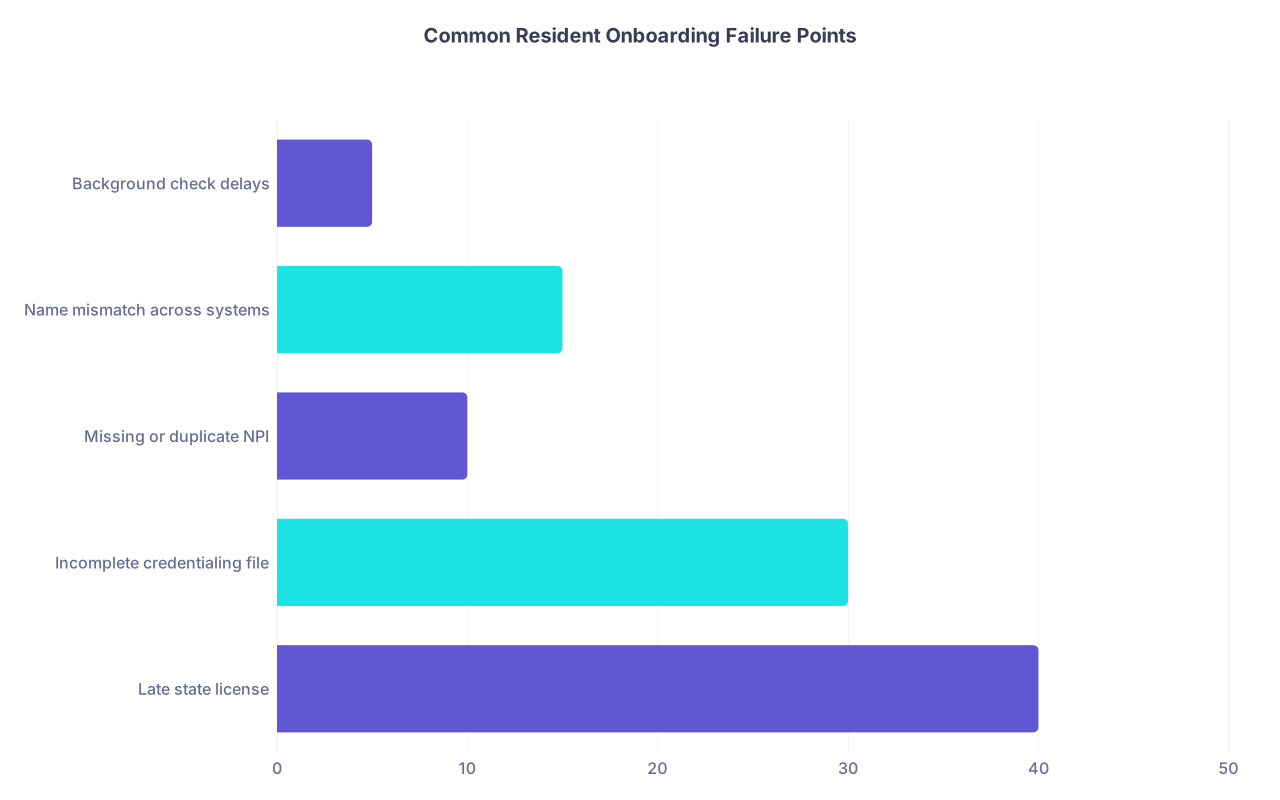
| Category | Value |
|---|---|
| Late state license | 40 |
| Incomplete credentialing file | 30 |
| Missing or duplicate NPI | 10 |
| Name mismatch across systems | 15 |
| Background check delays | 5 |
What you can actually control
You cannot speed up a state board that is backed up. You cannot make a credentials committee meet more often. But you can avoid self-inflicted damage.
Concrete moves:
- Submit everything early. Weeks matter.
- Use the same legal name on every document. No nicknames for official paperwork.
- Keep a personal folder (digital is fine) with PDFs of:
- Diploma
- USMLE / COMLEX transcripts
- Med school transcript
- State license(s)
- NPI confirmation letter
- Respond to every “deficiency” or “missing doc” email within 24–48 hours.
- Tell your program and credentialing office immediately if you realize you already had an NPI or past license somewhere.
Practical Walkthrough: What You Should Be Doing Month by Month
Let me sequence this from Match Day forward.
Match Week (March)
- Read every onboarding email from GME; do not skim.
- Note:
- Required license type
- State board website and deadlines
- Credentialing vendor / portal link
- NPI instructions
If anything is ambiguous, ask by email and get a written answer.
Late March – April
Start state license application:
- Request med school send whatever verifications the board demands.
- Do fingerprints / background checks as directed.
- Pay the fee; document the transaction.
If you do not have an NPI:
- Create your NPPES account.
- Apply for a Type 1 NPI using the exact instructions from GME.
Tackle credentialing packet:
- Complete every required field accurately.
- Disclose what is required; do not dramatize or minimize.
This is the heavy lift. You want this mostly done before May.
May – June
Follow up with the state board:
- Use their online portal if available.
- Confirm they have all documents.
- Respond quickly to deficiency notices.
Monitor credentialing status:
- Ask the medical staff office or coordinator if there are any outstanding verifications.
Keep GME in the loop if:
- There are any surprises in your background check.
- You get board requests for explanations or extra letters.
Orientation / Late June – Early July
By the time you show up for orientation, ideal state:
- License number issued (or guaranteed before clinical start date if your state norms support that).
- NPI confirmed and entered correctly in hospital systems.
- Initial privileges granted by hospital medical staff (even if “provisional”).
- EMR access created with proper role (intern / PGY‑1, not “student”).
If something is not in place, do not pretend it is fine. Talk to GME and your PD on day one. Programs usually have a contingency workflow (shadowing, delayed start to inpatient duties, etc.), but they need time to implement it.
Visualizing the Flow: How a Resident Becomes “Live” in the System

| Step | Description |
|---|---|
| Step 1 | Match Day |
| Step 2 | Receive GME onboarding |
| Step 3 | Apply for state license |
| Step 4 | Apply or confirm NPI |
| Step 5 | Complete hospital credentialing |
| Step 6 | State license issued |
| Step 7 | NPI confirmed |
| Step 8 | Credentials committee approval |
| Step 9 | Privileges built with scope |
| Step 10 | EMR and billing build |
| Step 11 | Resident fully active on start date |
You want to be at node K by July 1. Not stuck at F or H because you sat on paperwork.
FAQs
1. Do I need to apply for a new NPI when I change residency programs or states?
No. You should keep one Type 1 NPI for your entire career. When you change programs, specialties, or practice locations, you update your existing NPI record in NPPES with the new practice address and taxonomy code if needed. Multiple NPIs cause credentialing and billing headaches and can delay your EMR build.
2. My state license will not be issued until after my official July 1 start date. Am I in trouble?
Maybe, maybe not. Some states and institutions plan for this and allow residents to attend orientation, simulations, and non‑independent clinical activities while the license is pending, as long as the application was submitted on time and there are no red flags. The key is transparency: tell your program exactly where your application stands and confirm what you are allowed to do until the license is active.
3. What happens if I answer “yes” to mental health or substance use questions on the credentialing form?
It depends on the exact wording and your current status. Many forms distinguish between past, resolved issues and current impairments. A past, successfully treated condition with no current impairment often triggers a request for more information but does not automatically block credentialing. Hiding a history that later surfaces is much more damaging. If you are unsure how to answer a specific question, discuss it with your program director or GME before submitting.
4. Do residents actually bill using their own NPI, or is everything under attendings?
Both occur, depending on setting and service. In many teaching environments, attendings are the billing providers and your notes and orders support their billing. However, your NPI still needs to be in the system for documentation, ordering, prescribing, and in some cases for specific billing scenarios (e.g., certain procedures, moonlighting, or when acting as a teaching physician later in training). The short answer: even if you are not the primary billing provider, you still need a valid, properly configured NPI.
5. I realized I already had an NPI from med school research work. Should I apply for a new one for residency?
No. You should not create a second NPI. Instead, log in to NPPES (or recover your login), update your existing NPI with your current information (practice address, taxonomy as appropriate), and then tell your GME / credentialing office the number so they can align their records. If you accidentally created a second NPI already, inform the credentialing office; they may need to work with billing to retire or consolidate the extra record.
Key takeaways:
- Licensure, NPI, and hospital credentialing are three different systems that must all be aligned before you can actually function as a resident.
- Your main leverage is timing and accuracy: submit early, use consistent legal identity data, and respond fast to deficiency requests.
- If anything looks like it will not be ready by July 1, involve your program and GME immediately; silent optimism is how people end up “interns” who cannot write orders.