
The idea that “where you match for residency completely determines your fellowship future” is wrong—and it’s holding people hostage on rank lists.
Here’s the truth: your residency program matters for fellowship—but not nearly as much, and not in the way, most people think.
Let’s break this down like adults, not message-board panic.
The short answer: How much does your residency program really matter?
It matters. But it’s not destiny.
If you want a clean breakdown, it looks roughly like this for competitive fellowships (cards, GI, heme/onc, some surgical subs):
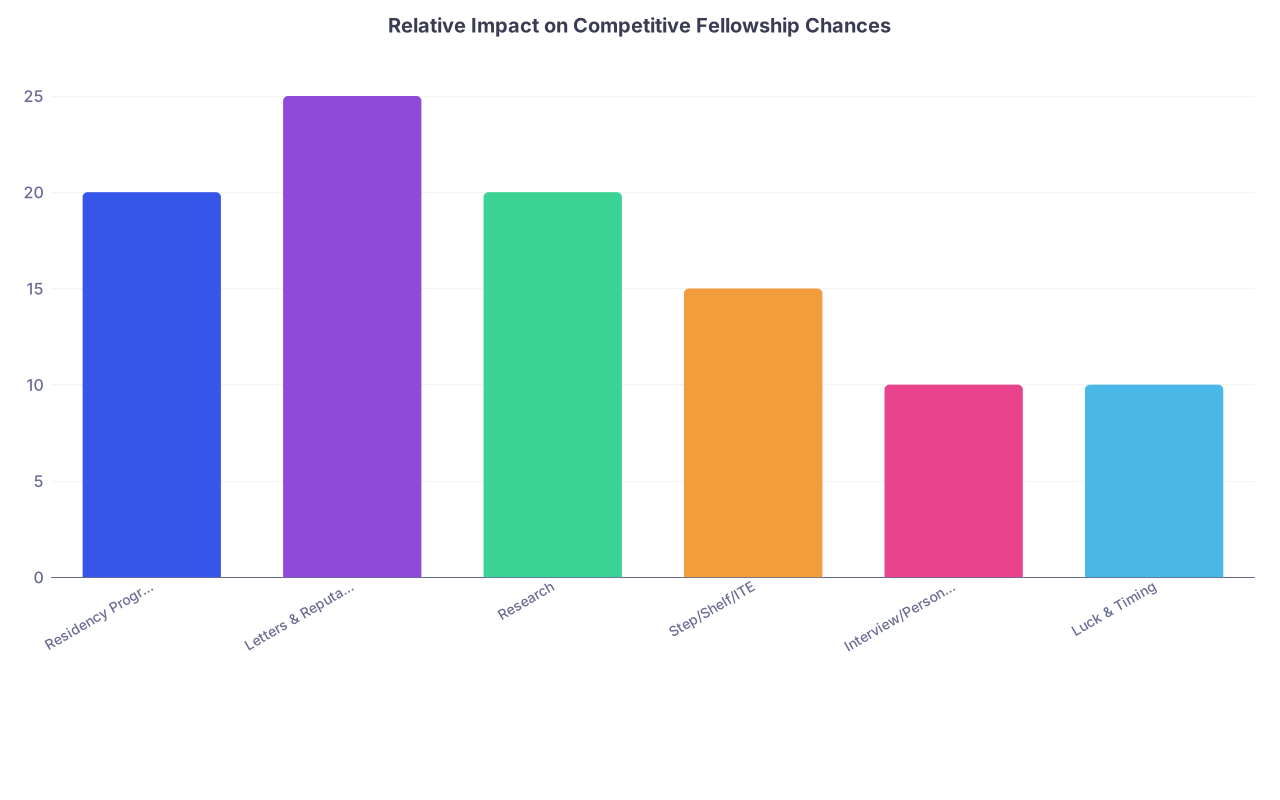
| Category | Value |
|---|---|
| Residency Program | 20 |
| Letters & Reputation | 25 |
| Research | 20 |
| Step/Shelf/ITE | 15 |
| Interview/Personality | 10 |
| Luck & Timing | 10 |
So yes—your program is a real factor, but it’s not 80% of the equation. It’s one strong piece among several.
Bluntly:
- A strong applicant from a mid-tier program will often beat a mediocre applicant from a top brand.
- A motivated resident at a community program can absolutely match into competitive fellowships—if the infrastructure is there and they play the game right.
- A truly weak record from a “name” place won’t magically open every door.
You should respect program reputation, alumni track record, and resources. You should not worship the logo.
What fellowship programs actually look at
Fellowship selection is not mystical. It’s pattern recognition.
Here’s what program directors actually care about, in order of consistent importance (for most internal medicine subspecialties; surgery variants are similar but more pedigree-heavy):
- Strength and detail of letters of recommendation
- Performance in residency (in-service exams, clinical evaluations, responsibility)
- Research productivity and subspecialty engagement
- Program reputation and known quality of training
- Interview performance and “fit”
- Red flags or unusual gaps
Notice: “Program reputation” is one line in the middle, not the headline.
Let’s take those apart with respect to where you train.
1. Letters of recommendation
This is where your program choice indirectly matters a lot.
A fellowship PD seeing “Letter from Dr. Smith, director of cardiology at Big Brand University”—and knowing that person writes tight, honest letters—is reassured. They know how to interpret the adjectives.
But it’s not just the name. The letter has to say something:
- “Best resident in 5 years”
- “Already functioning at the level of a cardiology fellow”
- “Top 5% in judgment and work ethic among all residents I’ve supervised”
Those phrases move applications. I’ve seen mediocre letters from famous institutions sink people.
From a smaller or less-known program, you can still win if:
- Your letter writers are enthusiastic and concrete
- They’re known in the field through research, conferences, or society involvement
- They pick up the phone when PDs call
So the real lever isn’t “Is my program famous?” It’s “Can this place give me letter writers who are respected and who know how to advocate?”
2. Your clinical performance
Program name does not fix bad in-training exam scores, remediation, or a reputation as unreliable.
You’re graded on:
- In-Training Exam (ITE) or ABSITE performance
- How you run the team as a senior
- How nurses, attendings, and co-residents talk about you
- Whether people want you on their service again
Here’s the key: strong programs often have strong co-residents. Standing out may actually be harder. At a smaller or mid-tier place, it can be easier to become “the star resident,” which carries a lot of weight in letters and word-of-mouth.
Program affects the environment; you still control your performance.
Where program prestige really changes the game
“Prestige” is vague. Let’s talk concrete advantages.
| Factor | Big-Name Academic Center | Solid Mid-Tier University | Community-Heavy Program |
|---|---|---|---|
| Built-in research access | High | Moderate | Low–Variable |
| Home fellowships available | Many subspecialties | Some | Few/None |
| Faculty known nationally | Many | Some | Few |
| Easy to get big-name letters | Easier | Possible | Harder but doable |
| Automatic “pedigree bump” | Strong | Moderate | Weak |
1. Home fellowship advantage
Matching into your home institution’s fellowship is often the single biggest built-in benefit.
Programs like:
- Cardiology at a strong academic IM program
- GI at a well-known university
- Heme/Onc at a research-heavy center
Heavily favor:
- Known quantities they’ve worked with
- Residents who’ve rotated with them and done projects in their division
- People who fit their culture
If your residency has no home fellowship in your desired field, you’re starting from behind in that narrow sense. You don’t get that “we already know and trust you” bonus.
But that’s not fatal. It just means:
- You must network externally
- You need away electives (if allowed)
- Your research and letters must reach outside your own hospital
2. Research infrastructure
Research expectations vary by specialty:
- Cardiology, GI, heme/onc, PCCM, and most surgical subs? Research matters.
- Endo, rheum, nephrology, geriatrics? Research helps, but isn’t always required.
- Highly academic positions in any field? Research matters a lot.
Big academic residencies usually give you:
- Easy access to clinical datasets and statisticians
- Faculty already writing grants and papers who can plug you in
- Journal clubs, conferences, and mentorship norms
Community programs:
- Sometimes have nothing formal, and you have to create your own opportunities
- Sometimes partner with university faculty or have one research-oriented attending who’s your lifeline
So does program affect research output? Yes. But a motivated resident with a clear plan can out-publish a complacent resident at a top place. I’ve watched that play out over and over.
If you’re serious about a competitive fellowship and you’re ranking programs now, look at:
- How many residents in the last 3–5 years published in your target field
- Whether there’s a research track or protected time
- Whether there’s at least one busy mentor in your area of interest
How much does “program reputation” itself move the needle?
Here’s the honest, slightly uncomfortable breakdown.
For very competitive fields (cards, GI, heme/onc; some surgical subspecialties):

| Category | Value |
|---|---|
| Top 10 Academic | 90 |
| Top 25 Academic | 80 |
| Regional University | 65 |
| Strong Community-University Hybrid | 55 |
| Pure Community | 40 |
Interpret that correctly:
- A stellar applicant from a pure community program can absolutely beat a mediocre applicant from a top 25 academic program. The numbers aren’t destiny.
- The “ceiling” and ease of getting into top fellowships are higher from top academic places, assuming equal performance.
- The closer you are to the competitive edge, the more resort you’ll need to program prestige to nudge you over.
For moderately competitive or less competitive fellowships (endo, rheum, nephro, geri, infectious disease, many hospitalist tracks):
- Program reputation still helps but isn’t decisive.
- Consistently good clinical performance and solid letters often outweigh brand.
For surgical fellowships:
- Pedigree matters more. Surgical PDs often have long-standing pipelines with certain residencies.
- But I’ve seen trauma, vascular, or MIS fellows from “non-name” places who were simply phenomenal and got in because their attendings went to bat for them.
Where applicants massively overestimate program impact
People love magical thinking. It’s easier than honestly gauging your own record.
Common bad assumptions:
“If I don’t match at a top-20 IM program, cardiology is off the table.”
False. You’ll need:- Strong ITE scores
- Multiple cardiology projects
- At least one cardiologist letter with national connections
- Early, proactive planning
“If I match at a big-name program, I can coast and still get GI.”
Also false. At those places, everyone is applying GI. You’ll get buried if you’re average.“Community program = no chance at any good fellowship.”
Wrong. But you do need to confirm before matching that:- People from that program have actually matched into your desired field
- There are mentors in that specialty
- You’re ready to hustle harder than your academic-center peers
What you should actually look for in a residency if you care about fellowship
Instead of obsessing over rank lists or brand, ask three ruthless questions of any program.
1. Do they consistently place people into the fellowships I want?
Not “once 10 years ago.” Recently.
Ask for a list of the last 3–5 years of fellowship matches by:
- Specialty
- Institution
If they dodge, that’s a red flag.
2. Is there a track record in my specific field?
It doesn’t help you that the program sends tons of people to cards if you want rheum and they’ve placed one rheum fellow in a decade.
You want:
- Active faculty in your target subspecialty
- A home fellowship if possible
- At least a handful of recent residents who did what you want to do
3. Can I become a standout here?
If you match into a hyper-elite place where:
- Half the class did PhDs
- Everyone has 20+ publications
- People are gunning for the exact same fellowships
You might be the middle of the pack no matter how hard you work.
At a solid but less flashy program:
- You might become the go-to resident for your field
- You might get stronger, more personal letters
- You might get more leadership and teaching opportunities
That “standout factor” is one of the most underrated pieces in this entire conversation.
How much does your program matter if you’re undecided on fellowship?
If you’re not sure you even want a fellowship, here’s the practical view:
Big academic program
- Pros: options open, research easy, strong mentorship, more subspecialties
- Cons: more pressure, more competition, sometimes less autonomy in basic bread-and-butter
Balanced university/community program
- Pros: broad training, strong generalist skills, still decent fellowship options
- Cons: may need to work harder for high-end academic fellowships
Pure community program
- Pros: very hands-on, great for hospitalist or community practice
- Cons: path to top academic fellowships is possible but steeper
If you’re truly undecided, going to a program that keeps doors open (mid–high level academic or hybrid) is usually the smart play.
Decision framework: Does your match program “hurt” your fellowship chances?
Use this quick internal checklist:
- Look at where you matched.
- Google or ask for fellowship match lists from that program.
- Compare those lists to what you think you might want: cards, GI, onc, endo, etc.
- If your program has:
- Repeated, recent matches in your field → You’re fine. Focus on performance.
- Rare but existent matches → You need to be intentional, but it’s doable.
- No matches in that field → You’re climbing uphill and need a very clear, early plan.
To visualize the basic flow:

| Step | Description |
|---|---|
| Step 1 | Residency Program |
| Step 2 | Focus on being top resident |
| Step 3 | Maximize research and mentorship |
| Step 4 | Consider away rotations and external mentors |
| Step 5 | Strong fellowship prospects |
| Step 6 | Path is possible but uphill |
| Step 7 | Has recent matches in my field |
| Step 8 | Has faculty in my field |
Bottom line: How much does your match program affect fellowship chances?
Summing it up without sugarcoating:
- Your residency program is a meaningful, but not dominant, factor in fellowship chances.
- Prestige helps mainly through:
- Home fellowships
- Known faculty writing powerful letters
- Easier access to research and networking
- A strong resident at a mid-tier or community-affiliated university program can absolutely match into competitive fellowships.
- A weak resident at a top program will struggle no matter what the hoodie says.
- Your strategy inside your program (mentors, research, performance, reputation) usually matters more than the name on your badge.
What you should do today
Pull up your matched residency program’s website—or your top-ranked choices if you haven’t certified your list yet.
Look for:
- A list of resident fellowship matches for the last 3–5 years
- Names of faculty in the subspecialty you’re eyeing
- Any mention of research tracks, scholarly activity, or mentorship programs
If you can’t find that, email the chief residents or program coordinator and ask directly. Don’t guess how much your program will affect your fellowship chances. Get real data and build a plan around it.