
You went into Match Week thinking, “Worst case, I’ll SOAP into my backup specialty.” Forty-eight chaotic hours later, you’re staring at an email: you matched through SOAP… into something you never seriously considered. Maybe you wanted ortho and got PM&R. Aiming for EM and landed in IM. Dreaming of pediatrics, now holding a prelim surgery spot.
You’re not just asking “What did I match into?” You’re asking, “What does this do to my entire career?”
This is where you are: SOAP match to an unexpected specialty. Let’s rebuild from there.
1. First 72 Hours: Stabilize Before You Strategize
The first mistake people make is trying to make a 30-year career decision in a 30-minute emotional meltdown.
For the first 72 hours, your job isn’t to decide your destiny. Your job is to calm the chaos enough to think clearly.
Step 1: Name what actually happened (precisely)
Write down the exact situation. Not the drama — the facts. Example:
- “I SOAPed into a categorical Internal Medicine position at a community program I didn’t research, in a city I don’t love. I originally applied Pediatrics.”
- “I wanted EM, but I SOAPed into a Transitional Year (TY) at a small hospital. No guaranteed PGY-2 spot.”
- “I missed Derm, SOAPed into Prelim IM at an academic center. No advanced spot yet.”
The type of SOAP position changes your options later. If you skip this step and just say “I matched into something I don’t want,” you’ll make terrible, vague decisions.

Step 2: Separate three distinct questions
Do not mash these together:
- Do I show up to this residency and give it a real shot?
- Do I try to pivot later into my original specialty?
- Do I eventually move into a related or non-clinical career?
Those are three different timelines. Right now, you only answer Question 1. The others come later with actual information, not panic.
Step 3: Immediate non-negotiables
Within the first 72 hours, you should:
- Acknowledge receipt and accept the SOAP offer formally (if you have not already).
- Read the contract. Slowly. Look for:
- Categorical vs prelim vs TY status
- Length of contract
- Any early termination / penalty clauses
- Tell your support system what happened in clear language. “I matched IM through SOAP. I was aiming for EM. I’m upset, but I’m going to show up and see what this actually is before I decide anything bigger.”
You are not “locking yourself” into a whole career by taking the SOAP spot. You’re locking in one year of training and income. That’s it.
2. Understand What You Matched Into — and What It Opens or Closes
You cannot redesign a career path if you don’t understand the building blocks you’re standing on.
The core question: Does this specialty give you a board-eligible, marketable endpoint?
Use this table as a starting sanity check:
| Matched Position Type | Long-Term Flexibility |
|---|---|
| Categorical IM | Very high |
| Categorical FM | High |
| Categorical Peds | High |
| Categorical Psych | Moderate–High |
| Categorical PM&R | Moderate–High |
| Categorical Surgery | Moderate |
| Prelim IM or Surgery | Moderate (bridge only) |
| Transitional Year | Bridge only |
Here’s how to think about each bucket.
A. Categorical in a Core Specialty You Didn’t Plan (IM, FM, Peds, Psych, PM&R)
You might feel like you “settled.” The market does not see it that way. Categorical in a core specialty is power. You can:
- Finish and practice clinically (hospital, outpatient, locums).
- Subspecialize (cards, GI, pulm/crit, heme/onc, sports, pain, etc., depending on field).
- Pivot to non-clinical work much more easily (industry, admin, informatics, med ed).
For many students, the emotional gap between their dream specialty and this SOAP match is much bigger than the actual career gap after residency.
If you’re here, your default plan should be:
- Show up.
- Commit to at least 12–18 months.
- Evaluate from the inside whether this life is actually unacceptable or just different from what you pictured.
B. Categorical Surgery or Another High-Intensity Specialty You Didn’t Expect
Different beast. You didn’t just match a field; you matched a lifestyle. If you SOAPed into general surgery but wanted, say, anesthesia or EM, you need to be brutally honest with yourself about:
- Call schedule and post-call existence
- Length of training (5+ years)
- Physical and mental burnout risk
You can absolutely finish gen surg and pivot (critical care, trauma, even some cross-over to interventional specialties for motivated people), but surgery is an all-in commitment. If you’re deeply ambivalent, you must pay attention to that early.
C. Prelim Year or Transitional Year (No Guaranteed PGY-2)
These are bridge years. Nothing more, nothing less.
- If you’re in a prelim IM/surg or TY, your full-time job is:
- Learn to function as an intern.
- Build a story and track record to reapply.
- Stay alive and not get fired.
These spots don’t leave you empty-handed, though. You gain:
- US clinical experience (critical for IMGs).
- Performance data: letters, evals, proof you can handle residency.
- Time to reposition your application.
3. Decide: Am I Testing This Specialty or Treating It as a Bridge?
You don’t have to blast this decision on social media, but in your own head, you need clarity:
- “I will genuinely test-drive this specialty for at least a year.”
- OR
- “I’m treating this as a structured bridge to something else.”
Trying to do both halfway usually fails.
If you’re genuinely testing it
Then commit. Act like you chose it on purpose. Because your future options inside that specialty depend heavily on whether people believe you’re invested.
What that looks like:
- Seek a mentor in that field in month 1.
“I matched here through SOAP and this wasn’t my initial specialty, but I want to give this a real shot and figure out if it fits. Would you be willing to mentor me this year?” - Volunteer for some specialty-specific opportunities:
- QI projects
- Journal club presentations
- Clinic continuity opportunities if available
- Go in with curiosity, not resentment. Watch who in the program actually looks happy and what their career paths look like.
You’re not “lying” if you later decide to switch. You’re just doing your due diligence.
If you’re treating it as a bridge year
Then you have two parallel jobs:
- Be a solid intern so you get strong letters and no problems.
- Run a disciplined reapplication campaign.

| Step | Description |
|---|---|
| Step 1 | Start SOAP Position |
| Step 2 | Bridge Path |
| Step 3 | Commit 12-18 months |
| Step 4 | Excel Clinically |
| Step 5 | Meet PD Early |
| Step 6 | Plan Reapplication |
| Step 7 | Categorical vs Prelim |
| Step 8 | Test or Bridge |
For bridge-year folks, you need an early, honest meeting with your PD, within the first 2–3 months:
“Dr X, I’m grateful to be here. Long-term, I’m still very interested in [original specialty]. I want to be upfront about that. My plan is to do excellent work here and, with your support if possible, reapply this fall. What can I do this year to be an asset to the program and earn strong letters?”
If your PD reacts badly, that doesn’t end your plans. It just tells you to be more discreet and lean more on associate PDs and faculty allies.
4. Concrete Pathways to Pivot (Without Blowing Up Your Life)
Now let’s get into the scenarios I actually see.
Scenario 1: You SOAPed into IM/FM/Peds/Psych but Wanted a More Competitive Specialty
Example: You wanted Derm, matched IM. Or wanted EM, matched FM.
Here are your realistic paths:
- Stay, finish residency, build a career inside this specialty.
- You’d be shocked how many “failed ortho” residents end up very satisfied as hospitalists, intensivists, or outpatient docs.
- Stay in residency, pivot via fellowship or niche:
- IM → cards, critical care, nephro, heme/onc, sleep, etc.
- FM → sports med, palliative, addiction, urgent care/ED work in some systems.
- Peds → NICU, PICU, heme/onc, etc.
- Attempt in-training transfer:
- Rare but not impossible. Example: Strong IM resident transfers into anesthesiology PGY-2 when a spot opens, especially within the same institution.
- Finish residency, then reapply as a board-eligible physician to another residency:
- Longer path, but attending salaries make it more tolerable. I’ve seen IM -> radiology, FM -> anesthesia, etc.
If you’re even mildly open to the SOAP specialty, default to path 1 or 2. Paths 3 and 4 are for people with borderline-obsessive commitment to the original field.
Scenario 2: You SOAPed into General Surgery but Wanted Something Else
Be very deliberate here.
If you don’t love OR culture, hierarchy, and surgery’s tempo, think hard before you lock into a full surgery path. But also don’t run at the first rough week of intern year. Surgery is rough for people who do love it.
Your options:
- Give yourself 6–12 months before making a “do I stay in surgery?” decision.
- During that time, watch:
- Seniors and attendings: Is their life something you could tolerate?
- Your own emotional state: Are you miserable in a way that feels wrong for you, or just tired in a way that might be temporary?
- If you want out:
- Speak early with PD (ideally mid-PGY1, not mid-PGY3).
- Look for PGY-2 transfers in IM, EM, anesthesia, etc.
- Be honest: “I have deep respect for surgery, but long-term I do not see myself as a surgeon. I want to transition before wasting more of the program’s training resources.”
Scenario 3: You SOAPed into a Prelim Year Only (IM or Surgery)
This is the classic “bridge and rebuild” situation.
Your next 12 months should roughly follow this structure:
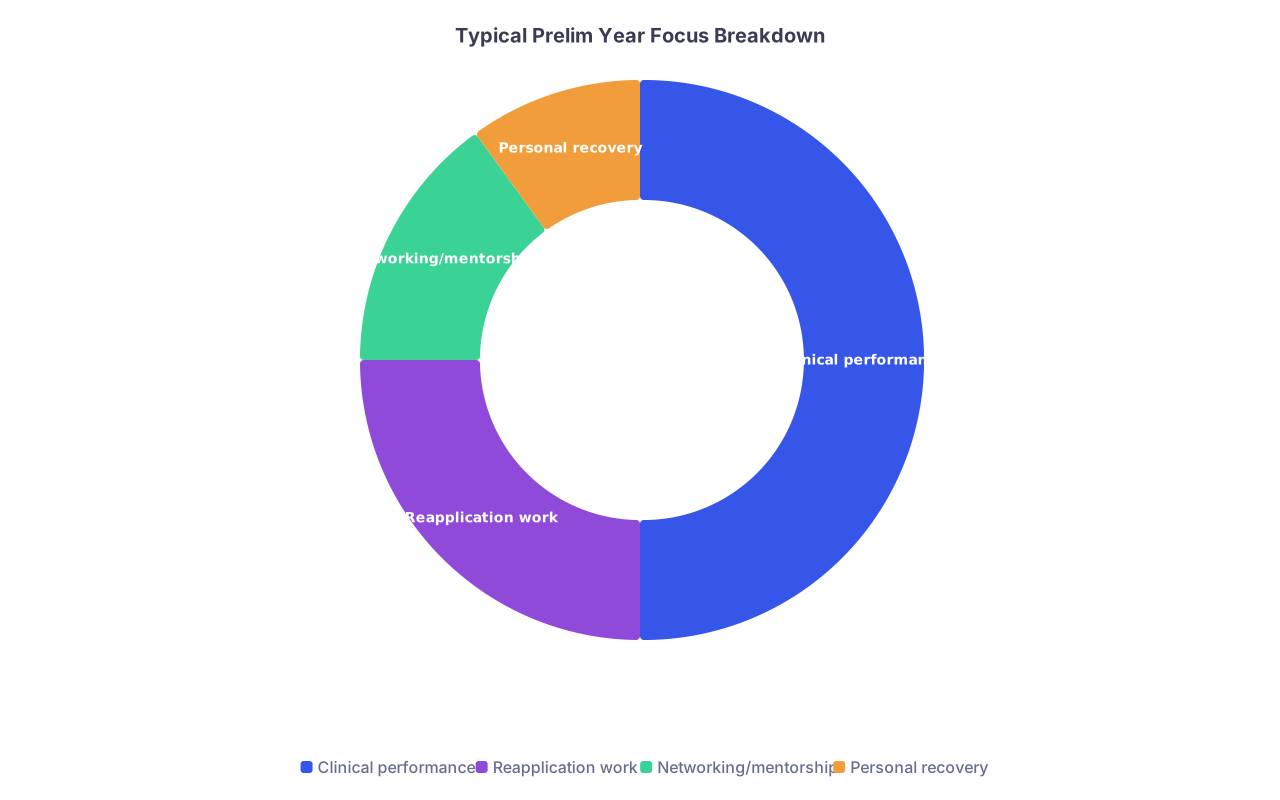
| Category | Value |
|---|---|
| Clinical performance | 50 |
| Reapplication work | 25 |
| Networking/mentorship | 15 |
| Personal recovery | 10 |
- Learn EMR, workflows, call responsibilities.
- Identify 2–3 faculty who could become letter writers.
- Tell at least one trusted faculty member your real goal.
Month 4–8:
- Update CV with residency activities.
- Take/retake Step 3 if it helps.
- Rework personal statement:
“I’ve now had direct experience caring for inpatients and working closely with [target specialty teams]. This has confirmed that [X specialty] best aligns with how I want to practice.” - Apply early and broadly. Earlier than you think.
Month 9–12:
- Interview (if you’re getting traction).
- If not getting traction, now you have to ask hard questions:
- Do I do a second prelim year?
- Do I pivot into a categorical spot in IM/FM if offered?
- Do I start building a hybrid path (e.g., hospitalist + non-clinical work)?
5. Money, Geography, and Life Outside Medicine
Everyone talks career. Few talk logistics. That’s how people burn out and then feel trapped.
Geography reality check
SOAP often throws you into a place you didn’t want. Before you decide it’s unbearable:
- Visit before you sign a long-term lease, if possible.
- Ask current residents blunt questions:
- “Where do most residents live?”
- “How bad is the commute?”
- “What do you actually do on your one real day off?”
- Decide minimum viable quality of life:
- A safe apartment
- 1–2 things you enjoy locally
- Access to people (or virtual connections) you actually like
You don’t need your dream city during residency. You need a survivable one.
Money planning (unsexy but critical)
You might be going from “I thought I’d be an EM attending at 32” to “I’ll be an IM attending at 30” — or add more years for reapplication. Adjust your numbers.
- Build a one-page financial snapshot:
- Loans
- Minimum monthly payments
- Projected PGY salary (look it up; don’t guess)
- Decide your guardrails:
- No new high-interest debt.
- Avoid buying a house during a bridge year or when you’re thinking about switching programs.
- If the SOAP specialty leads to potentially less pay long-term (e.g., FM vs ortho), accept that earlier. You can still live well with intelligent choices.
6. When the Original Dream Specialty Might Need to Die
Harsh, but necessary section.
Some specialties simply will not be realistic for you after SOAP, given your application, scores, visa status, or number of attempts. I’ve watched people burn 3–4 extra years chasing a door that’s basically welded shut.
Red flags that your original specialty should probably be let go:
- You’ve applied 2 full cycles (pre- and post-residency) with:
- No interview invites, or
- Only prelim/TY interviews, no categorical in that field
- Major, unfixable barriers:
- Multiple Step failures in a hyper-competitive specialty
- Severe visa restrictions for a field with few sponsoring programs
- Consistent feedback along the lines of “You’re a strong candidate, but this field has become impossible with your profile”
Letting go isn’t surrender. It’s reallocating your effort to a path where you can actually win.
When you consciously “kill” the old dream, you create space to fully commit to the new one instead of living in mental limbo for years.
7. How to Actually Like — or At Least Respect — Your New Path
You don’t need to fall in love with your SOAP match specialty on day one. But you do need to give it a fair trial.
Here’s what I’ve seen help:
- Find one thing you genuinely like on each rotation. A patient population, a type of procedure, the way a team works.
- Look ahead at what people actually do after this residency:
- IM → nocturnist work, ICU shifts, telemedicine, hospitalist jobs in dream cities.
- FM → sports med, urgent care, rural practice with incredible autonomy.
- Psych → mix of inpatient, outpatient, consult, forensics, telepsych.
- Talk to a PGY-4 or attending who never planned this path:
- “I wanted EM, matched IM. Now I’m critical care and would not trade it.”
- This is more common than anyone admits on Match Day.
Your career is not defined by how you entered your specialty. It’s defined by how you use it once you’re in.
FAQ (Exactly 4 Questions)
1. Should I ever decline a SOAP match in a specialty I really don’t want?
Rarely, but yes, in very specific cases. If it’s a categorical spot in a specialty you are 95% sure you will never practice (say, categorical surgery when you know you want a primarily outpatient lifestyle and hate the OR), and you have another realistic path next year (e.g., strong home program support, decent scores, ability to support yourself financially), you can consider not ranking or declining. But understand: giving up guaranteed GME training is a big gamble. Most people are better off taking the spot, doing strong work for a year, and then reassessing with more information.
2. How early is too early to tell my PD I want to switch specialties?
Telling them on day 1 is too early. You look unserious. Telling them after you’ve collected concerning evaluations is too late. The sweet spot is usually between months 2 and 5, once you’ve shown you can function and are coachable. Go in with a respectful, grateful tone: “I’m committed to doing excellent work here, and I also want to be transparent about my long-term interests.”
3. Do programs in my original specialty look down on SOAP candidates from other fields?
Some do. Many don’t. What matters is how you use the SOAP year. If you show up late, complain constantly, and get mediocre evals, then yes, reapplying looks bad. If you crush your intern year, get powerful letters, maybe pass Step 3 with a strong score, and can clearly explain how this year clarified your goals, plenty of PDs will respect the persistence and maturity.
4. How long should I give my SOAP specialty before deciding to commit long-term or pivot away?
Minimum 6 months in residency, preferably 12. The first 2–3 months of any intern year are so miserable and disorienting that you can’t trust your judgment. By 6–12 months, you know the workflows, the personalities, the real lifestyle. That’s when you can ask, “If this were my life for 20 years, would I be okay?” If the answer is a clear no after a full, honest trial, then you plan your pivot. If the answer is “This isn’t what I pictured, but I could make this work,” you seriously consider staying and building a life there.
Key points to walk away with:
- A SOAP match to an unexpected specialty is not the end of a dream; it’s the beginning of a more complex, more realistic version of your career.
- Your first responsibility is to show up, stabilize, and perform; your second is to decide whether this is a test-drive or a bridge and act accordingly.
- Most doors don’t slam shut as completely as they feel on Match Week, but some do; your job is to be honest about which is which and then fully commit to the path that actually leads somewhere.