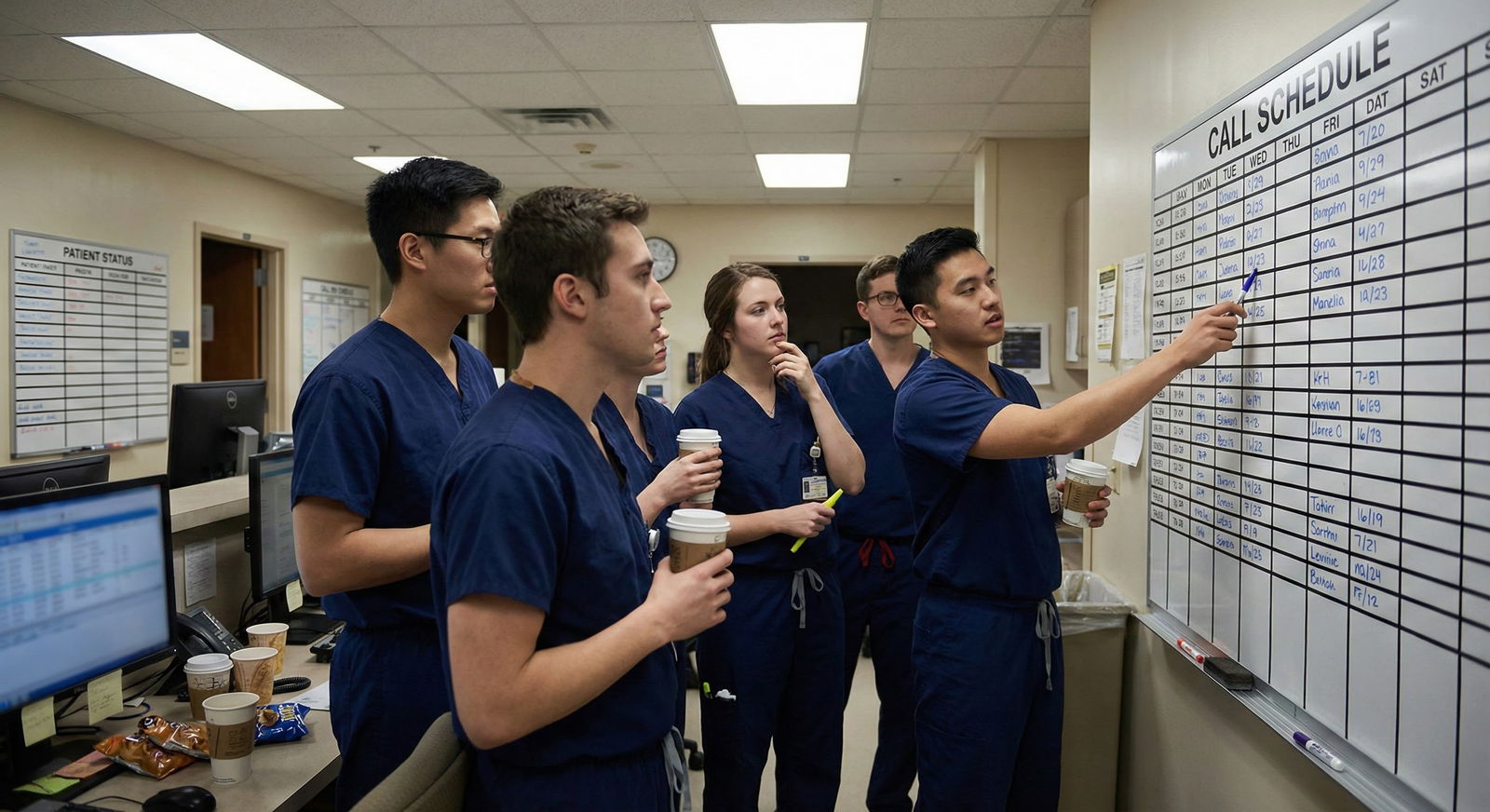
Most applicants misunderstand call schedules more than they misunderstand the Match itself.
You obsess over program reputation, case volume, and board pass rates. Meanwhile, the thing that will dominate your life for the first year—your call schedule—gets reduced to a vague, “We do night float here,” on interview day. That is a mistake.
Let me break down exactly how programs assign nights to new interns, what “q4”, “night float”, and “14-hour rule” really translate to, and how different specialties quietly weaponize scheduling to protect (or sacrifice) their PGY‑1s.
1. The Non-Negotiables: What Programs Are Required To Do
Before we talk about how schedules are actually built, you need to understand the guardrails. Program directors are not drawing your schedule on a napkin. They are wedged between ACGME rules, hospital coverage demands, and resident wellness requirements that look good on paper but bend under real-world pressure.
Core ACGME Duty Hour Rules (The Stuff That Shapes Your Calendar)
For most specialties (Internal Medicine, Pediatrics, Surgery, etc.), the residency duty hour backbone is:
- Maximum 80 hours per week, averaged over 4 weeks
- Maximum shift length for interns: 16 hours (historically) vs 24+4 in some current frameworks depending on specialty and program policy
- At least 1 day (24 hours) off in 7, averaged over 4 weeks
- 10 hours off between duty periods is encouraged; some programs enforce it strictly, others barely
And the big one for you as a PGY‑1:
Whether the program uses traditional “call” (in-house overnight) or “night float” (a block of consecutive nights).
Different specialties interpret these differently:
| Specialty | Common Night Structure | Max Consecutive Nights | Typical Intern Role |
|---|---|---|---|
| Internal Medicine | Night float + short call | 4–7 nights | Admits, cross-cover |
| General Surgery | In-house q-call + some NF | 2–3 call nights/week | Floor calls, ED consults |
| Pediatrics | Mostly night float | 4–7 nights | Floor + nursery cross-cover |
| OB/GYN | In-house 24h shifts | 1–2 per week | L&D, triage, postop calls |
| Emergency Medicine | Mostly shifts, not call | 3–5 nights/week | ED-only, no cross-cover |
These are patterns, not laws. I have seen IM programs still running 24-hour calls for upper levels while keeping interns on “long days” until 10–11 PM. I have seen surgery interns doing 24+4 “q3” effectively on some services. The ACGME language gets stretched.
So: the rules define the boundary. The culture and service demands define your reality.
2. The Invisible Equation: How Many Nights You Owe
Every intern “owes” a certain amount of nights. No one announces this number on Match Day, but the chief residents know it down to the shift.
The equation they are quietly solving looks like this:
Approximate nights per resident
Then they correct for:
- Senior vs intern coverage requirements
- Vacation/leave
- Electives with no nights
- Cross-cover demands
Let’s make this uncomfortably concrete.
Example: Internal Medicine, 18 PGY‑1s
Assume a midsize academic IM program with:
- 3 admitting night-float teams (each needs 1 PGY‑1 nightly)
- 365 nights per year
- 18 interns
- Each night shift = 1 intern; no overlap
Total PGY‑1 night shifts needed per year:
3 night interns × 365 nights = 1,095 intern-nights
Divide by 18 interns:
1,095 ÷ 18 ≈ 61 nights per intern, per year
Now spread that out:
- If a typical NF block is 5 nights/week × 4 weeks = 20 nights
- You need about 3 full NF blocks (60 nights) per intern to cover the year
This is why many IM interns end up doing 2–3 blocks of night float.
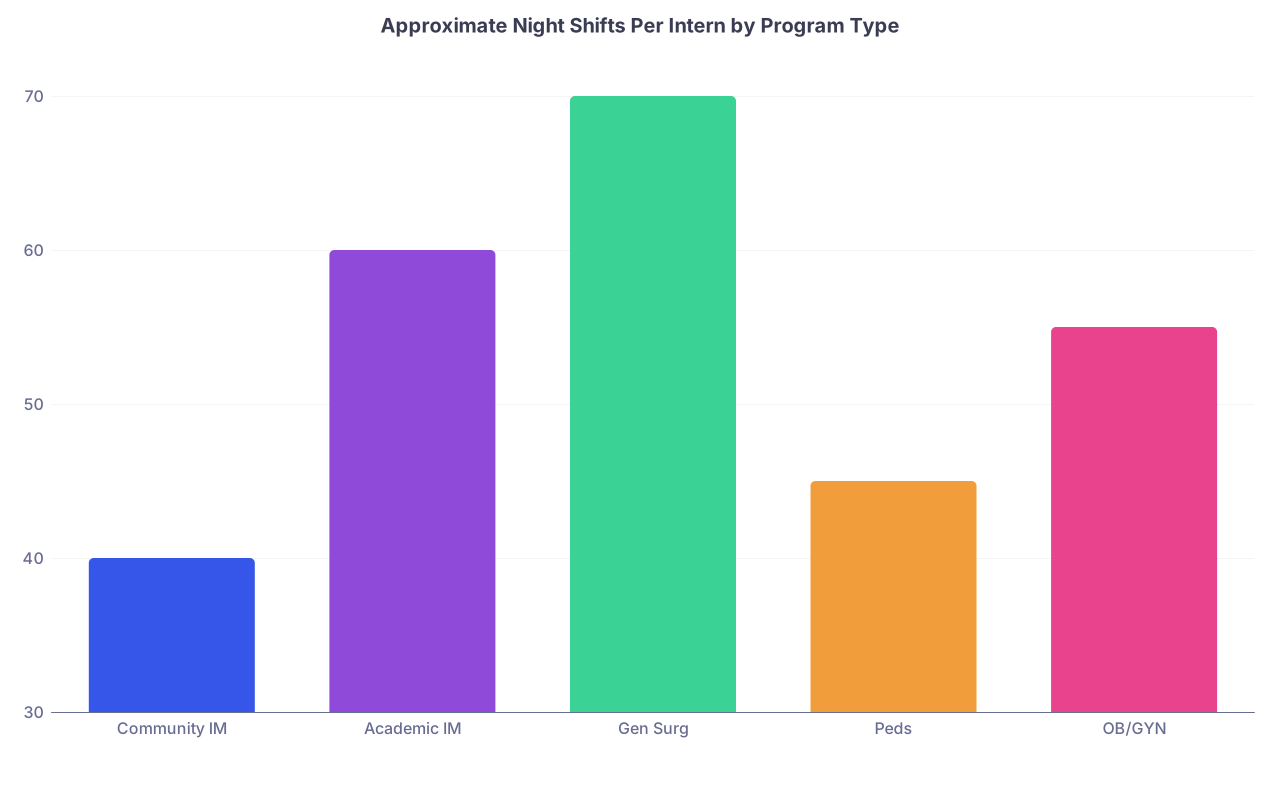
| Category | Value |
|---|---|
| Community IM | 40 |
| Academic IM | 60 |
| Gen Surg | 70 |
| Peds | 45 |
| OB/GYN | 55 |
Is this exact? No. But it explains why you hear things like “Our interns do 2–3 weeks of nights per quarter” – they are just slicing the same pie differently.
Example: Surgery, 6 PGY‑1s on a Busy Service
Surgery is more old-school. Less night float, more “call.”
Let’s say:
- A service needs 1 intern in-house overnight every night
- 365 nights per year
- 6 interns rotating through that service over the year
Total nights: 365
365 ÷ 6 ≈ 61 nights per intern assigned to that service that year
But surgery splits interns across multiple services (Trauma, Vascular, Night Float, ICU). So you might see:
- 1 Trauma NF month = ~18–20 nights
- 1 ICU month with q4 call = 7–8 nights
- 2–3 other services with q5–q7 = 4–6 nights each
You end up around 35–60 nights per intern, depending on program volume and how creatively they distribute things.
The important takeaway: call is not random. Programs back-calculate your nights based on service coverage, then try to package it into something that looks humane (or at least defensible).
3. The Assignment Logic: Who Gets Nights, When, And Why
Now you understand the volume problem. Let me show you how they decide which intern takes which nights.
There are several overlapping principles:
- Coverage first, fairness second
- Seniors before interns where possible for autonomy-heavy roles
- No one blatantly violates ACGME too obviously
- Protect certain months (board season, in-service, fellowship interview season)
Stepwise: How Chiefs Actually Build a Call Schedule
A typical real sequence in June when chiefs are panicking over schedules:
Map the rotations for the entire year for each intern
– Who is on wards, ICU, ED, electives, off-site rotations each month.Define which rotations carry nights
– Wards A/B: night float coverage
– ICU: in-house overnight q4
– ED: shift work, but nights are counted separately
– Clinic/elective: usually no nightsMark protected or restricted times
– Intern vacation weeks
– Institutional retreat days
– “No call after exam” days (for big in-service or Step 3; better programs do this)Slot in fixed night blocks first
– Example: “Every intern must do 2 blocks of NF: 1 in first half, 1 in second half.”
– They scatter you so no service is overwhelmed with brand-new interns on nights.Backfill remaining single nights
– For services with home call or sporadic nights, chiefs use interns on lighter rotations that month.
– You will see “cross-cover nights” slapped onto outpatient or consult months.Run duty-hour sanity checks
– Ensure nobody accidentally hits 90 hours/week because they’re on days + extra nights.
– Adjust pairings: if you are on a heavy rotation, you are less likely to get “add-on” nights that month. Usually.
What you care about as a matched intern:
- Are nights concentrated (blocks) or scattered (singletons)?
- Are your earliest months night-heavy, or do they push more nights later once you are semi-competent?
- Do they cluster multiple bad rotations back-to-back (ICU → NF → wards) or intersperse relief?
I have seen both extremes. Some programs aggressively front-load nights (“you learn the most that way”), which is code for “the seniors want December off.” Others shield July entirely from nights because no one wants 3 new interns running cross-cover at 3 a.m. (sensible).
4. Call Models: What “Q4” And “Night Float” Really Feel Like
Same total number of nights. Very different lived experience depending on scheduling model.
Traditional Call: “q4”, “q5”, “24+4”
Language you will hear:
- “We do q4 24+4 in the ICU”
- “Floor interns do long call q5 until 10 PM, seniors stay overnight”
- “Golden weekends” (both Sat and Sun off following a call cycle)
Traditional call means you cycle:
Call → Post-call → Short day → Normal day → Repeat
As an intern, flavor varies by specialty:
- In IM and Peds, many programs now avoid 24-hour intern calls but keep long days (till 9–11 PM). Seniors often stay fully overnight.
- In Surgery and OB/GYN, true 24+4 can still exist for everyone, including interns.
Pros (from programs’ perspective):
- Continuous patient ownership: the same team that admits sees overnight evolution
- Less handoff complexity
Cons (for you):
- Entire weeks destroyed by post-call haze
- Physical wear that is very different from 5 straight nights where you at least sleep during the day
Night Float: Blocks Of Pure Nights
Night float is simpler: you work nights only for a block.
Typical pattern:
- 5–6 nights per week (Sun–Thu or Mon–Fri)
- Shift length: 12–14 hours (e.g., 7 PM–7 AM or 8 PM–8 AM)
- Free days in between blocks, sometimes a “golden” weekend after
Your job:
- Cross-cover multiple wards
- Admit new patients overnight for day teams
- Put out fires: chest pain, hypotension, “patient needs sleep meds”
Programs like night float because it is easy to standardize and report to ACGME. Fewer 28-hour call logs to justify. Easier to show compliance.
From an intern standpoint:
- Better for circadian rhythm than scattered single nights
- Social life: obliterated for 4 weeks, fine the rest of the time
- Learning: heavy on acute issues, lighter on rounding/comprehensive care
Hybrid Models: Where Most Real Programs Live
Many programs use a hybrid:
- Ward months with a night float system
- ICU or specific services with q4 or q5 24-hour calls
- Occasional cross-cover “late call” shifts up to 11 PM
So do not get fooled by “We use night float” as if that is the whole truth. Ask:
- On which rotations do interns still take 24-hour call?
- Are there any 28-hour shifts for PGY‑1s?
- How many total weeks of night float will I have as an intern?
- How do you handle holiday coverage for nights?
5. How Call Differs By Specialty (And What That Signals About Training Culture)
You matched into a specialty for a reason. The call schedule will reflect that specialty’s identity more brutally than any brochure.
Internal Medicine
Common pattern:
- 2–3 months of night float
- 2–3 ward months with long days and maybe a few late “cross-cover” shifts
- 1 ICU month with heavier hours, maybe some overnight call or long shifts
- The rest electives, clinic, consults, often without nights
IM programs that respect their residents tend to:
- Avoid true 24-hour intern calls
- Spread night float months out (e.g., July, November, March)
- Give post-call days actually off, not “work until 1 p.m.”
Red flags:
- Interns talking about “I lived in the hospital my ICU month” with 90-hour weeks being normalized
- “You will get used to staying late even if the schedule says 7 PM” – that is code for hidden extra hours.
General Surgery
Surgery uses call as a pressure test.
Common features:
- Interns on trauma or transplant with heavy in-house call
- ICU or SICU rotations with q3–q4 call
- A dedicated trauma/night float month where you hardly see sunlight
If you are in surgery, you probably expect this. Still, there is a difference between:
- A program that swaps interns off brutal rotations after a night-heavy month
- A program that stacks ICU → Trauma NF → Vascular in one sequence because “someone has to do it”
Ask seniors (not PDs) how often they are post-call and still in the OR at 4 p.m.
Pediatrics
Peds loves night float, especially at children’s hospitals. Typical:
- NICU: in-house 24s or night float blocks
- Floor: night float teams with 1–2 interns and a senior
- Nursery: fewer nights, more days
Culture varies. Some children’s hospitals are incredibly humane, others have ICU schedules that are basically surgical in disguise.
OB/GYN
OB is continuous. Babies do not care about GME rules.
You will see:
- L&D 24-hour or 12-hour shifts, often as straight nights or mixed
- Gyn Onc or benign gyne services with traditional call
- Night float specifically for L&D at large centers
Watch for whether interns are first-call for L&D with minimal senior backup. That will change the perceived severity of nights dramatically.
Emergency Medicine
You technically have “no call.” You have shifts.
But nights? Plenty.
Pattern:
- You work in blocks of shifts (days, evenings, nights)
- Nights often cluster to minimize circadian whiplash
- Total hours still capped at 60–72/week depending on program
EM programs differ in how they assign nights:
- Some use strict fairness algorithms – each resident gets similar night/weekend loads
- Others give more nights to interns and protect seniors a bit, especially in PGY‑3/4
6. How “Fairness” Really Works (And Where It Breaks)
Program directors will swear the schedule is fair. The chief resident’s spreadsheet may even be beautiful.
Reality: fairness gets distorted by three forces.
1. Seniority
Even in PGY‑1 class, chiefs may treat prelims vs categoricals differently. Or:
- Random-number–assigned “intern A” always on more painful blocks because of how vacations lined up
- Interns pursuing certain fellowships steered toward heavier or lighter ICU/call months strategically
Chefs will deny bias. You will see patterns anyway.
2. Skill And Reliability
I have seen this repeatedly:
- The intern who can run a cross-cover list cleanly, put in lines, and not melt down gets stacked with more complex nights.
- The struggling intern quietly has their nights reduced and sheltered with more senior-heavy coverage.
Is that fair? Not evenly. Does it happen? Yes. Especially by mid-year when faculty start asking, “Who is on nights? Oh good, it’s X, we’ll be fine.”
3. Service Politics
Certain services are black holes: high volume, bad nursing ratios, outdated EHR. Faculty who run those services often have sway.
You end up with months where:
- One rotation hoards the most talented or “grind-ready” interns
- Another rotation becomes the de facto cush month where people hide before taking Step 3 or interviews
Nights follow that same pattern.
7. What You Should Be Asking About Call (Before You Sign a Contract)
During interview season and especially on second looks, almost nobody asks the right questions about call. You get vague answers because you ask vague questions.
Instead of:
“How is the call schedule here?” (useless)
Ask things that force specifics:
- “How many total weeks of night float does a typical intern do?”
- “Are there any 24-hour or 28-hour shifts for PGY‑1s? On which rotations?”
- “Can you walk me through a typical call cycle for the ICU or wards?”
- “What does a post-call day actually look like? Do you ever stay past noon?”
- “How do you handle holiday coverage for nights? Who works Christmas vs New Year’s?”
- “How often are night schedules changed last minute?”
On pre-interview dinners or resident-only sessions, push lightly:
- “On your worst month as an intern, how many hours were you working?”
- “Which months are known as the ‘brutal’ ones for nights?”
Then watch their faces, not just their words.
8. A Realistic Month: What Your Life Actually Looks Like
Let me sketch two concrete intern months so you can see how the same number of nights can feel very different.
Month A: Internal Medicine Ward With Night Float System
- Days Mon–Fri: 6 AM–5:30 PM
- Call: None for you; NF team admits after 7 PM
- You do 2 separate 7-night NF blocks during the year, but not this month
Your average week:
- 60–70 hours
- You are home by 6:30 PM most days
- Nights are front-loaded to other months in dedicated blocks
You sleep nightly, but you will be physically drained by the pace.
Month B: ICU With q4 Call
- Normal days: 6 AM–5 PM
- Call days: 6 AM–noon the next day (24+6 is still real at some sites in practice, even if logged differently)
- Post-call: leaving anywhere between 11 a.m. and 2 p.m.
Across 4 weeks:
- ~7 call days
- Average weekly hours: 75–85 (yes, they will say “it washes out over 4 weeks”)
- You feel half-alive by week 3
Same year total nights? Maybe. But your psychological memory of intern year will be built around that ICU month, not your relatively mild clinic month.

| Step | Description |
|---|---|
| Step 1 | PGY1 Start July |
| Step 2 | Light wards with no nights |
| Step 3 | Night float block 1 |
| Step 4 | ICU with q4 call |
| Step 5 | Elective no nights |
| Step 6 | Night float block 2 |
| Step 7 | Heavy wards with late stays |
| Step 8 | Clinic month minimal nights |
| Step 9 | Night float block 3 |
| Step 10 | PGY1 End June |
9. How Programs “Protect” New Interns On Nights (When They Actually Do)
Not all programs throw PGY‑1s into nights blindly. Some build real guardrails.
Common strategies:
- No July nights for interns – seniors and PGY‑2s cover initial months; interns start nights in August or September.
- Buddy call – first few overnight shifts paired with a more experienced resident or fellow who is in-house, not just “available by phone.”
- Tiered cross-cover – interns handle floor calls, but all ICU/unstable patients route through an in-house senior first.
- Escalation algorithms: clear rules like “any SBP <90, call senior immediately, no debate.”
If you ask “How do you onboard interns to nights?” and the answer is “We orient you for two days on days, then you start nights,” expect a rough July.
FAQ (Exactly 4 Questions)
1. Do programs ever change call schedules after the year starts?
Yes, constantly. Cancellations, maternity/paternity leave, medical issues, and unexpected attrition force adjustments. Good programs have transparent rules: swaps must be agreed upon by residents and approved by chiefs, and no one gets punished with extra nights repeatedly. Bad programs quietly dump extra call on the “reliable” people and hope they do not complain. As an intern, you will feel this most when someone takes extended leave mid-year and night blocks are rebalanced.
2. Are preliminary interns treated differently for nights compared to categoricals?
Often, yes. In some Internal Medicine and Surgery programs, prelims are used as coverage workhorses because they are only there one year and not being developed long-term. That can mean heavier ward months and more nights. In other programs, prelims get more electives and fewer core inpatient months, which indirectly reduces nights. Ask specifically: “Do prelims and categoricals have the same call expectations?” and get residents, not PDs, to answer.
3. How much say do interns actually have in their call schedule?
Very little in most places. You might be allowed to request vacation months or block off certain dates (weddings, exams, major family events), and chiefs will build around that. But the core night distribution is driven by service needs. Swaps are possible, but you will trade pain for pain—nobody is handing away a golden weekend for free. Where you do have some influence is early: submit scheduling preferences promptly, communicate constraints clearly, and avoid being the person who asks for five different changes in August.
4. Should a heavier call schedule be a deal-breaker when ranking programs?
Not automatically. A program with a heavier call load but excellent teaching, strong support, and real camaraderie can be far more tolerable than a “light” program that is disorganized and unsupervised. That said, chronically brutal hours with weak supervision is a serious red flag, both for your wellness and your education. The smart move is to compare two things: total night burden and how well-supported nights are (in-house seniors, attendings, ancillary staff). A heavy but structured and well-supervised schedule can still be a strong training environment. A chaotic one will just crush you.
Key points:
- Call schedules are not random; they are the product of ACGME rules, service demand, and internal politics, and every intern “owes” a predictable number of nights.
- The model of nights (traditional call vs night float vs hybrid) changes your lived experience far more than a simple “we average 60–70 hours/week.”
- You should interrogate programs about specifics—total weeks of nights, 24-hour shifts, ICU call patterns, and how they protect new interns—because this will shape your entire PGY‑1 year.