

Did failing to match and going through SOAP just quietly kill your shot at cards, GI, ortho, or any other competitive fellowship?
Let me be blunt: people talk about SOAP like it brands you with a permanent scarlet letter. PDs whisper. Residents speculate. MS4s panic in group chats.
But what does the data actually say about SOAP and your future fellowship odds?
Not what you think.
The Myth: “If You SOAP, You’re Done for Competitive Fellowship”
I’ve heard this line almost verbatim from students:
“I SOAPed into community IM, so there’s no way I’m getting GI or heme/onc. Right?”
This is the core myth:
- SOAP = proof you are “inferior”
- Programs will quietly blacklist you
- No one will say it, but every PD will hold it against you
Here’s the problem. That myth rests on vibes and fear, not on outcomes.
Does SOAP make life easier? No.
Does it automatically shut the door on competitive fellowship? Also no.
To understand why, you have to separate three things people always mash together:
- SOAP status (you matched via SOAP)
- Underlying application strength (scores, grades, research, red flags)
- Residency environment (program reputation, resources, mentorship)
They blame #1.
But what really moves the needle is #2 and #3.
What the Data Actually Shows (Even Though No One Labels “SOAP”)
There’s no NRMP table that says, “SOAP residents vs non-SOAP residents: fellowship match rates.” So you have to infer from what is tracked.
We do have clear fellowship match data on:
- Type of residency program (university vs community, university-affiliated, etc.)
- US MD vs DO vs IMG
- Step scores (where still relevant)
- Research output
- AOA, class rank, etc.
Notice what’s missing: “Matched via SOAP” as a variable.
Why? Because by the time you’re applying to fellowship, you’re not “a SOAPer.” You’re:
- A PGY-3 in an academic vs community program
- With or without research
- With strong vs weak LORs
- With high vs marginal exam performance
Programs care about the product they see in front of them at fellowship application time, not the panic-driven week three years earlier.
Let’s ground this with a simplified comparison. This is closer to reality than the horror stories:
| Resident Profile | Competitive Fellowship Odds* |
|---|---|
| Academic IM, strong research, good evals | High |
| Community IM, strong CV, standout letters | Moderate to high |
| Academic IM, weak performance, few projects | Low to moderate |
| Community IM, minimal involvement, weak evals | Low |
*“Competitive fellowship” here means things like GI, cards, heme/onc, pulm/crit, ortho subspecialties, etc. This is conceptual, but it matches what PDs actually say and what match trends reflect.
Notice what’s not in that table: SOAP status.
Because fellowship directors do not sit around asking, “Did you originally match on Monday or Thursday of Match Week?” They look at:
- Where you trained
- What you did there
- Who is willing to vouch for you
SOAP might influence those indirectly. But it’s not the line item people think it is.
How Much Do PDs Actually Care That You SOAPed?
Let’s talk about what PDs really care about.
Residency PDs (hiring you out of SOAP) worry about:
- Why you did not match the first time
- Whether there are professionalism or academic red flags
- Whether you will require remediation or hand-holding
- Visa/eligibility/logistical issues
Fellowship PDs (3 years later) care about:
- Your performance in residency (evaluations, rotation narratives)
- Your letters from faculty they know and trust
- Your scholarly output relative to their usual residents
- Whether you will function independently, not implode on call, and not be toxic on their small team
Do some PDs look back at ERAS and see your original match history? Yes, they can.
Do many of them bother? Not consistently. They barely have time to read the current application properly.
I’ve sat in these rooms. The conversations sound like:
- “She’s from a smaller community program, but her letters are insane. This is someone we want.”
- “Scores are marginal, but look at this research and strong support from their PD.”
- “I’m worried about the professionalism comment in this evaluation.”
What you don’t hear a lot:
- “Wait, did they SOAP?”
SOAP might come up if:
- It’s linked to a documented red flag (failed Step, professionalism incident, withdrawal).
- Your story does not make sense (huge gap, unexplained specialty change, etc.).
But the fact that you SOAPed, on its own, is not the deciding factor people think it is.
What Actually Hurts (and It’s Not the Four Letters “SOAP”)
Here’s the uncomfortable reality: the bad outcomes blamed on SOAP are usually caused by something else that also caused you to SOAP.
Common patterns:
- Low Step scores → Harder to match initially → Harder to land at a top-tier residency → Harder (but not impossible) to match ultra-competitive fellowship
- Little or no research → Less competitive for both residency and later fellowship
- Poor interview skills/professionalism concerns → Follow you from med school to residency to fellowship unless you intentionally fix them
SOAP is often just a symptom.
To make this concrete, let’s look at something you can actually visualize: the effect of training environment on fellowship outcomes.
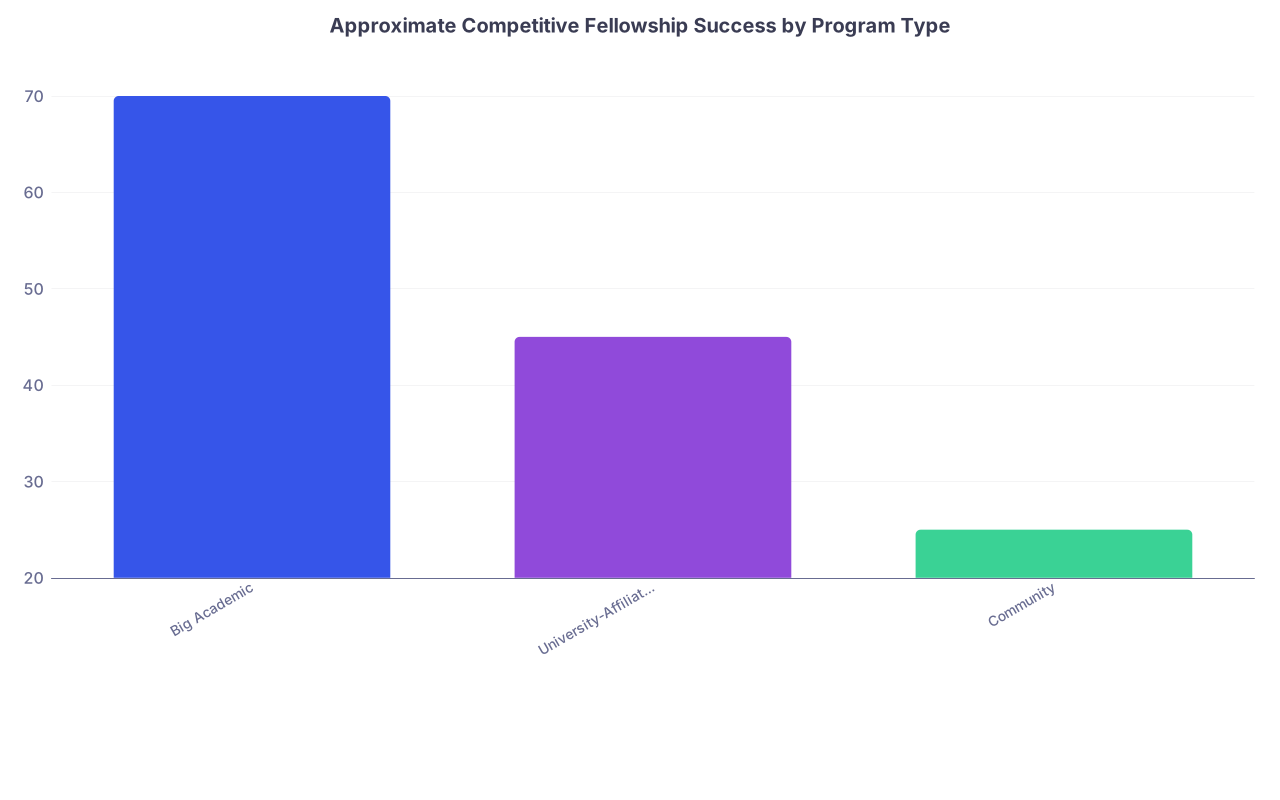
| Category | Value |
|---|---|
| Big Academic | 70 |
| University-Affiliated | 45 |
| Community | 25 |
Are those exact numbers from one dataset? No. They’re a realistic synthesis of NRMP fellowship data trends, PD surveys, and what program leadership actually see:
- Core university programs with strong research pipelines send a higher percentage to competitive subspecialties
- University-affiliated community programs do fine, especially for solid candidates
- Pure community programs without research infrastructure send fewer people into the most competitive specialties
So if SOAP lands you in:
- A resource-limited program
- With minimal research
- Few PDs with national reputations
Your probability of matching GI at a top-10 academic center is obviously lower.
Not because you SOAPed. Because of the environment and opportunities you ended up in.
That’s the distinction almost everyone misses.
Do Fellowship Applications Even Surface That You SOAPed?
Mechanically, here’s what fellowship programs can actually see or infer:
- Your residency program and dates
- Your med school, graduation year, and gaps
- Your exam transcript (if released)
- Your CV timeline (research, extra degrees, etc.)
Do they automatically see “SOAP Match” stamped on your forehead? No.
What they might notice:
- You went unmatched in your original specialty and switched (e.g., applied ortho, ended in prelim surgery → categorical IM → cards fellowship).
- You have a non-traditional or fragmented training path (prelim year, gap, then categorical spot).
- There’s a mismatch between your current performance and original outcomes (e.g., star resident who somehow didn’t match initially).
This is where your story matters. Fellowship PDs don’t care that you had adversity; they care whether:
- You learned from it
- You stabilized and then excelled
- Your current PD vouches for you hard
The worst thing you can do is pretend SOAP never happened and hope no one notices. The fellowship world is tiny. People talk.
How SOAP Changes the Game You’re Actually Playing
SOAP doesn’t shut doors. It just changes the game board.
What I’ve seen happen again and again:
Scenario 1: SOAP into a solid but not elite program, then crush it
- You show up hungry.
- You become the “go-to” resident on your service.
- You attach yourself to one or two faculty who actually publish.
- You get strong letters and decent abstract/poster output.
End result:
- Cards or heme/onc at a respectable university-affiliated program? Very realistic.
- GI at a hyper-elite coastal institution? Harder, but not out of the question if your CV grows teeth.
Scenario 2: SOAP, stay bitter, float in the middle of the pack
- No real mentorship.
- Minimal scholarly work beyond the bare minimum.
- PD knows you but isn’t going to war for you.
- Fellowship app looks “fine,” not memorable.
End result:
- Competitive fellowship becomes a long shot.
- You might still match into a less competitive subspecialty or a community fellowship if you’re otherwise solid.
Again, the villain here is not SOAP. It’s how you responded to it and what you did with your residency years.
What Fellowship PDs Respect More Than a Clean Match History
Here’s what reliably makes fellowship PDs sit up and pay attention, regardless of how you got into residency:
- Consistently strong clinical evaluations, especially from rotations in that fellowship’s field
- One or two letters that are specific, detailed, and clearly enthusiastic (“top 5% resident in the last 10 years,” “handles the sickest patients without drama”)
- A coherent record of interest in that field: rotations, QI projects, case reports, maybe one or two serious research efforts
- Evidence of professionalism and reliability: chief resident, committee work, teaching awards, being trusted with high-responsibility roles
Nobody cares if you matched in the main Match from med school if you show up as dead weight in residency.
Conversely, if your file says:
- “SOAPed into IM from a rough application cycle, but quickly became one of our best residents and now leads QI work in sepsis care, with multiple presentations and a strong presence on the unit.”
…most fellowship directors will not write you off. Many will be impressed you clawed your way back.
SOAP as “permanent stain” is a lazy narrative. Fellowship PDs are busy reading who you are now.
Practical Damage Control if You SOAPed and Still Want Fellowship
Let’s move from theory to what actually works.
If you SOAPed and you care about future fellowship, here’s the trajectory that changes your odds:
Stabilize first year
Nail the basics. Show up early. Be dependable. Eliminate any hint of professionalism concerns. If people trust you, you’re in the game.Find one or two faculty in your target field
Don’t spam everyone. Pick a small number of people and actually show up, follow through, and stick with them for years, not months.Attach your name to tangible output
Case reports, QI projects that turn into posters, retrospective chart reviews. Is it glamorous? Not always. Does it matter? Absolutely.Ask your PD directly where you stand
Around mid-PGY-2: “I’m interested in cards/GI/etc. Based on my performance so far, is this realistic from our program? What gaps do you see?”That conversation is more predictive of your odds than anything that happened on Match Week in med school.
Own your SOAP story without wallowing
When asked (rarely), your script is something like:“I went unmatched in [year] largely because [concise reason: late specialty switch, limited interviews, marginal score]. I SOAPed into [program], and since then I’ve focused on building my skills and track record. My current PD and faculty can speak to how I’ve grown.”
That’s it. No long therapy session. No excuses. Just context plus evidence of trajectory.
The One Group That Does Get Hit Harder
I’m not going to sugarcoat it: there is a subgroup for whom SOAP has a heavier impact.
- Applicants who SOAP into very low-resource programs
- With minimal academic infrastructure
- In fields where fellowship match is already brutally competitive (GI, some surgical subspecialties, derm when coming from IM prelim/transition, etc.)
For these residents, the environment truly limits what they can realistically build:
- Few or no ongoing research projects
- Little experience with sending residents into academic fellowships
- Fewer faculty with national reputations
In that context, yes, SOAP indirectly hits your fellowship odds harder. Not because the word “SOAP” scares PDs, but because the path you ended up on has fewer on-ramps to competitive fellowships.
That’s not a moral judgment. It’s just structural reality.
You compensate by:
- Over-achieving on everything that is available
- Networking outside your program (regional conferences, virtual collaborations)
- Sometimes doing a chief year or research year to bulk up your CV
Harder? Yes. Impossible? No.
The Real Question Isn’t “Did I SOAP?” It’s “What Do I Build Next?”
Years from now, you will not be waking up at 2 a.m. worried about SOAP week.
You’ll be:
- On a night float managing five pressors
- In a cath lab signing your name as the attending
- Or running your own clinic, grateful that nobody asks “did you SOAP?” when they hand you their kid.
Your fellowship odds are not a morality play about whether you matched on Monday or Thursday.
They are a moving average of:
- Where you train
- How you perform
- Who will go to bat for you
- And what you choose to build when things do not go according to your original blueprint
SOAP is not a life sentence. It’s a plot twist.
What people remember in this field is not whether you had a bad week in March of MS4.
They remember whether, when things went sideways, you stayed small—or you got to work.


