

Myth vs Reality: Does Matching ‘Community’ Limit You Academically?
Did you just open your Match email, see “Community Program” instead of “University Hospital,” and immediately think: “Well, there goes fellowship, research, and any shot at academics”?
Let me be blunt: that reaction is common. It’s also mostly wrong.
The “community = dead-end, academic = golden ticket” narrative is one of the laziest myths in residency culture. It gets repeated by people who have never looked at a single outcomes report, never read a fellowship class list carefully, and mostly just parrot what the loudest person in the group chat said.
Let’s dismantle this properly.
The Core Myth: Community = Cap, University = Rocket Ship
The standard story goes like this:
- If you match at a big-name university program, doors fly open. Research flows, fellowship is easy, academic careers are lined up for you.
- If you match at a community program, you become “just a clinician,” your academic options evaporate, and you’re stuck in some professional cul‑de‑sac.
There’s a grain of truth hiding in there, but it’s mostly correlation misread as fate.
Here’s what the data and real-world outcomes actually show:
- Tons of subspecialists — including at big-name institutions — trained at community residencies.
- Fellowship match statistics from many community programs are extremely competitive.
- What you do during residency matters vastly more than the label “community” or “university”.
The nuance: structure, proximity to resources, and culture differ. Those can make your path easier or harder. But “permanently limited academically because you’re at a community program”? No.
What “Community Program” Actually Means (And What It Doesn’t)
First problem: people use “community” like it’s one thing. It isn’t.
There are at least three fairly different beasts all lumped under that label:
Hybrid / university-affiliated community programs
Example: Internal medicine residency at a major community hospital that serves as a teaching affiliate of a nearby med school. Faculty often have university appointments. Subspecialty services on-site or via rotations.Large community teaching hospitals
400–800 bed hospitals with multiple residencies, robust subspecialty presence, sometimes even fellowships. May not carry the “Fancy U” brand but function academically: journal clubs, QI, some research infrastructure, students rotating, etc.Small stand-alone community programs
Smaller hospitals with limited subspecialties, maybe fewer residents per class, minimal formal research infrastructure, limited or no medical school affiliation.
When someone says “community limits you academically,” they’re usually imagining Scenario 3 and ignoring 1 and 2 — and even then, they’re overstating the ceiling.
To put some structure on it:
| Feature | Large Community | University |
|---|---|---|
| Subspecialty exposure | Moderate–High | High |
| Built-in research infra | Low–Moderate | High |
| Funding for conferences | Variable | Moderate–High |
| Med student presence | Some–Many | Many |
| Formal academic titles | Limited | Common |
You’ll notice something: none of those rows say “impossible.” They describe friction, not final outcomes.
What Actually Predicts Academic/Fellowship Outcomes
Here’s where people lie to themselves.
They want to believe: “If I just get into a big-name academic hospital, I don’t have to think strategically; it’ll happen for me.” That’s not how this works.
Every fellowship director I’ve talked to cares about four things, in some order depending on the specialty:
Performance in residency
Evaluations, letters, how you are on the wards and in clinic. Are you the resident people trust at 3 a.m.?Evidence of interest in the field
Electives, scholarly work (doesn’t always mean bench research), presentations, involvement.Concrete output
Presentations, posters, publications, QI leadership. They want to see that you can start something and finish it.Board scores and exams
Step 2, in‑training exams, specialty boards. Not everything, but not nothing.
Whether your badge says “Big U Medical Center” or “Regional Community Hospital” is background context. The four items above are the real file‑movers.
Let’s visualize the gap between myth and reality.
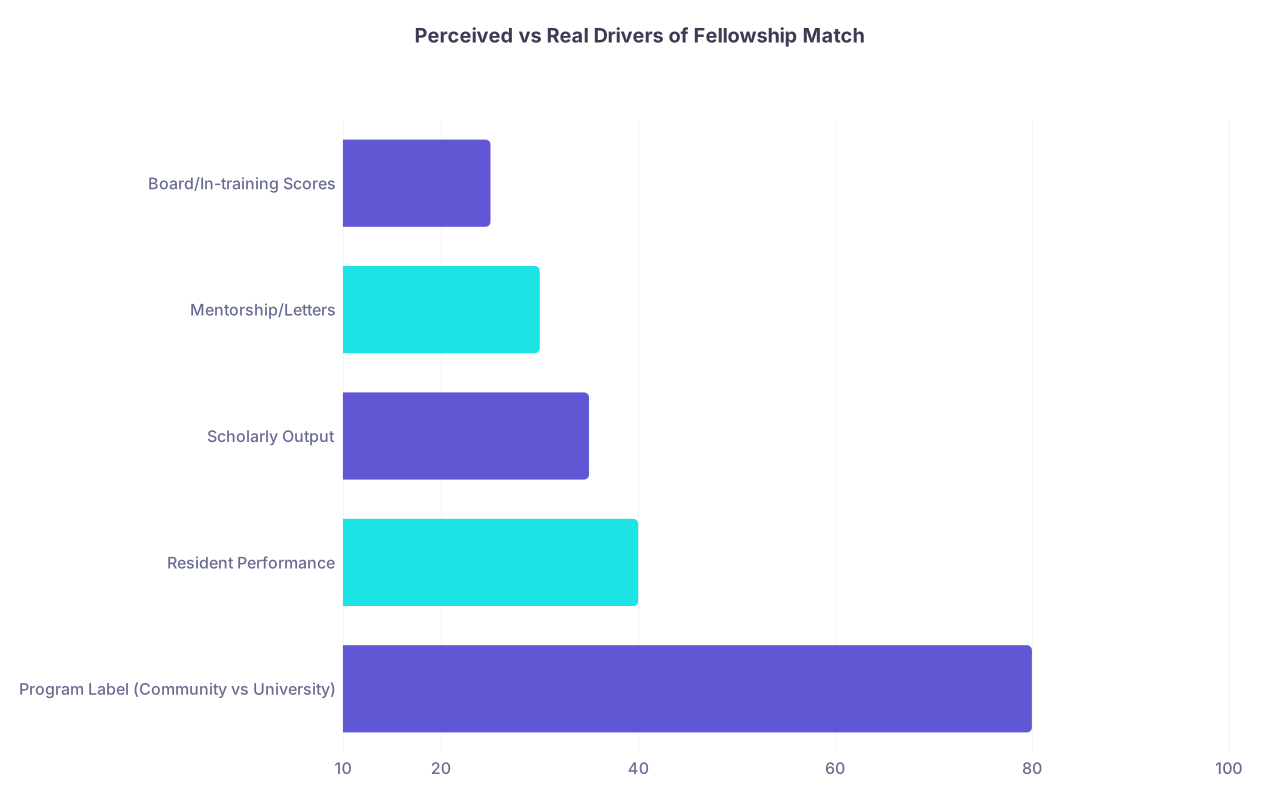
| Category | Value |
|---|---|
| Program Label (Community vs University) | 80 |
| Resident Performance | 40 |
| Scholarly Output | 35 |
| Mentorship/Letters | 30 |
| Board/In-training Scores | 25 |
Interpretation:
- Perception: People massively overweight “program label”.
- Reality: The boring stuff (how you perform, what you produce, who will vouch for you) is what matters.
You can crush those four at a community program. You can also coast right past them at a university program and get burned.
Fellowship From a Community Program: Fantasy or Normal?
Let’s talk outcomes, not vibes.
Look at fellowship rosters in internal medicine subspecialties — cards, GI, heme/onc. Skim program websites for places like Mayo, Cleveland Clinic, University of Michigan, even the hyper-competitive ones. You’ll see:
- Residents from strong university programs
- Residents from big community teaching programs
- Residents from hybrid affiliates you’ve never heard of
Is it easier from a top‑tier university IM program to match cards at a top‑tier institution? Yes. You’re swimming in research, famous faculty, pipeline connections.
But easier is not the same as exclusive.
In practice, the community→fellowship path usually looks like this:
- Choose electives strategically at places with fellowships.
- Do a focused scholarly project (often QI or clinical).
- Get at least one letter from a recognized person in the field, even if that requires away rotations.
- Show up to interviews with a tight narrative and clear commitment.
Residents who do that from community programs match well. Residents who wait for opportunity to be hand‑delivered do not — regardless of program type.
Here’s the uncomfortable bit: community programs sometimes look worse on paper because they attract more residents who are less aggressively fellowship-driven from day one. That lowers the overall “fellowship rate,” and people mistake that for “no one can get fellowship from here.”
Those aren’t the same thing.
The Hidden Strengths of Community Programs (That No One Talks About)
Contrary to the doom narrative, community programs often give you real advantages if you’re even moderately strategic.
1. Massive hands-on responsibility
I’ve seen PGY-2s at community hospitals running codes solo because the attending’s on the way in from home. You learn fast or you sink. Fellowship directors know this.
They’ll trust a letter that says: “This resident can independently manage sick patients; we relied on them heavily.” Sometimes more than a letter full of vague praise from an academic PD who barely saw you outside of grand rounds.
2. Easier leadership roles
At big-name universities, there are usually 30 residents all fighting over the same chief spots, QI projects, education committees, and teaching opportunities.
At many community sites, if you’re even mildly enthusiastic, you end up:
- Running journal club
- Leading QI initiatives that actually change practice
- Teaching med students or new interns regularly
Those are actual, documentable leadership activities. They show up well on applications. You do not need a famous logo for that.
3. Direct attending access
Community attendings may not all be “Professor of X,” but the good ones tend to be:
- On the wards with you, not buried in meetings
- Accessible for letters because they know your work intimately
- Hungry to support projects because fewer people are asking
You’d be amazed how far a detailed letter from a program director or department chair who truly knows you will go — even if their hospital brand is less sexy.
The Real Constraints: Where Community Can Make It Harder
None of this means all programs are equivalent. They’re not. Some community programs absolutely give you a steeper climb if you want a high-end academic or research career.
The actual constraints you should care about:
Limited subspecialty presence on-site
If there’s no in-house GI, heme/onc, cards, etc., your exposure is weaker. You’ll need away rotations, creative networking, and perhaps earlier planning.Sparse research infrastructure
No biostats support, no built-in IRB help, no ongoing clinical trials to join. You can still do QI and clinical projects, but large, complex multi-center trials? Probably not.Fewer name-brand mentors
“Dr. Well-Known-PI-With-Ten-R01s” doesn’t exist there. That matters if you’re aiming for a heavily research-focused career at elite institutions.
Let’s compare, realistically:
| Factor | Strong Community | Strong University |
|---|---|---|
| Ease of finding a project | Moderate | High |
| Access to big-name mentors | Low–Moderate | High |
| Expectation of scholarship | Low–Moderate | Moderate–High |
| Need for self-direction | High | Moderate |
So no, you are not “capped.” But if you want to be a physician-scientist doing R01-level work, then yes, starting at a tiny stand-alone community program is making your life harder than necessary.
The Part Nobody Wants To Hear: You Matter More Than the Logo
Here’s the myth people cling to because it’s emotionally comfortable:
“My academic career is determined by where I matched.”
Here’s the reality:
Your trajectory is determined far more by how you behave after you match.
I’ve watched this play out:
Resident A at Top-10 university program: Does the minimum, no projects finished, average evaluations, “planning to apply to fellowship but hasn’t really done anything.” Outcome: weak fellowship cycle, ends up in a job they never actually thought about strategically.
Resident B at mid-sized community program: From PGY-1, seeks out one subspecialty mentor, does 1–2 manageable projects, presents at regional meetings, crushes their clinical work. Outcome: matches solid university fellowship.
Neither story is rare.
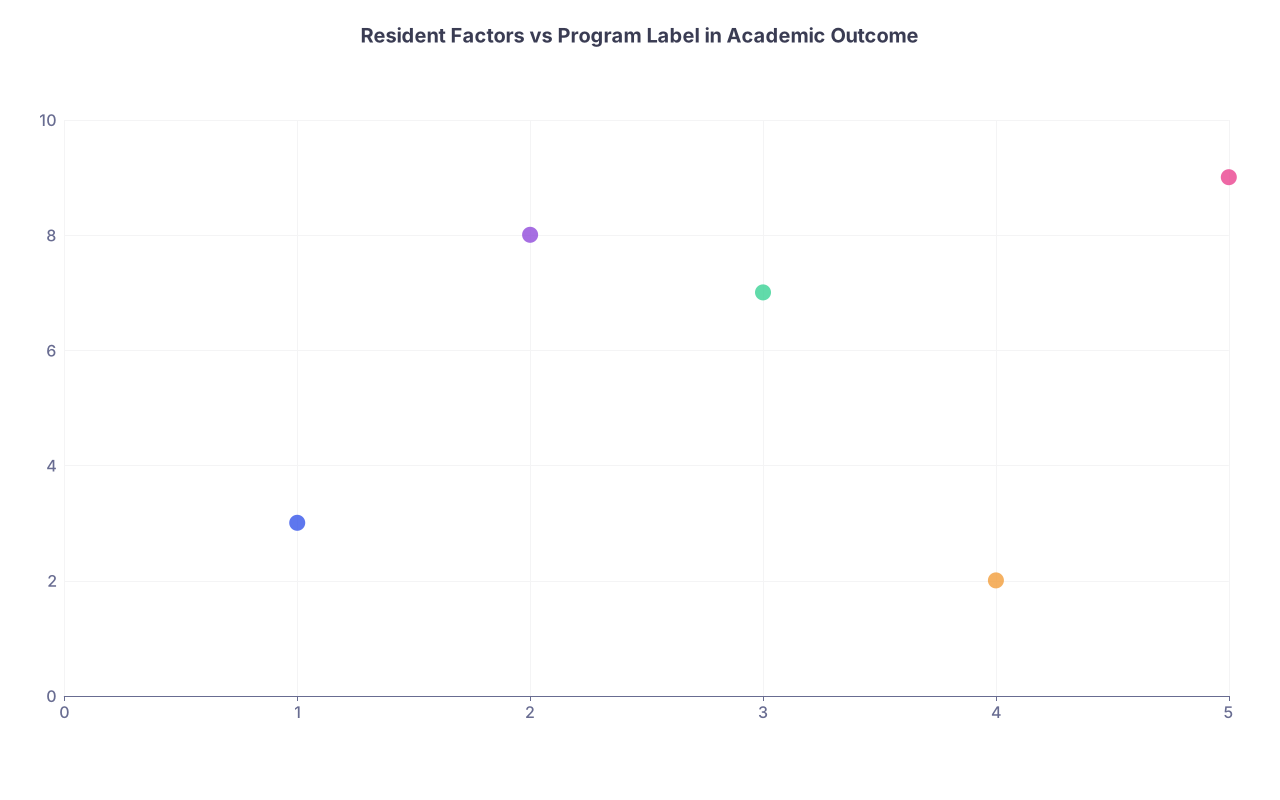
| Category | Value |
|---|---|
| Resident 1 | 1,3 |
| Resident 2 | 2,8 |
| Resident 3 | 3,7 |
| Resident 4 | 4,2 |
| Resident 5 | 5,9 |
Think of the x‑axis as “Program Name Brand” (1 = low, 5 = high) and y‑axis as “Academic Outcome” (1–10). The point is simple: you see good and bad outcomes at every program level. The straight-line “big name = good outcome” fantasy doesn’t match reality.
How To Turn a Community Match into an Academic Springboard
If you’re staring at your “community” Match and you want options — fellowship, academic hospital job, maybe clinician-educator — here’s the non-fluffy version of what to do.
1. Decide early if academics/fellowship is a real goal, not a vague idea
If you might want fellowship, act like you do. Early.
That means by mid-PGY1 you should:
- Identify at least one subspecialty of interest
- Talk to your PD about past graduates who matched that field
- Ask explicitly: “Who here has successfully mentored residents into this field?”
2. Build one focused project, not ten half-baked ones
At a community program, breadth of projects won’t save you. Completion will.
Good bets:
- A QI project that leads to a poster at a regional or national meeting
- A small retrospective chart review with reasonable N and a clear question
- A case series or single strong case report tied to a topic in your target fellowship
Do not spend 2 years being the third author on a project that never finishes.
3. Get at least one letter from a known person in the field
This is where away rotations, electives at academic centers, and networking at conferences matter.
Typical pattern that works:
- Do solid work at your home program → strong clinical letters from PD/chief.
- Arrange an elective at a university fellowship site where you’re interested.
- Treat that elective like a month-long interview. Show up, help, read, ask smart questions.
- Ask for a letter with specific examples, not generic, “They were fine.”
4. Say yes to visible, finite leadership/teaching roles
Not every committee. Not every project. You’ll drown.
But a few high-yield roles pay off:
- Resident representative on an education or QI committee where something actually changes
- Regular small-group teaching for students or interns, documented by your program
- Leading morbidity and mortality or journal club with written materials you can attach to your CV
When Matching Community Actually Is a Red Flag
There’s one scenario where your “community” match might legitimately limit you: the program itself is weak.
Not “not famous.” Weak.
Red flags I’ve heard directly from residents:
- Chronic unfilled positions or high attrition
- No one in years has matched into competitive fellowships, and there’s no plan to change that
- PD shrugs when you bring up academic goals: “Most people just get jobs around here”
- No protected didactics, rampant service-over-education culture
In that situation, your ceiling isn’t “community.” Your ceiling is “dysfunctional program.”
Different problem. Different solution. Sometimes that means transferring (rare but happens), more often it means grinding extra hard on away rotations, networking, and self-study.
So, Did Matching Community Just Ruin Your Academic Future?
No.
Matching at a community program means:
- You’ll likely need more self-direction to build an academic or fellowship‑oriented portfolio.
- You may have to travel — physically or virtually — to connect with subspecialty mentors.
- You’ll be judged more heavily on concrete output and performance than on the brand on your name badge.
What it does not mean:
- That you’re locked out of fellowship.
- That you can never work at a university hospital.
- That you can’t publish, teach, or build an academic CV.
If you remember nothing else, take this:
- Program type shapes the path, not the destination.
- Your performance, output, and mentors matter more than the logo on your coat.
- A strong resident from a community program beats a mediocre resident from a big-name program more often than anyone on Reddit wants to admit.
The myth says community limits you.
Reality: complacency does.


