
The way you will be judged in July has almost nothing to do with how you got ranked in March.
Let me say that again because it shocks a lot of new interns: the criteria that got you your Match are not the criteria your program will use to decide whether you are safe, progressing, or in trouble in the first 6–12 months. That shift is where EPAs and milestones come in.
You matched based on scores, letters, research, and vibes.
You will be measured, promoted, and sometimes remediated based on observable work-based behaviors: can you admit a patient? Can you call a consult? Can you run a cross-cover night without imploding?
That is EPAs and milestones territory.
What EPAs and Milestones Actually Are (Not the Glossy Brochure Version)
Let me break the jargon down precisely.
EPAs: “Can I trust you to do this thing without me?”
Entrustable Professional Activities (EPAs) are discrete, real-world clinical tasks that faculty care about because they live or die by them daily. Each EPA is basically answering one question:
“Can I trust this resident to do this specific activity with the right level of supervision?”
Not “Are they smart?” Not “Are they nice?”
Very concrete. Very unforgiving.
Common early residency EPAs look like:
- Admit and manage a new inpatient from ED to the floor
- Perform and document a complete history and physical for a complex patient
- Hand off care safely to another team
- Call and manage a consult appropriately
- Recognize and manage an acutely decompensating patient
- Obtain informed consent for a basic procedure
- Perform core procedures for your specialty (e.g., central line, intubation, lumbar puncture, abscess I&D)
Each EPA has levels of supervision that usually look something like this:
| Level | What It Means Briefly |
|---|---|
| 1 | Only observe, no independent action |
| 2 | Act with direct, in-room supervision |
| 3 | Act with indirect, readily available |
| 4 | Act independently, routine supervision |
| 5 | Supervise others doing this |
Nobody cares if you got a 260 on Step 2 if, three weeks into July, they cannot trust you to admit a patient without writing a dangerous admission order set.
EPAs are binary in spirit: entrustable vs not yet. The levels are just a polite gradient.
Milestones: “Where are you on the spectrum from beginner to ready-for-unsupervised-practice?”
Milestones are the more granular competency framework used by ACGME-accredited programs. Every specialty has its own milestone set (the PDFs are public; I have seen residents find them at 2 a.m. during anxiety spirals).
They are organized by competency domains, usually:
- Patient Care (PC)
- Medical Knowledge (MK)
- Systems-Based Practice (SBP)
- Practice-Based Learning and Improvement (PBLI)
- Professionalism (PROF)
- Interpersonal and Communication Skills (ICS)
Each domain has several specific milestones. For example, in Internal Medicine:
- PC1 – History and Physical
- PC3 – Clinical Judgment and Decision Making
- ICS1 – Communication with Patients and Families
- PROF1 – Professional Behavior and Ethical Principles
And each of these has a developmental scale, typically Level 1–5:
- Level 1 – New intern
- Level 2 – Early to mid intern
- Level 3 – End intern / early senior
- Level 4 – Graduation target (ready for unsupervised practice)
- Level 5 – Advanced / exceptional (beyond expected graduate)
Programs submit semiannual milestone ratings for each resident to the ACGME. This is not optional. You become a dot on a national graph.
Where EPAs talk about tasks, milestones talk about traits and capabilities that show up across tasks: your reasoning, reliability, communication, efficiency, professionalism.
EPAs: “Can you safely do X without me?”
Milestones: “Overall, how developed are you along domain Y for your level of training?”
They intersect. Often the same behaviors drive both.
What Happens Right After the Match: The Shift From Applicant to Product
Once you match, programs stop reading your ERAS and start planning how to use you safely as workforce starting July 1. They think in three buckets:
- What you must be able to do day one without harming anyone
- What you should progress to by 6 months
- What you must be at by the end of PGY-1 to not become “a problem”
EPAs and milestones are the scaffolding they use.
The First 4–6 Weeks: Silent EPA Stress Test
Nobody calls it this, but I have watched it play out the same way every July.
Your attendings and seniors are watching you for a few high-value EPAs:
- Can you pre-round and know what is going on with your patients without being spoon-fed?
- Can you present a new admit in a coherent, prioritized structure?
- Can you place orders that make sense and do not conflict or harm?
- Can you call a consult that is not embarrassing for the team?
- Can you respond to a nurse page about chest pain or hypotension without freezing?
They are mentally tagging you: EPA 1 (admit and manage new patient): Level 2 or maybe Level 3?
EPA 2 (hand off care): Still Level 1. Hand-offs scattered, missing contingency planning.
Is there a formal form for this in July? Often not. But those impressions will show up, sometimes word-for-word, at your first Clinical Competency Committee (CCC) meeting when they assign milestone levels.
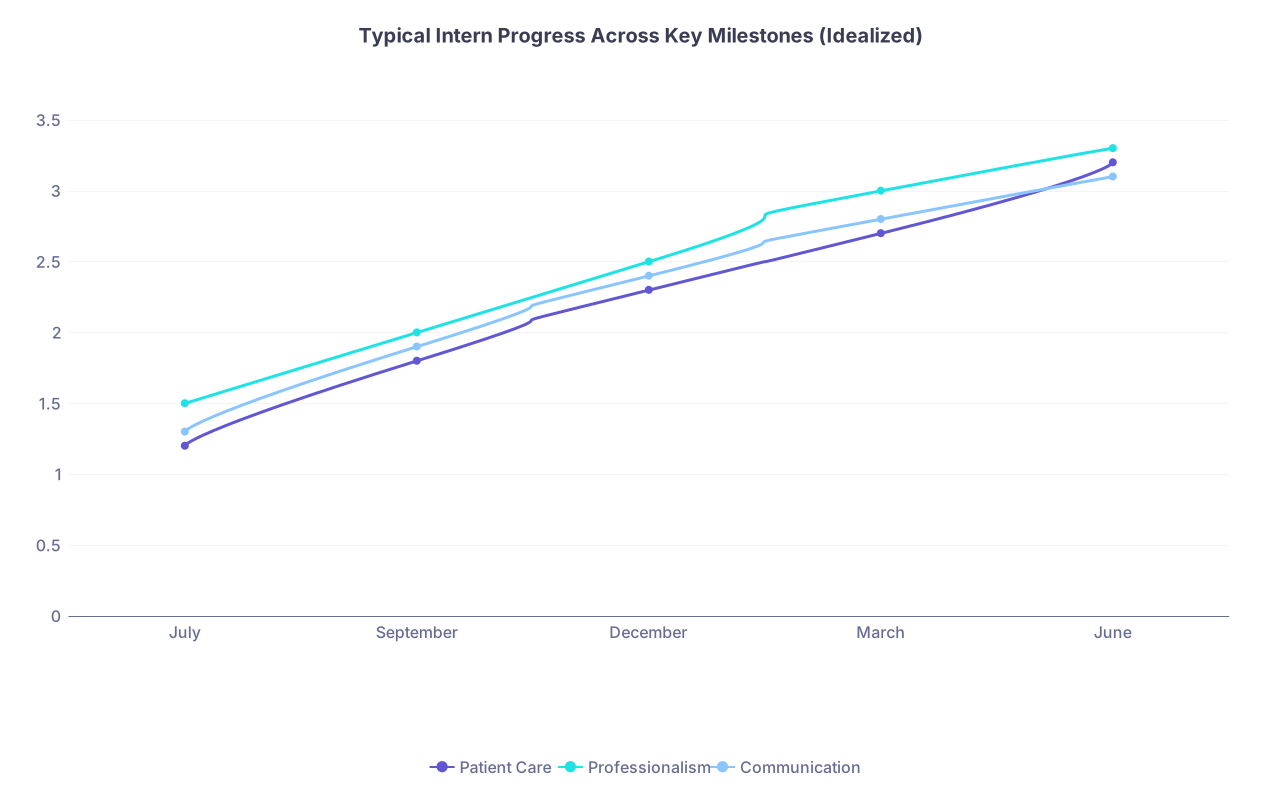
| Category | Patient Care | Professionalism | Communication |
|---|---|---|---|
| July | 1.2 | 1.5 | 1.3 |
| September | 1.8 | 2 | 1.9 |
| December | 2.3 | 2.5 | 2.4 |
| March | 2.7 | 3 | 2.8 |
| June | 3.2 | 3.3 | 3.1 |
That chart is what programs want: smooth, upward trends. It is not reality for everyone, but it is the mental model.
The First CCC Meeting: Where EPAs Turn Into Numbers
Most programs’ Clinical Competency Committees meet twice a year, often November/December and May/June.
What do they use?
- Faculty rotation evaluations (often EPA-ish checkboxes + narrative)
- 360 evaluations from nurses, case managers, sometimes patients
- Procedure logs and EPA-specific assessment forms (e.g., “LP EPA, Level 2”)
- In-service or shelf-like exam performance (feeds MK milestones)
- Incident reports or professionalism flags
- Direct observation tools from boot camp / simulation sessions
They sit around a table (or Zoom), pull up your name and picture, and talk concretely:
“For PC – Clinical Judgment, I see them at about Level 1.5. They still miss hemodynamic implications of simple data.”
“Agree, but their communication is solid. For ICS with patients, I am comfortable at early Level 2.”
Then they submit a number to the ACGME portal. That becomes your official milestone record.
Your EPAs feed this. If repeated evaluations say “Requires direct supervision for new admissions and order sets,” your PC milestones are not going to miraculously be Level 3.
Concrete Examples: How This Looks in Real Life (By Specialty)
Let me show you how this actually plays out on the ground. Vague theory is useless at 3 a.m. on night float.
Internal Medicine
Core early IM EPAs:
- Admit a patient with common internal medicine problems from ED/clinic
- Formulate prioritized assessment and plan for multi-morbid patients
- Respond to cross-cover calls safely
- Communicate with consultants and primary teams
- Write safe, appropriate discharge plans
Coupled milestones:
- PC1 (History and Physical): Level 1 → Can do a basic H&P with help; Level 2 → Begins to focus on relevant positives/negatives; Level 3 → Efficient, hypothesis-driven H&P
- PC3 (Clinical Judgment): Level 1 → Follows cookbook plans; Level 2 → Begins to adapt to patient complexity
- ICS1 (Patient Communication): Graded on clarity, empathy, shared decision-making
Scenario:
You are on wards in July. You admit a 70-year-old with pneumonia, CHF, and CKD. Your initial plan:
- Broad-spectrum vanc/zosyn for uncomplicated CAP
- 2L NS bolus for sepsis based on an old guideline you half-remember
- No thought about their EF of 25% and baseline creatinine 2.5
- Discharge summary at the end: half-complete, no follow-up arranged
Your senior corrects everything. They will document your performance.
That one case, by itself, will not sink you. But three rotations of similar patterns? The CCC will place you at low PC3 levels and may explicitly say you are not yet entrustable for independent night cross-cover.
General Surgery
Early Gen Surg EPAs:
- Initial evaluation and resuscitation of acute abdomen
- Management of post-op patients on the floor and in step-down
- Perform basic procedures: wound debridement, incision and drainage, central line under supervision
- Participate in OR cases safely: knows steps, handles instruments without causing harm
Milestones here are ruthless about intraoperative performance and reliability:
- PC2 – Technical Skills
- SBP2 – Coordination of care
- PROF2 – Accountability and reliability
Example: New intern, first month. Every time you are on call, you delay seeing consults, do not pre-write notes, and show up late to the OR. You are technically fine with suturing but logistically unreliable.
Result? Your PC technical skills may be Level 2, but your Professionalism and Systems-Based Practice milestones sit at Level 1. That is a red flag. Programs care far more about the latter in PGY-1 than your knot-tying elegance.
Pediatrics
EPAs and milestones look similar but with developmental lenses:
- Perform age-appropriate history and physical
- Communicate with parents in clear, non-terrorizing language
- Recognize and respond to a sick child who is crashing
- Vaccination counseling and preventive care planning
I have seen very smart peds interns get hammered on ICS and PROF milestones because they talk to parents like co-residents: too much jargon, not enough reassurance, poor boundary handling. That shows up quickly in milestone ratings.
Emergency Medicine
EM actually has formalized EPAs very tightly. Early tasks:
- Triage and initial management of common ED complaints
- Prioritize multiple patients simultaneously
- Call appropriate consults with succinct, structured cases
- Procedural skills: laceration repair, basic airway, splinting
What gets you low milestones? Poor situational awareness. You can do a beautiful individual resuscitation, but if you lose track of the other 10 people in your pod, your PC and SBP milestones drop. EPAs about “manages the ED pod safely at their level” are not checked off.
How Programs Actually Use EPAs Day-to-Day
EPAs were not invented to make ACGME happy. They were created because saying “good resident” and “weak resident” get you sued when something bad happens without documented specifics.
Programs now link EPAs to many routine processes:
- Orientation and boot camps: “EPA 1 – Admit and present a floor patient” is explicitly taught and then observed.
- Simulation: Codes, rapid response, procedural EPAs are tested in sim. Faculty fill EPA forms during or after.
- Direct observation tools: Mini-CEX, direct observation forms that map to specific EPAs.
- Procedure sign-offs: Many places will not let you place a central line solo until an attending has formally marked that EPA at Level 3+.
A typical IM intern in July:
- Admits a patient.
- Senior or attending shadows for part of it, then uses an EPA form “Admission H&P and initial management.”
- They click checkboxes like “prioritized differential,” “recognized unstable features,” “independent order entry safe/unsafe,” plus a global entrustment level.
- That form feeds both EPA summary and PC milestones.

| Step | Description |
|---|---|
| Step 1 | Intern starts rotation |
| Step 2 | Assigned core EPAs |
| Step 3 | Faculty observe tasks |
| Step 4 | Complete EPA forms |
| Step 5 | Data to Clinical Competency Committee |
| Step 6 | Milestone levels assigned |
| Step 7 | Feedback and development plan |
If you are thinking: “Nobody explained this to me at orientation.” Correct. Most programs are terrible at explaining their own assessment system. That does not mean it is not running in the background.
How This Affects You: Promotion, Autonomy, and Trouble
EPAs and milestones are not academic. They decide three big things:
- How much independence you get (and when)
- Whether you progress normally, need remediation, or get labeled “high-risk”
- What goes into your summative letters and future fellowship applications
Autonomy: When attendings stop hovering
Supervision is legally required for interns. But the intensity of that supervision is discretionary and driven heavily by trust, which is just “informal EPA rating.”
If, by September:
- You consistently present organized, accurate admissions
- You anticipate issues overnight
- Your orders are safe, if not always perfect
Then you start hearing:
“Page me if you are worried, but otherwise go ahead and manage.”
“You can handle the new admit; I will review later.”
That is EPA Level 3–4 for admissions, at least for the common bread-and-butter cases.
If, by December, attendings still insist on being present for every little thing you do, you are not progressing. That will show up in your milestone trajectory. The CCC will notice. They compare you to your peers, they know what typical looks like.
Promotion and Remediation
Programs do not decide promotion based solely on milestones, but milestones give them cover.
Patterns that trigger concern:
- Flat lines: still Level 1.1 for core PC milestones at mid-year
- Regression: an intern who looked like 1.8 in July but now is 1.3 with multiple professionalism notes
- Major safety event tied to EPA failure (e.g., missed septic shock, incorrect insulin orders)
What happens then:
- Targeted remediation plan: designated mentor, extra direct observation, reading assignments, simulation sessions
- Restricted autonomy on certain EPAs: “No independent discharges until reviewed by senior/attending”
- Formal documentation for your file (and yes, that can follow you if things escalate)
On the other hand, strong EPA/milestone performance gives programs justification to:
- Let you run codes earlier
- Give you chief calls on certain services
- Use your name favorably in fellowship letters: “Already functioning at Level 3–4 in several PC domains as a PGY-1.”
What You Should Actually Do About This (Starting Now)
You cannot game EPAs and milestones like you gamed the MCAT. The work is visible. Still, there are some precise strategies that matter.
Before You Start: Know what you will be graded on
Do this, and you will already be ahead of most of your class:
- Download your specialty’s ACGME Milestones 2.0 document. Read the Level 1–3 descriptions. That is your actual rubric.
- Ask your program (politely) during orientation: “Which EPAs are a focus for PGY-1, and how will they be assessed?” Some will hand you a list. Others will mumble. Press a bit; it signals maturity.
You are not asking so you can manipulate. You are asking so you do not waste effort on things nobody is looking at.
On Rotation: Make entrustment the explicit conversation
Phrase that works with attendings or seniors:
“For this admitting task/procedure/consult, what level of supervision do you think I am at right now, and what would you need to see to feel comfortable stepping back?”
You have just asked them to translate their fuzzy impressions into EPA language. They may not say “EPA” out loud, but that is what you are doing.
Then you do it again at the end of the rotation:
“Compared to when I started, do you feel more comfortable with me handling [X] with less oversight? Any specific behaviors you saw that changed that?”
You are forcing concrete feedback instead of the useless “you are doing fine.”
Handle bad feedback like a pro, not like a spooked MS3
You will get dinged. Everyone does. Maybe a nurse complains. Maybe you miss something on cross-cover. Maybe your first set of milestone ratings feels embarrassing.
The critical move: do not argue the label. Fix the behavior.
Bad: “I do not think my professionalism is a Level 1, that seems unfair.”
Better: “The feedback mentioned late notes and slow response to pages. That is fair. Here is how I plan to fix that over the next month. Are there other patterns you are seeing?”
CCC members talk. Residents who own the issue and show visible change almost always recover. Residents who litigate every rating sink.
How EPAs and Milestones Tie Back to Your Future Fellowship / Job
You probably care about this more than you admit. Yes, this system impacts your Match 2.0 (fellowship) and job offers.
Program directors writing letters for fellowship will mine your milestone trends:
- “Consistently above expected level for training in clinical judgment and communication.”
- “Reached graduation-level milestones early in several domains.”
They also know if you needed remediation or had major EPA struggles. They may not write “this resident could not be trusted to cross-cover until January,” but subtle phrases appear:
- “Required additional support early in training but ultimately met expectations.”
- “Growth trajectory steep in the second half of residency.”
Fellowship PDs can read these subtexts. There is a shared language now.
So yes, how you are measured right after the Match turns into narrative currency later.
Quick Reality Checks and My Unfiltered Opinions
A few blunt truths from watching this up close:
- Milestones are imprecise, but the trend matters more than the exact numbers. Do not obsess over 2.2 vs 2.5. Obsess over whether your trajectory is clearly upward.
- Programs vary wildly in how honest they are with residents about low milestones. You may get “you are doing great” to your face and see Level 1.3 behind the scenes. Ask specific questions. Force clarity.
- EPAs are the most honest part of the system. If your senior will not let you run a simple overnight call list alone, that is your EPA assessment in real time. Take that more seriously than any form.
- You cannot compensate for poor professionalism with brilliance. Ever. A resident who is solidly average clinically but absurdly reliable, kind, and safe will be promoted and loved. A mercurial genius with recurrent professionalism hits will sit on probation.
FAQs
1. Do my Step scores or med school ranking affect my milestone levels?
No. Once you start residency, high test scores may affect how people expect you to perform, but milestone ratings are supposed to reflect observed behaviors only. In practice, if anything, high-scorers get held to a higher informal standard: “We expected more from them.”
2. Can low milestone ratings or EPA concerns get me fired?
Not by themselves, at least not immediately. Low ratings typically trigger remediation: extra supervision, coaching, repeat rotations. Termination usually comes from a combination of persistent low performance despite support, major safety events, or serious professionalism violations. But chronically poor EPA/milestone trajectories are the paper trail used when programs defend those decisions.
3. Will I see my exact milestone levels?
You should. Many programs show you your milestone grid during semiannual meetings with your program director or advisor. If nobody has shown you yours by mid-year, ask directly: “Could we review my milestone ratings and any trends the CCC has noticed?” You are entitled to understand how you are being evaluated.
4. How fast should I expect my milestone levels to increase as an intern?
Roughly: starting around Level 1 in July, moving toward late Level 1–early Level 2 by mid-year, and approaching high Level 2–early Level 3 by the end of PGY-1 in core domains like Patient Care and Professionalism. Some domains lag (Systems-Based Practice often trails). What matters is visible progress and that you are roughly in step with your peers, not hitting a precise number on a fixed schedule.
Key takeaways: EPAs and milestones are the real currency of residency performance right after the Match. They convert everyday clinical work into formal judgments of trust and progression. If you understand the specific EPAs your program cares about, watch your autonomy as real-time feedback, and force clear conversations about expectations, you will not just survive PGY-1. You will control the story being written about you from day one.