
The time‑stamp on your Match email is not a secret ranking of your worth. Treating it like one is how smart people drive themselves crazy over noise.
Let’s dissect this properly, because every March I watch the same superstition spread across GroupMe chats and Reddit threads: “My result email came late — does that mean they didn’t want me?” Or the flip side: “Mine came right away, I must’ve been ranked high.” Both are wrong in almost every way that matters.
Match communications are engineered processes, not love letters. And once you understand how the system actually works — algorithm, servers, batching, program behavior — the whole “they sent it late so they didn’t really want me” narrative falls apart fast.
How the Match Algorithm Actually Works (And Why Timing Is Irrelevant)
Start here: the algorithm finishes before any email goes out. Not during. Not dynamically as messages are sent.
NRMP (and similar systems worldwide) run a stable matching algorithm. It chews through everyone’s rank lists — programs and applicants — and spits out a final assignment table. That table is the match. Fixed, done, locked.
Your fate is decided at that point.
Emails and portal updates are just how you’re informed of a decision that’s already final. Think about board scores: the software scores your exam first; then days or weeks later, they flip a switch and release the results. You’d never say “my email was later than my friend’s, so they must’ve graded my exam last and liked me less.” You instinctively know that’s nonsense.
Same thing here.
The key point:
- The algorithm doesn’t run slowly one applicant at a time in timestamp order.
- It doesn’t “match the strong candidates first, then fill with leftovers.”
- It doesn’t know or care when an email will later be sent.
So connecting “late email” with “they must not have wanted me” is like connecting “cloudy day” with “maybe my MCAT score is lower.” There’s no causal path.
Where Timing Actually Comes From: Servers, Batching, and Chaos
If it’s not ranking you in real time, what’s controlling timing?
Boring things. All the deeply unromantic guts of a mass-notification system.

| Step | Description |
|---|---|
| Step 1 | Algorithm Complete |
| Step 2 | Results Stored |
| Step 3 | Batch Creation |
| Step 4 | Notification Queue |
| Step 5 | Email Servers |
| Step 6 | Portal Updates |
| Step 7 | User Inbox |
| Step 8 | User Login |
Here’s what actually affects when you see your result:
Batching / Queues
When thousands (or tens of thousands) of messages go out around the same time, they’re almost always batched or queued. Some batches fire slightly earlier, some slightly later. It’s more like boarding groups on a plane than a secret ranking. Group A doesn’t “deserve” more than Group C; they were just assigned a boarding time.Email provider behavior
Gmail, Outlook, institutional email — they throttle, filter, and delay mail constantly. Some domains delay large bulk sends more than others. I’ve watched people in the same class, same school, same result type get messages separated by 10–20 minutes. One was literally in the next seat over.Time zones and release strategy
Different match systems time their public release in local time or in a central time zone. Your perception of “late” is often completely meaningless if you’re comparing coastal schools, different services, or different countries.Institutional filtering
Hospital and university email servers love to put mass messages into quarantine or “bulk.” Your friend on Gmail gets it at 10:01. Your .edu address gets it at 10:14 once the filter decides it’s legit.Portal vs email differences
Sometimes the portal flips live first, and emails lag. Sometimes the reverse. Sometimes people refresh obsessively and see the portal the second it updates; other people casually check 15 minutes later and assume they were “late.”
None of that has anything to do with where you sat on a program’s rank list.
To make it painfully obvious, imagine this table:
| Factor | Affects Email Time? | Related to Rank Position? |
|---|---|---|
| Batch order in notification | Yes | No |
| Email provider (Gmail, etc.) | Yes | No |
| Your time zone | Yes | No |
| Algorithm match order | No | No |
| Your rank on a program list | No | Yes (but only content) |
Email timing and your rank are basically on different planets.
But What About Early vs Late Rejection/Waitlist Emails?
Different thing. And here’s where there’s a tiny bit of reality mixed with a whole lot of overinterpretation.
When people say “Match email,” they sometimes lump together:
- NRMP/central match results
- Individual program emails:
- Rejections
- “You’re ranked to match” style messages
- “We really liked you” fluff
- Post-Match scramble / SOAP communication
Those are completely different beasts.
Program emails do sometimes follow patterns — but not the magical patterns people want to see.
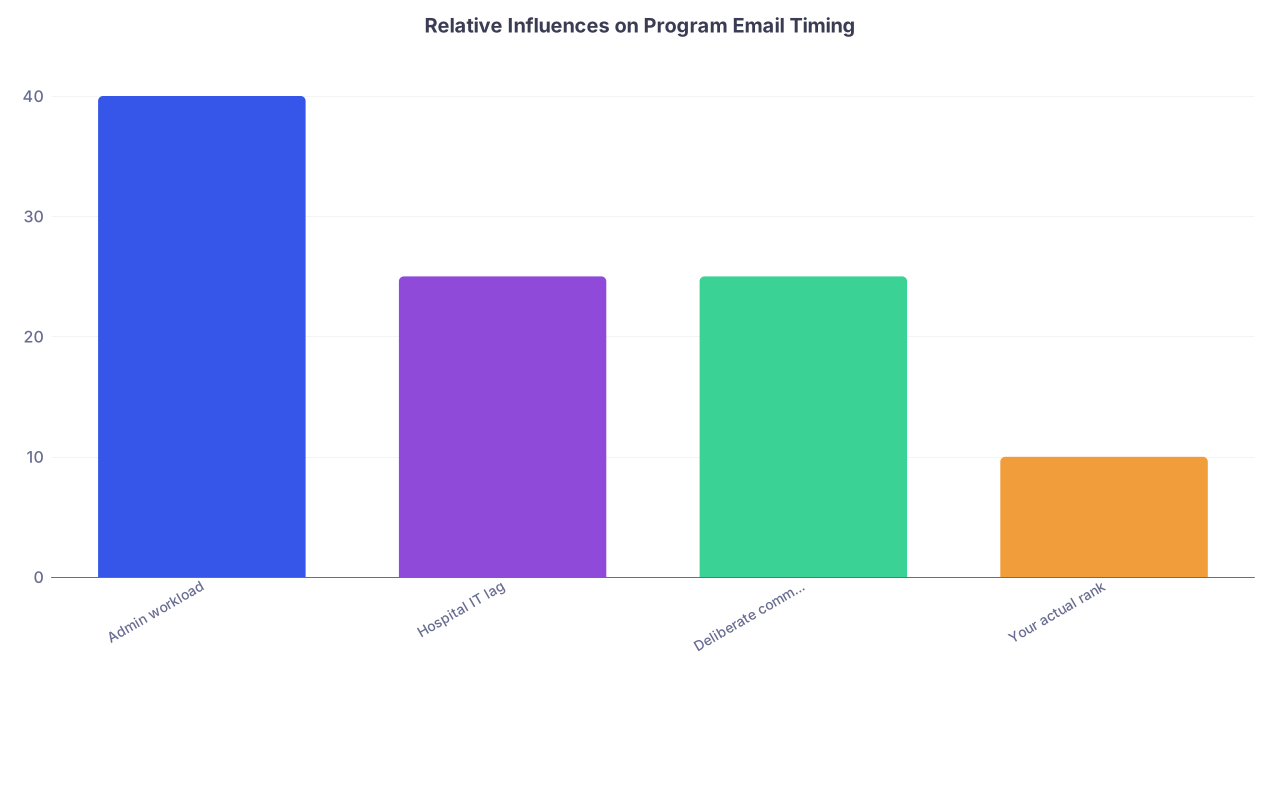
| Category | Value |
|---|---|
| Admin workload | 40 |
| Hospital IT lag | 25 |
| Deliberate comms strategy | 25 |
| Your actual rank | 10 |
Roughly how it plays out in the real world:
Rejections for interview invites:
Some programs mass-reject early to be “kind.” Others send nothing until the very end and then dump rejections. A late rejection often means nothing more profound than “we finally got around to clearing our queue.”“We ranked you highly” pre-Match emails:
Some programs send these to almost everyone they liked even a little. Some send none. Some send a handful to genuine top choices. Timing here is driven far more by when the PD had time to sit with the coordinator than some precise rank gradient.Post-Match communication (congrats, welcome emails):
Masses of people are getting the same email template. If you get yours 17 minutes after your classmate, that’s not a hidden insult. That’s a server clearing a queue.
The idea that “they emailed me late so clearly they were ambivalent” is mostly projection. You’re trying to assign human emotion to workflow timing.
Does timing ever reflect intent? Occasionally. A same-day, personalized message from a PD you met, clearly written by them, probably signals genuine enthusiasm. But that’s the content and specificity, not the timestamp formatting.
The Psychology: Why Smart People Invent Timing Theories
I’ve watched very rational students become full-on conspiracy theorists during Match Week.
Why? Because this entire system assaults your sense of control. You spend years collecting data — scores, grades, LORs — then hand it to an opaque algorithm and dozens of committees. Suddenly you’re back to reading tea leaves.
Email timing myths are a coping mechanism. If I can decode the pattern, the thinking goes, I can make sense of whether I “deserved” this outcome. Or whether someone secretly “didn’t really want me.”
Two hard truths:
The match process is not emotionally calibrated to your narrative. You can be someone’s #1 choice and still get a generic, late, poorly formatted email. You can be #18 and get a sweet, early, glowing one.
Programs are run by humans drowning in admin. Rank meetings run over. IT goes down. Coordinators get sick. People type the wrong date. “Late” often means someone was in clinic until 6 pm.
If anything, obsessing over email timing is a way to distract yourself from the real questions:
- Did I build a balanced list?
- Did I apply strategically for my profile?
- Did I understand the competitiveness of my specialty?
Those matter. Timestamp superstition doesn’t.
The One Place Timing Sort of Matters: SOAP and Scramble
During SOAP or equivalent scramble processes, timing can carry more practical weight — not emotional weight, practical.
Programs with unfilled spots are often doing this in real time:
- Logging into their portal
- Reviewing new applications as they pour in
- Sending out interview requests fast
- Making calls
There, being earlier in responding or applying can actually change your outcome. But again, that’s your timing, not their original Match email timing.
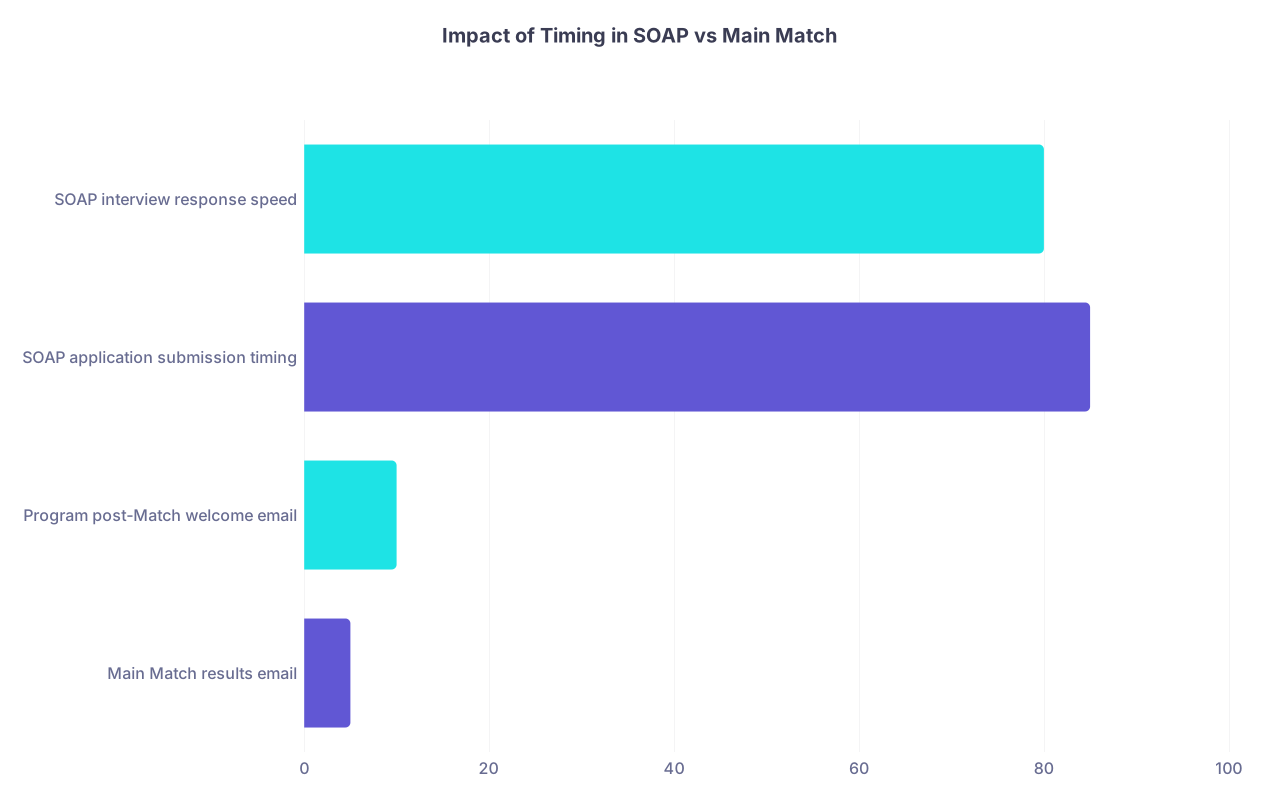
| Category | Value |
|---|---|
| Main Match results email | 5 |
| Program post-Match welcome email | 10 |
| SOAP application submission timing | 85 |
| SOAP interview response speed | 80 |
Main Match result timing: background noise.
SOAP timing: sometimes life or death for an unfilled spot.
Don’t confuse those two universes.
Concrete Scenarios: What Late Emails Actually Meant in Real Life
A few real-world patterns I’ve seen or had relayed directly from students:
Same program, different times:
Two students matched the same categorical spot type at the same academic center. One got the central NRMP email at 12:01. The other saw it in her inbox at 12:09. Their ranks? #3 and #4 on the list. The timing was 100% on their email providers.“I must have been low on their list”:
Student matched at a mid-tier IM program and was offended their “Welcome to the family!!” email hit his inbox the following morning, not that afternoon. Later he learned the PD had been on an overnight call, came in late, and wrote every email personally between cases. His position? Top 5. The “delay” was literally ICU work.Batch vs personal:
A student matched at a competitive surgical specialty. At 10:00 she got a generic “Congrats from GME” email. At 2 pm she got a highly personal note from the PD referencing their interview conversations. She assumed the 2 pm meant “maybe I was an afterthought.” PD later told her the truth: they wrote to their top tier the weekend before Match — and scheduled send everything for that afternoon.
This is why timing-based narratives are such a trap. You’re filling in gaps with stories that feel emotionally consistent, not factually accurate.
How to Interpret Your Match Email (Without Losing Your Mind)
You want a rule of thumb? Here:
- The content of your result (Matched vs Did Not Match, specialty, program) reflects the algorithm’s decision, which is driven by both your rank list and the program lists.
- The content of any direct program email (especially once you’re matched) reflects their culture, level of organization, and sometimes their genuine warmth or indifference.
- The timing of when the message hits your inbox mostly reflects technical and logistical noise.
If you must read something into timing, keep it narrow:
Rapid follow-up, personalized communication after Match Day can sometimes suggest a program that’s organized and enthusiastic. That might predict a better resident experience. But that’s very different from “my email was late so they didn’t want me.”
And if your email was delayed on a day when the entire internet is stressed and thousands of identical messages are flying around? Assume it’s technology, not a hidden insult.
To keep it tight:
- The Match decision is made before any emails are sent; notification timing has no relationship to how much a program “wanted” you.
- Late or early emails are dominated by batching, servers, time zones, and human logistics, not your rank position.
- Focus on what you can actually learn — the content of the result and the program’s culture — and stop treating timestamps like they’re x-rays into a PD’s soul.


