
The biggest mistake new interns make after the Match is obsessing over the wrong paperwork.
You’re probably worried about some random form your friend’s cousin mentioned on Reddit, while the truly critical documents sit in your inbox, ignored. Let’s fix that.
Below is exactly what paperwork actually matters in the first 2–4 weeks after the Match, what can wait, and what will screw you if you miss it.
The Short List: Paperwork That Actually Matters First
Let me be very clear. Right after you match, there are only a handful of paperwork buckets that are truly time-sensitive and high-stakes:
- Contract / Offer and acceptance paperwork
- Credentialing & onboarding forms (hospital + GME)
- Licensing-related paperwork (state license or training license)
- Background check, drug screen, I-9 / employment eligibility
- Immunizations and health clearance
- Visa/immigration documents (if you’re an IMG or non-citizen)
Everything else is noise at the beginning.
| Category | Priority | Typical Deadline |
|---|---|---|
| Contract/Offer | Highest | 1–3 weeks after issue |
| Credentialing | Highest | Rolling, often ASAP |
| Licensing | High | 2–4 months before July |
| Background/Drug | High | Within 3–14 days |
| Health Clearance | High | 1–2 months pre-start |
| Visa Docs (if any) | Highest | As early as possible |
If you do nothing else: identify which of these your program has already sent you, and finish them first.
1. The Contract: What Actually Matters and What Doesn’t
Some programs call it a “resident agreement,” some an “offer letter,” some both. This is essentially your employment contract.
What actually matters in this document:
- Salary and benefits
- Start date
- PGY level/title
- Hours/expectations language
- Moonlighting policy (if mentioned)
- Required conditions (passing Step/Level 2, background check, license, etc.)
What students waste time on:
- Negotiating salary (99% of the time, not negotiable)
- Trying to change vacation policy in year one
- Worrying whether the malpractice clause is “too harsh” (it’s almost always standard institutional language)
You should:
- Read it once slowly.
- Flag any true red flags (weird non-compete, forced arbitration with absurd terms, something that contradicts what they told you on interview day).
- Ask ONE concise email with genuine questions if needed.
- Sign by the deadline.
If you’re matched at a big academic center (think UCSF, Mayo, MD Anderson), their contract is boilerplate and vetted by armies of attorneys. You’re not going to rewrite it.
If you’re at a small private hospital or unfamiliar institution, look more closely. But still: sign on time or communicate if you need a short extension. Silence is what gets you in trouble.
2. Credentialing & Onboarding: The Time Sink You Can’t Ignore
This is the part everyone underestimates.
Hospital credentialing and GME onboarding ask you for:
- Every job you’ve had since age 18
- Every state you’ve lived in
- Every school, exact dates, addresses
- Explanations for any “gaps”
- Copies of scores, diplomas, certificates
- References in some cases
- Releases for background checks
This is the stuff that delays your ability to start if you drag your feet.

| Step | Description |
|---|---|
| Step 1 | Match Day |
| Step 2 | Receive Program Welcome Email |
| Step 3 | Review and Sign |
| Step 4 | Complete Credentialing Packet |
| Step 5 | Submit Licensing Application |
| Step 6 | Background Check and Drug Screen |
| Step 7 | Employee Health Clearance |
| Step 8 | Ready for Orientation |
| Step 9 | Contact Program Coordinator |
| Step 10 | Offer/Contract Received |
What matters most:
- Filling it out completely and accurately
- Using consistent dates and info across all documents
- Uploading what they ask for in the correct format
- Hitting their internal deadlines (often earlier than you think)
I’ve seen residents’ start dates delayed because:
- They “forgot” to upload their final med school diploma
- They never responded to a follow-up email about an unexplained “gap”
- They didn’t list an old job because they thought it “wasn’t relevant”
Assume everything is relevant. If you worked at Starbucks in 2014, include it.
3. Licensing: The Slow Beast You Need to Start Early
Your program will tell you whether you need:
- A full state license
- A training license
- Nothing yet (rare, but happens in some states for PGY-1)
Do not guess. Wait for their instructions, but once you get them, move quickly.
Licensing paperwork usually includes:
- Application (online or PDF)
- Verified school transcript or diploma
- USMLE/COMLEX score reports sent directly to the board
- Fingerprints, background check forms
- Notarized identity documents
- Letters of good standing (for transfers or prior training)
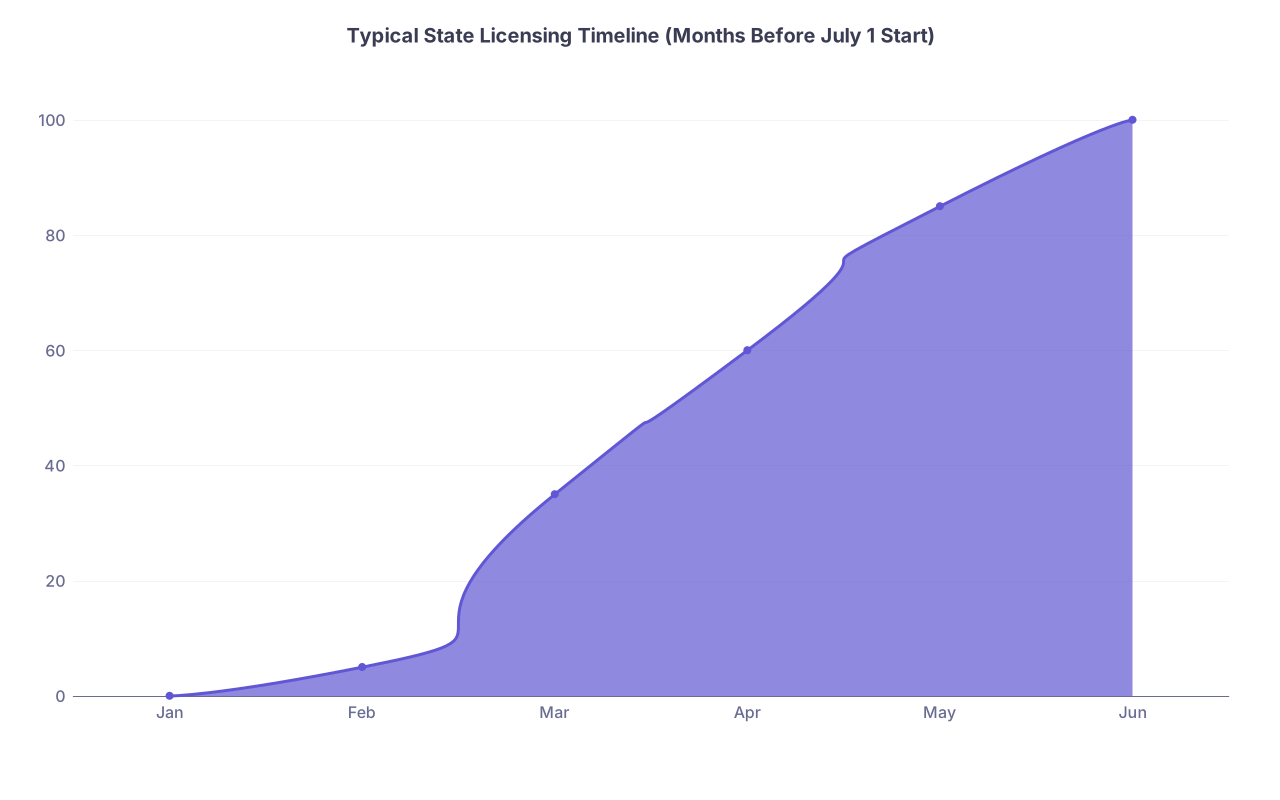
| Category | Value |
|---|---|
| Jan | 0 |
| Feb | 5 |
| Mar | 35 |
| Apr | 60 |
| May | 85 |
| Jun | 100 |
Rough reality:
- Some state boards are fast (4–6 weeks).
- Some are painfully slow (3–4 months).
- If you apply late in a slow state, you start on time only because GME pulls strings for a temporary solution—and you do NOT want to be that intern.
Your job:
- As soon as the program sends license instructions, block off a day.
- Make a checklist of every required upload/document.
- Request anything that takes time (official transcripts, score verifications) that same week.
Do not wait for “after graduation.” That’s how you end up on the phone in late June asking a bored state board clerk why your application is still “pending.”
4. Background Check, Drug Screen, and I-9: Fast but Unforgiving
These are often bundled into your onboarding packet, but they’re usually on tighter deadlines.
Common elements:
- Online background check authorization
- Appointment for fingerprinting
- Drug test at a third-party lab
- I-9 employment eligibility verification (passport OR combo of driver’s license + Social Security card, etc.)
These are the landmines:
- You ignore the email and the link expires.
- You’re out of town when the drug screen window closes.
- Your ID documents are expired or not accessible.
You cannot start work if:
- HR doesn’t have a cleared background check
- You never completed the I-9
- Your drug screen is missing or outside the allowed window
Your move:
- As soon as you get HR’s email, do these first. Not after your celebratory trip. First.
- If you have travel or immigration complications, tell HR early, not after the deadline passes.
5. Health Clearance and Immunizations: Boring but Essential
Employee/occupational health clearance usually includes:
- TB test or screening form
- Proof of MMR, varicella, hepatitis B immunity (titers or vaccine records)
- COVID/flu vaccination per hospital policy
- Possibly a physical exam form
Common issues:
- People can’t find childhood vaccine records.
- Hep B titers come back non-immune and you need a booster series.
- TB test timing doesn’t work with your travel plans.
This isn’t dramatic. But without clearance, some hospitals literally will not let you badge in or touch patients.
What you should do now:
- Start hunting down immunization records immediately. Ask your med school, pediatrician, student health, your parents’ files.
- If you suspect gaps (no idea about hep B, for example), be ready for titers and possible boosters.
- Once your program sends forms, schedule occupational health as soon as allowed.
6. Visa and Immigration: If This Applies to You, It’s Priority #1
If you need a visa (J-1, H-1B, etc.), your paperwork priorities shift. Visa-related tasks jump to the very top.
Your program’s GME or international office will ask for:
- Passport copy
- Medical school diploma and translations
- ECFMG certificate
- Contracts/offer letters
- DS-2019 or H-1B petition information
- Financial and personal data
Delays here can absolutely prevent you from starting on time. I’ve seen residents spending June in immigration limbo while their classmates are at orientation.
If this is you:
- Respond to every email from GME/ECFMG within 24–48 hours.
- Keep all documents scanned, organized, and backed up.
- Track every deadline like your career depends on it—because it does.
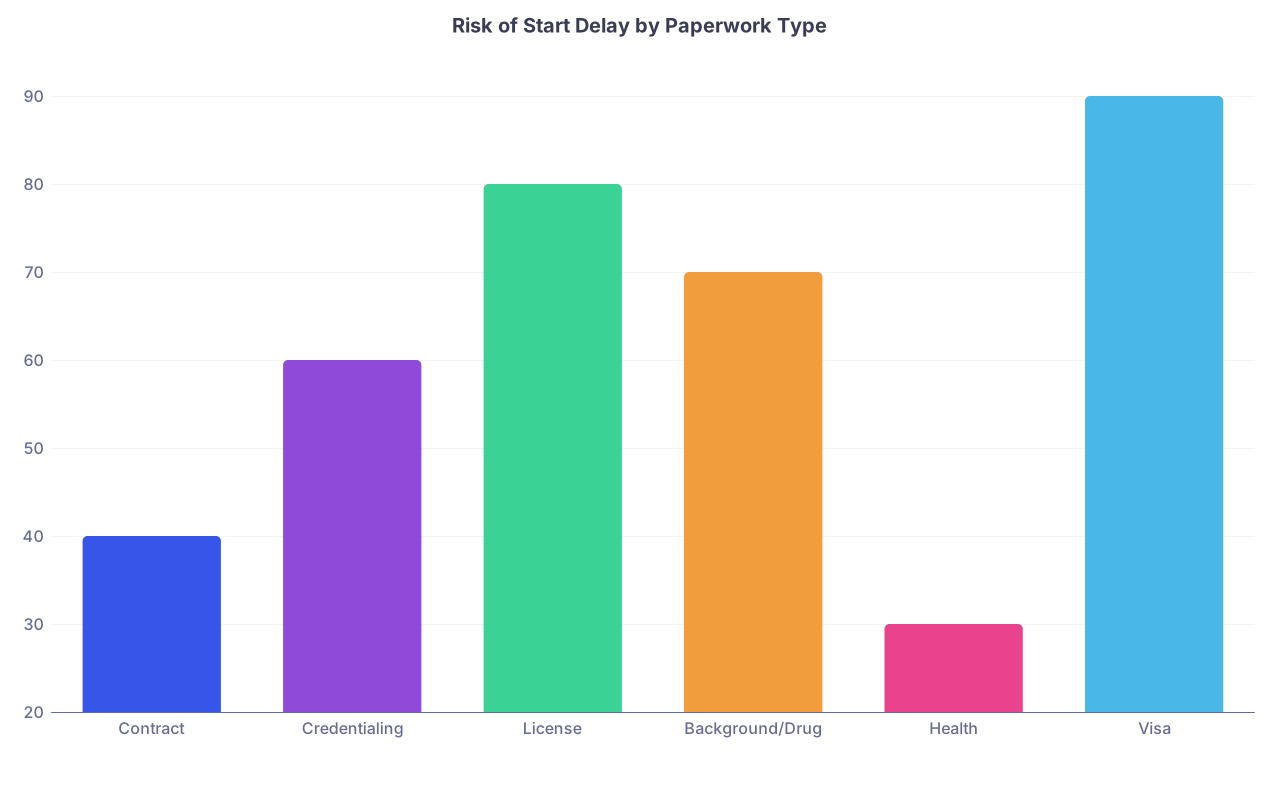
| Category | Value |
|---|---|
| Contract | 40 |
| Credentialing | 60 |
| License | 80 |
| Background/Drug | 70 |
| Health | 30 |
| Visa | 90 |
What Can Actually Wait (and What People Overthink)
Right after the Match, people get spun up about things that are either:
- Not time-sensitive, or
- Mostly preference-based rather than required
These include:
- Housing forms or leases (important, but not as time-critical as credentialing if deadlines are looser)
- Parking applications
- Scrubs and white coat sizing forms
- Direct deposit forms (helpful, but payroll can often fix this later)
- Optional benefits enrollment details
- Wellness surveys, “getting to know you” questionnaires, social invites
Do them, sure. But after you’ve:
- Signed your contract
- Completed credentialing and background check
- Started your licensing application
- Scheduled or completed health clearance
Order matters. Your energy is limited right now. Put it where it counts.
How to Organize All This Without Going Nuts
You do not need a project manager. You need a simple system.
Here’s a setup that works:
- Create a dedicated email folder labeled “Residency – Action Needed” and another “Residency – Completed.”
- Any email that requires forms or tasks:
- Flag/star it
- Add a due date to your calendar 3–5 days before the real deadline
- Make a simple checklist with these headings:
- Contract/Offer
- Credentialing
- License/Training Permit
- Background/Drug/I-9
- Health Clearance
- Visa (if applicable)
- Under each, list specific items from your program’s packet with dates.
You want to be the person the coordinator calls “on top of things,” not the one whose name is always followed by a long sigh.
Quick Priority Framework: What To Do This Week
If you just matched and you’re overwhelmed, here’s your triage:
- Check your personal and school email for anything from:
- Your matched program
- GME office
- “HR,” “onboarding,” “employee health,” or the hospital name
- Do, in this order (when available):
- Sign contract/offer
- Complete background check + drug screen + I-9
- Start credentialing forms
- Start license/training permit application
- Schedule occupational health visit
- If IMG/non-citizen: respond to any visa/ECFMG request within 24 hours
If you cannot find any emails or instructions by 1–2 weeks after Match, contact your program coordinator. Do not sit quietly and hope it shows up.
FAQ: Post-Match Paperwork, Answered
1. Do I have to sign my residency contract right away, or can I wait to “review” it for weeks?
You should review it, but you should not sit on it. Most programs give a specific return deadline. Take a day or two to read, ask questions once if needed, then sign. Stretching this into weeks makes you look unreliable and can trigger panicked emails from GME.
2. What happens if my state license or training license is not ready by July 1?
Programs usually have contingency plans, but they’re messy. You might be restricted in what you can do, need extra supervision, or be delayed in formally starting. In extreme cases, a very delayed license threatens your ability to complete required rotations on time. This is why starting the application early matters.
3. How serious is it if I miss the drug screen window or background check deadline?
Serious. HR and hospital policy are rigid here. Missed windows can mean having to repeat the entire process, delays in clearing you for work, and frantic last-minute scrambling. If you know you’ll be traveling, email them early and ask for alternate timing.
4. My vaccine records are incomplete. Will that stop me from starting residency?
Not usually, as long as you work with employee health and do what they recommend. That may mean getting titers, booster doses, or repeat series (like hep B). The only real problem is ignoring their messages or refusing required vaccinations without following exemption processes.
5. I matched as an IMG and my visa isn’t arranged yet. What should I prioritize?
Visa paperwork is your top priority. Answer every email from GME/ECFMG immediately, send documents promptly, and keep all scans organized. Delays in visa processing are one of the most common reasons IMGs start late. Licensing still matters, but without a visa, none of it happens on schedule.
6. Can I negotiate my resident salary or benefits after the Match when I get my contract?
In almost all ACGME programs, no. Salary and core benefits are set at the institutional level and not negotiable per resident. You can ask clarifying questions or occasionally push for small, specific adjustments (e.g., start date nuance), but treating this like a private job negotiation usually frustrates everyone and changes nothing.
7. I have not heard anything from my matched program a week after Match Day. Is that normal?
It happens, but do not stay passive. Check spam folders and any other email addresses you used in ERAS. If still nothing by about 7–10 days, send a short, polite email to the program coordinator: confirm you matched, share your best contact info, and ask if there’s an onboarding packet or timeline you should be aware of.
Open your inbox right now and create a simple checklist of every post-Match form or request you’ve received—then mark just three items as “do this week” based on the hierarchy above. That’s how you stay ahead of the paperwork that actually matters.