It’s the week after Match Day. Your phone has finally stopped buzzing, your parents have told every relative on Earth, and you’ve celebrated hard. Now you’re staring at your shelf of review books and Anki decks asking:
“Do I actually have to keep studying? Or can I just…stop?”
Here’s the blunt answer: no, you do not need to grind like you did for Step 1 or dedicated. But yes, you absolutely should keep studying—strategically. Not to impress anyone. To avoid getting crushed in July.
Let’s break down exactly how much, what to focus on, and how it changes based on your situation.
The Short Answer: How Much Studying After Match Day?
If you matched and you’ve passed your licensing exams (or only have Step 3/COMLEX 3 left for later), here’s a very reasonable, sanity-preserving target:
- About 3–6 hours per week
- Starting 2–3 months before residency
- Focused on: your specialty basics + core inpatient knowledge + basic skills (orders, notes, emergencies)
That’s it. Not 4 hours a day. Not rebuilding your Anki streak from zero.
If you’re going into something cognitively heavy (IM, EM, anesthesia, surgery, peds, OB, etc.), I like a simple rule:
3 focused hours per week is “minimum to not feel lost.”
5–6 hours per week is “I feel decently prepared on day one.”
If you’re starting in a specialty where you’re more shielded early (path, radiology, derm, psych at some programs), your “studying” may be more about basic medicine refreshers and early specialty reading, not hardcore question banks.
You earned a break. You do not want to show up blank.
Who Actually Needs to Keep Studying (And Who Can Chill More)?
Let me be specific, because this is where a lot of vague advice goes wrong.
You should keep studying more seriously if:
You have a licensing exam coming up:
- Step 2/COMLEX Level 2: rare post-Match but happens.
- Step 3/COMLEX Level 3: some programs want it done early PGY-1 or before PGY-2. If you’re in this bucket, your exam takes priority. Treat it like a light board prep season, not a full-on war, but still structured.
You matched into a demanding, front-loaded program:
- Think: surgical prelims, categorical surgery, traditional IM, EM, OB/GYN, anesthesia, ICU-heavy tracks.
- These programs expect you to hit the ground running with:
- How to write basic orders
- How to call consults
- Initial management of common inpatients
You feel rusty:
- Long research year?
- Non-clinical gap?
- You cruised through M4 with “easy” electives and very little actual medicine? Then yes—you should be doing consistent review. You’ll feel that rust very acutely when someone asks about DKA or chest pain and your mind goes blank.
You can lean toward minimal studying if:
You’re starting in a more “ramped” specialty:
- Pathology, radiology, derm, many psych programs, some neurology programs with heavy PGY-1 IM support.
- You still need basic medicine, but you won’t be admitting crashing sepsis patients on day one (usually).
You just finished hard clinical rotations:
- If you’re coming right off ICU, wards, or EM, your clinical brain is probably still warm.
- You still benefit from structured reading, but it doesn’t need to be intense.
The honest rule: the further you are from real clinical work, the more prep you should do.
What Exactly Should You Study After Match Day?
You’re not “studying medicine” in general. That’s too vague. You’re prepping for your actual job as an intern.
Think about what PGY-1s actually get judged on:
Are your notes coherent? Do you put in safe orders? Do you call for help appropriately? Do you know day-to-day bread-and-butter stuff?
1. Core inpatient medicine
Even if you’re going into surgery, psych, or OB, you’ll still deal with basic medicine or cross-cover.
Focus on:
- Chest pain basics (ACS workup, initial management)
- Shortness of breath: CHF, COPD exacerbation, PE, pneumonia
- Fever and sepsis (cultures, fluids, antibiotics)
- Electrolytes: Na, K, Ca, Mg – what to do with low/high
- AKI – pre-renal vs intrinsic vs post-renal
- Common endocrine: DKA, HHS, hypothyroid, adrenal crisis
Best way to cover this: a short, structured resource—not a full textbook.
| Resource | Best For |
|---|---|
| Pocket Medicine | Quick reference on the wards |
| Step-Up to Medicine | Focused reading by topic |
| MKSAP or UWorld IM | Question-based reinforcement |
| OnlineMedEd Videos | Fast, high-yield refreshers |
You don’t need to “finish” any of these. Skim and target high-yield inpatient topics.
2. Your specific specialty basics
Spend at least 30–50% of your study time on your own field.
Concrete examples:
- Internal Medicine:
- Hypertension, diabetes, COPD, CHF, cirrhosis, AFib, anticoagulation, pneumonia, cellulitis, UTI, GI bleed.
- Surgery:
- Pre-op evaluation basics, post-op fever, fluid management, wound care, pain control, common post-op complications.
- Pediatrics:
- Normal vital signs by age, vaccine schedule, bronchiolitis, asthma, dehydration, otitis, simple rashes.
- EM:
- Initial approach to chest pain, stroke, trauma primary survey, sepsis, abdominal pain, shortness of breath, anaphylaxis.
Specialty-specific intern books are gold. For example:
- “The Mont Reid Surgical Handbook” for surgery
- “The Washington Manual of Medical Therapeutics” for IM
- “Tintinalli’s” or a smaller ED handbook for EM
- A short peds handbook like “Zitelli and Davis” style pocket guides
3. Practical skills: orders, notes, and calls
This is where interns sink or swim in the first month.
You should know:
How to write:
- Admission orders: “ADCA VAN DIMLS” type mnemonics (Activity, Diet, Code status, Allergies, etc.)
- Simple daily progress notes (subjective, vitals, labs, assessment & plan)
- Basic discharge summaries
How to think when:
- A nurse calls: “BP 80/40”, “Patient is more short of breath”, “Potassium is 2.9”, “No urine output for 8 hours”
- A lab is critical: very high potassium, troponin bump, hemoglobin drop
You don’t get this from boards books alone. A good intern handbook or hospitalist handbook helps. Or just shadowing real notes from your last rotations. Re-read a few old patient notes you wrote and ask yourself: would this actually guide tomorrow’s care?
How to Structure Your Post-Match Studying (Without Killing Your Joy)
You don’t need a 20-tab spreadsheet. You do need a bare-bones plan.
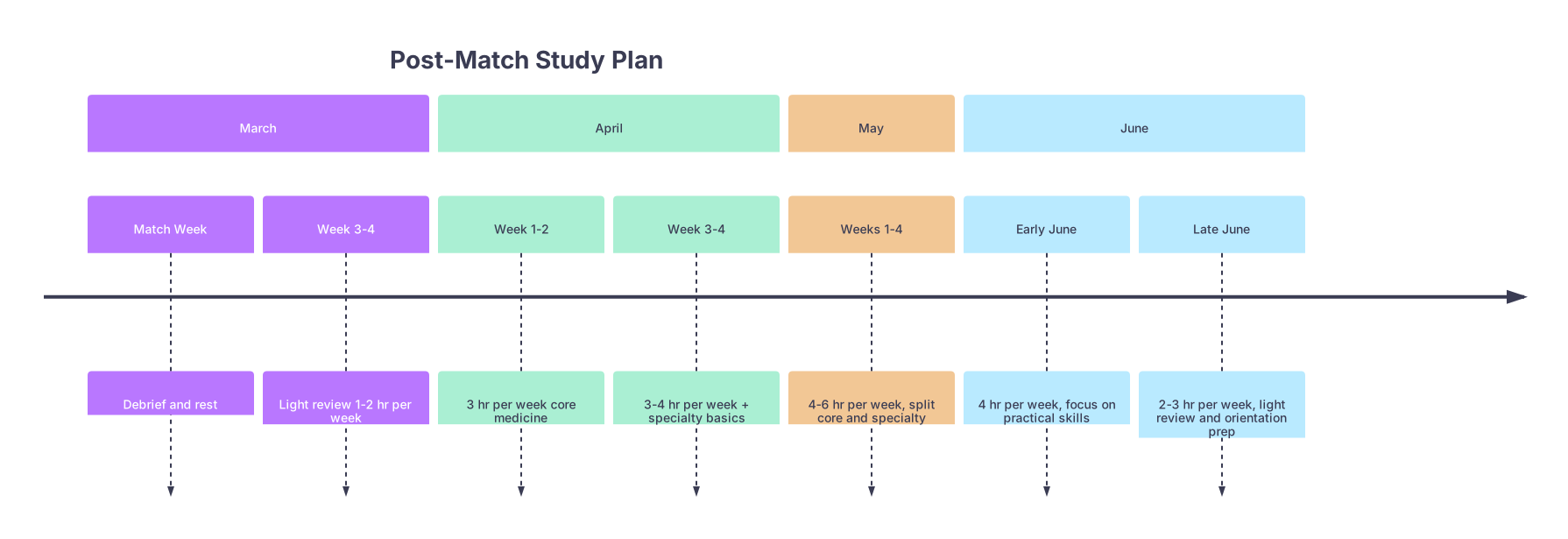
Here’s a simple structure that works for most people starting residency in July, assuming you start in April:
Months before residency: a realistic framework
| Period | Event |
|---|---|
| March - Match Week | Debrief and rest |
| March - Week 3-4 | Light review 1-2 hr per week |
| April - Week 1-2 | 3 hr per week core medicine |
| April - Week 3-4 | 3-4 hr per week + specialty basics |
| May - Weeks 1-4 | 4-6 hr per week, split core and specialty |
| June - Early June | 4 hr per week, focus on practical skills |
| June - Late June | 2-3 hr per week, light review and orientation prep |
How to break down a typical “study week” post-Match:
Example: 4 hours per week
- 2 hours: your specialty (target 2–3 topics)
- 1 hour: general medicine
- 1 hour: practical things (orders, notes, emergencies, reviewing real cases)
Tools that actually work in this phase:
- Question banks: 10–15 questions at a time, 2–3 times a week. Small sets. Review the explanations.
- Short reading: 2–3 pages per day of a handbook or a video lecture here and there.
- Anki: if you already use it and like it, fine. If not, this is not the time to start from scratch.
If you find yourself dreading it, you’re probably overdoing it. This is prep, not punishment.
What About Step 3 / COMLEX Level 3?
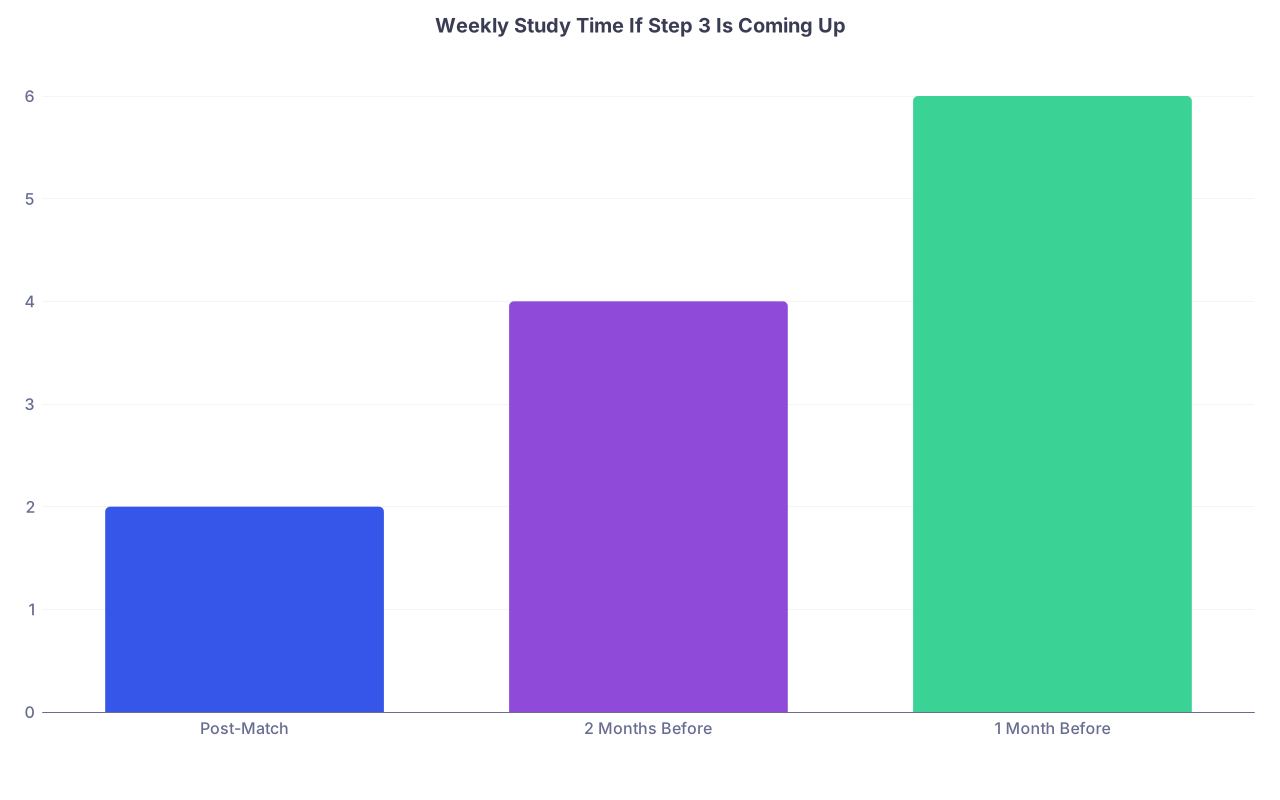
If you’ll be expected to take Step 3 / Level 3 early in residency, post-Match is actually a pretty good low-stress time to set the foundation.
Here’s what I’d do:
- Post-Match through June:
- Light to moderate Qbank use 1–2 times per week (10–20 questions/session).
- Focus on reading explanations for weak areas.
- During intern year:
- 2–3 months before your exam date, ramp up more seriously.
| Category | Value |
|---|---|
| Post-Match | 2 |
| 2 Months Before | 4 |
| 1 Month Before | 6 |
Don’t burn all your mental fuel pre-residency on Step 3. You’ll need that energy. Use this time to get familiar and reduce how painful it’ll be later, not to “cram to perfection.”
How Hard Do Programs Expect You to Prep?
Here’s the unspoken truth: most PDs will tell you, “Enjoy your time off, you’ve earned it.”
But if you show up unable to manage a simple pneumonia admission or write a coherent note, everyone notices. Fast.
No one expects you to:
- Know nuanced subspecialty details
- Have board-level recall on every rare disease
- Be fast
They do expect you to:
- Recognize sick vs not sick
- Have a basic plan for common problems
- Ask for help early without flailing
You don’t get that confidence from two weeks of “I’ll skim Pocket Medicine the night before I start.”
Your goal is not to be brilliant on day one. Your goal is to avoid being dangerously behind.
Mistakes People Make After Match Day
I’ve seen these over and over:
“I’m done forever” mode
They close every book, touch no clinical content for 4–5 months, then spend the first 6 weeks of residency terrified and behind.The guilt-spiral grind
They try to do 4 hours a day again. Burn out. Quit. End up doing less than if they’d planned something sane.Studying the wrong things
They re-do Step 1 style biochemistry, esoteric diseases, or memorize minutiae, but still don’t know how to write TPN orders or manage common conditions.Putting off Step 3 prep entirely
Then they’re drowning in intern year and trying to study for Step 3 at night after 14-hour shifts. Predictably miserable.
A calm, boring middle path beats all of these.
Practical 4-Week Mini-Plan (If You’re Starting Late)
Let’s say it’s already May or June and you haven’t done anything. You still have time.
Here’s a focused 4-week blueprint, 4–5 hours per week:
Week 1 – Core inpatient basics
- Read: 3–5 key topics (sepsis, chest pain, shortness of breath, AKI, electrolytes).
- Do: 20–30 mixed medicine questions.
Week 2 – Specialty basics
- Read/watch: high-yield content for your specialty (e.g., intro chapters or videos).
- Do: 10–20 specialty-flavored questions if available.
Week 3 – Practical work
- Review: examples of admission orders, daily notes, and discharge summaries.
- Practice: write a mock admission and progress note from a sample case (even from old UWorld stems).
Week 4 – Emergencies and holes
- Focus: “what freaks me out” list—chest pain, strokes, bleeding, hypotension.
- Do: another 20–30 mixed questions.
- Make: a one-page “intern survival sheet” with doses, first-line treatments, and phone numbers/contacts once you know your hospital.
That alone puts you ahead of many co-interns.
FAQ (Exactly 5 Questions)
1. Do I really need to study if my program told me to “just relax and enjoy your time”?
Yes—lightly. Program directors are trying to protect you from burnout and they’re right that you need rest. But they’re also assuming you’ll show up with a functioning M3/M4-level brain. A few hours a week of focused prep doesn’t contradict “enjoy your time”; it just means you won’t be panicking at 2 a.m. over basic management.
2. Should I keep doing Anki every day after Match Day?
Only if it’s already part of your routine and you don’t hate it. If Anki has always been a slog for you, this is not the time to chain yourself to a giant deck. You’ll get more value from targeted reading, small question sets, and practical note/order practice than grinding spaced repetition of obscure facts.
3. If I matched into a ROAD specialty (Radiology, Ophtho, Anesthesia, Derm), do I still need to study medicine?
Yes, but you can scale the intensity. You will still do prelim or transitional internships, which are heavy on inpatient medicine, ICU, or surgery. That year will judge you on general medicine competence. You don’t need to master radiology physics or ophtho subspecialties right now; you do need to handle a CHF exacerbation or sepsis admission.
4. How much is “too much” studying after Match Day?
If you’re doing more than 10 hours per week for multiple months and you feel resentful, exhausted, or like you’re still in Step dedicated, that’s too much. You’re trading away a rare window of rest. Aim for 3–6 hours per week. If you genuinely enjoy more, fine—but be honest about whether it’s helping or just feeding anxiety.
5. What if I feel totally behind and anxious even thinking about intern year?
That’s common, and usually a sign you need structure—not punishment. Pick a short list of topics (10–15 problems that scare you most) and a single resource for each: a question bank + a slim handbook or video series. Commit to a small, consistent schedule for 4–6 weeks. Progress quiets anxiety better than vague worrying, and you’ll realize fast that you don’t need to know everything—just the basics, solidly.
Key takeaways:
You do not need to grind like a Step exam again after Match Day, but you also should not shut your brain off for months. A smart target is 3–6 focused hours per week for 2–3 months, aimed at core inpatient medicine, your specialty basics, and practical skills like orders and notes. Do that, and you’ll start residency tired—but not terrified.