
You matched… and now you’re kind of freaking out
It’s Match Week is over. People are popping champagne, posting those stupidly happy Instagram stories with “DREAM PROGRAM!!” in glittery fonts, and your family is blasting the match email in the family group chat.
And you?
You’re staring at your results thinking:
“I matched… but did they make a mistake?”
“What if I’m the weakest person in my class?”
“What if my intern year proves I never should’ve gotten in?”
Everyone’s telling you, “Congrats! You did it!” and all you can think is:
“I tricked the algorithm and now I’m going to be exposed. In front of attendings. And coresidents. And nurses. And patients. And my own brain at 3 am.”
If that’s where your head is right now, you’re exactly who I’m writing this for.
Because this is way more common than anyone wants to admit. And the silence around it makes it feel like you’re the only one spiraling.
You’re not.
Let’s pull this apart.
First: No, they didn’t “accidentally” rank you
Let me just get the big terrifying thought out of the way:
“They must have clicked the wrong name.”
“They ranked me as an alternate and I somehow jumped the line.”
“The PD probably doesn’t even remember me.”
No.
Programs are not casually ranking people at 2 am on their phones like it’s Tinder. Their rank process is way more structured (and honestly, kind of brutal).
Here’s what typically happens behind the curtain:

| Step | Description |
|---|---|
| Step 1 | Applications Reviewed |
| Step 2 | Interview Invites Sent |
| Step 3 | Interview Day Evaluation |
| Step 4 | Rank Meeting |
| Step 5 | Place on Rank List |
| Step 6 | Do Not Rank |
| Step 7 | Submit Rank List |
| Step 8 | Discuss Each Applicant |
That “discuss each applicant” step? That’s not optional. I’ve watched it happen.
Stuff that usually comes up in those rooms:
- “Would I trust this person on call at 2 am?”
- “Are they coachable?”
- “Would they fit in with the culture here?”
- “Would I want them taking care of my own family?”
Nobody says, “Eh, I don’t know, but let’s just roll the dice and see if they crash and burn.” That’s not a thing.
And the match algorithm itself? It favors you, the applicant, not the program. You didn’t “force” your way in. They ranked you high enough, on purpose, for this to happen.
If you matched there, several people in that program basically voted:
“Yes, I want this person here for the next 3+ years.”
Do they think you’re perfect? No. Nobody is.
Do they think you’re trainable? Yes. That’s literally the point.
You feel like you snuck in the back door. From their side, they opened the front door and put your name on the guest list.
“But what if I’m the dumbest one there?”
Yeah. This one hits hard.
You start imagining:
- Everyone else is a 270 Step 1 genius with 14 first-author papers.
- You’ll be the only one asking “uh, how do I order this?” on day one.
- Morning report will expose you as the person who doesn’t know basic pathophys.
Let me be blunt: every single new resident thinks they’re at the bottom.
In almost every program I’ve seen, if you took a confidential poll of interns and asked:
“Where do you think you rank academically in your class?”
at least 70–80% would put themselves in the bottom half.
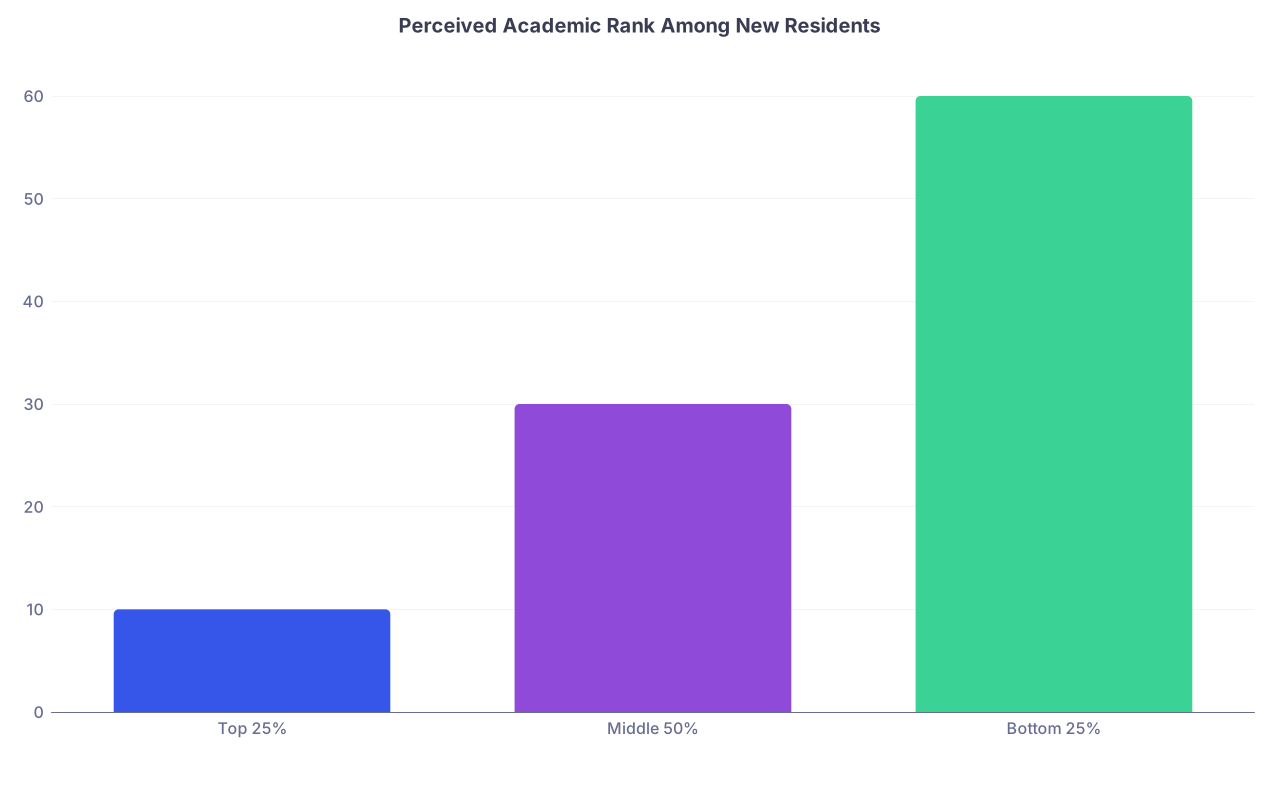
| Category | Value |
|---|---|
| Top 25% | 10 |
| Middle 50% | 30 |
| Bottom 25% | 60 |
Obviously that math doesn’t work in reality. But that’s how it feels from the inside.
Three things programs actually care about way more than being the “smartest”:
- Can you recognize when you’re over your head and ask for help?
- Are you reliable? (Show up, follow through, own your tasks.)
- Will you improve from month 1 to month 12?
No one cares if you can recite obscure trials on day one. They care if you:
- Call when the patient looks sicker than the numbers.
- Don’t disappear when work gets heavy.
- Don’t get defensive when you’re corrected.
That’s it. That’s the secret sauce.
If you can do those three things, you won’t be “the dumb one.” You’ll be “the new one who’s getting better.” Which is literally what an intern is supposed to be.
“I matched higher than I expected… what if I can’t keep up?”
This is the scary version of “good news.”
You thought you were a solid mid-tier applicant. You packed your list with safeties.
And then you matched at that “reach” program you low-key assumed was out of your league.
Now your brain is doing this:
“People at [insert big-name program] don’t make med errors. They don’t struggle. They don’t forget to follow up labs. That’s not me. I will be the weak link.”
Here’s the reality almost no one talks about: even at top programs, there’s a wide range of residents. The brand name is not a guarantee that every single person is a God-tier clinician from day one.
I’ve seen residents at so-called “elite” places:
- Miss basic orders
- Struggle with note templates
- Need extra coaching on procedures
- Get overwhelmed, have rough evals, recover
That doesn’t make them bad residents. It makes them… new.
And those big-name programs? They usually have:
- Stronger systems
- More structured teaching
- Senior residents who have explicitly been told: “Your job is to protect and teach the interns.”
Ironically, being at a stronger program can help you more if you feel behind, because:
- There’s usually more backup.
- They’ve seen every flavor of struggling intern before you.
- They care about their outcomes and reputation, so they pour energy into getting you up to speed.
You’re imagining that everyone else will be sprinting while you crawl. What actually happens is:
- Everyone crawls for a bit.
- Some people pretend they’re not crawling.
- The ones who quietly keep going, ask questions, and fix their mistakes? They’re the ones who end up solid by the end of PGY-1.
The “what if I hurt someone?” fear
This one’s darker, but let’s not dodge it.
You’re not just afraid of looking stupid. You’re afraid of:
- Missing a subtle sign and a patient crashing.
- Forgetting to follow up a result.
- Choosing the wrong med and causing harm.
And the awful truth?
Yes, residents make mistakes. All of us.
And yes, sometimes those matter.
But there are layers between you and disaster. Residency is designed that way on purpose.

Realistically, your protection comes from:
- Seniors double-checking your orders early on.
- Attendings supervising plans, especially on complex patients.
- Nurses who will page you if something looks off and who often notice issues before you do.
- Protocols (sepsis bundles, anticoagulation pathways, order sets) that keep you inside safe lanes.
Your job as terrified-new-intern is not “never make a mistake.” That’s impossible. Your job is:
- Don’t be overconfident.
- Don’t wing things you truly don’t understand.
- Don’t be too embarrassed to say, “Can you walk me through this?”
If anything, your fear here is actually a good sign. The people I worry about?
The ones who aren’t scared at all.
How to survive the “I’m not good enough” months
Let’s talk practical, because the anxiety won’t go away just because you understand the system.
Here’s what tends to help the most in those brutal first 3–6 months.
1. Stop trying to hide your level
The instinct is to perform. To nod like you understand. To say “Got it” when… you don’t.
That’s how people get in trouble.
Examples of what you should actually say:
- “I’m not familiar with that order set yet — can you show me once so I do it right next time?”
- “I’ve never consented for that procedure before. Can I watch you do it and then try it with you supervising?”
- “I’m still slow writing notes. Is there a template you recommend so I don’t miss key elements?”
Attendings and seniors would 1000x rather hear that than discover you silently didn’t know what you were doing.
2. Give yourself a learning curve that’s actually human
You’re expecting day 1 competency on a year 3 job.
Think in phases instead:
| Time frame | What “good enough” actually looks like |
|---|---|
| Month 1 | Not lost all the time, asking lots of questions |
| Month 3 | Handling simple patients with supervision |
| Month 6 | Anticipating some issues, calling for help appropriately |
| Month 9–12 | Running most of your list, needing targeted backup |
Notice what’s not on there:
- “Flawless presentations”
- “Never forget a task”
- “Perfect plans from the start”
Your brain wants you to be competent immediately. Residency training assumes you’ll be rough for a while.
3. Make a “panic plan” for when you feel behind
You know those shifts where everything is chaos and you’re sure you’re drowning and everyone else is fine? Yeah. Those.
Have a default script for yourself for those days:
- Step 1: List every active task on paper or a note on your phone. Get it out of your head.
- Step 2: Star anything that touches hemodynamics, airway, infections, anticoagulation, or insulin. Those are higher risk.
- Step 3: Grab your senior and say: “I’m getting behind. Here’s my list. Can you help me prioritize what must get done first?”
Is it fun to admit that? No. But people respect it way more than silent meltdown mode.
Comparing yourself to your coresidents (aka the fastest way to suffer)
You’re going to meet a few people PGY-1 who terrify you. The ones who:
- Present like fellows on day 3.
- Somehow know the EMR inside and out instantly.
- Are already on a first-name basis with half the attending staff.
Your brain will decide: “They belong here. I don’t.”
Remember:
- You didn’t see their background. Some were scribes, nurses, MAs, or did prelim years.
- Some have massive anxiety and are overcompensating.
- Some are great on rounds and totally lost in the ICU, or vice versa.
You’re comparing your internal chaos to their external performance. That’s not a fair match-up.
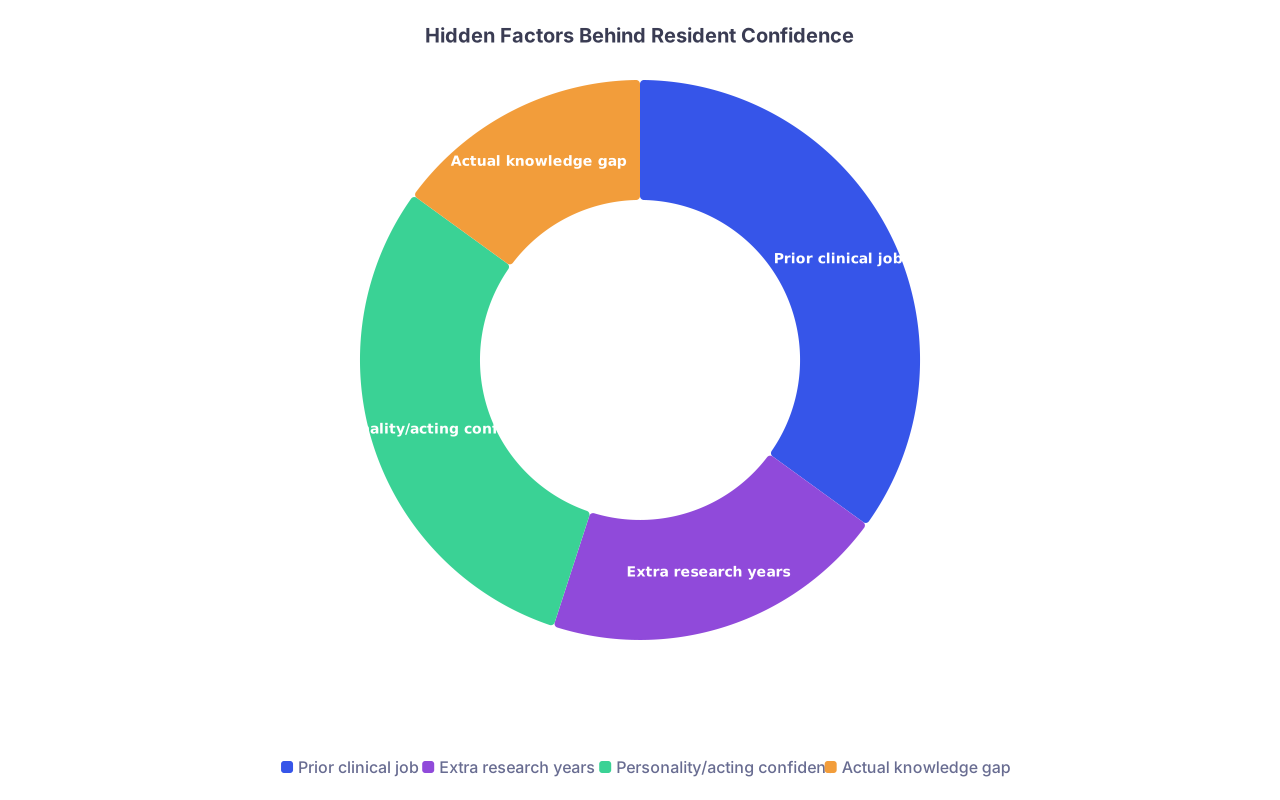
| Category | Value |
|---|---|
| Prior clinical job | 35 |
| Extra research years | 20 |
| Personality/acting confident | 30 |
| Actual knowledge gap | 15 |
Instead of “I’ll never be as good as them,” try something more neutral:
- “They’re good at this now. I can get there with time.”
- “On this rotation, they’re stronger. On another, I might be stronger.”
- “I’m allowed to be in the early chapters of my curve while they’re in the middle.”
You don’t need to be the top resident. You just need to grow.
When the fear starts whispering “You don’t belong here”
Let’s call this what it is: imposter syndrome with sharp teeth.
The thoughts sound like:
- “If they really knew me, they wouldn’t have ranked me.”
- “Everyone is overestimating me.”
- “I only got in because of luck / diversity factors / a fluke good interview.”
Some harsh truth: programs don’t “accidentally” invest hundreds of thousands of dollars in training someone they think is trash. Not in this market. Not with these workloads. They are selfish. In a good way.
They picked you because:
- They believed you could do the work with training.
- Something about you—your letters, your interview, your record—said “we can trust this person.”
Your brain wants to rewrite that as: “They were wrong about me.”
Reality check: the people least able to judge themselves accurately are often the most self-critical.
You’re not an unbiased observer of your own competence. You’re the harshest attending you’ll ever have.
Concrete things you can do before residency starts
You don’t fix anxiety just by thinking differently. Sometimes you need small, practical steps.
Here are a few that actually help:
Pick 2–3 high-yield topics for your specialty that always come up (for IM: chest pain, sepsis, DKA; for surgery: post-op fever, SBO, wound care; etc.) and:
- Read one solid guideline-style summary.
- Write your own 1-page cheat sheet: initial orders, key meds, when to worry.
Get familiar with common meds:
- Basic doses for antibiotics you’ll use daily.
- Starting doses for common antihypertensives/insulin regimens in your field. Nothing fancy, just: “I’ve seen these names before.”
Decide in advance what you’ll say on day one:
- “Hey, just so you know, I’m someone who learns by doing. I’ll ask questions when I’m not sure, and I appreciate any direct feedback.”
Set one goal for your first month that has nothing to do with being impressive:
- “I will always call for help when a patient makes me uneasy.”
- “I will write down tasks instead of trusting my memory.”
- “I will ask one ‘why’ question a day.”

You’re not trying to become a star before day 1. You’re just shortening the “I feel completely useless” phase by a tiny bit.
If your fear feels bigger than “normal”
There’s regular intern anxiety. Then there’s the kind that:
- Keeps you awake nightly with racing thoughts.
- Makes your chest tight every time you think about July 1.
- Has you crying in private more days than not.
If that’s you, that’s not a personal failure. That’s your nervous system on overload. And you do not have to just “muscle through.”
Before residency starts is actually the perfect time to:
- Get plugged in with a therapist (especially one who works with med folks).
- Talk to your PCP about how you’re feeling.
- Ask your incoming program (quietly, through GME or wellness) about mental health resources—most have them and don’t advertise well.
I’ve watched people white-knuckle it through intern year and implode in PGY-2. You’re not weak for needing help before things get hard. You’re smart.
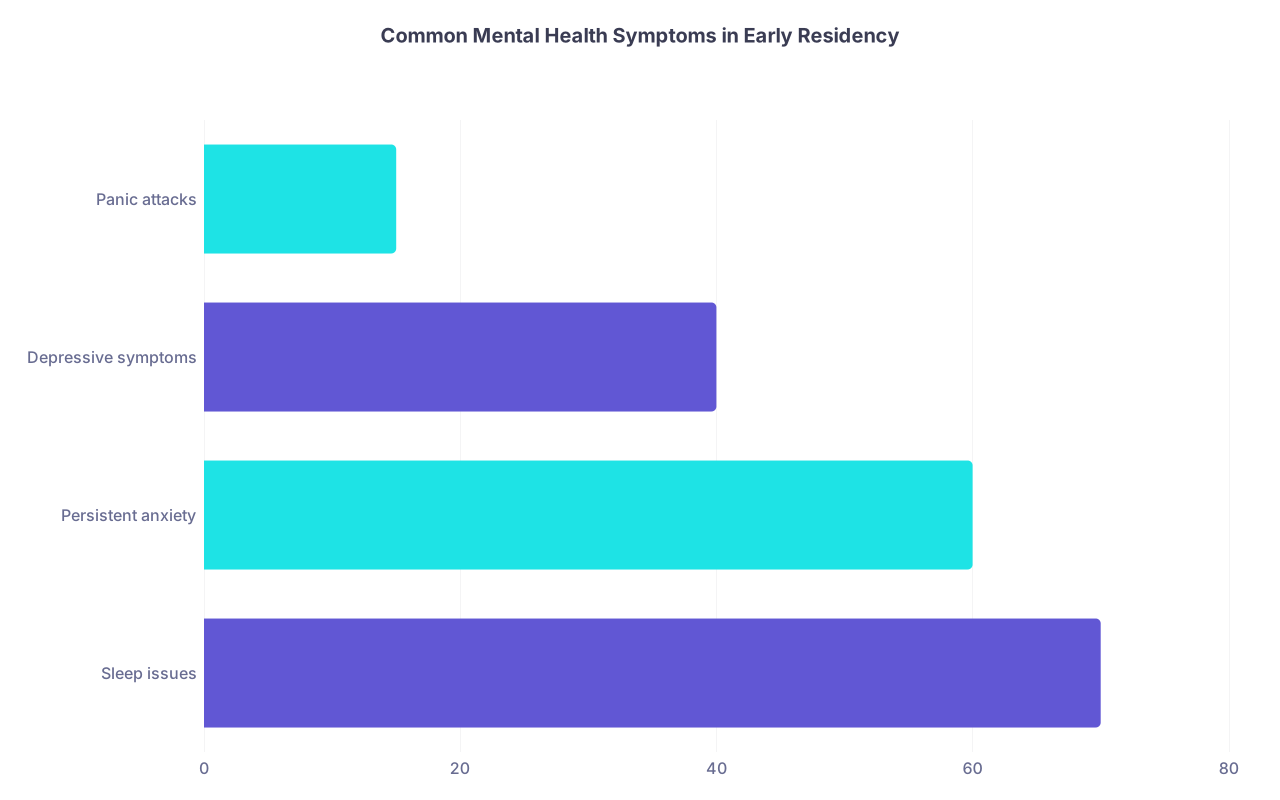
| Category | Value |
|---|---|
| Sleep issues | 70 |
| Persistent anxiety | 60 |
| Depressive symptoms | 40 |
| Panic attacks | 15 |
Those numbers? They’re not rare outliers. You’re not the only one.
Quick reality reset before you spiral again
Let me land this, because you’ve got enough noise in your head already.
Here’s what I want you to walk away with:
You didn’t trick the system.
Your program saw your application, talked about you in a room, ranked you on purpose, and is expecting a new, imperfect, trainable resident. Not a fully-formed attending.Feeling “not good enough” is basically a residency entrance requirement.
Almost everyone starts out convinced they’re behind. The ones who do well are not the ones who start out the strongest—they’re the ones who keep asking for help, fix their mistakes, and improve month after month.Your fear doesn’t disqualify you.
Being scared you’ll hurt someone, or let people down, or be the weakest intern? That’s not proof you don’t belong. It’s proof you care. And residents who care, who are cautious, and who keep showing up are exactly who programs want.
You don’t have to feel ready. You just have to be willing to learn in public.
And you already did the hardest part: you made it in the door.