

Program directors are not mind readers, and the algorithm is not a snitch.
Let me say it bluntly: no residency program director (PD) can see where you ranked them, what number they were on your list, or how many programs you listed above or below them. The NRMP algorithm was literally built so they cannot know. The rest is rumor, paranoia, and people trying to sound like insiders.
If you’re walking into orientation thinking, “They know I ranked them #4,” you’re carrying anxiety you do not need.
Let’s strip this down to what PDs actually see, what they do not see, and where the real power—and risk—actually sits.
What PDs Actually Get From the Match
Here’s the unsexy truth: the post-Match data PDs receive is boring compared with the conspiracy theories.
From NRMP and their own records they can see things like:
- Their own rank list (which they created before Match Day).
- Which of their ranked applicants matched to their program.
- How far down their own list they went to fill spots.
- Whether they filled completely, partially, or not at all.
- General aggregate match outcome data published later (NRMP Program Director Survey, Charting Outcomes, etc.).
What they cannot see:
- Your rank order list.
- Your rank number for their program.
- Where else you applied or interviewed (beyond what they already know from invitations they sent).
- Where you matched if it wasn’t with them (unless you tell them or someone gossips).
To make this more concrete:
| Type of Information | Visible to PDs? |
|---|---|
| Their own rank list | Yes |
| Which applicants matched there | Yes |
| How far down **their** list they went | Yes |
| Your personal rank list | No |
| Your rank number for their program | No |
| Where else you ranked | No |
The NRMP is very explicit about this. The Match is confidential and binding. Programs don’t get secret reports showing, “This applicant ranked you #7 but only matched here because #1–6 rejected them.” That would destroy trust and invite manipulation.
“But My PD Said They Knew I Ranked Them Low…”
No. They guessed. Or they inferred. Or they were bluffing.
Here’s how this garbage rumor usually starts. A PD or faculty member says something like:
- “We figured you probably ranked us high.”
- “You must have had us at the top of your list.”
- Or the passive-aggressive version: “You matched here, so I guess it all worked out how it was meant to.”
That’s not insider data. That’s social dynamics.
They do know:
- Whether you seemed enthusiastic or disinterested on interview day.
- Whether you sent a “you’re my #1” email (or similar).
- Whether you were geographically tied and likely to stay local.
- Whether you looked like you were aiming more “up” or “down” based on your metrics.
So they make assumptions. People are terrible at separating assumptions from facts, especially when they want to believe they were your first choice.
A common pattern I’ve seen:
- A strong applicant matches at a solid-but-not-elite program.
- PD: “We were surprised you ranked us that high.”
- Applicant (internally): “Wait, how did they know I ranked them #3?”
- Reality: They did not. They assumed that if you matched there, you put them high enough, and their ego filled in the rest.
The only time a PD really “knows” something is if you told them in a love letter and stuck to it. Otherwise, it’s vibes and probability, not data.
What the Algorithm Actually Does (And Why It Protects You)
The NRMP algorithm is applicant-proposing. Translation: it tries to make your preferences win whenever possible, not the program’s.
Very rough version:
- It starts with your rank lists.
- It “proposes” you to your #1 choice.
- If that program has space and you’re high enough on their list, you’re tentatively placed there.
- If not, you “propose” to your #2. And so on.
- Programs only know: “This person matched here” or “did not match here.”
They never get the running play-by-play: “This applicant tried Program A, got denied, then proposed to you as their Plan B.” That’d be ridiculous.
Here’s a visual of the relevant part:

| Step | Description |
|---|---|
| Step 1 | Applicant rank list |
| Step 2 | Try first choice |
| Step 3 | Tentative match |
| Step 4 | Try next choice |
| Step 5 | Unmatched |
| Step 6 | Program ranks applicant? |
| Step 7 | More programs left? |
Key point: the internal attempts are invisible to programs. They only see the final stable arrangement. Not the near-misses. Not the “they ranked you 12th then slid into your DMs” drama.
The Real Thing PDs Do See: Their Own Rank List Position
Here’s where people get tangled.
PDs do know where you were on their rank list.
So if:
- You were #3 on their list and you matched there, they know they got a highly desired candidate.
- You were #42 and they had 12 spots, they know they went down the list a bit.
But that’s their preference, not yours.
They might think: “We had her at #3, so she probably had us high too.” Maybe. Maybe not. You could have had them at #9 and just didn’t match anywhere above.
That gap—between how much they wanted you and how much you wanted them—is inherently unknowable from their side. The algorithm doesn’t publish it. By design.
What About SOAP, Scramble, and “Desperate” Programs?
This is where the paranoia gets louder.
You hear: “If you come in through SOAP, they’ll know you didn’t want them.” Or, “They know you ranked them low if you only ended up there through scrambling.”
Let’s clean this up.
If you match in the main Match:
- Program has zero objective data about your list.
- You are, on paper, the same as every other matched resident there in terms of “how much you wanted them.” The record shows only: you matched. Full stop.
If you end up there via SOAP:
- Obviously you did not match in the main round.
- Obviously they were not on your main matched list (because you didn’t have one).
- Yes, they know you were scrambling for a position—that’s the whole point of SOAP.
- But SOAP still does not reveal your original rank list or sequence.
So what they know is: “This person didn’t match, then applied to us in SOAP, and we took them.” It tells them nothing about whether you ranked Program X above them in the main Match.
And most PDs already understand this: SOAP is a supply–demand rescue process. Nobody thinks SOAP applicants were just “undecided.”
Where You Actually Can Expose Your Rank List
The main danger to your confidentiality isn’t the algorithm. It’s you.
The people who accidentally reveal their rank list are usually doing one of three things:
Love letters gone wrong.
“You’re my #1,” sent to multiple programs. PDs talk. This has burned people.Post-Match victory laps.
Posting on social media: “So happy to have matched at my #5 program!” Faculty see it. Residents show PDs. Awkward silence at orientation.Loose lips on the trail.
Telling residents or faculty, “Honestly I ranked [Fancier Program] above you, but I’m glad to be here.” Word travels faster than you think.
If you want the NDAs the algorithm gives you to actually hold, stop breaching your own privacy with your mouth and your Twitter account.
What PDs Actually Care About After You Match
Here’s a reality check that should calm you down: once you match, most PDs care about one thing—are you going to be a good resident here?
Your exact rank number fades fast. Their guess about how much you wanted them fades even faster. Their memory of your interview day behavior and your performance as an intern? That sticks.
They care about:
- Do you show up? Prepared, professional, not constantly late.
- Do you take feedback without melting down or arguing every correction.
- Do you work well with nurses, other residents, attendings.
- Are you safe with patients.
Nobody is rounding thinking, “She’s performing like a #2 rank, not a #7.” That’s not how minds work on busy services.
For the more neurotic among you: I’ve seen PDs three years later forget how high someone was on their rank list. They remember, “They were strong,” or “We got lucky getting them,” but not, “You were #5.”
Where People Confuse “Preference Signaling” With Rank Knowledge
Another layer of confusion: programs can sometimes infer interest through your behavior and external signals (especially in competitive specialties), and people misinterpret that as rank list visibility.
Tools/signals PDs might see:
- Signals in specialties that use preference signaling (like ENT, derm, etc.).
- Away rotations: if you rotated there, that’s a strong interest sign.
- Geographic ties and your personal statement’s vibes.
- Communication: pre- and post-interview emails, “I would love to train here,” the classic “you are among my top choices” line.
From that, they can guess. “This applicant signaled us, rotated with us, and wrote us a love letter—probably ranked us high.” Reasonable inference. Still not data.
Contrast that with what they never see: “Ranked you #2 out of 14.” That level of granularity simply doesn’t leave the NRMP black box.
The One Thing You Should Actually Worry About: Lying
If there’s real risk anywhere, this is it.
If you:
- Explicitly tell a PD, “I’m ranking you #1,”
- …and you do not,
then:
- You’ve made a promise you can’t prove, but they can easily suspect was false.
- If they find out through the grapevine, they won’t forget. Faculty talk across programs and years.
Does NRMP police this? Not really; they explicitly say programs and applicants can express interest but no one can require ranking. But your reputation is your currency. This field is surprisingly small.
So the sane strategy:
- Be honest and vague if you want to keep doors open:
“You are one of my top choices, and I would be very excited to train here.” - Be specific only if it’s true and you’re ready to back it with your rank list:
“I will be ranking your program #1.”
That’s how you keep the benefits of confidentiality without playing games you can’t control.
Quick Reality Snapshot: What PDs Actually See vs The Myths
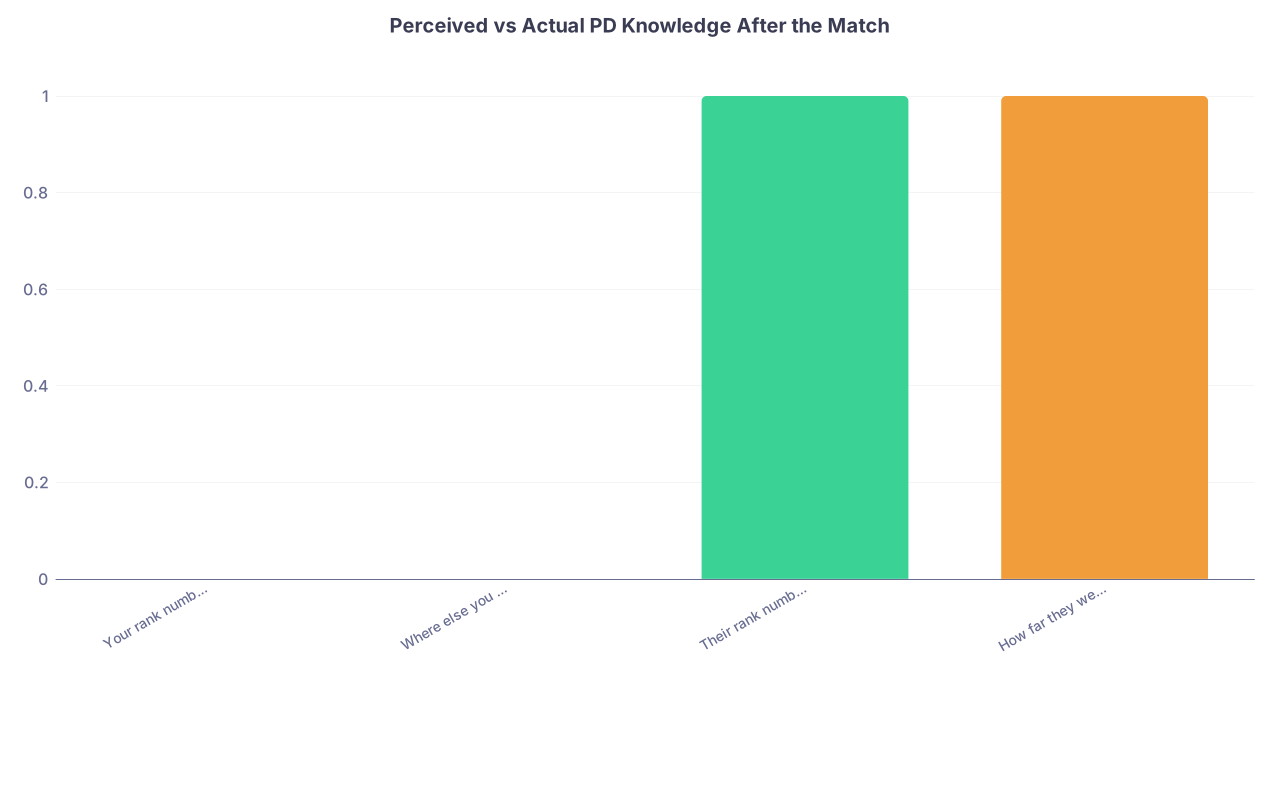
| Category | Value |
|---|---|
| Your rank number for them | 0 |
| Where else you ranked | 0 |
| Their rank number for you | 1 |
| How far they went down list | 1 |
Interpretation:
- 0 = They absolutely do not see it.
- 1 = They absolutely do see it.
Your rank list: 0.
Their rank list: 1.
Everything else: noise.
FAQs
1. Can a program director ever find out where I ranked their program?
Not through the NRMP or any official channel. The algorithm and NRMP policies are set up to keep rank lists confidential on both sides. The only way they “find out” is if you tell them directly, or you post something publicly that makes it obvious (“Matched at my #7 program!”). Otherwise, they’re guessing based on your behavior and signals, not reading some secret report.
2. Do programs know if they were my first choice if I send a “you’re my #1” email?
They know what you said, not what you did. If you tell them, “You are my #1,” they will assume you’re telling the truth and rank you accordingly. But they still never see your actual rank list in the system. The risk is reputational, not algorithmic—if they later suspect you lied and word spreads, that can hurt you with that program or faculty who move elsewhere.
3. If I matched at a program that was not my top choice, will they treat me differently?
In practice, very unlikely, and they probably don’t know anyway. Once you show up as a PGY-1, the only things that matter are how you perform and how you fit. I’ve never seen a resident be evaluated based on where anyone imagined they ranked the program. PDs might be curious or make small talk about your “story,” but they’re not tracking your hidden preferences day-to-day.
4. Does SOAP reveal anything about my original rank list to programs?
No. SOAP only reveals that you did not match in the main algorithm and that you applied to them during SOAP. They do not see how you ranked programs in the main Match or why you didn’t match. They know you were looking for an available spot; they don’t see your prior rank order or which programs were above or below them.
Bottom line:
- PDs cannot see your rank list or your exact rank number for their program.
- They can see where you were on their list and whether you matched, and everything else is guessing.
- The biggest threat to your confidentiality isn’t the algorithm—it’s what you choose to say (or post) after.


