
The welcome email is not a formality. It is the first test you did not know you were taking.
Everyone thinks once you match, the evaluation starts on July 1. That is wrong. The informal file on you starts growing the minute that “Congratulations and welcome to…” email hits your inbox. I’ve sat in rooms where faculty pulled up those early interactions when deciding who gets chief, who gets the best letters, and who gets quietly written off as “high maintenance.”
You think nobody is watching. They are.
Let me walk you through what actually happens on the program side, because nobody tells you this part.
What Really Happens After the Match List Is Released
Here’s the sequence you do not see, but directors and coordinators live every year.

| Step | Description |
|---|---|
| Step 1 | Match Results Released |
| Step 2 | PD Reviews Matched List |
| Step 3 | Draft Welcome Email |
| Step 4 | Coordinator Sends Bulk or Staggered Emails |
| Step 5 | Track Responses and Issues |
| Step 6 | Update Informal Notes on Residents |
| Step 7 | Onboarding and Orientation Planning |
Once the Match results drop, there’s a flurry of activity you never witness:
The program director looks at the list and immediately categorizes people in their head: “top recruit,” “solid,” “risk,” “no idea who this is but NRMP gave them to us.” Then they sit down with the coordinator and decide how to set the tone.
That welcome email you get? Often drafted by the PD, polished (and enforced) by the coordinator. The language is not accidental. If the email is highly structured with explicit deadlines, that’s usually a reaction to having been burned before. If it’s warm and casual, that program tends to trust their residents more and micromanage less.
But here’s the real secret: they track what you do with that email.
Some coordinators literally keep an Excel sheet with columns like:
- Date/time welcome email sent
- Date/time resident replied
- Missing documents / follow-up needed
- “Notes” (and this column is where you live for the next few months)
| Category | What They Call You | What It Really Means |
|---|---|---|
| Early star | On top of it | Fast, polite, low-drama |
| Watch list | Needs reminders | Disorganized or not prioritizing us |
| Problem | High maintenance | Already taking more time than others |
| Unknown | Quiet | No data yet, but we remember silence |
Nobody tells you that. But I’ve watched coordinators roll their eyes and say, “He still hasn’t filled out his credentialing packet; this is going to be fun.” That comment follows you farther than you think.
The Welcome Email: What They’re Really Testing
The words “welcome to the residency family” are the honey around the pill. Underneath the warm language, they are checking several things at once.
1. Responsiveness (And Yes, They Time You)
Programs do not expect a reply in 5 minutes. They do expect one in 24–48 hours.
When your email just sits there, three stories form in people’s heads:
- You do not check your email reliably.
- You do not prioritize the program that just committed hundreds of thousands of dollars to train you.
- You are going to be a problem for time-sensitive issues (schedules, licensing, credentialing).
Resident selection is pattern recognition. If you start by showing “slow to respond,” faculty subconsciously file you under “needs extra managing.”
On the flip side, the resident who replies the same day, confirms receipt, follows instructions, and asks one thoughtful, contained question? Coordinators literally say, “Oh, she’s going to be easy.”
You want that label. “Easy” to a coordinator often translates to “reliable” to the PD.
2. Can You Follow Instructions Like an Adult?
This is where a lot of very smart people fail.
The typical welcome email is long and loaded: forms, deadlines, portals, background check, drug screen, state license, immunization uploads, maybe a housing survey or technology setup.
Programs watch how you handle that volume.
They notice:
- Did you read the whole email before asking questions?
- Do you send a frantic email about something that’s literally in paragraph two?
- Can you complete multiple small tasks without dropping any?
There’s a reason for this. Residency is nothing but parallel streams of responsibility. Duty hours, clinic inbox, orders, notes, follow-up, emails from GME, QI projects, conferences. If you struggle with a single onboarding email, they worry you’ll drown on night float.
I’ve watched a PD say this verbatim: “He’s already asking for us to resend things three times. Keep an eye on his documentation when he starts.”
That “keep an eye on him” becomes your starting reputation.
3. Professionalism in Writing
Nobody is grading your prose like an English teacher. But tone, format, and respect absolutely get noticed.
These are the silent red flags:
- “Hey” or “Hi guys” to the PD
- Zero greeting, just “I need…”
- Typos in your own name or the program’s name
- Super casual sign-offs like “Thx” / “Sent from iPhone, sorry lol”
Do they auto-fail you? No. But people remember who looks polished and who looks like a loose end.
Here’s what they actually value:
- Clear subject lines referencing what they wrote (“Re: Welcome Email – Required Documents”)
- Brief confirmation of instructions (“I’ll complete the background check and upload immunizations by Friday as requested.”)
- A closing that fits the setting (“Best regards,” “Sincerely,” with your full name and “Incoming PGY-1 [Specialty]”)
It signals you know how to talk to patients, administrators, and other professionals. Which is half the job.
4. Attitude and Entitlement: The Biggest Unspoken Filter
This is the one that changes careers.
Program staff remember every early interaction from the resident who sounds like the hospital should be grateful they matched there.
Examples I’ve actually seen:
- “I’ll be out of the country for most of May and June, so I’ll get to the paperwork when I return.”
- “I’m sure there’s some flexibility on this deadline, right?”
- “I prefer not to do the standard orientation modules since I’ve already done similar things as a student.”
These emails are forwarded, discussed, and saved. The label “entitled” sticks.
Compare that with: “I’ll be traveling internationally from May 10–25. I’ve already started the paperwork and will complete the remaining items before I leave. If anything has to be done in person, please let me know so I can arrange it beforehand.”
Same situation. Completely different signal.
Residency is a service job. Programs are hypersensitive to any whiff of “you work for me,” especially from incoming interns who have not done a single night shift yet.
Behind the Scenes: How Your Replies Get Talked About
Let me walk you into the meeting you never see—the quiet ones that happen between the PD and coordinator in May and June.

Typical conversation snippets I’ve heard:
- “She’s amazing. Already has everything in, super polite. Going to be a star.”
- “We’ve emailed him three times about the drug screen. I’m worried he’s not going to take call handoffs seriously either.”
- “This one has already asked for two special schedule accommodations before she’s started…”
- “He’s been great with communication but seems very anxious. Let’s pair him with a strong senior during July.”
Notice something? They are already assigning narratives to you:
- “Star”
- “Disorganized”
- “High-maintenance”
- “Anxious but workable”
Those narratives will color how they interpret your first few months. Same objective performance, different storyline depending on what bucket you went into.
People pretend residency is a clean slate on July 1. It is not. The slate starts being written on the day of your welcome email.
The Silent Scoring System: What They Notice First
Programs do not have a formal rubric for “welcome email response quality.” But if you forced them to write it down, it would look something like this.
| Dimension | Positive Impression | Negative Impression |
|---|---|---|
| Response time | Reply within 24–48 hours | Takes multiple reminders |
| Thoroughness | Completes all tasks with minimal questions | Incomplete forms, lost links, repeated issues |
| Tone | Polite, succinct, professional | Demanding, casual, or oddly emotional |
| Tech savvy | Uses portals correctly, uploads correctly | Constant “I can’t log in” without troubleshooting |
| Reliability | Meets stated deadlines | Frequently asks for extensions |
You do not need to be perfect across every dimension. Programs know new grads are overwhelmed, on rotations, traveling.
What they really fear is the pattern. If you are slow to respond, hard to direct, and already negotiating every small ask, they start mentally preparing for a three-year battle.
If you are generally quick, polite, and a little proactive? They breathe out. You’ve bought yourself a lot of goodwill that will matter when you inevitably screw something up later (and you will, because everyone does).
Common Mistakes Residents Make With the Welcome Email
Let’s cut through the fluff. Here are the mistakes I’ve seen over and over from matched students who don’t realize they’re still being evaluated.
1. Treating It Like Spam
You’d be amazed how many people let the welcome email sit unread for days because they’re celebrating, traveling, or burned out after Match.
I’ve heard: “Oh, I thought the official stuff would come later.”
No. That first email often includes time-sensitive items—background checks linked to expiring portals, drug screens that must be done by a certain date, license processes that take months.
When you delay, you compress the onboarding timeline and trigger a cascade:
- Coordinator has to chase you.
- HR has to expedite steps.
- PD gets an email from GME: “Your incoming resident is late on…”
Suddenly you’re on the radar for the worst possible reason.
2. Asking Questions Answered in the Email
I’m going to be blunt: nothing irritates a coordinator faster than this.
If the email clearly says, “Please submit your immunization records via the MedHub portal by May 15,” and you reply, “Where do I upload my records?” you’ve just told them you did not read what they took time to write.
You don’t want to be known as the resident who makes extra work for no reason.
The fix is simple:
- Read the email once fully.
- Read it again with a notepad.
- Only then draft your questions—and group them into one message.
“Thanks for the detailed information. I’ve read through the email and have three brief questions…” is a very different introduction than, “So what do I do about my license?”
3. Being Overly Casual or Overly Emotional
I’ve seen people write welcome email replies like they’re texting a friend:
“Woohoo!!!! So excited to join you guys, this is a dream come true, I’ve wanted to be there since I was like 10, can’t wait to meet everyone!!!”
It’s not the worst sin. But it reads…young. Programs are about to hand you narcotics ordering privileges and overnight responsibility. They want to see some gravitas.
On the other extreme, some replies overshare:
“I’ve been really anxious about moving, my fiancé is struggling with this, my parents are upset I’m leaving, I hope this all works out.”
That kind of emotional dump to a coordinator you have never met? It scares them. They start wondering if you’ll cope with night float, ICU trauma, real stress.
Save the life story for your therapist, your partner, or a trusted senior later on. The welcome email reply should be warm but controlled.
4. Over-negotiating Before Day One
Do not start your relationship with the program by trying to rearrange the furniture.
Repeating patterns I’ve seen:
- Asking to change vacation blocks before you’ve started
- Asking to avoid certain rotations based on “preferences”
- Asking to match schedule with a partner in another specialty
- Asking if you can start late for a non-emergency reason
Emergencies, visas, genuine life events? Those are different. Programs will often bend for those.
But if the first thing they learn about you is that you want special treatment, you get labeled “high maintenance” instantly. That label is unbelievably sticky.
Start by showing you can work within the system. Once you’ve built trust and demonstrated reliability, people become much more flexible.
How to Handle the Welcome Email Like Someone Who Gets It
Let me spell out what a smart, insider-aware response looks like.
Step 1: Timeframe
Aim to respond within 24 hours. If you’re on a brutal rotation, 48 is acceptable. Beyond that, it should only be because you truly did not see it.
If you know you’ll be off-grid (travel, limited internet), set your own email alert and plan to at least send a quick acknowledgment.
Step 2: Structure of Your Reply
Keep it simple:
- Greeting with correct title: “Dear Dr. [Last Name] and [Ms./Mr. Last Name],”
- Brief expression of appreciation and excitement (one or two sentences, not a novel).
- Clear confirmation of next steps: what you will do and by when.
- Any essential questions grouped at the end.
- Professional sign-off with full name and “Incoming PGY-1 [Program], Start July [Year].”
You’re not trying to impress them with style. You’re showing you’re organized and sane.
Step 3: Dealing with Problems Early and Maturely
If you already know you’ll have an issue—travel dates, expiring visa, financial constraint for moving—mention it early, but frame it like an adult.
Wrong way:
“I can’t do the drug screen until June because I’m away.”
Better:
“I’ll be traveling from May 15–June 1. I saw the drug screen needs to be done before orientation. I can complete it any time before May 15 or immediately after June 1—do you have a preference, or will that timing affect my onboarding?”
You’re acknowledging their needs, not just stating your own.
What Happens If You Screw This Up?
Here’s the part nobody is honest about: one clumsy email won’t ruin your career. A pattern will.
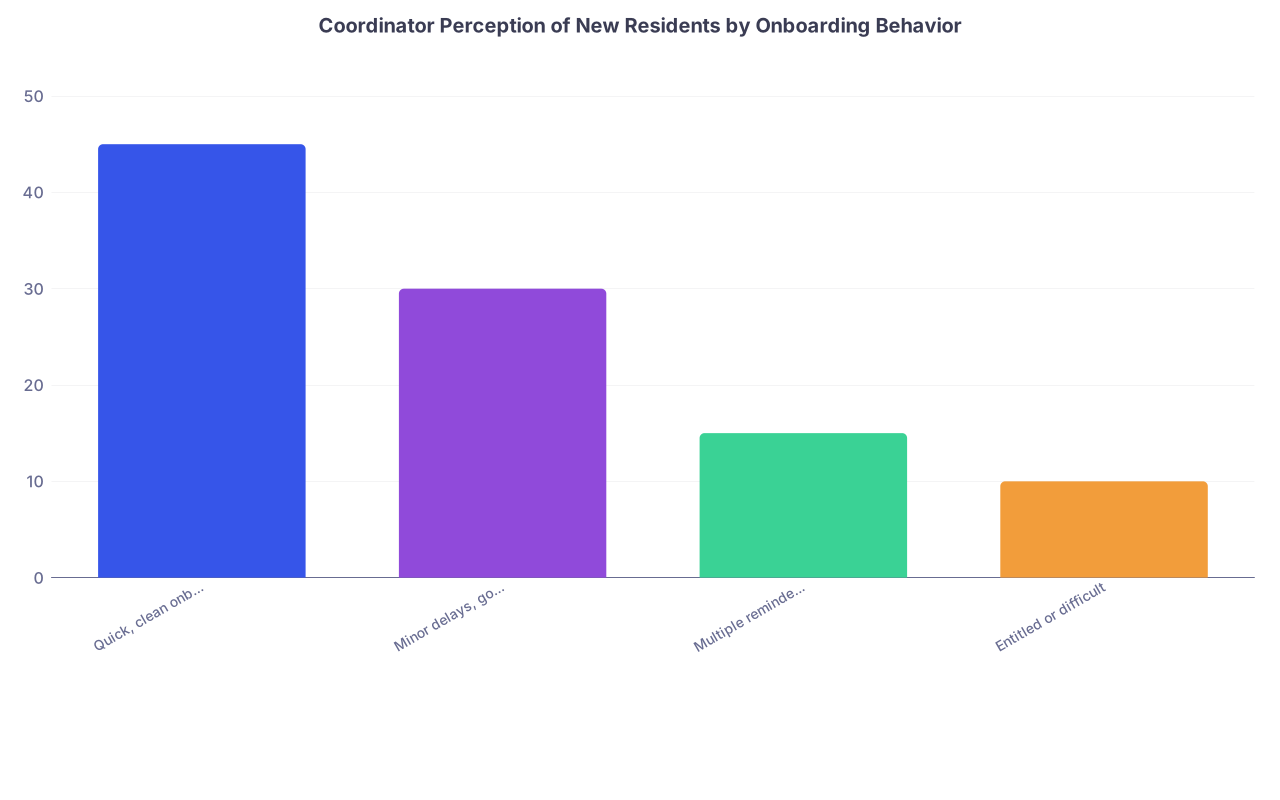
| Category | Value |
|---|---|
| Quick, clean onboarding | 45 |
| Minor delays, good communication | 30 |
| Multiple reminders needed | 15 |
| Entitled or difficult | 10 |
Roughly speaking, in a typical class:
- Half the interns will handle onboarding smoothly. Their names trigger no anxiety.
- A third will have small hiccups but are pleasant and communicative. Nobody worries much.
- A minority will already require extra energy or show attitude. That group gets watched.
If you’ve already fallen into that bottom group before July 1, you’re starting residency in a deficit of trust.
What that looks like in practice:
- You get less benefit of the doubt when something goes wrong.
- Faculty are slower to advocate for you for high-yield opportunities.
- When chiefs are chosen, your name comes with a mental asterisk.
The good news? You can climb out. Being a strong intern, showing up consistently, and treating staff well can absolutely rewrite your story. But it’s harder when you’re fixing an early narrative you could have avoided.
Much easier to start neutral or positive.
The Part Nobody Talks About: Staff Remember Who Respects Them
One final insider truth: the most powerful person in your early residency life is often not the PD. It’s the coordinator.

They:
- Control your paperwork
- Know every deadline
- Hear every complaint from HR, GME, and IT about you
- Are in the PD’s office constantly
If you blow off their instructions, send sloppy replies, or treat them like “just admin,” you’re quietly tanking your own support system.
On the other hand, when you:
- Reply promptly and politely
- Thank them for their help when they fix inevitable issues
- Own your mistakes instead of blaming the system
They remember. And they go to bat for you when you’re in trouble. I’ve watched coordinators defend residents with, “He’s always great with communication; this must be a one-off,” and that single sentence changed how the PD approached the problem.
You’re not just replying to an email. You’re building (or damaging) an ally.
Quick Reality Check: What Programs Actually Expect
They are not expecting perfection.
They are expecting signs that:
- You can read and follow multi-step instructions
- You respect timelines
- You communicate like a professional adult
- You are not going to be a chronic fire they need to put out
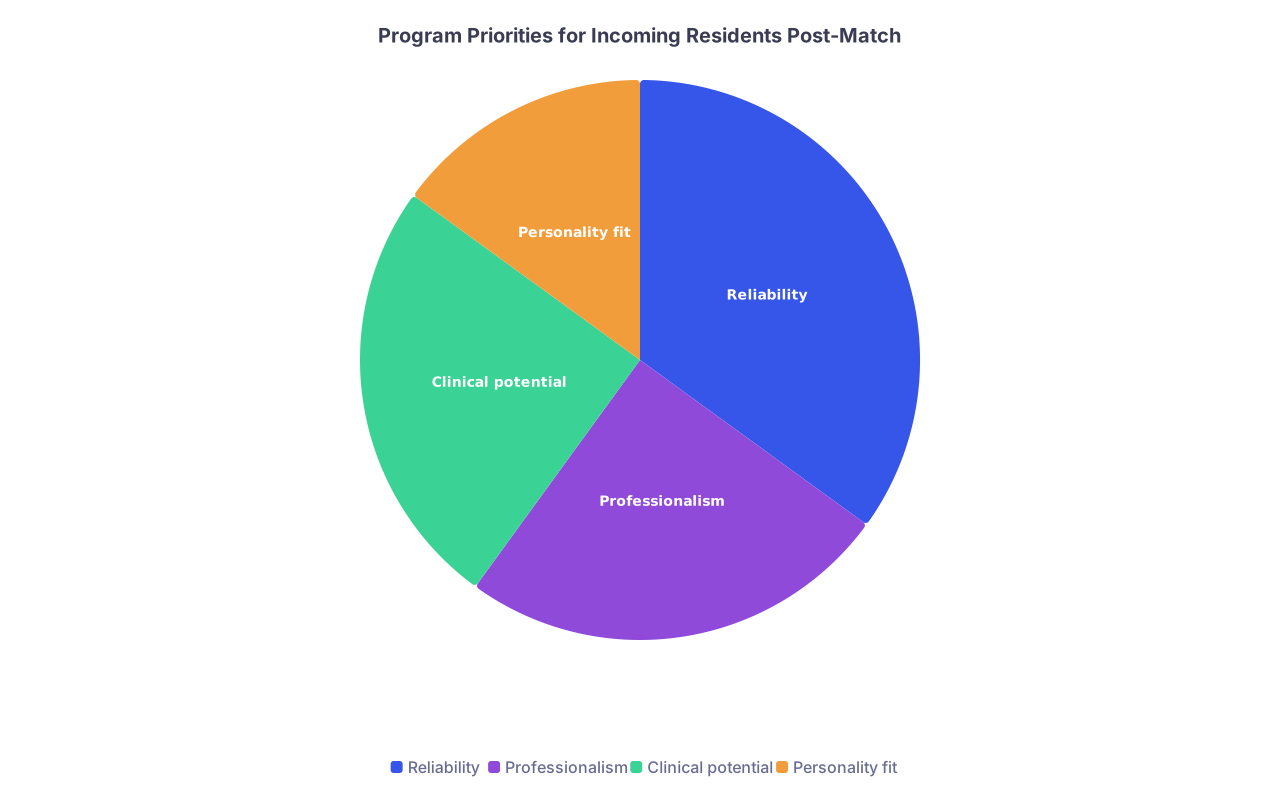
| Category | Value |
|---|---|
| Reliability | 35 |
| Professionalism | 25 |
| Clinical potential | 25 |
| Personality fit | 15 |
Notice what’s at the top: reliability and professionalism. You can’t show them your clinical skills in April. You can show them how you handle a welcome email.
That is why they care.
FAQs
1. What if I genuinely miss the welcome email for several days?
Own it. As soon as you see it, reply with a brief, non-dramatic acknowledgment:
“I apologize for the delay in responding; I was on an away rotation with limited email access. I’ve read through the information and will complete the required items by [date]. Please let me know if that timeline causes any issues.”
Then hit every deadline you just promised. Consistency afterward matters more than the initial miss.
2. Is it bad to ask questions or for clarification?
No. Bad is asking disorganized, lazy questions. If something is unclear even after you’ve read the email carefully, ask—once, clearly:
“I reviewed the onboarding instructions and had one question about [specific point]. Should I [option A] or [option B] in this situation?”
That kind of question signals care, not incompetence.
3. Can I mention scheduling needs (weddings, moves, family events) this early?
You can, but be strategic. If it’s a fixed, significant event (your own wedding, a visa deadline), it’s reasonable to bring it up early, framed respectfully:
“I understand schedule requests are complex, but I did want to mention that my wedding is scheduled for [date]. If there’s any way to consider time off around then, I’d be very grateful, and I’m flexible otherwise.”
Just do not show up with a list of “must-haves” before Day One.
4. Do programs really remember any of this once residency starts?
Yes. Not every detail, but the overall impression absolutely lingers. Coordinators and PDs might not recall your exact email, but they remember who was “great to work with” and who was “a headache before they even started.” That memory shapes how much slack or support you get when the real work begins.
Key points: The welcome email is your first real test of reliability and professionalism post-Match; your response starts the informal narrative about you long before July 1; and small, controlled, respectful communication decisions now will buy you a surprising amount of goodwill when residency actually hits.