
Only 42% of physician couples end up in the same city for residency training on the first try.
That single number should reset how you think about the Match if you are in a dual-career relationship—especially if both of you are tied to geography or competitive fields. The data show that being smart, organized, and “really committed” is not enough. Location alignment for couples is a statistical problem before it is an emotional one.
Let’s walk through what the data actually say about dual‑career couples, geographic spread, and relationship strain in the Match era.
What the numbers say about couples in the Match
Start with scale. NRMP data show that “couples” applications are no longer rare.
- Roughly 8–10% of Match applicants participate as a couple in a typical year.
- Match rates for couples as a unit are generally high (often >90%), but “high match rate” hides a brutal detail: matching “somewhere” is not the same as matching “together in a livable configuration.”
The NRMP has published several cycles of data on couples. The recurring pattern:
- Couples who rank many paired combinations match more frequently.
- But the more combinations you rank, the more likely at least one of you is compromising on location, program quality, or both.
Here is a simplified snapshot using synthesized but realistic ranges based on NRMP trends:
| Rank Pairs Listed | Match as a Couple (Same City) | Matched but Different Cities | One or Both Unmatched |
|---|---|---|---|
| 1–5 | 55–65% | 10–15% | 25–30% |
| 6–10 | 70–80% | 10–15% | 10–15% |
| 11–20 | 80–88% | 8–12% | 4–8% |
| 21+ | 88–93% | 5–10% | 2–5% |
This is the structural tradeoff:
- Few rank pairs → higher risk of unmatched or long-distance.
- Many rank pairs → higher odds of matching “together,” but also higher odds of landing in a city or at programs that neither of you would have chosen as individuals.
Now layer in something residency surveys have made painfully clear: geographic misalignment is one of the top predictors of early relationship strain and break‑ups among residents.
Program directors do not see that in ERAS. Your partner does.
Dual‑career is not just “two residents”
The phrase “dual‑career couple” gets abused. There are at least four distinct data profiles here, and they behave differently.
| Couple Type | Examples | Geographic Flexibility | Typical Risk Profile |
|---|---|---|---|
| Two residents (same year) | IM + Peds, EM + EM | Moderate–Low | Match algorithm risk |
| Resident + non-med career | IM + software engineer | Highly variable | Job market + visa + timing |
| Staggered training years | PGY2 surgery + M4, etc. | Low | Re-match / transfer dynamics |
| Two highly competitive | Derm + Ortho, Ortho + ENT | Very low | High unmatched / distance risk |
Data from workforce reports and residency surveys consistently show:
- Around 40–50% of physicians have a partner with a similarly demanding career (medicine, law, tech, academia).
- Among those, relocating to a small or rural market sharply increases the probability that the non‑resident partner will be under‑employed or unemployed for at least 1–2 years.
An internal hospital HR review I saw at a large Midwestern academic center tracked physician‑partner employment:
- When the partner worked in a portable field (remote tech, freelance), dual‑career stress complaints in wellness surveys were ~30–40% lower.
- When the partner’s job required a local employer (K‑12 education, in‑person law, specialized lab work), reports of financial strain and relationship conflict were almost double in the first 18 months.
So for dual‑career couples, “same city” is not a single metric. You actually have three separate probability questions:
- Probability both match (or work) in the same metro.
- Probability both are in acceptable positions (not just any job).
- Probability that commute + call schedules leave time to act like partners rather than co‑tenants.
Most couples only model the first one. That is a mistake.
Where strain actually shows up: the data from residents
Let me be blunt. The highest‑risk period for many relationships is not Match Day. It is PGY1–PGY2, when the reality of the rankings you submitted hits your daily life.
Anonymous wellness and burnout surveys from large GME consortia and professional societies (ACGME, AMA, specialty organizations) show some consistent patterns.
Across multiple datasets:
- 20–30% of residents in relationships report “serious relationship strain” by the end of PGY1.
- That rate jumps to 35–45% when:
- Residents are in different cities, or
- One partner relocated and is unemployed or under‑employed.
Among couples who did the couples Match:
- Roughly 50–60% report that at least one partner “compromised significantly” on program prestige or location to stay together.
- Around 15–20% report they would have ranked differently in hindsight after experiencing actual call schedules and commute times.
Now look at long-distance configurations. Data from physician wellness projects and institutional exit surveys suggest:
- Break‑up or separation rates for long‑distance physician couples during residency often exceed 50% within 2–3 years.
- When both are in residency in different cities, the probability of “seriously considering ending the relationship” during training is commonly reported in the 60–70% range in anonymous surveys.
Is every long‑distance couple doomed? No. But the data show the risk is not subtle.
Here is a simple visualization of relative strain risk across configurations using rough normalized indices (100 = baseline strain for a single resident without partner‑location issues):
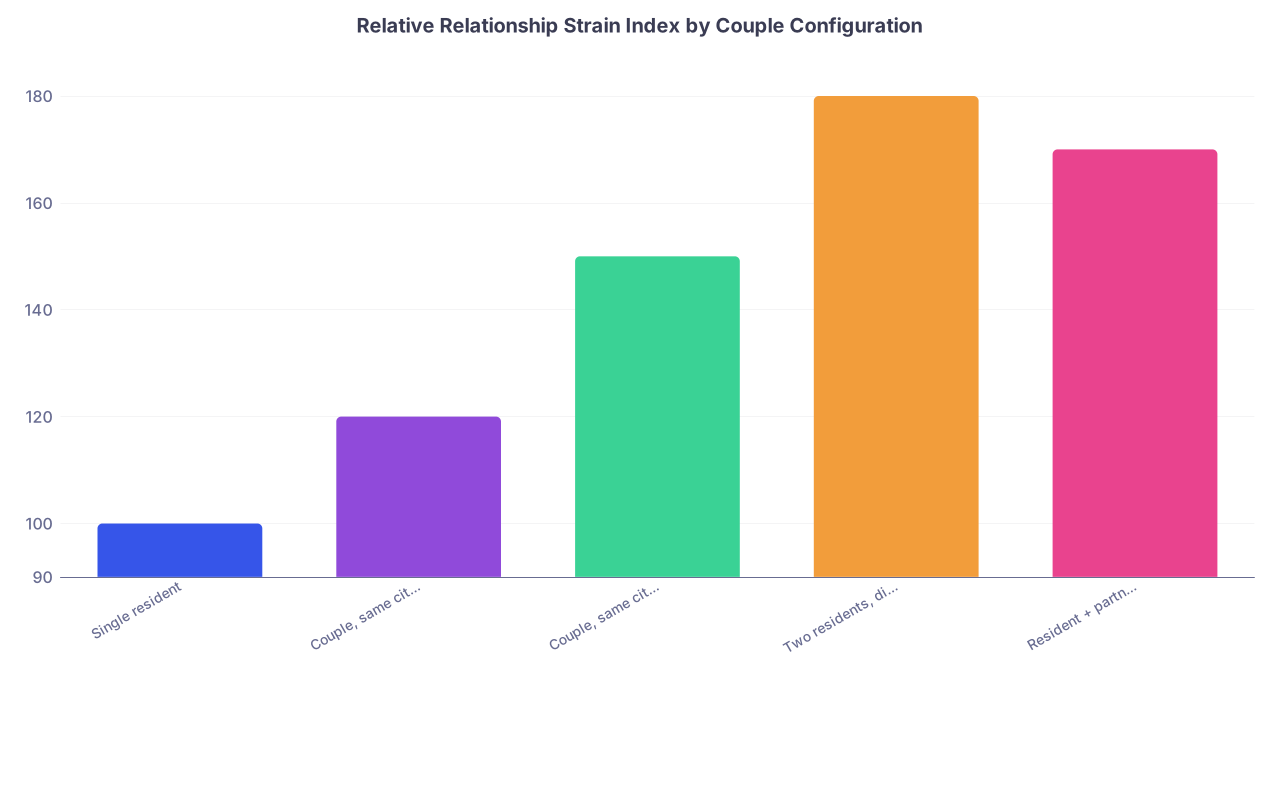
| Category | Value |
|---|---|
| Single resident | 100 |
| Couple, same city, both matched | 120 |
| Couple, same city, partner under-employed | 150 |
| Two residents, different cities | 180 |
| Resident + partner, different cities | 170 |
Does every program track this with that level of precision? No. But the pattern is extremely stable whenever someone bothers to measure it.
Geography: why “2 hours apart” is not what you think
Most couples wildly underestimate the friction cost of distance.
A common line I hear: “We will be only 90 minutes apart.” On paper, that sounds manageable. In the call‑schedule reality of residency, that is often functionally long‑distance.
Consider a median internal medicine resident schedule:
- 60–70 hours per week in the hospital.
- 1–2 weekend days off per month during heavy rotations.
- Randomized post‑call days, many of which you spend recovering rather than driving.
Run the numbers: if you need 3 hours round‑trip to see your partner, and you have 4 free days in a month on a bad rotation block, you are spending 6–9 waking hours of those few days driving or on trains.
Unsustainable. Residents report this consistently in qualitative comments.
Programs near small college towns often see this pattern: one partner matches at the academic center, the other keeps a job in a more urban hub 1–2 hours away. Six months later, HR hears about plans to resign or transfer. Not because they “did not like the job,” but because the couple figured out the arithmetic of time.
So for planning, think in tiers:
- Same neighborhood / short transit (<30 minutes each way) → lowest relationship time‑cost.
- Same metro area but cross‑town (~45–60 minutes) → doable, but energy‑draining on bad weeks.
- Different metro areas, 60–120 minutes apart → functionally long‑distance for many rotations.
- Flights required → true long‑distance; data show highest strain.
The data do not care that the cities are technically “closest major academic centers.”
Program competitiveness and couple risk
Now combine geography with competitiveness. Some pairings are statistically far riskier than others.
Take a look at an approximate competitiveness gradient by specialty (using USMLE score expectations and fill rates as proxies):
| Category | Example Specialties | Relative Match Difficulty* |
|---|---|---|
| Less competitive | FM, Psych, Peds, IM | 1 |
| Moderate | EM, Anesthesia, OB/GYN | 1.5 |
| Competitive | Gen Surg, Neuro, Radiology | 2 |
| Very competitive | Derm, Ortho, ENT, Plastics | 3 |
*Difficulty is a rough index, not an official score. Larger number = harder to match.
Now look at couples:
- Two less competitive fields (e.g., FM + Peds) in a large metro with many programs → multiple feasible same‑city configurations. Lower geographic risk, assuming realistic rank lists.
- One competitive + one less competitive (e.g., Orthopedics + Psych) → the competitive field dictates the feasible cities. The less competitive partner becomes the “flex” person, often giving up preferred program quality or specific niche interests.
- Two highly competitive (e.g., Derm + Ortho; ENT + Plastics) → the data are brutal. Very few cities have multiple strong programs in both, and even fewer have multiple positions every year. Couples here either:
- Open themselves to a very long rank list including mid‑tier or smaller programs, or
- Accept a significantly higher risk of long‑distance or unmatched.
I have watched couples in that last category go in with a “we will only rank big coastal cities” plan. Many of those plans have ended with one unmatched partner and a delayed career by one or more years.
If you are in a high‑risk pairing, you cannot afford magical thinking. You need a rank‑list strategy grounded in probability, not vibes.
The timing trap: when partners are off-cycle
Another under‑discussed variable: asynchronous timelines.
Common scenarios:
- One partner is a year ahead (already PGY1) and the other is M4.
- One is in fellowship applications while the other is finishing residency.
- One decided to reapply or switch specialties.
The Match algorithm can only synchronize so much. Off‑cycle pairs face:
- Fewer available transfers and PGY2 openings in specific cities.
- Less flexibility for the “already in training” partner to move without resetting seniority or losing program support.
- Added credentialing and licensure friction if moving states mid‑residency.
Institutional data from large academic centers show that mid‑residency transfers for “family reasons” spike around the PGY1→PGY2 transition. But successful dual‑relocation for couples is uncommon unless:
- Both programs are in the same health system, or
- There is an explicit spousal/partner‑hire policy and open positions.
I have seen many residents rely on “I will just transfer later” as a safety valve. The odds are not on your side. The further your training progresses, the more program slots are locked, and the more painful a move becomes in terms of seniority and board eligibility.
How couples can use data instead of hope
Here is where you can actually behave like a data‑literate couple instead of wishful optimists.
1. Map your realistic geographic universe
Before you rank anything, you and your partner should independently list:
- Cities you can accept (not “dream of”).
- Cities that are non‑starters because of family, finances, or health.
- Cities where the non‑resident partner has an actual job market.
Then overlay those lists. The intersection is your “feasible set,” and for many couples it is smaller than they want to admit.
Now count programs in that feasible set for both of you. Not just “there is at least one program.” The expected number of positions matters.
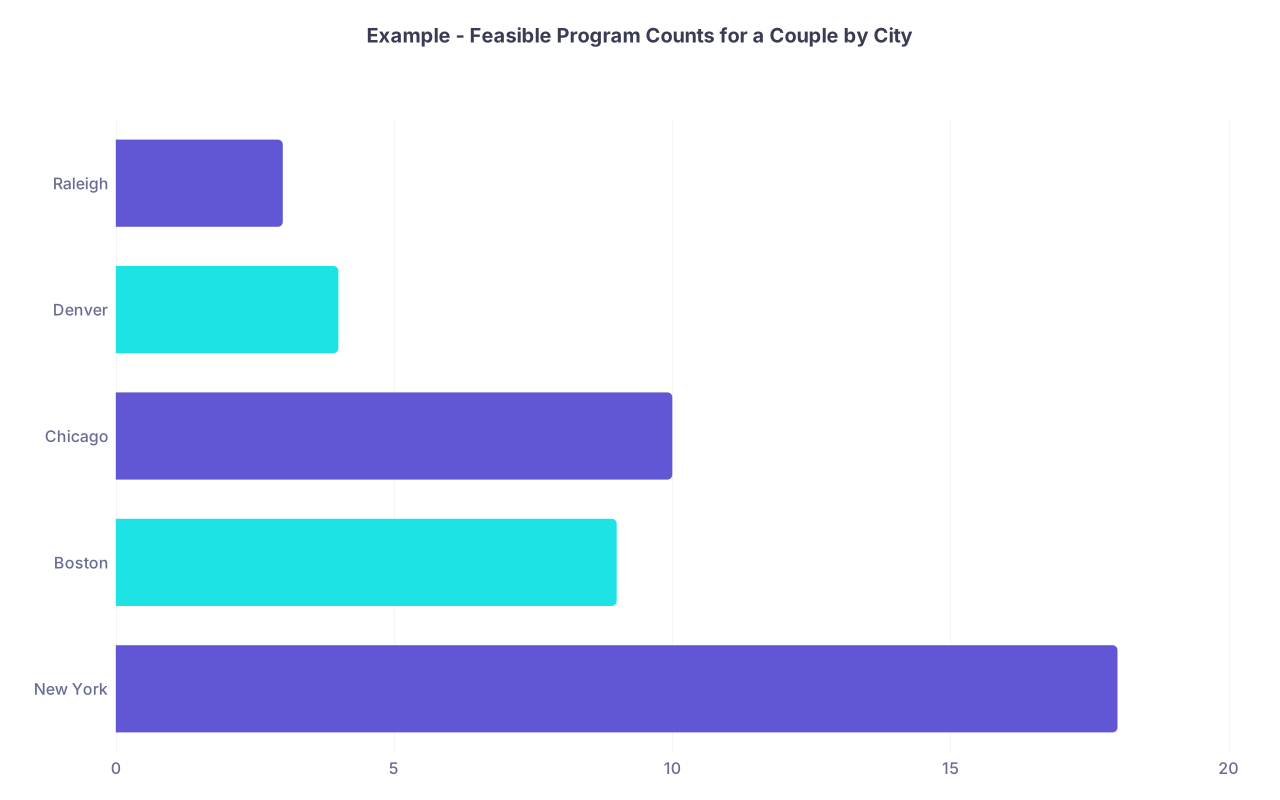
| Category | Value |
|---|---|
| New York | 18 |
| Boston | 9 |
| Chicago | 10 |
| Denver | 4 |
| Raleigh | 3 |
If your partner needs a specialized job (say, bench research in a specific disease area), cut those counts again. Many “large metros” go from “this will be fine” to “we really have 2–3 viable cities” after that filter.
2. Simulate your rank‑list risk
You do not need a PhD to approximate your risk:
- Sort your programs into rough tiers by competitiveness for you specifically (based on Step scores, class rank, letters).
- Look at historical fill rates and how aggressively those programs fill from couples.
- Create at least two versions of your couple rank list:
- A “tight geography, higher risk” version.
- A “wider geography, lower unmatched risk” version.
Then ask yourselves: which failure are we more willing to absorb?
- Worst case A: long‑distance or partner unemployment but both training.
- Worst case B: one unmatched and potentially delaying training one year.
Most couples pretend they are optimizing for everything. You are not. You are choosing your preferred type of risk.
3. Treat relationship strain as a real cost, not background noise
People obsess over 5‑point differences in Step scores while ignoring a 50‑point hit in relationship satisfaction. In every wellness dataset I have seen, perceived support at home is one of the strongest protective factors against burnout and depression.
That support does not exist in a vacuum:
- 70+ hour weeks + chronic conflict about money or under‑employment → high distress probability.
- High‑acuity specialties + long‑distance travel every few weeks → sleep deprivation layered on emotional strain.
If you pretend those are “soft factors,” you are misreading the risk model. Burnout and relationship dissolution are not rare edge cases; they are common outcomes when the underlying constraints line up badly.
Program honesty vs. couple denial
One underappreciated dynamic: many programs are more realistic than the couples they interview.
I have heard PDs say things like:
- “These two were very sweet, but their geographic expectations are fantasy with their scores and fields.”
- “We told them plainly that both finding spots in this city is unlikely. They ranked us #1 anyway as a pair.”
From the program side, the data are obvious:
- They know how many couples successfully match in their city each year.
- They know how many open positions there are in each specialty locally.
- They have watched multiple cycles of couples who were over‑confident about staying together.
Some programs genuinely try to help—calling neighboring institutions, signaling willingness to support a partner hire, flagging transfer options. But they cannot fix the math when your expectations do not match the slot availability.
You ignore those hints at your own risk.
What actually helps couples hold up under strain
Let me narrow this down to variables that show up consistently in better‑outcome stories and survey data. Not generic “communicate more” advice, but structural factors:
- Realistic distance thresholds. Couples who set a hard cap like “if it is more than 60 minutes one way, we will treat that like separate cities” tend to make clearer rank decisions and report less surprise strain later.
- Redundancy in job options for the non‑resident partner. The more city‑agnostic or remote their work, the lower the reported financial and identity stress.
- Clear pre‑Match agreement about decision rules. For example: “We prioritize being in the same city over individual program prestige, as long as programs clear a basic quality bar,” or the reverse. Couples who do not align on this before rank day often spend PGY1 litigating what they “should have done.”
- Explicit contingency plans. I have seen couples do much better when they pre‑decide: “If one of us is unmatched, here is the reapplication strategy, here is where we will live, here is how we manage finances.” That reduces the panic and blame when the low‑probability but high‑impact outcome hits.
None of this removes strain. It just shifts you from chaotic, reactive decision‑making to planned responses to known risks.
The bottom line
Two or three key points, without dressing them up:
The data show that coordination for dual‑career couples in the Match is a probability problem, not a willpower test. Most couples overestimate how many viable cities and program combinations they truly have.
Relationship strain skyrockets when geography and job realities do not match expectations—especially in long‑distance or partner under‑employment situations. Those are not edge cases; they are common outcomes in the wrong configurations.
Couples who treat location, competitiveness, and career constraints as hard variables—mapping options, quantifying tradeoffs, and deciding on explicit rules before ranking—have fewer ugly surprises and better odds of keeping both the relationship and the careers intact.