
The obsession with “program tier” is statistically exaggerated—and strategically misunderstood.
If you matched “below your dream” and you are already catastrophizing your fellowship odds, you are reacting like most residents. But the data show a more nuanced story: prestige helps, yes, but it is not the dominant variable many people believe. It is a multiplier, not a substitute, for performance.
Let’s walk through this the way a selection committee quietly does: as a probability problem, not a vibes problem.
1. What “Tier” Actually Buys You (And What It Does Not)
Programs are not officially tiered, but everyone on the trail talks in the same broad buckets:
- Top 10–20 “brand name” national programs
- Strong academic regionals (top ~25–75)
- Solid community / hybrid academic programs
- Pure community programs with minimal research focus
Most residents grossly overestimate the “step function” between these buckets. They imagine a cliff. The data show more of a gradient.
A few reasonably consistent advantages for higher-tier residencies:
- Stronger fellowship placement on average
- More program leadership connections to PDs at competitive fellowships
- Higher density of research, mentors, and built-in pipelines
- Stronger peer cohort (you are compared against strong co-residents, which can help or hurt, depending on your performance)
But here is the part residents like to ignore: fellowship selection committees weight your metrics more than your program name once you cross a basic threshold of program reputation and clinical training.
I have seen this play out multiple times in the same fellowship rank meeting:
- Candidate A: Top-15 IM residency, middle-of-the-pack in that cohort, weak research, Step 2 CK 238, average letters.
- Candidate B: Mid-tier academic IM residency, top 5% of class, robust research and one first-author paper, Step 2 CK 252, very strong letters.
Nine times out of ten, B outranks A. The program name gets attention, but it does not override performance.
2. The Data: How Much Does Program Tier Move the Needle?
You will not find perfect national datasets with all variables exposed, but we have enough partial signals: NRMP “Charting Outcomes,” subspecialty match reports, and program-level fellowship placement data that residents whisper about and PDs present at conferences.
To make this concrete, let’s sketch approximate (but realistic) probabilities based on pattern data in internal medicine → cardiology GI heme/onc, since those are among the most competitive medicine fellowships.
Approximate Fellowship Match Odds by Residency Type
Assumptions: U.S. MD, no major professionalism issues, roughly average applicant effort.
| Residency Tier | Competitiveness of Fellowship | Approx Match Probability |
|---|---|---|
| Top 20 academic IM | Cardiology | 70–80% |
| Strong regional academic IM | Cardiology | 55–65% |
| Community/university-affiliate | Cardiology | 35–45% |
| Pure community IM | Cardiology | 20–30% |
These are not official numbers, but they align with what PDs themselves present privately: a 2–3x swing in probability between top academic vs low-resource community programs, all else equal.
Now add performance into the equation. Performance moves your curve more than tier alone.
Performance vs Tier: A Simple Model
Imagine a crude “fellowship desirability score” built from:
- Step 2 CK / ITE performance
- Clinical evaluations
- Research output (weighted by relevance and authorship)
- Strength of letters and advocacy
- Program tier bonus
In practice, selection committees are doing a noisy version of this in their heads. Program tier generally acts as a 10–25% “multiplier,” not a 200% jump.
So:
- High performer at mid-tier academic program often outranks a mediocre performer at a top-20
- High performer at community program can absolutely match into competitive fellowships, but usually needs a stronger portfolio (more research, better scores, stronger advocacy)
Let’s visualize this conceptual tradeoff.
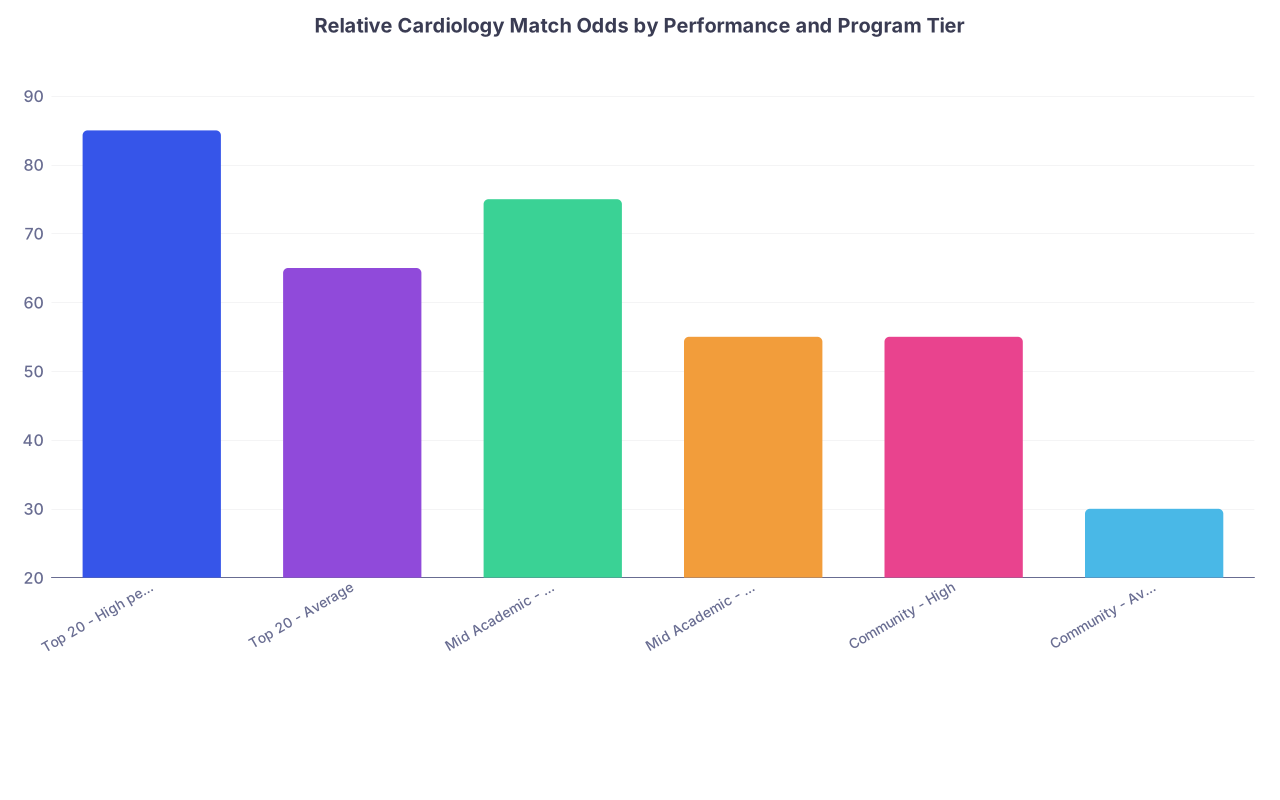
| Category | Value |
|---|---|
| Top 20 - High performer | 85 |
| Top 20 - Average | 65 |
| Mid Academic - High | 75 |
| Mid Academic - Average | 55 |
| Community - High | 55 |
| Community - Average | 30 |
Interpretation:
- Moving from “average” to “high performer” inside the same tier shifts odds by ~20 percentage points.
- Moving up one tier at the same performance level shifts odds by ~10–20 points.
So, yes, your program “tier” matters. But your rank within your residency matters at least as much.
3. Subspecialty Variability: Where Tier Matters Most
Program tier impact is not uniform across all fellowships. The more over-subscribed and academic the field, the more pedigree matters.
Think of this as a “tier sensitivity index.”
Tier-Sensitive (High Prestige Weight)
- Dermatology (from prelim / TY year perspective)
- Radiation oncology
- Cardiology (especially interventional tracks later)
- GI
- Heme/Onc at top research programs
- Surgical subspecialties (e.g., surg-onc, CT, vascular from gen surg)
Moderately Tier-Sensitive
- Pulm/CCM
- Endocrinology
- Rheumatology
- Nephrology (largely academic but with somewhat more room)
- ID (academic, but many programs less obsessed with prestige)
Lower Tier Sensitivity
- Geriatrics
- Palliative care
- Hospital medicine fellowships / chief years that function as quasi-fellowships
- Community-based fellowships in almost any field
For top academic cardiology or GI at brand-name institutions, program tier can be a significant differentiator. Many of their rank lists are stacked with residents from the same ~40–50 “name” programs. They simply trust the calibration of evaluations and letters from those institutions more, and there is more cross-pollination among faculty.
I have sat in a room where someone said, “She is at [Top 10 IM program], their PD does not oversell. If they say she is top 10%, I believe it.” That is the network effect in raw form.
But notice the pattern: this is about signal reliability. If your program is lesser-known, you need harder evidence (scores, pubs, clear metrics) to compensate for the weaker brand signal. It is not an automatic rejection.
4. Internal Pipelines vs External Mobility
Where tier really asserts itself is through pipelines.
Higher-tier programs often have:
- In-house fellowships in multiple subspecialties
- Alumni spread across many national fellowships
- Faculty with personal connections to PDs in your target field
- “Home-field” advantage for their own residents
Look at this simplified comparison.
| Residency Type | In-house Fellowships | External Name Recognition | Alumni Network Reach |
|---|---|---|---|
| Top 20 academic IM | 6–10+ subspecialties | Very strong | National/international |
| Strong regional academic IM | 3–7 | Strong in region | Regional + selective national |
| Community/university-affiliate | 1–3 | Variable | Mostly regional |
| Pure community IM | 0–1 | Limited | Local/regional |
The internal pipeline matters for two big reasons:
- Home fellowship spots: You are competing against a smaller applicant pool, and the faculty know your work personally. Odds of matching at your own institution are often higher than at a similar-level external program.
- Advocacy strength: A fellowship PD at your hospital can call a colleague at another program, say, “This resident is outstanding,” and that phone call carries much more weight than a generic LoR.
Residents at pure community programs typically lack both. That does not mean shutout. It means you must build external relationships deliberately: away rotations, regional/national conferences, collaborative research.
5. Case Scenarios: “Below Dream” vs Outcomes
Let me walk through stylized, data-informed scenarios that mirror cases I have seen repeatedly.
Scenario 1: Internal Medicine, Matched to Mid-Tier Academic, Wants GI
Profile:
- U.S. MD, Step 2 CK 244
- Matched to a mid-tier academic IM program (e.g., mid-ranked university hospital)
- No publications yet, some research exposure
Baseline GI odds from this seat, with average trajectory: perhaps 40–50%.
How to push that to 60–70%:
- Become a top 10–20% resident (ITE, ward evaluations)
- Get at least 1–2 GI-focused publications or abstracts at DDW
- Secure a letter from a GI PD / division chief who is known outside the institution
- Apply broadly (40–60 programs) and be willing to move
Here, the “below dream” program is not remotely a death sentence. The variance from your performance is bigger than the tier gap between your current and dream program.
Scenario 2: Community IM, Wants Cards at Top Academic Center
Profile:
- U.S. MD, Step 2 CK 250
- Community-based IM residency, no in-house cardiology fellowship
- Minimal research infrastructure
Baseline odds at a top-15 cards fellowship: low. Maybe 5–10% if you apply cold with nothing but scores and good evals.
But if you:
- Crush your ITEs and become clearly the best resident in your class
- Build a research relationship with an academic cardiologist at a nearby university (even if it means unpaid time, commuting, remote work), producing 1–2 meaningful abstracts/pubs
- Get letters from that academic mentor plus your PD that use explicit comparative language (“best resident in 10 years”)
- Apply across the full spectrum (including mid-tier academic fellowships)
Then your odds of matching cards somewhere (not necessarily top-15) can jump into the 40–50% range. For top-15, maybe 20–25% if your portfolio is stellar and you interview well.
This is the uncomfortable truth: coming from a very low-resource community program, cracking the very top academic fellowships requires you to be an outlier. The tier penalty is real at that extreme. But the majority of solid academic cardiology fellowships remain accessible.
6. Quantifying the “Tier Penalty” and “Tier Bonus”
Let’s frame this like a simple model, because that is how selection bias actually behaves.
Imagine you had a baseline probability of matching a competitive fellowship if all programs were reputationally identical. Then adjust:
- +10–20 percentage points if you train at a top-20 research-heavy academic residency
- +5–10 points if you are at a strong regional academic program
- 0 baseline at community/university-affiliate
- −10–20 points at a small, completely unknown community program with no track record
Then add performance modifiers:
- +20–30 points if you are top 10% of your class with strong scores and research
- +10–15 points for solid research and above-average evals
- 0 for average
- −15–25 points if weak evaluations or no scholarly activity in a research-heavy field
Now apply it to a hypothetical GI applicant.
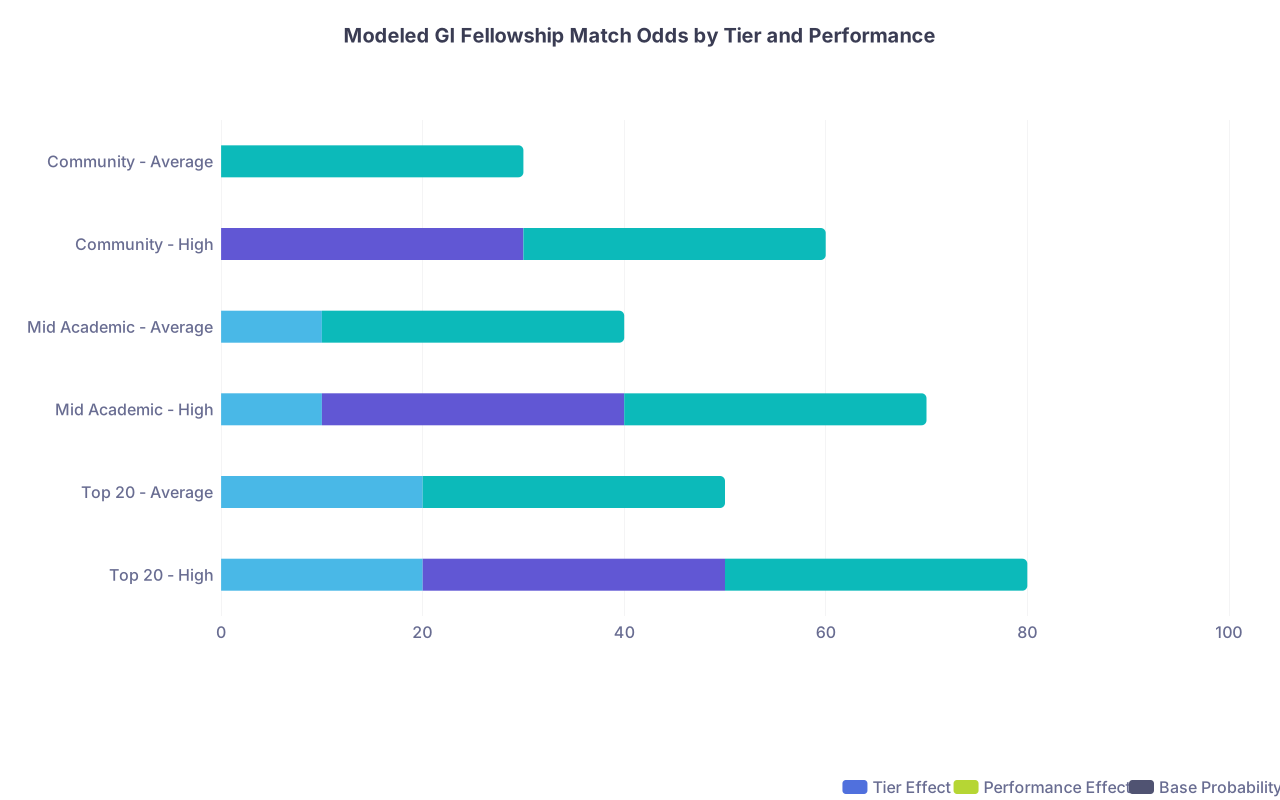
| Category | Tier Effect | Performance Effect | Base Probability |
|---|---|---|---|
| Top 20 - High | 20 | 30 | 30 |
| Top 20 - Average | 20 | 0 | 30 |
| Mid Academic - High | 10 | 30 | 30 |
| Mid Academic - Average | 10 | 0 | 30 |
| Community - High | 0 | 30 | 30 |
| Community - Average | 0 | 0 | 30 |
Interpretation:
- “Top 20 – High”: 30 base + 20 tier + 30 performance = ~80%
- “Mid Academic – High”: 30 base + 10 tier + 30 performance = ~70%
- “Community – High”: 30 base + 0 tier + 30 performance = ~60%
Massive difference? No. Tier helps, but being a high performer narrows the gap dramatically.
The real disaster is “Average at low-resource community” in a hyper-competitive field: 30 base − 10 or −20 tier, 0 performance boost → you are in sub-20% territory.
In other words, being average is far more dangerous than being “below dream tier.”
7. How Selection Committees Actually Read Your File
You should think about fellowship applications the way PDs discuss them in closed-door rooms. They do not say, “This person is from a low tier, reject.” They say:
- “Do we know anyone at this program who can vouch for her?”
- “This is a small community program, but she has three first-author papers in our field.”
- “He is at [top-5 program] but looks very average for that environment, and their letter is lukewarm.”
- “This IM program has sent us good fellows before, I trust their evaluations.”
Program tier shows up indirectly:
- Calibration: They know how to interpret a “top 10%” comment from a big-name institution better than from a tiny program they have never heard of.
- Risk mitigation: Unknown program + no research + no personal connection → harder to justify a risky interview slot.
- Ease: It is simply easier to fill your interview list pulling from familiar brands.
You break out of that inertia with:
- Clear, hard evidence (scores, publications)
- Strong, specific letters from known names or very detailed PD letters
- Signals of excellence (chief resident, teaching awards, national abstract awards)
This is why some residents at “below dream” programs end up with objectively stronger fellowship outcomes than classmates from top-10s—because they had to build a real, data-backed application instead of relying on program name.
8. Strategy if You Matched Below Your Dream Tier
Now the part that actually matters: what you do from here.
8.1 Calibrate Your Target Field with Reality
Look at competitiveness data:
- For IM: cards / GI / heme-onc high; pulm/CCM mid-high; endo, rheum, ID, neph somewhat lower; geri/pall lower still.
- For gen surg: surg onc, CT, vascular more competitive than community MIS, bariatric, etc.
Ask your PD for your program’s last 3–5 years of fellowship placement by field. That is your “base rate.” If your program has never sent someone to a top-15 GI program, you are not doomed—but you know you must be exceptional and probably geographically flexible.
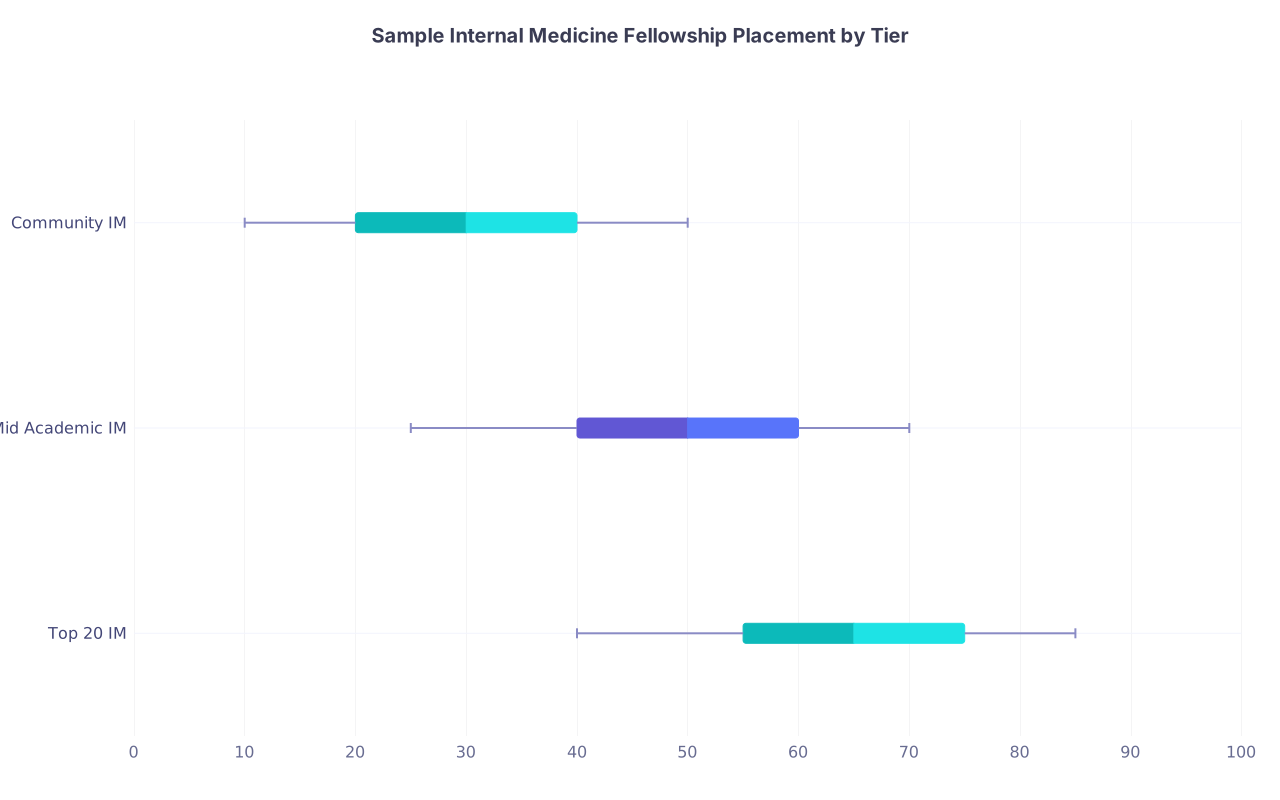
| Category | Min | Q1 | Median | Q3 | Max |
|---|---|---|---|---|---|
| Top 20 IM | 40 | 55 | 65 | 75 | 85 |
| Mid Academic IM | 25 | 40 | 50 | 60 | 70 |
| Community IM | 10 | 20 | 30 | 40 | 50 |
This boxplot-like approximation: fraction (in %) of residents over several years who matched any competitive subspecialty. You can see tier shifts the distribution, but there is overlap.
8.2 Maximize the High-Leverage Metrics
If your program is “below dream,” your margin for mediocrity is smaller. The levers that statistically move your odds most:
- Be at the top of your residency class: Strong ITEs, clear “go-to” on wards. PD letters that say “top 5%” or “best in X years” are huge.
- Research in your field: Even 1–2 well-executed projects with presentations at national meetings (AHA, ACC, DDW, ASH, ATS) can dramatically upgrade your profile.
- Get known externally: Regional/national abstracts, elective at a neighboring academic center, or virtual collaboration. Create at least one external mentor if your home program is small.
I have seen residents at modest community programs who understood this game and walked into excellent fellowships because they treated the first 18–24 months of residency as a focused portfolio-build, not just survival.
8.3 Be Strategic About Geography and Program Lists
Tier interacts with geography.
- If you are at a mid-tier program in the Midwest, you are more likely to match fellowships in the Midwest, even at higher-prestige institutions, than hop to the coasts into ultra-elite places.
- Your “dream” GI program on the coasts might be a stretch, but a strong academic GI program in your current region is statistically more achievable.
Do not anchor on a single institution. Build ranges:
- Tier 1: Dream programs (maybe 5–10)
- Tier 2: Strong academic programs where your profile realistically fits
- Tier 3: Solid but less shiny spots that still give you the subspecialty you want
Volume matters. Competitive fellowship candidates applying to 60–80 programs is common. Residents hate to hear this, but the data from subspecialty matches is clear: more apps → more interviews to a point, especially if you are coming from a lower-tier residency and need breadth.
9. The Bottom Line: Tier Is a Modifier, Not a Fate
If you matched below your dream, the data story is blunt but not bleak:
- Program tier shifts your fellowship odds by roughly 10–25 percentage points in either direction, depending on how extreme the tier difference is.
- Your performance within residency—scores, evaluations, research, and letters—typically swings your odds by 20–40 percentage points. Larger effect size.
- Hyper-elite fellowships at brand-name institutions are more tier-sensitive. But the majority of solid academic fellowships in most fields remain accessible to high performers from mid-tier or even community residencies.
The key points to remember:
- Tier is a multiplier on your existing profile, not a replacement for it.
- Being average at a top program is far less powerful than being outstanding at a mid-tier one.
- You cannot change where you matched, but you have enormous control over how strong your data look by PGY-2.
Do not waste your next three years mourning the program you did not get. Use those three years to generate numbers, letters, and outcomes that make fellowship PDs stop and say, “This applicant is clearly top-notch—where they trained is almost secondary.”