
Last March, I watched a fourth-year who was dead-set on ortho open her Match email. “Preliminary Surgery – One Year.” She stared at the screen and said exactly what you’re probably thinking: “So…did I fail? And what do I do now?”
If that’s you right now—matched to a surgical prelim year, not a categorical spot—this is where the fantasy of a neat, straight-line career path ends. But it’s also where your next move actually matters more than the Match itself. Let’s walk through this as if we’re sitting in a call room and you’re asking, “Ok, what now?” Because there is a path—actually several—and some of them are much better than others.
1. What a Surgical Prelim Year Really Means (And What It Does Not)
First, you need clarity, not vibes.
A surgical preliminary (prelim) year is:
- A one-year, non-categorical position in general surgery (sometimes other surgical subspecialties)
- Intended either as:
- A “tryout” year for possible advancement into a categorical spot, or
- A service year for people headed into another specialty (anesthesia, radiology, etc.)
It is not:
- A guaranteed path to a categorical surgery position
- A hidden back door that automatically converts if you work hard enough
- A signal that you’re doomed or unmatchable
Here’s the harsh part: many programs see prelims as workforce. Some invest in them, some don’t. You need to quickly figure out which one you’re in.
You also need to understand your own context:
- Did you rank prelim as a back-up while aiming for categorical surgery?
- Did you aim for something ultra-competitive (ortho, urology, plastics) and this is your landing spot?
- Did you actually prefer another field but used prelim surgery to stay clinically active?
Your strategy depends on those answers.
2. Step One: Call It What It Is and Decide Your Real Goal
Before you start planning, you have to admit to yourself what you want. Not the polite version you tell faculty. The real one.
There are basically four paths from a surgical prelim year:
- Move into a categorical general surgery spot (at your program or another)
- Move into a categorical subspecialty surgery (rare, and heavily relationship-based)
- Switch into a different specialty (anesthesia, EM, IM, radiology, etc.)
- Do the prelim year, then end up scrambling again with weaker leverage and more fatigue
Your job is to choose which of the first three you’re actually chasing, so you can avoid the fourth.
Ask yourself:
- “If I could magically have any PGY-2 position a year from now, what would it be?”
- “If I never got into a surgical categorical spot, would I still want to be a doctor? In what field?”
If your honest answer is: “I only want to be a surgeon, or I’d rather quit medicine,” you’re playing a narrow and risky game. Not impossible. But risky. You then need an all-in surgical strategy.
If your answer is: “I really just want to operate, but I’d be happy in anesthesia/EM/IR/etc,” your approach is different—still intense, but more flexible.
I’d actually write this goal down in one sentence and keep it somewhere you’ll see it. Because by October, post-call, exhausted, you’re going to forget what you decided when you were clear-headed.
3. Before July 1: Damage Control and Positioning
You have a few months between Match Day and starting intern year. Use them smartly.
A. Get brutally honest feedback on why you didn’t match categorically
You cannot fix what you won’t name.
Reach out to:
- Your med school’s surgery chair or program director
- A mentor in the specialty you applied to
- Your home program’s APD or core faculty who know your file
Ask direct questions:
- “If you were a PD, what would have kept you from ranking me to match?”
- “Was it scores, grades, letters, interview skills, or something else?”
- “If I want to end up in a categorical surgical spot, what has to change in the next 6–12 months?”
Do not argue. Take notes. Assume they’re mostly right.
B. Understand your prelim program’s track record with prelims
This is huge. Every prelim year is not equal.
Email or call your future program coordinator or chief residents and ask:
- “Over the past 3–5 years, how many prelims go on to categorical surgery—here or elsewhere?”
- “Does this program ever convert prelims to categorical if someone leaves?”
- “Do prelims get protected OR time, or mostly floor/ICU coverage?”
Then talk to current prelims. Off the record. Ask them:
- “If you could redo Match, would you still come here?”
- “Do you feel the program actually advocates for prelims?”
- “Are any of you moving into categorical spots? How did that happen?”
You are not being nosy. You’re doing survival scouting.
C. Decide if you’re reapplying in the upcoming cycle—before you start
If you want to be in the next ERAS cycle (this fall), you have to prepare before the intern year steamrolls you.
That means:
- Updating your CV and personal statement
- Requesting letters now from med school faculty
- Registering for ERAS early
- Scheduling any missing Step 2 / Step 3 if relevant
- Telling your mentors and med school that you plan to reapply
Trying to assemble an application from scratch in October during q4 call is how people end up missing an entire cycle.
4. How to Run Your Prelim Year If You Want a Categorical Surgery Spot
Let’s say your goal is: “I want a categorical general surgery PGY-2 spot next year.” Here’s how to behave from Day 1.
A. Day 1–30: Signal your intent to leadership (clearly but not desperately)
Within the first month, you should meet with:
- The program director
- The associate PD or site director
- At least one or two respected surgical faculty
The conversation sounds like:
“I’m very grateful to be here. My long-term goal is a categorical general surgery position. I’d love your honest guidance on how I can make myself competitive for any PGY-2 openings here or elsewhere. If any opportunities for extra responsibility, research, or strong letters arise, I’d really appreciate being considered.”
You are not asking them to promise you a spot. You’re asking for a roadmap and visibility.
Follow it up with a short thank-you email that restates your goal in writing.
B. Work like someone they’d be embarrassed to lose
Yes, everyone says “work hard.” But specifics matter.
Things that actually move PDs:
- Show up early, leave late, reliably
- Know your patients cold—labs, imaging, plans—so your seniors trust you
- Volunteer for cases, then read on the procedure and anatomy the night before
- Be the prelim who quietly fixes problems: consents missing, imaging not ordered, discharge summaries done on time
You are trying to be the intern people name when a last-minute PGY-2 opening appears:
“If anyone deserves that spot, it’s them.”
Don’t be a martyr. Don’t be fake. But understand that prelims are often used to “audition” for surprise vacancies.
C. Get at least 2–3 powerful, specific letters
Aim for:
- The program director or APD
- A high-volume surgeon who saw you operate and manage patients
- Optional: A research or subspecialty mentor
Ask for letters when:
- You’ve spent a full rotation or several months with them
- You’ve just had a strong block or case
- You know they like your work (you’ll feel it)
Phrase it this way:
“I’m planning to apply for categorical PGY-2 positions in general surgery this year. Would you feel comfortable writing me a strong, detailed letter of recommendation?”
If they hesitate, don’t use them.
Tell them your timeline, provide your CV and personal statement, and gently remind them a few weeks later.
D. Be strategic about rotations
Some prelim schedules are customizable. If you get any say:
- Maximize rotations where PDs and key faculty can see you (main hospital, busy services)
- Avoid getting buried in endless off-service months where no one in surgery knows you
- Try to spend time on services where categorical residents are strong—you’ll be compared to them
If your schedule is rigid, still do the same mentally: overperform in high-visibility months.
5. The PGY-2 Hunt: How to Actually Find a Categorical Spot
This part is chaotic if you wait. Less chaotic if you’re deliberate.
A. ERAS reapplication vs. off-cycle PGY-2 spots
You basically have two routes:
- Re-apply in ERAS as if you’re applying from scratch
- Chase off-cycle PGY-2 openings that appear throughout the year
In reality, you probably have to do both.
| Path | Timing | Main Tool | Risk Level |
|---|---|---|---|
| ERAS PGY-1 Reapply | Standard cycle | ERAS | Medium |
| Off-cycle PGY-2 Spot | All year | Direct contact | High |
| Internal Conversion | Unpredictable | PD decision | Variable |
| Switch to Other Specialty | Standard cycle | ERAS | Medium |
B. ERAS strategy as a prelim
Your “story” in your application has to evolve:
- New personal statement: what you learned from intern year, proof you can function as a resident
- Updated experiences: include concrete intern responsibilities, not just med school fluff
- New letters: at least 2 from your current prelim program
You also need to decide:
- Are you reapplying to PGY-1 categorical spots?
- Or applying specifically to PGY-2 openings (when listed)?
Many programs will only take you as a PGY-1 categorical even if you did a prelim; some will slot you into PGY-2 if your training matches ACGME requirements.
C. Off-cycle PGY-2 positions
These come from:
- Residents who resign, are dismissed, or transfer
- Program expansions
- New funding lines
You find them by:
- FREIDA postings
- ACGME vacancies page
- Specialty-specific vacancy lists (ABS, specialty societies)
- Program listservs and word-of-mouth
And then you email directly:
- PD
- Program coordinator
Subject line example: “Current Surgical Prelim PGY-1 Seeking PGY-2 Categorical Position”
In the body:
- 2–3 sentences about who you are (current prelim at X, previous med school, step scores roughly)
- Clear interest in their program
- Attached CV, ERAS application (if applicable), and a concise paragraph on why you’re a strong PGY-2 candidate
CC a mentor if appropriate—they sometimes quietly vouch for you behind the scenes.
6. If You’re Using Prelim Surgery as a Bridge to Another Specialty
You might have matched to a surgery prelim but already know you want:
- Anesthesia
- Emergency medicine
- Radiology
- PM&R
- IM
Different game.
A. Decide now what you’re applying into
Do not wait until December to “see how the year goes.” By then, ERAS is over and interview season is in full swing.
Pick your target specialty by July.
B. Tell your surgical PD early—but carefully
You do not need to pretend you’re trying to be a surgeon if you’re not.
Script:
“I’m very grateful for this prelim opportunity. My long-term goal is to match into anesthesia. I’m committed to doing an excellent job on your service this year, and I also plan to apply in this upcoming ERAS cycle. I’d really appreciate any advice and, if appropriate, your support.”
Most PDs respect honesty if you’re a good worker. Where they get annoyed: prelims who do minimal work because “this isn’t my field.”
C. Get letters from both worlds
You should have:
- One strong letter from your surgical PD or core faculty: “This person is a strong intern. We’d keep them if we could.”
- Letters from the specialty you’re applying to (home institution or visiting rotations if possible)
If your target field is at your prelim institution, try hard to rotate through it. Elective month in anesthesia or EM as a hard-working intern is high-yield.
7. Managing the Reality: Prelim Year Is Often Brutal
Let’s not pretend this is a cozy gap year.
Surgical prelims often:
- Work some of the hardest schedules
- Get fewer “protected” educational experiences
- Have more uncertainty about the future than categoricals
You need a survival plan or you’ll burn out halfway and tank your chances.
A. Protect the basics aggressively
Nobody’s going to do this for you:
- Sleep: Post-call, go home. Do not agree to “just help with one more thing” unless the patient is crashing.
- Food: Keep real food in your bag. Surviving on graham crackers and coffee will destroy you.
- Health: Schedule your own dentist, PCP, therapist. Don’t be the martyr who ignores chest pain because “rounds are starting.”
This isn’t wellness fluff. If you fall apart physically, your work declines, and so do your letters and options.
B. Contain your resentment
You’ll see categorical interns complaining about things you’d kill to have (a guaranteed PGY-2, a protected research block, a calm clinic day). You’ll be tempted to stew.
Don’t.
You cannot afford to be the bitter prelim who bad-mouths the program or specialty. People talk.
Vent to:
- One trusted non-surgical friend
- A therapist
- Your family
At work, stay professional and neutral. You can be honest with trusted residents—just don’t dump on everyone.
C. Have a clear “Plan B” and “Plan C”
Example:
- Plan A: Categorical general surgery PGY-2
- Plan B: Re-enter Match as PGY-1 categorical general surgery or anesthesia
- Plan C: Switch fields completely (IM, EM, etc.) next cycle if doors stay closed
You’re less likely to panic if you know, “If by January nothing is biting, here’s what I do.”
8. How Programs Actually See Prelims (The Part No One Says Out Loud)
You need to understand the politics so you can stop taking everything personally.
Reality:
- Some programs genuinely use prelims as a pipeline for categorical spots.
- Some programs never convert prelims and view them purely as service.
- Some PDs will never rank a former prelim from their own program because “it’s complicated with our current residents,” but they’ll happily recommend you elsewhere.
- Your reputation as “the amazing prelim from X” can open doors at places you’ve never rotated.
So:
- Don’t cling to the idea that your prelim program owes you a spot.
- Do focus on becoming the prelim everyone will fight to recommend.
Your stock is not only determined by a single PD. It’s also shaped by the senior residents who say, “We’d take them over half our own interns.”
9. Timeline: What You Should Be Doing, Month by Month
Here’s a rough flow so you don’t get lost.
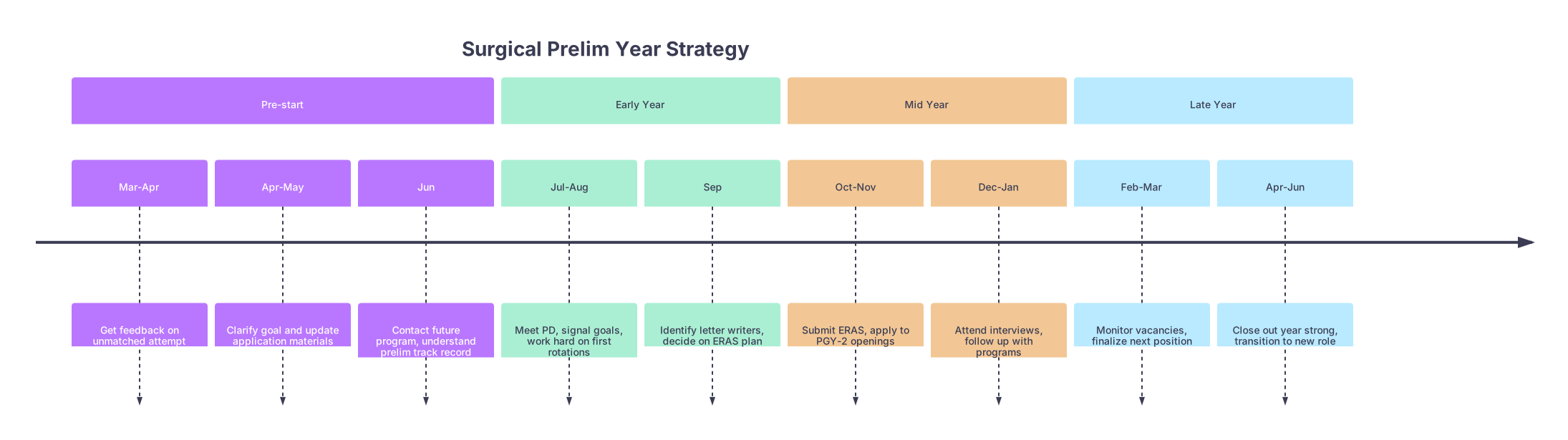
| Period | Event |
|---|---|
| Pre-start - Mar-Apr | Get feedback on unmatched attempt |
| Pre-start - Apr-May | Clarify goal and update application materials |
| Pre-start - Jun | Contact future program, understand prelim track record |
| Early Year - Jul-Aug | Meet PD, signal goals, work hard on first rotations |
| Early Year - Sep | Identify letter writers, decide on ERAS plan |
| Mid Year - Oct-Nov | Submit ERAS, apply to PGY-2 openings |
| Mid Year - Dec-Jan | Attend interviews, follow up with programs |
| Late Year - Feb-Mar | Monitor vacancies, finalize next position |
| Late Year - Apr-Jun | Close out year strong, transition to new role |
You’re basically running two parallel jobs:
- Do not crash and burn your intern year.
- Conduct a targeted, relentless search for your next position.
Both matter.
10. When It Feels Like It’s Falling Apart
There will be a night—honestly, probably several—where you’re post-call at 11 pm, dictating a consult, and you’ll think, “Did I wreck my entire career?”
Let me be blunt:
- Prelim surgery is not a career death sentence.
- It can be an asset if you convert it into proof: “I can function as a strong intern in a demanding environment.”
- It can also be a trap if you coast and then act surprised when no one fights for you.
When you’re spiraling, pull back to three questions:
- What’s my real goal?
- What’s the next concrete action I can take this week for that goal?
- Who do I need to talk to next (PD, mentor, faculty) to move one inch closer?
Then do that. One inch at a time is how people move from prelim to categorical, not some magical overnight jump.
11. Quick Recap: Your Next Step After Matching a Surgical Prelim
Keep these three points front and center:
- Decide your real end goal early—categorical surgery, other specialty, or something else—and let that drive every decision in your prelim year.
- Treat the prelim year like a high-stakes audition, not a holding pattern: overperform clinically, get powerful letters, and actively hunt for PGY-2 or categorical spots starting in the fall.
- Control what you can and have a backup plan—you can’t force a program to create a spot, but you can become the intern they’re proud to recommend anywhere, and that reputation travels a lot farther than you think.