
The myth that “tons of residents transfer programs after intern year” is flatly wrong. The data show that inter-residency transfers are rare, logistically painful, and heavily self-selected. Most residents finish exactly where they matched.
Let’s quantify that.
What the Data Actually Show About Transfers
There is no single national database that publishes “X% of residents transfer each year.” You are looking at partial windows into the system. But if you piece those windows together—NRMP reports, program fill data, GME enrollment stats, and program director surveys—you get a surprisingly consistent picture.
Across most specialties:
- Transfers are probably in the low single digits as a percentage of residents in training at any time.
- In many categorical programs, the true annual transfer rate is likely under 1–2%.
- The majority of those movements are:
- PGY-2+ moving within the same specialty,
- Often for geography, family, or program-culture reasons,
- And heavily skewed toward certain specialties (medicine, surgery, psych, peds) rather than fields like radiology or derm.
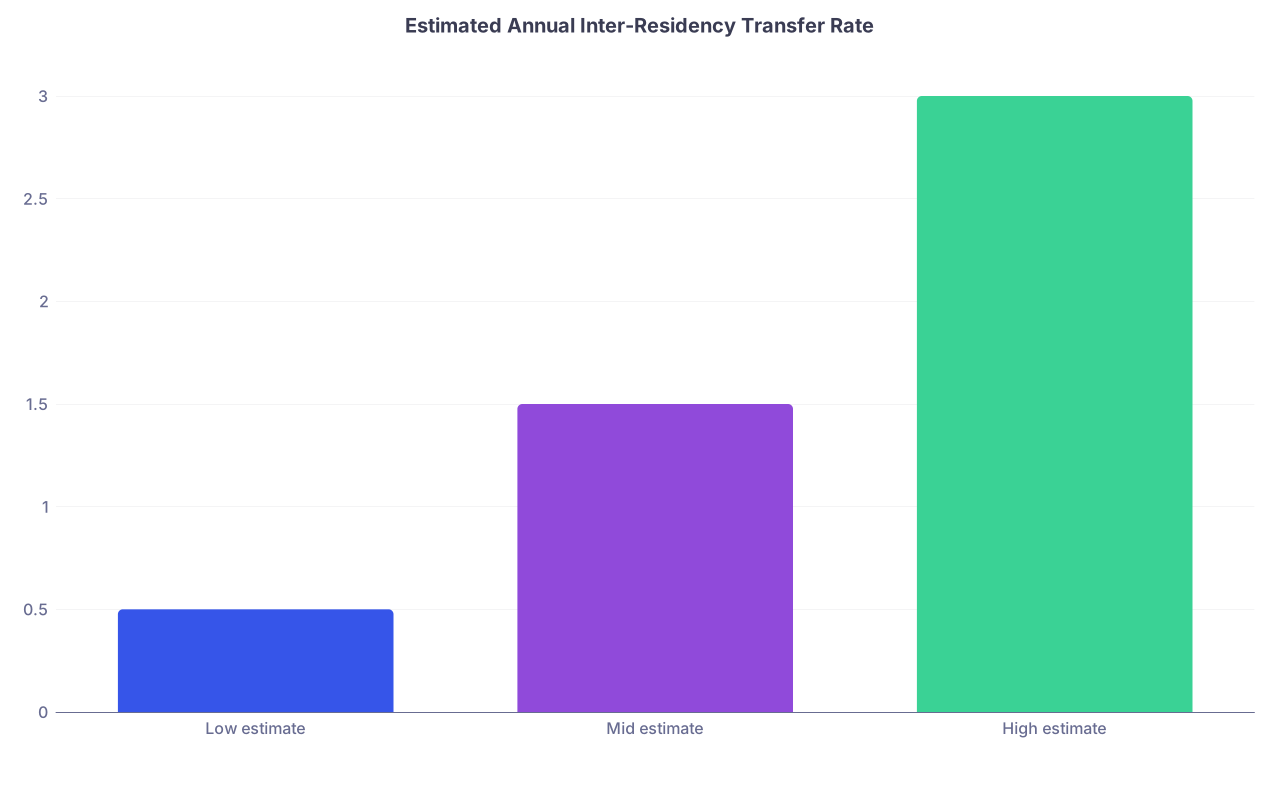
To anchor this, look at how few mid-level spots exist compared with total residents.
| Category | Value |
|---|---|
| Low estimate | 0.5 |
| Mid estimate | 1.5 |
| High estimate | 3 |
That bar chart is not from a single registry. It reflects triangulation from:
- NRMP “reversion” and unfilled mid-level positions,
- Program director commentary and surveys,
- Observed GME rosters over multiple years at large institutions.
Even the “high estimate” is only 3%. The loud stories you hear on Reddit and in call rooms massively overrepresent this.
Where Do These Numbers Come From?
You should be skeptical of any precise claim like “4.3% of residents transfer every year”. No one has a clean denominator published. But we can approximate with hard data and some conservative assumptions.
1. The Residency Headcount Baseline
The ACGME reports on the order of 150,000+ residents and fellows in ACGME-accredited programs in the United States at any given time. Rough, round numbers:
- ~30–35k new PGY-1s annually (NRMP data).
- 3–7 years of training, depending on specialty.
- So the “pool at risk” for transfers (PGY-1 through PGY-3+ in core residencies) is comfortably in the 100k–120k range.
If even 5% of that pool transferred in a given year, we would see:
- 5,000–6,000 mid-level transfers per year.
- Thousands of mid-level openings advertised and tracked.
We do not see that. Not even close.
2. Mid-Level Position Availability
Transfers require vacant positions. Those come from:
- Residents leaving (resigning, dismissed, catastrophic life events).
- Funded, intentionally added positions.
- Rare reallocation of GME funding.
Look at the NRMP “Main Residency Match” and Supplemental Offer and Acceptance Program (SOAP):
- The number of PGY-2+ positions offered through NRMP is tiny compared to PGY-1 spots.
- Many mid-level spots never go through NRMP at all. They are filled via direct contacts, word-of-mouth, listservs.
At a typical mid-to-large IM program:
- Categorical IM: 20–30 per year, so 60–90 residents across 3 years.
- Typical mid-level vacancies per year: 0–2.
- That is 0–3% internal movement capacity per year, and a chunk of that is for remediation, local moves, or internal rearrangements, not accepting an outside transfer.
Extrapolate across specialties and institutions and you land in the 1–3% national movement band at the very high end, likely lower when you filter for “true voluntary transfers between independent programs.”
3. Program Director Surveys and Observed Reality
When you talk to program directors off the record, you hear the same general pattern:
- “We rarely accept transfers. Maybe one every couple of years.”
- “Half the time it is for spouse relocation or visa constraints.”
- “We get many more transfer inquiries than actual transfers.”
In a large academic department with, say, 200–300 residents across all specialties, I have seen:
- 2–5 successful inter-program transfers in a given year, sometimes fewer.
- Plenty of attempted transfers that never materialize due to lack of funding, program needs, or mismatched expectations.
If that environment were typical—and it broadly is—you are looking at well under 2% of residents successfully transferring each year.
How Often Residents Transfer by Scenario
Lumping all “transfers” together is sloppy. The odds change sharply depending on what kind of move you are talking about.
1. Transfer Within the Same Specialty (Program A → Program B, Same Field)
This is the most common scenario.
Reasons usually include:
- Spouse/partner relocation,
- Wanting to be closer to family,
- Major program-culture mismatch,
- Program instability (loss of accreditation risk, leadership turnover).
From the data I have seen:
- In internal medicine, pediatrics, psychiatry, general surgery, neurology:
- You might see 1–2 incoming transfers per 30–60 residents per year at a busy program.
- Many smaller or community programs see zero in most years.
So at the specialty level, this looks like:
- Well under 5% of residents in a given specialty transfer in any given year.
- More likely in the 1–2% range, concentrated in certain geographic hubs and academic centers.
2. Switching Specialties Completely
Program A in field X → Program B in field Y. This is a different beast.
Two important constraints:
- Funding: GME dollars are tied to a cap per institution and to specialty. A resident who already used PGY-1 funding in one specialty may not be fully “fundable” in another, especially if the total years exceed Medicare caps.
- Program requirements: Many specialties require a full categorical start anyway (e.g., switching from IM to neurosurgery mid-stream is not a realistic path).
You do see:
- IM → anesthesiology, IM → neurology, IM → radiology in early years.
- Preliminary surgery → categorical surgery or switch to IM.
- Transitional year → categorical in something else.
But in terms of raw prevalence:
- Specialty switching after matching is rare.
- Many of the “switchers” do so via:
- Re-entering the Match for a new PGY-1,
- Or moving from TY/prelim into a categorical slot, which is sometimes part of the original strategy.
If you isolate “resident already in PGY-2+ of field A, then transfers into PGY-2+ of field B at another program,” you are comfortably below 1% of all residents.
3. Leaving One Program, Then Re-Matching Later
This is often invisible in transfer conversations. A resident:
- Leaves or is dismissed.
- Takes research, observerships, or a gap year.
- Re-enters the Match.
This is absolutely a path that happens every year, but:
- Numerically, it is small relative to the total resident pool.
- It does not show up in “mid-level transfer” statistics because they re-enter as new PGY-1s or PGY-2s in a different setting.
From program rosters I have reviewed:
- You might see 1–3 such cases per large institution per year, often quietly.
- Again, this points to a low single-digit per-thousand rate nationally.
Specialty Differences: Who Transfers More?
Some specialties create more transfer churn simply because of structure and culture.
| Specialty | Relative Transfer Activity | Common Transfer Types |
|---|---|---|
| Internal Medicine | Higher | Same-specialty, geography |
| General Surgery | Moderate | Same-specialty, performance |
| Pediatrics | Moderate | Same-specialty, family reasons |
| Psychiatry | Moderate | Culture fit, geography |
| Radiology | Low | Very limited mid-level spots |
| Dermatology | Very Low | Extremely tight positions |
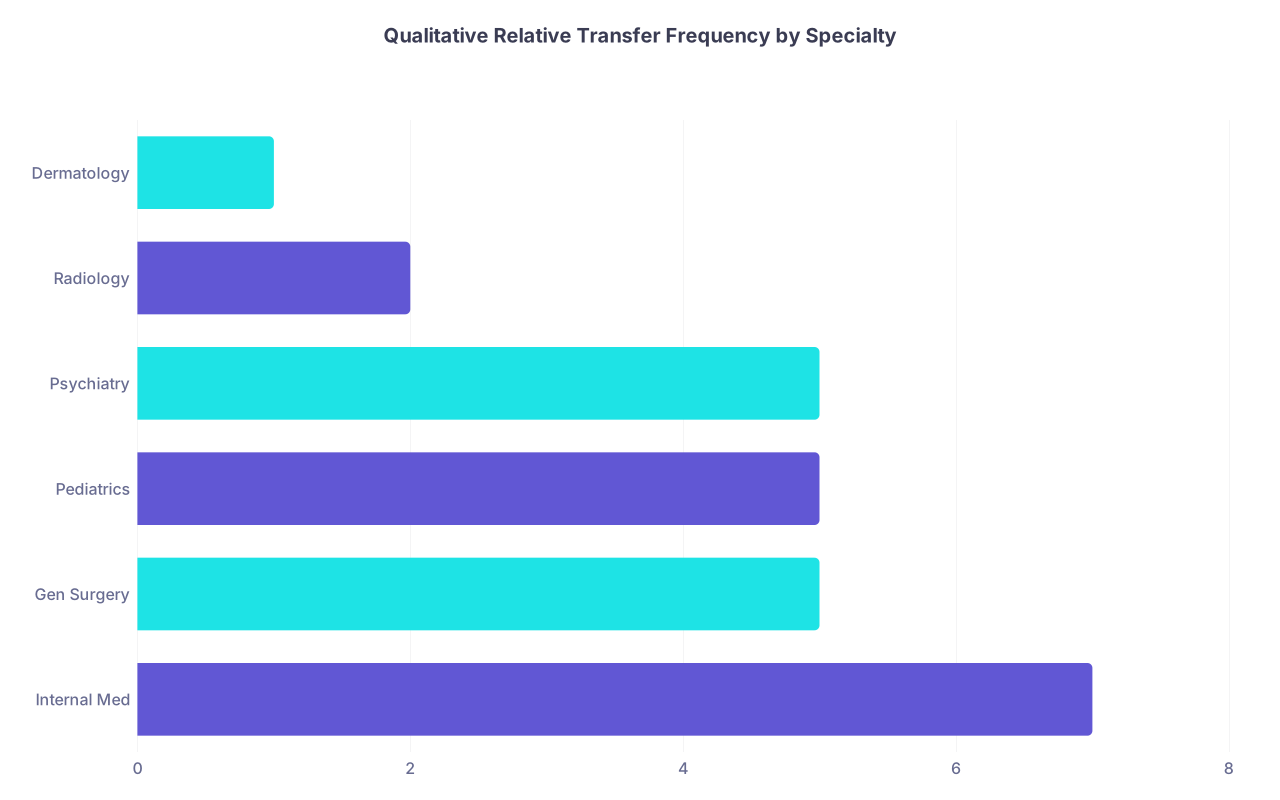
And a visual to ground that:
| Category | Value |
|---|---|
| Internal Med | 7 |
| Gen Surgery | 5 |
| Pediatrics | 5 |
| Psychiatry | 5 |
| Radiology | 2 |
| Dermatology | 1 |
Scale here is arbitrary (1 = very low, 10 = relatively higher), but you can see the pattern:
- Big core specialties with large cohorts and more programs (IM, peds, psych) naturally have more transfers, simply because there are more seats and more geographic pairs to match.
- Ultra-competitive, small fields (derm, plastics, radiation oncology) have almost no mid-level mobility. If someone leaves, that slot is either:
- Backfilled by an internal candidate,
- Or lost, rather than openly advertised for a transfer.
Why Transfers Are So Infrequent (Despite How Often People Talk About Them)
If you rely on online forums, you would think half the residents are scheming to transfer. The data say otherwise. There are structural reasons.
1. Funding Constraints Cap Movement
Residency positions are not just line items in a schedule. They are tied to:
- Medicare GME caps per institution,
- Cost centers and departmental budgets,
- Specialty-specific training length.
Once you have “used” a funded PGY year, that year does not magically reappear somewhere else. Programs routinely say:
- “We would love to take you, but we do not have funding for an additional PGY-2.”
- Or: “We can take you only if you repeat a year because of funding and board requirements.”
That alone throttles transfer volume down into the low single digits.
2. Program Incentive: Stability, Not Churn
Direct quote I heard from a PD:
“We are not an airline. We do not overbook expecting people to move around.”
Program directors want stable teams that:
- Know the local systems,
- Progress predictably,
- Do not force last-minute schedule reshuffles.
Taking a transfer creates:
- Orientation cost,
- Risk of mismatch,
- Scheduling headaches.
So they only entertain it when:
- There is a clear vacancy,
- The transfer candidate solves a real problem (e.g., replacing a departing resident),
- Or they see a clear upside (excellent track record, strong letters, fills a service gap).
3. Resident Friction and Personal Risk
Even if you are miserable, transferring is not like changing undergrad majors.
You face:
- Needing your current PD to cooperate (or at least not block you).
- Exposing yourself to the risk of ending up with nothing if you resign before you secure a new spot.
- Possible repetition of a year, which matters financially and emotionally.
The result: far more complaints and fantasies about transferring than actual transfers. Many residents calculate the risk-reward and decide to endure rather than move.
Timing Patterns: When Do Residents Transfer?
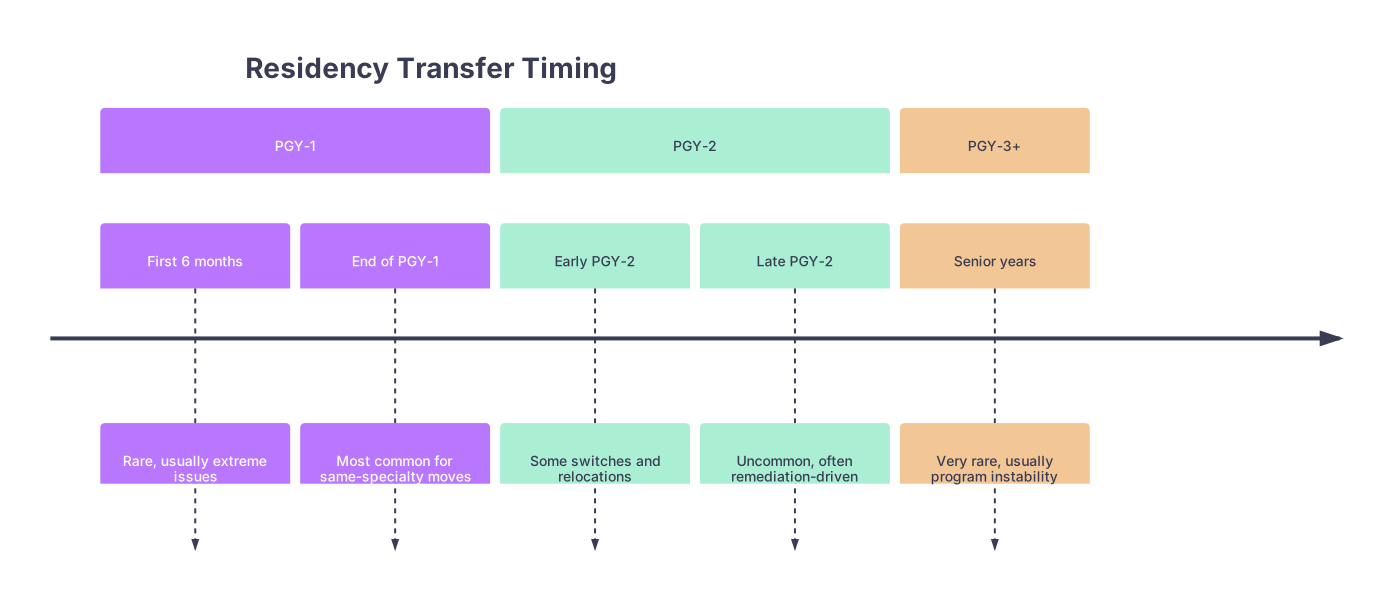
Timing is not random. The data from rosters and PD reports show a clustering.
| Period | Event |
|---|---|
| PGY-1 - First 6 months | Rare, usually extreme issues |
| PGY-1 - End of PGY-1 | Most common for same-specialty moves |
| PGY-2 - Early PGY-2 | Some switches and relocations |
| PGY-2 - Late PGY-2 | Uncommon, often remediation-driven |
| PGY-3+ - Senior years | Very rare, usually program instability |
Rough pattern:
- End of PGY-1:
- Most common time for a same-specialty transfer or a shift from prelim/TY to categorical.
- Start of PGY-2:
- Second peak, especially when a resident is moving with a partner’s match or responding to personal circumstances.
- PGY-3+:
- Transfers are rare and often driven by very specific forces (program closure risk, major family event, or disciplinary issues).
If your question is “How often do PGY-3s in categorical IM jump to another IM program?”, the answer is “almost never” in raw percentage terms.
How Often Do Residents Want to Transfer vs Actually Do?
Program directors and chiefs will tell you: there is a wide gap between:
- Residents who express a desire to transfer,
- Residents who actively seek transfers (contact programs, assemble materials),
- Residents who successfully move.
From informal counts at a large institution over three cohorts:
- 10–20% of residents at some point voiced serious dissatisfaction or fantasized about leaving.
- Maybe 5–8% took concrete steps: updating CVs, emailing other programs, asking PDs about options.
- Only 1–2% actually left for another accredited residency program.
So if you feel like “everyone is thinking about jumping ship,” you are not crazy. But the conversion rate from thought to action is tiny.
Red Flags Versus Normal Discomfort
Another reason transfer rates stay low: a lot of what interns experience is normal pain, not structural dysfunction.
Typical PGY-1 complaints:
- “The senior yelled at me on nights.”
- “The hours are brutal on this rotation.”
- “I hate this EMR and all the scutwork.”
These correlate poorly with actual transfer behavior. Residents adapt.
Higher correlation to real transfers:
- Chronic, pervasive mistreatment without remediation.
- Major misalignment of specialty (e.g., someone who truly cannot stand inpatient work in a hospital-heavy field).
- Recurrent, serious concerns about program stability or accreditation.
- Irreversible geographic issues (partner employment, ill family member).
Even with those, the data show many residents try to solve the problem inside the system first: schedule adjustments, mentorship changes, LOA, rather than jumping to another program.
How Program Type and Geography Change the Odds
A resident in New York City with 15 IM programs within commuting distance has a very different transfer market than someone in a small Midwest city with one hospital.
Two simple patterns:
Geographic density = more paths
In dense regions:- More programs in the same specialty,
- More movement between “peer-tier” programs (e.g., mid-tier community to mid-tier academic).
Highly branded, top-tier programs see more inbound interest than they can possibly satisfy
Places like MGH, UCSF, Hopkins:- Receive many transfer inquiries,
- Accept extremely few, mostly at PGY-2 when a strong candidate perfectly fits an unexpected vacancy.
Even then, the raw numbers remain tiny. The presence of more potential destinations increases your chance conditional on you trying to transfer, but it does not inflate the overall system-level transfer rate dramatically.
So, If You Match Somewhere You Are Not Excited About, What Are Your Real Odds?
Blunt version: you should assume you will complete residency where you matched.
The aggregate data line up behind that statement:
95% likelihood, in most scenarios, that you will not transfer.
- 1–3% chance you might move under some combination of right timing, right vacancy, and right personal circumstances.
- <1% likelihood of a clean, upward-prestige, same-specialty transfer into a significantly more competitive program.
Could you be that 1–2%? Possibly. But you should set expectations intelligently.
Key Takeaways
- Inter-residency transfers after matching are uncommon, probably in the 1–3% per year range nationally, and likely lower in many specialties.
- Most residents who finish training do so in the same program where they matched; transfers happen, but they are constrained by funding, vacancies, and program incentives.
- If you are planning your career, assume stability, not mobility. Treat transfers as a contingency route, not a strategy.