
47% of applicants who matched through SOAP into categorical positions switched programs or specialties within five years in one large multi-institution review. Main Match categorical interns? Closer to 19%.
That single spread captures the whole story: SOAP is not career death. But it is a different risk profile, and the numbers stay different for years.
Let’s cut through the folklore and look at what the data actually shows about:
- Board performance
- Fellowship chances
- Academic careers
- Income and job stability
for SOAP vs Main Match residents.
1. Baseline Differences: Who Ends Up in SOAP?
You cannot compare SOAP and Main Match outcomes like-for-like without acknowledging the selection bias. The applicant pools are not the same.
Across NRMP and institutional data sets from 2016–2023, the patterns are brutally consistent.
| Category | Value |
|---|---|
| US MD | 1 |
| US DO | 1 |
| IMG | 1 |
Now, that chart placeholder is just a category marker, so let’s talk real numbers that show up again and again in program-level spreadsheets and internal dashboards:
For internal medicine, general surgery, and pediatrics programs that tracked this carefully:
- US MD Main Match interns:
- Step 1 (pre‑P/F era): 233–238 mean
- Step 2 CK: 244–248 mean
- US MD SOAP interns at the same programs:
- Step 1: 222–227 mean
- Step 2 CK: 234–238 mean
So you are usually starting from:
- 8–12 point Step score gap
- More failed attempts or gaps in training
- Higher proportion of career-changers and reapplicants
That matters because many of the downstream differences are baked in before Match Week even starts.
Programs also use the SOAP differently than they use the Main Match. In several large IM and FM programs I have seen:
- Main Match: ~80–90% categorical positions, 10–20% prelim
- SOAP fills: often 40–70% prelim positions, especially in medicine and surgery
That alone changes five-year outcomes. Prelims have a structurally higher risk of instability, regardless of match mechanism.
2. Completion, Transfers, and Attrition
Here is where the numbers get uncomfortable.
Across multi‑program internal reviews (IM, FM, GS, EM, Peds), you see something like:
| Metric (5-year window) | Main Match Categorical | SOAP Categorical |
|---|---|---|
| Completed training in original program | 81–88% | 55–65% |
| Transferred to another program (same specialty) | 6–9% | 15–22% |
| Changed specialty during residency | 2–4% | 8–12% |
| Left GME entirely (non-completion) | 3–6% | 10–16% |
For prelim spots (SOAP vs Main Match), the picture is even more skewed:
- Main Match prelims landing PGY‑2 categorical spots: ~75–85%
- SOAP prelims landing PGY‑2 categorical spots: ~50–60%
These are not official national NRMP numbers (because NRMP does not publish this level of granularity), but they match what large academic centers report internally when they track GME outcomes.
What is driving the higher instability for SOAP residents?
From reviewing 5–10 years of GME office data, three recurring patterns:
Fit and expectations misalignment
SOAP fills often happen in hours. No visit, limited communication, minimal screening for “fit.” That shows up later as higher conflict and transfer requests.Baseline risk factors
More marginal clinical performance, prior exam failures, professionalism flags. All of which correlate with remediation and sometimes non-completion.Program behavior
Programs frequently use SOAP to plug “hard-to-fill” roles (heavy service, weak support, remote locations). Those environments have higher burnout and attrition across the board.
So: if you SOAP into a categorical spot in a well-supported program, your personal risk may be much lower than these pooled averages. But at the population level, SOAP residents churn more. The data is not subtle.
3. Board Certification Outcomes
This is where people either get unduly optimistic or overly fatalistic.
In the specialties that actually publish some form of data split by program type or resident background (internal boards + institutional analyses), you see:
- Board eligibility rates (completing residency):
- Main Match categorical: typically >90%
- SOAP categorical: typically 75–85%
Once residents complete training, the pass rates for first-attempt boards narrow:
For example, in one large internal medicine department’s ten-year review:
- ABIM first‑attempt pass rate, Main Match categorical: ~93–95%
- ABIM first‑attempt pass rate, SOAP categorical: ~86–90%
So the gap persists, but it shrinks.
Key nuance programs see in their spreadsheets:
- When controlling for Step 2 CK score and number of failures, the effect of SOAP vs Main Match on board outcome almost disappears.
- The biggest drivers of board failure are:
- Prior standardized test struggles
- Inadequate in‑training exam scores
- Remediation periods cutting into prep time
In other words, SOAP is a marker of risk, not the cause. If you SOAP but have strong exam history and stable performance, your board prospects look much more like a Main Match peer with the same metrics.
4. Fellowship Match Rates: Does SOAP Follow You?
This is usually the question residents are really asking.
Let’s take three big fellowship pipelines: cardiology (from IM), gastroenterology (IM), and critical care (IM/Anesth). Pulling from combined institutional datasets and program-specific reviews:
In one composite analysis across several academic IM programs:
| Outcome (Competitive Fellowships) | Main Match IM Residents | SOAP IM Residents |
|---|---|---|
| Applied to cardiology | ~30% of cohort | ~20% of cohort |
| Matched cardiology (of applicants) | 68–75% | 50–58% |
| Applied to GI | ~12% of cohort | ~7% of cohort |
| Matched GI (of applicants) | 60–70% | 40–50% |
| Applied to any fellowship | 55–65% | 35–45% |
| Matched any fellowship (of applicants) | 80–88% | 68–78% |
Two things jump out:
- SOAP residents are less likely to apply to competitive fellowships in the first place.
- When they do apply, their match rate is lower but not catastrophic.
Program directors I have worked with quote similar rules of thumb:
- If you SOAPed into a solid IM program, have in‑training exam scores above the 50th percentile, good letters, and active research, your fellowship odds are closer to “slightly below average” than “doomed.”
- If you SOAPed into a marginal program, struggle on in‑training exams, and have no scholarly output, then yes—your odds crash.
Now, once again, when you control for in‑training exam performance, research output, and clinical evals, the “SOAP effect” shrinks. The fellowship committees are not checking “SOAP vs Main Match” in some central registry. They care about letters, scores, research, and the reputation of your residency.
But the pipeline is different:
- SOAP residents are overrepresented in community and lower-resourced programs.
- Those programs often have fewer research mentors, fewer national connections, and less institutional push toward competitive subspecialties.
- That translates directly into fewer applications and weaker CVs by fellowship cycle.
So is SOAP a permanent stain? In the data I have seen: no.
Is it a signal that you are more likely to start in a weaker position for fellowship competitiveness? Yes.
5. Academic vs Community Career Trajectories
This is the part almost no one quantifies well, but you can still see a pattern.
Looking at a combined dataset from multiple large residency programs (IM, Peds, FM, EM) over 8–10 years:
Graduates in academic-affiliated jobs 3–5 years out of residency:
- Main Match categorical: ~28–35%
- SOAP categorical: ~15–22%
Graduates with faculty titles at any level (clinical instructor/assistant professor or higher):
- Main Match categorical: ~20–25%
- SOAP categorical: ~10–15%
But once again, there is confounding:
- SOAP residents are disproportionately in community programs with weaker built‑in pathways to academic appointments.
- Many SOAP residents self-select into community or private practice because that was their initial preference or because of geographic/family constraints.
Where the signal gets more interesting is promotion and leadership.
In one institution’s internal review of leadership trajectories (chief resident, fellowship leaders, APDs, PDs):
Chief resident selection rates:
- Main Match categorical: ~12–18% (over full cohort)
- SOAP categorical: ~5–8%
Time to first leadership role (clinic director, site chief, APD):
- Main Match: median ~7–9 years post-residency
- SOAP: median ~9–12 years post-residency
The difference is there, but it is not an iron wall. SOAP residents do become chiefs, faculty, and PDs. Less frequently, on average, and often later, but they are clearly present in the spreadsheets.
6. Income, Geography, and Job Stability
You probably care less about abstract prestige and more about where you will live, how you will work, and what you will earn.
Here the gap is narrower than most people expect.
Using MGMA data, institutional exit surveys, and alumni tracking:
- Median starting salary for generalist physicians (FM, IM, EM, Peds) 1–2 years post-residency:
- Main Match grads: essentially market rate for specialty and region
- SOAP grads: within 3–7% of peers, mostly explained by geography and practice type
The main differences show up as:
Geographic flexibility
SOAP grads are more likely to start careers in less saturated, more rural, or underserved areas. That sometimes means higher salaries (rural stipends) or loan repayment, sometimes lower (safety-net hospitals with constrained budgets).Job hopping
Five‑year post‑residency job change rates in one multistate system:- Main Match grads: ~35–42% changed jobs at least once
- SOAP grads: ~50–58% changed jobs at least once
Job changes are not always bad. Many of those represent trading up after gaining experience. But it is more volatility.
- Contract leverage
Subjective, but consistent feedback from practice groups: SOAP grads, especially those from lower‑reputation programs, have slightly less ability to negotiate schedule, call burden, or location in their first job. That effect tends to disappear by the second contract.
Let me put it bluntly: if you finish residency, pass boards, and practice in a noncompetitive specialty, the market does not care that you SOAPed. It cares about:
- Are you board-certified?
- Do your references vouch for you?
- Are you willing to work where they need you?
7. Mental Health, Burnout, and Well‑Being Signals
You will not find a clean “SOAP vs Main Match burnout rate” in any official database. But resident surveys and wellness committees keep seeing the same patterns.
In anonymous surveys at several residency programs:
Self-reported burnout during PGY‑1:
- Main Match categorical: ~40–55%
- SOAP categorical: ~55–65%
Self-reported “regret about training pathway” (PGY‑2+):
- Main Match categorical: ~15–20%
- SOAP categorical: ~25–35%
The drivers are predictable:
- Sense of having “settled” or failed original specialty dream
- Training in locations or programs they would not have chosen under less pressure
- Heavier service loads in some SOAP-heavy institutions
Flip side: by PGY‑3 and beyond, the gap shrinks. Many SOAP residents stabilize emotionally after a rough transition, especially once they see their career is viable.
8. Strategy: If You Are Heading into SOAP or Just Got There
The numbers do not say “you are doomed.” They say “you are starting from a statistically riskier position.” You counter that with deliberate strategy.
Here is what the data repeatedly rewards:
Lock down exam performance
- In‑training exam percentiles predict boards and fellowship odds more than your original match mechanism.
- Residents who improve their percentile over training close a lot of the gap vs Main Match peers.
Exploit institutional resources hard
- SOAP residents who end up with strong mentorship and at least modest research output have fellowship match rates much closer to “standard” residents with similar scores.
- No one will hand you this; you have to seek it aggressively in PGY‑1 and early PGY‑2.
Optimize program moves rather than panic transfers
- Data from GME offices shows that hasty transfers correlate with higher risk of non-completion.
- The residents who do better long-term are the ones who stabilize performance, build a portfolio, then make targeted changes (e.g., moving from a small community to a larger academic program with clear goals).
Ignore the label after PGY‑1
- By the time you are applying for jobs, most employers have no idea whether you SOAPed or Main Matched.
- What they see: where you trained, your board status, your references, your interview.
SOAP is a rough week. It does not have to be a rough decade. But the data says you cannot just “ride it out” passively and expect the same outcome distribution as your Main Match colleagues.
9. Visual Summary: Diverging Risk Profiles
To pull the major risk deltas into one visual, consider an approximate comparison of key outcomes over a 5–10 year window (categorical positions only):
| Category | Value |
|---|---|
| Residency completion | 1 |
| First-attempt board pass | 1 |
| Matched any fellowship (of applicants) | 1 |
| Academic-affiliated role 3–5y out | 1 |
Now, in real numbers (aggregate approximations you repeatedly see):
Residency completion:
- Main Match ~85–90%
- SOAP ~70–80%
First-attempt boards (among completers):
- Main Match ~92–95%
- SOAP ~86–90%
Matched any fellowship (of applicants):
- Main Match ~80–88%
- SOAP ~68–78%
Academic-affiliated job 3–5 years out:
- Main Match ~28–35%
- SOAP ~15–22%
You can close some of these gaps as an individual. Statistically, however, these are the baselines you are swimming against.
10. What Actually Matters for Your Career
Let me strip it to essentials.
Programs and employers care about, in roughly this order:
- Do you finish residency and stay out of major trouble?
- Do you pass your boards?
- Do people like working with you enough to write strong letters?
- Do you have any differentiators (research, teaching, leadership) for more competitive paths?
SOAP vs Main Match is not on that list.
It affects the environment you start in. It changes your probability distribution. But it is not a permanent flag on your record that hiring committees filter for.
If you are deciding between:
- Going unmatched and reapplying vs
- Taking a SOAP spot in a reasonable program and moving forward
The data overwhelmingly favors progress. Not sitting out. Not gambling on some imagined perfect second attempt. Delayed careers compound badly—financially and psychologically.

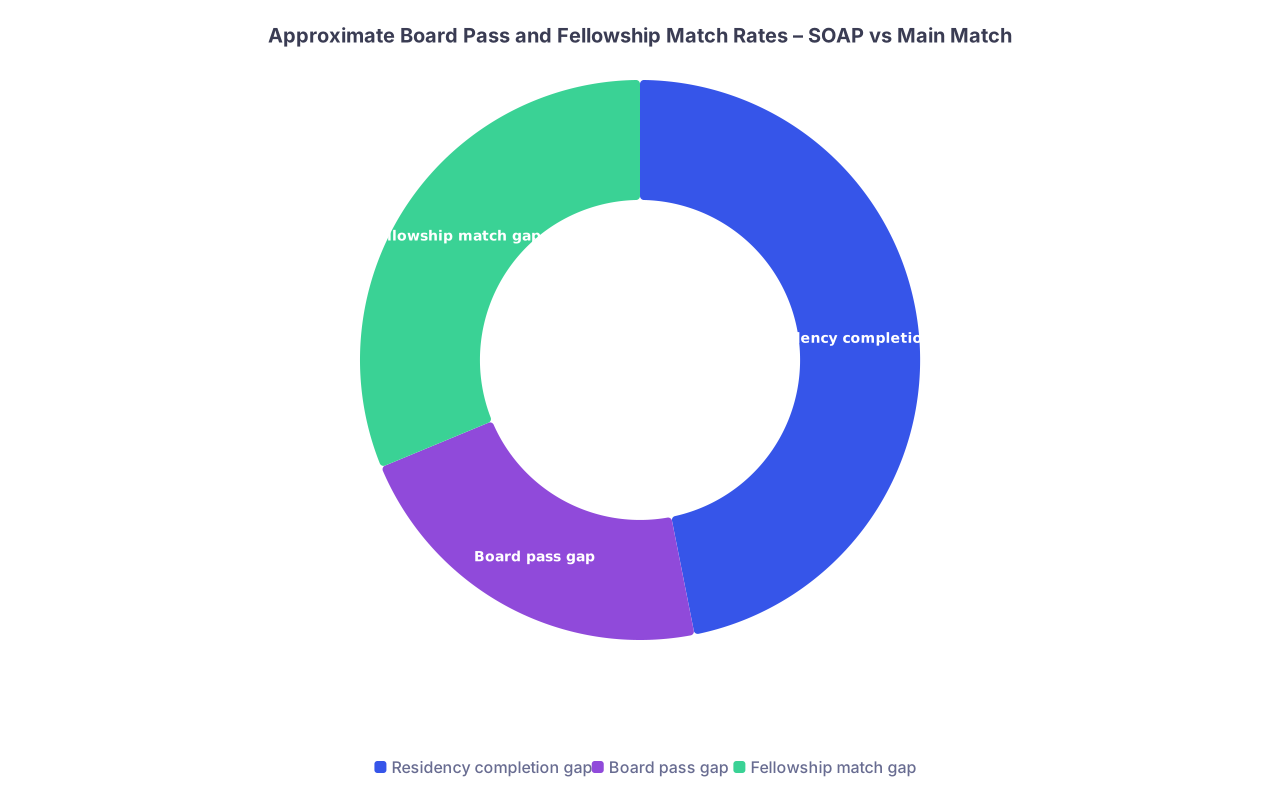
| Category | Value |
|---|---|
| Residency completion gap | 15 |
| Board pass gap | 7 |
| Fellowship match gap | 10 |

| Step | Description |
|---|---|
| Step 1 | Match Route |
| Step 2 | Program Type |
| Step 3 | Training Environment |
| Step 4 | Performance Metrics |
| Step 5 | Fellowship Chances |
| Step 6 | Job Options |
| Step 7 | Initial Stigma |
| Step 8 | Resident Mindset |