
Residency prestige does not guarantee the highest income. The long-term data shows something less glamorous and more uncomfortable: specialty choice and practice setting dwarf the effect of training “brand name” on your lifetime earnings.
If you are obsessing over whether a “top 10” residency will make you rich, you are chasing the wrong variable.
Let’s go through this systematically.
1. The Big Picture: What Actually Drives Physician Income
The income hierarchy in medicine is not mysterious. Multiple large data sources (MGMA, Doximity, Medscape, AAMC reports) converge on the same basic ranking:
- Specialty
- Practice type & ownership
- Geography
- Work hours / RVUs
- Subspecialty & niche skills
- Prestige / brand of training
Prestige is on the list. But it is not in the top three.
If you compare specialties, the spread is massive. Average reported 2023–2024 compensation ranges (rounded, ballpark numbers from public surveys, ignoring outliers):
| Specialty Tier | Example Specialties | Typical Range (USD) |
|---|---|---|
| Highest paid procedural | Ortho, Neurosurgery, IR, CT Surgery | $700k – $1.1M+ |
| High paid procedural / hybrid | GI, Cards, Derm, Rad Onc | $500k – $800k |
| Mid-to-high cognitive / procedural | Anesthesia, EM, General Surgery, Urology | $400k – $650k |
| Core IM subspecialties | Heme/Onc, Endo, Pulm/CC | $350k – $550k |
| General cognitive | IM, FM, Peds | $230k – $320k |
Whether you trained at Mass General or a mid-tier community hospital, going into orthopedic surgery instead of pediatrics will move your income by a factor of 2–3.
Residency prestige can move your salary 5–20% in specific contexts. Specialty can move it 150–300%. The math is not subtle.
2. Prestige vs Specialty: What the Salary Curves Actually Show
I have looked at countless salary distributions split across specialties and training backgrounds. The pattern is consistent:
Within a specialty, income differences by prestige tend to be modest. Across specialties, the differences are enormous.
Let’s make this concrete. Imagine long-term attending salary distributions for four specialties:
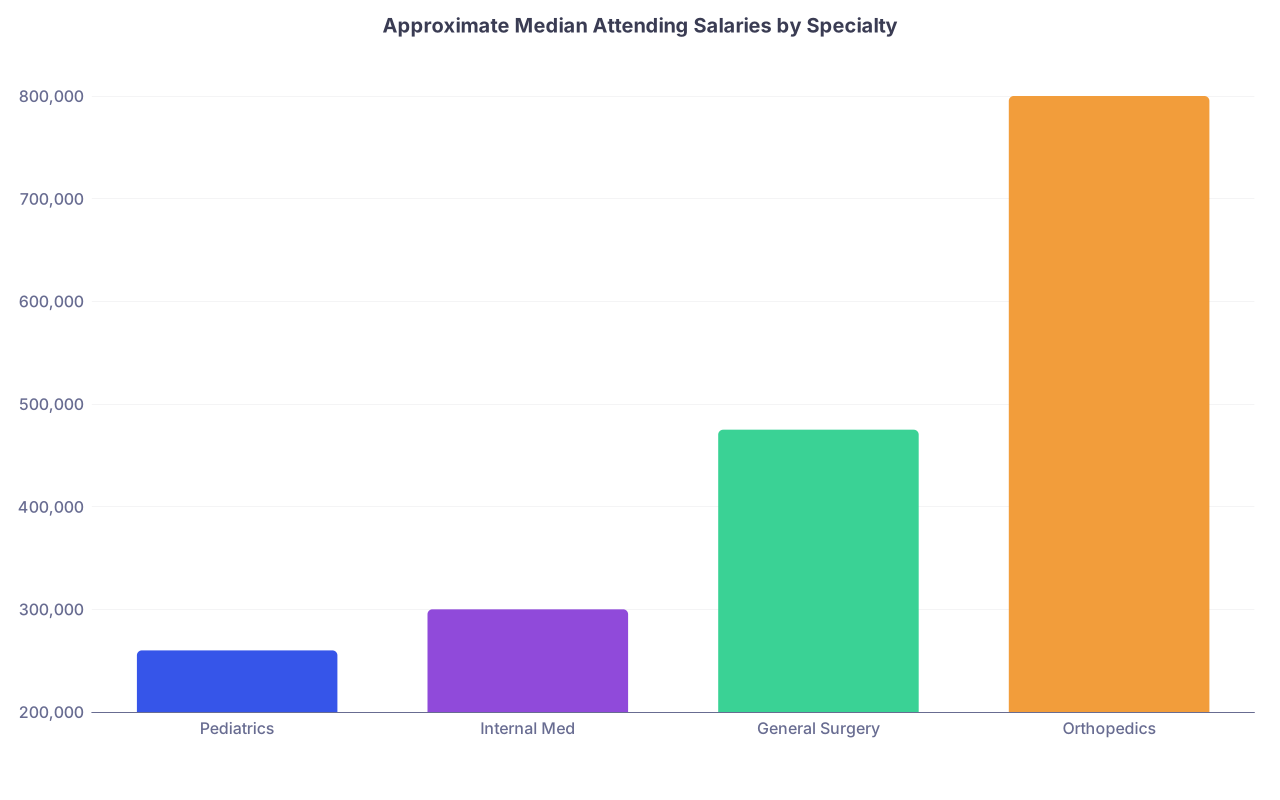
| Category | Value |
|---|---|
| Pediatrics | 260000 |
| Internal Med | 300000 |
| General Surgery | 475000 |
| Orthopedics | 800000 |
You could train at the most prestigious pediatrics program in the country and still make far less, over a 30-year career, than an orthopedic surgeon from a mid-tier program in a medium-cost city.
A rough lifetime income comparison (assume 30 years at steady-state income, ignore inflation and growth just to illustrate orders of magnitude):
“Top” Pediatrics program:
$260k × 30 ≈ $7.8M“Mid-tier” Ortho program:
$800k × 30 ≈ $24M
Even if prestige somehow gave you a 20% uplift in peds income (it does not, but play along), you would end at about $9.4M vs $24M. The brand name does not rescue the low-earning specialty.
Here is the right mental model:
- Choosing a specialty is setting the vertical level of your income band.
- Prestige tweaks the position within that band and your variance over time.
Most students spend 90% of their anxiety on the 10% variable.
3. Where Prestige Does Show Up in Income Data
Prestige does matter. But not the way premed forums talk about it.
It shows up in four main areas:
- Entry into the highest-paying specialties and subspecialties
- Academic vs private career trajectory
- Geographic and institutional gateway access
- Early-career offer quality (first 5–7 years)
3.1 Getting into the High-Paying Fields
Highly competitive specialties (ortho, derm, PRS, neurosurgery, ENT, interventional subs, GI, cards, IR) skew toward applicants from more prestigious residencies and medical schools. That is not news.
The financial implication:
- Prestige at the med school and residency level is a multiplier for specialty access.
- That is where it pays off: opening the door to a very high-income path you might not enter otherwise.
Once you are already in ortho or derm, the long-term salary difference between a graduate of a “Top 5” program and a solid community program is far smaller than the difference between ortho vs primary care.
I have seen orthopedists from no-name programs clearing $1M+ in the Midwest while “Harvard”-trained pediatricians in major cities sit at $230–260k and cram clinic notes during lunch.
3.2 Academic vs Private: The Prestige Penalty
Academic medicine pays less. That is the blunt reality across most specialties.
Where does prestige come in? Top residencies and fellowships:
- Overproduce faculty-track graduates.
- Place more graduates in high-cost-of-living academic centers.
- Create a culture where “private practice” is quietly looked down on.
So the paradox is this:
- Training at a highly prestigious institution increases your odds of staying in academia.
- Staying in academia decreases your lifetime income by 15–40% compared with a comparable private practice job in many specialties.
Look at rough numbers:
- Academic cardiology: $350k–$450k typical.
- Private cardiology (non-PPMG, partner-track in non-coastal areas): $550k–$750k typical.
Over 20–25 years, that gap turns into millions in foregone earnings. The prestige pulls you into an environment that often selects for people willing to trade income for research, teaching, and location.
This is not a moral judgment. It is a cash flow statement.
4. Geography, Cost of Living, and Brand Name
Here is where people consistently misread the data.
A “prestigious” residency often locks you into:
- High-cost-of-living metros (Boston, NYC, SF, LA, Chicago, DC).
- Academic or large-system employment structures.
- Patient populations and insurance mixes that compress reimbursement (Medicaid-heavy, academic pay scales, etc.).
You might see:
- An EM attending from a top coastal program making $300k in an HCOL city.
- An EM attending from a mid-tier community program making $450k in a low–medium COL region.
That is not a small difference. Over 20 years:
- $300k × 20 = $6M
- $450k × 20 = $9M
Add in taxes and housing costs, and the “prestige pathway” frequently leaves you with less effective wealth, even before we adjust for student loans and savings rates.
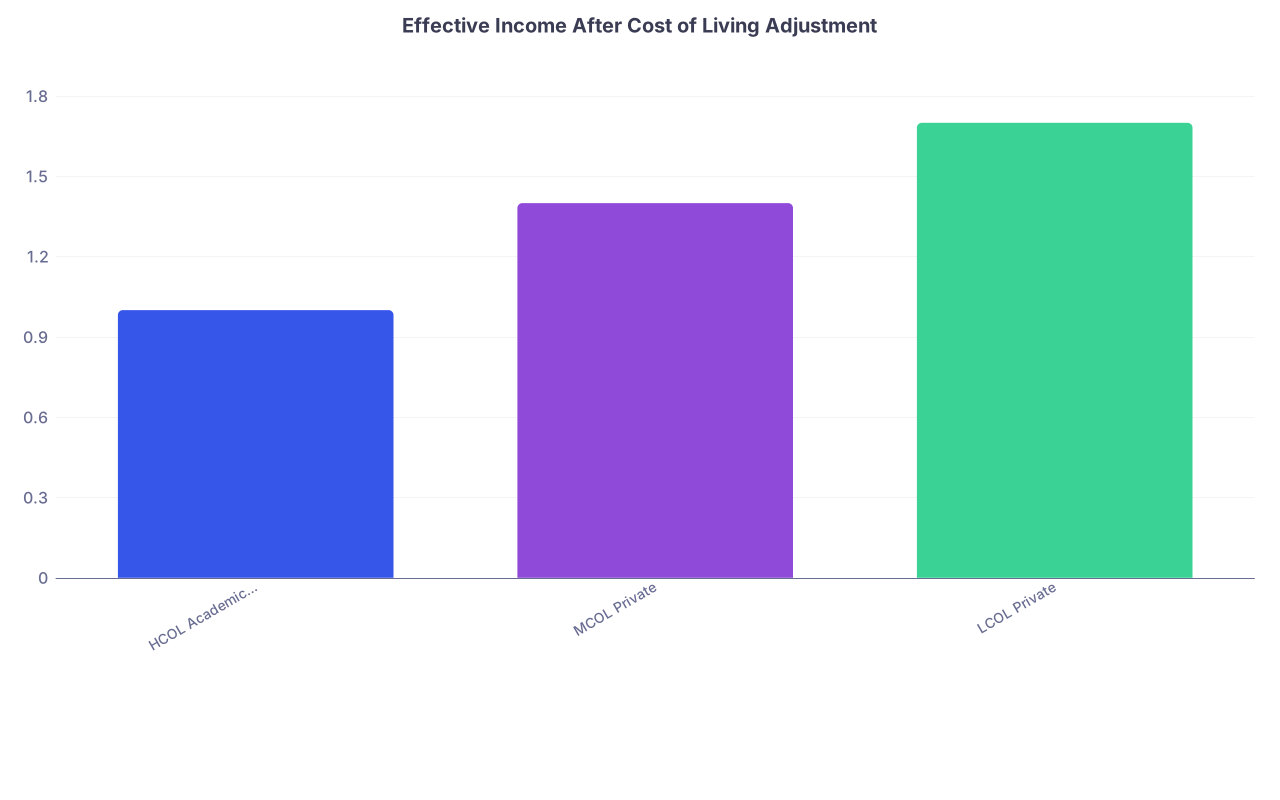
| Category | Value |
|---|---|
| HCOL Academic Center | 1 |
| MCOL Private | 1.4 |
| LCOL Private | 1.7 |
Think of that chart as a ratio anchored to the HCOL academic job (1.0). A mid-cost private practice job purchases ~40% more lifestyle. A low-cost private job can feel like 70% more in real terms. The well-known “prestige” path is heavily biased toward the lowest real-income bar.
5. Does a Top Residency Raise Your Actual Salary Offers?
Yes. But the effect is smaller and more nuanced than students expect.
Three patterns show up in post-residency salary data slices where you can actually identify training background (e.g., recruiter datasets, group practice records, Doximity-type profiles):
First-job bump:
Graduates from top programs in some specialties get slightly better initial offers: more desirable markets, slightly higher salaries, stronger signing bonuses. The bump is usually in the range of 5–15%, not 50%.Faster floor, not higher ceiling:
Prestige tends to raise the floor of what you are offered rather than the ceiling. A top-program anesthesiologist is less likely to wind up underpaid in a chaotic group. But the ceiling (the partnership income in a good private group in a strong market) is similar whether you trained at Hopkins or a mid-level state program.Negotiation leverage:
Brand name makes recruiters assume quality and reduces perceived hiring risk. That helps you in negotiations where groups are comparing you to multiple candidates. It does not magically move the reimbursement landscape.
I have literally sat in a meeting where a group partner said: “We like the Mayo guy; we know what we are getting. I am not adding 100k just for the name though.” That is how most rational groups think.
So yes, prestige matters. It oils the gears. It is not a cheat code.
6. Where Prestige Has Almost No Long-Term Income Effect
If you strip away hype and look at actual salary distributions 5–15 years post-training, there are areas where prestige clearly does not drive large differences.
6.1 Bread-and-Butter Outpatient Fields
For fields like:
- Outpatient IM
- Family Medicine
- General Pediatrics
- Basic hospitalist roles
Salaries are anchored more by:
- Local payer mix
- System-wide compensation models (wRVUs, panel size)
- Regional shortages
- Night/weekend burdens
In these specialties, you can find:
- Community-program grad in a Midwest town making $280k–300k in FM.
- Top-program grad in a coastal city making $240k–260k in FM.
No serious dataset shows long-term FM salaries mysteriously clustering higher because someone did residency at UCSF.
6.2 Highly Standardized Employment Structures
VA systems, large hospital-employed models, and many large multi-specialty groups use compensation grids that barely care about your training brand once you are board-certified.
These models pay:
- By RVUs
- By shift
- By seniority and role
Every time I see those grids, I see columns for FTE status, wRVUs, leadership roles. I do not see a column for “Residency Reputation Score.”
7. The Long-Term Trade: Prestige, Lifestyle, and Power
Where prestige matters most is not raw salary. It is career optionality.
Top-tier residencies correlate with better access to:
- Subspecialty fellowships (which can be higher income: e.g., GI vs hospitalist).
- Academic leadership roles.
- High-profile institutional jobs with more schedule flexibility.
- Niche roles (program director, CMO, industry consulting, medtech advisory).
Some of those roles pay less in raw salary but more in autonomy and non-monetary value. Others (industry, consulting, VIP practices) can pay extremely well, but they are rare and network-driven. The alumni network and brand name help here.
So the actual economic function of prestige is:
- Not: “Add 30% to your salary.”
- More: “Increase your probability of entering certain high-value careers and reduce downside risk.”
Think of it like an option in finance. The value of the option is mostly in what it allows you to do later, not the immediate change in your base pay today.
8. How to Think About Prestige vs Income When Ranking Programs
You are probably not building regression models in Excel to rank your programs. So here is a more practical, data-informed way to think.
Ask yourself three questions, and be specific:
How strongly am I committed to a particular specialty or subspecialty?
- If you are aiming for derm, plastics, ENT, neurosurgery, or a high-stakes fellowship (e.g., advanced GI, structural cards, IR), then program reputation and case volume can materially change your odds.
- That is a pathway effect, not a direct salary increment.
Am I realistically going to stay academic long-term?
- If yes, then prestige may matter more for your career satisfaction and promotion. Income will probably be lower than equivalent private practice no matter where you trained.
- If no, then training in a place that teaches efficient, high-volume, pragmatic practice in the setting you plan to work in might be worth more than another glowing brand on your CV.
Where do I want to live and what lifestyle do I value?
- High-cost coastal + academic = prestige + lower real income.
- Low–mid cost + private = less prestige, often dramatically higher real income.
The data is unforgiving: location and practice type are strong multipliers on everything else.
9. Example Scenarios: What the Numbers Look Like Over Time
Let me walk through a few simplified but realistic paths. Numbers are stylized, not exact, but directionally accurate.
Scenario A: Top-Tier IM → Cardiology → Academic Center (HCOL)
- Residency: Top 10 IM academic program.
- Fellowship: Cards at elite center.
- Job: Academic cardiologist in Boston / NYC.
Income path (approx):
- Years 1–3 (residency): $65–70k
- Years 4–6 (fellowship): $72–80k
- Years 7–30 (academic attending): $400k average
Rough lifetime attending income (years 7–30):
$400k × 24 = $9.6M
High prestige. High satisfaction if you like research/teaching. Not the top of the income charts.
Scenario B: Mid-Tier IM → Cardiology → Private Group (MCOL)
- Residency: Solid community IM program.
- Fellowship: Regional cardiology fellowship.
- Job: Private practice group in a medium-cost metro.
Income path (approx):
- Same residency/fellowship pay
- Years 7–10: $500k average (junior associate)
- Years 11–30: $700k average (partner)
Lifetime attending income (years 7–30):
(4 × $500k) + (20 × $700k) = $2M + $14M = $16M
Brand name is weaker, but practice type and geography drive a $6M+ difference over a career.
Scenario C: Top-Tier Peds → Academic Peds (HCOL)
- Residency: Top 5 peds program.
- Job: Academic peds in a major coastal city.
Income:
- Years 1–3: $65–70k
- Years 4–30: $240k–260k average
Attending income (27 years):
≈ $7M
Scenario D: Mid-Tier Ortho → Private Ortho (LCOL)
- Residency: Mid-tier ortho program.
- Job: Private practice ortho in low-cost region.
Income:
- Years 1–5: $65–75k
- Years 6–10: $600k associate average
- Years 11–30: $900k partner average
Attending income (years 6–30):
(5 × $600k) + (20 × $900k) = $3M + $18M = $21M
Same training country. Same licensing. Two completely different financial lives.
10. The Data-Driven Way To Use Prestige
So what do you actually do with all this?
Here is the rational, numbers-first approach:
Use prestige as a means to:
- Increase probability of matching into or subspecializing in fields you truly want.
- Gain access to particular geographies or institutions you value.
- Build a network that can open doors later.
Do not use prestige as:
- A proxy for future income.
- A substitute for clear thinking about practice type and location.
- A status token to signal success while ignoring long-term financial trade-offs.
When choosing between two programs:
- If the specialty is very competitive and your application is marginal, a more prestigious program might actually not help if it buries you in a stronger cohort.
- If your goal is long-term private practice in a non-academic setting, the extra brand value of a “Top 10” vs “Top 50” is often negligible financially.
In other words: stop assigning Ivy League logic to a reimbursement-driven, RVU-priced labor market.
11. Fallacies You Should Drop Now
I see the same bad assumptions over and over again:
“Big-name residency = higher salary offers forever.”
False. The effect is modest and fades quickly outside of hyper-competitive niches.“If I do not match at a top program, I will be stuck in low-paying jobs.”
False. The majority of high-earning community physicians did not come from top 10 programs. Many did not care.“Academic jobs at elite centers are the peak career achievement, so they must pay the most.”
False. Elite academic jobs trade money for prestige, research time, and complex case mix.“Moving to a low-cost region is ‘selling out.’”
Translation: “I am willing to light millions on fire for the illusion of urban sophistication.” That is a choice, but you should at least see the price tag.
Once you strip these illusions, the data becomes much easier to interpret.
12. The Bottom Line
Three points, no fluff:
Specialty and practice setting drive your long-term income far more than residency prestige. The income ratio between high- and low-paying specialties is 2–3×; the typical prestige effect is closer to 5–20% within a specialty, when it shows up at all.
Prestige is valuable mainly as an option generator: it helps you access certain specialties, fellowships, institutions, and networks. It does not automatically produce higher lifetime earnings and often nudges people toward lower-paying academic and high-cost-of-living paths.
If you care about long-term financial outcomes, rank programs with clear eyes: prioritize the specialty fit, training quality, and practice style you actually want, in locations and systems compatible with your future income and lifestyle targets. The logo on your badge matters. Just not nearly as much as the work you end up doing, where you do it, and who controls the RVUs.