
The belief that matching at a lower‑ranked residency program hurts your board pass chances is largely unsupported by the data. What actually predicts whether you pass boards is not the name on your program’s letterhead. It is your test-taking history, standardized exam performance before residency, and the educational culture of your specific program.
Let me walk through the numbers.
What We Actually Know About Board Pass Predictors
Strip away the anecdotes and program gossip, and the data shows a consistent pattern across specialties:
- Your prior standardized exam performance predicts your future exam performance.
- Program culture and structure matter more than national prestige labels.
- “Lower‑ranked” is usually a proxy for “less selective,” which correlates with applicant profile, not some mysterious board-prep curse.
The best high‑level example: the relationship between USMLE Step 1 / Step 2 CK scores and board certification rates. The ABIM (Internal Medicine), ABFM (Family Medicine), and several surgical boards have all published variations of the same finding:
- Residents with higher USMLE scores have higher first‑time board pass rates.
- Once you adjust for those scores, program‑level rank or name has much smaller incremental effects.
So when people say, “Lower-ranked programs have worse board pass rates,” what they are usually seeing is:
- Those programs recruit applicants with lower average Step scores and weaker test histories.
- Those applicants, on average, have lower probability of passing boards on the first attempt.
- The program gets blamed for what is mainly applicant-level variance.
That is correlation, not causation.
How Program “Rank” Relates to Board Pass Rates
There is no single, universal residency rank list. You have:
- Doximity “reputation” rankings
- US News hospital rankings
- Specialty-specific fellowship placement reputations
- NRMP match fill patterns (how early programs fill on rank lists)
None of these were designed to measure board exam teaching quality.
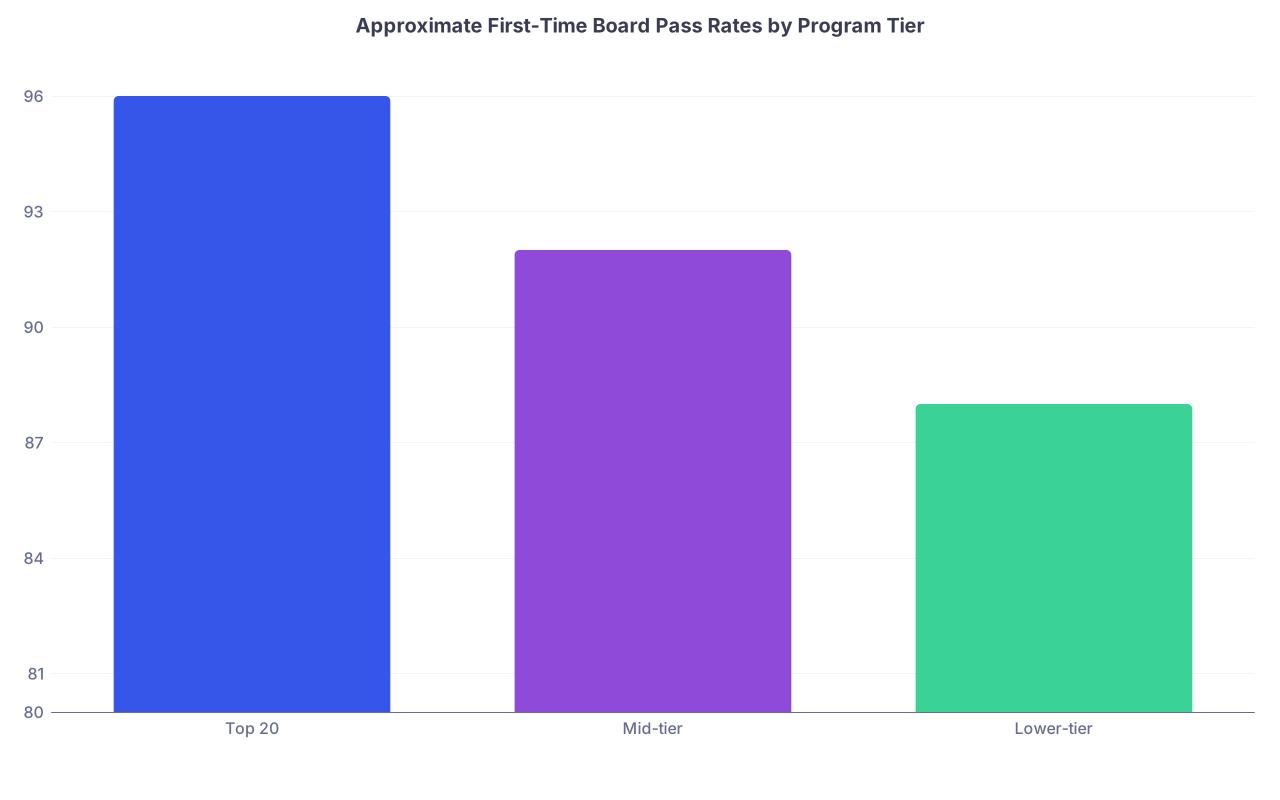
What we do have are program‑level board pass statistics. Many specialties publish these. When you cross‑reference them with perceived prestige, the pattern is clear but less dramatic than people think.
| Category | Value |
|---|---|
| Top 20 | 96 |
| Mid-tier | 92 |
| Lower-tier | 88 |
Interpretation:
- Yes, “top” programs tend to post higher first‑time pass rates.
- But the gap is single‑digit percentage points, not 96% vs 60%.
- The real question is whether that gap reflects:
- stronger incoming residents,
- better teaching structure,
- or both.
When researchers adjust for USMLE scores and med school performance, a lot of the “prestige advantage” shrinks.
In Internal Medicine, for example, analyses of ABIM pass rates have repeatedly shown:
- Residents with Step 2 CK > 240 have very high pass rates across almost all programs.
- Residents with Step 2 CK < 220 have elevated failure risk at every program.
- Program environment modifies that risk at the margins, but does not overturn the basic pattern.
Lower‑ranked match outcome ≠ doomed board outcome.
Individual vs Program Effects: Where the Variance Actually Lives
You need to think in terms of variance decomposition.
Imagine we model the probability of first‑time board passage (yes/no) using:
- Applicant-level variables:
- USMLE Step scores
- In-training exam (ITE) scores
- Med school performance (clerkship grades, AOA, etc.)
- Program-level variables:
- Program size
- Funding / resources
- Didactics structure
- Historical board pass rate
- Call schedule intensity
In multilevel models (people nested within programs), the common pattern is:
- Most of the variance in board outcomes is at the individual level, not the program level.
- Program identity explains a modest fraction of the total variance (often under 20%, frequently under 10%).
So:
- A relatively weak test-taker at a “top” program can fail boards.
- A strong test-taker at a “lower-tier” program usually passes.
The brand name shifts your probabilities a bit. Your own test history shifts them a lot.
The Ugly Confounder: Self-Selection and Match Dynamics
Match outcomes are not random assignment experiments. They are self‑selection plus constrained optimization.
- Higher Step scores → more interview offers from “top” programs
- Those same applicants also rank those “top” programs highly
- Programs with better historical board pass rates become more competitive, reinforcing the cycle
That means:
- When you look at program‑level board pass rates, you are seeing both training quality and applicant filtering.
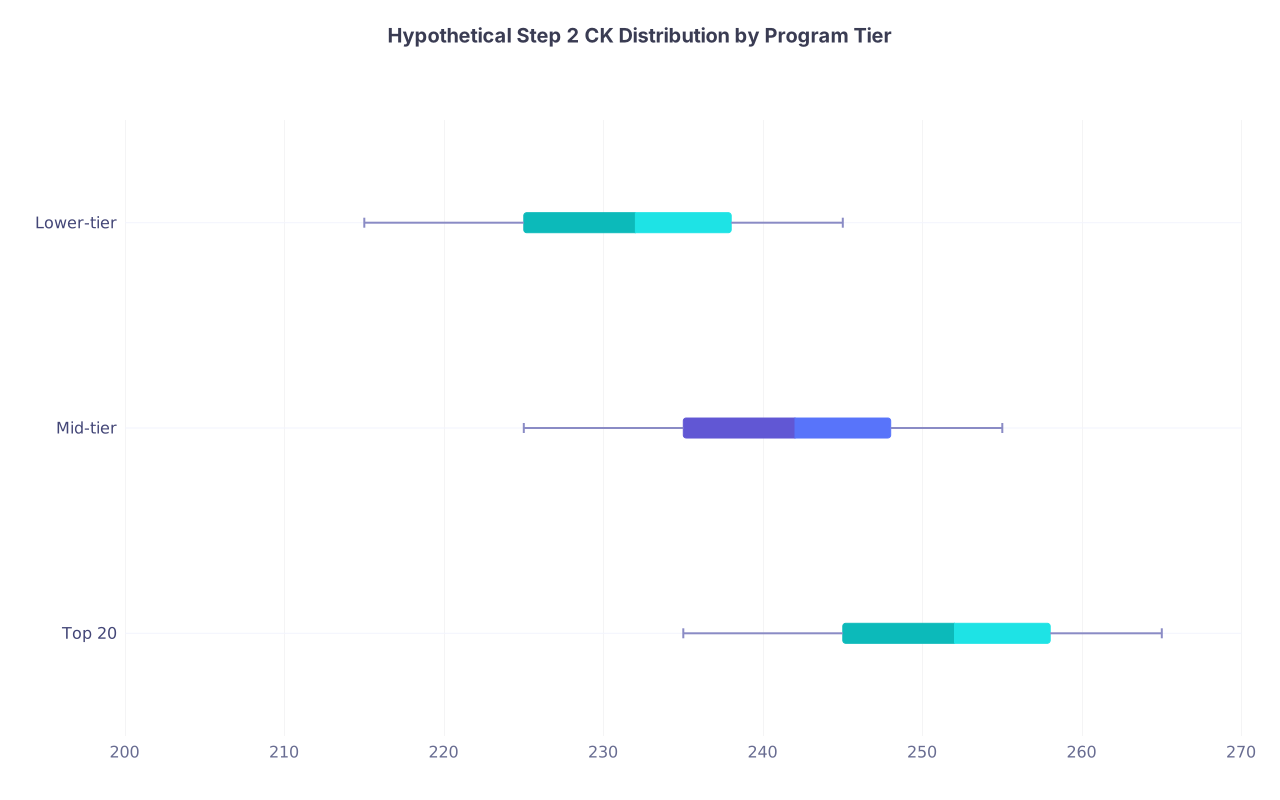
- Lower‑ranked programs (in reputation terms) often recruit from the left tail of the Step score distribution.
| Category | Min | Q1 | Median | Q3 | Max |
|---|---|---|---|---|---|
| Top 20 | 235 | 245 | 252 | 258 | 265 |
| Mid-tier | 225 | 235 | 242 | 248 | 255 |
| Lower-tier | 215 | 225 | 232 | 238 | 245 |
Notice what happens:
- Shift the entire Step distribution down 10–15 points.
- Even if the teaching quality is identical, aggregate board pass rates drop.
Residents and program directors then turn around and say, “Program X has worse board performance, so it must be weaker.” That is lazy inference. You are just seeing selection.
What Happens If You Personally Match “Lower” Than Expected?
Now let’s make this concrete. You are an applicant who expected to match at a “mid‑to‑high” tier program and ended up at what you perceive as a lower‑ranked outcome.
The question is not: “Is my program top 20 on Doximity?”
The question is: “Given my profile, how does this environment affect my board probability?”
There are three major levers that matter for you:
- Your own baseline risk
- Program’s structural support for exams
- Training workload vs protected study time
1. Your Baseline Risk: Your Scores Predict You
Multiple boards (IM, FM, Pediatrics, Surgery) show the same stepwise risk relationships:
- Residents with higher USMLE scores and ITE scores are at lower risk of failing written boards.
- Residents who repeatedly struggle on standardized tests face elevated risk, regardless of program tier.
A simplified example (these numbers are illustrative but in the right ballpark for many specialties):
| Step 2 CK Band | Estimated Board Pass Chance |
|---|---|
| ≥ 250 | 97–99% |
| 240–249 | 94–97% |
| 230–239 | 88–94% |
| 220–229 | 80–88% |
| < 220 | 65–80% |
Those probabilities shift slightly by program environment, but notice something critical: the jump between 245 and 255 is minor; the jump between 215 and 235 is huge.
Matching lower‑ranked changes your environment. It does not magically move you from the 250 bin to the 215 bin.
2. Program-Level Exam Culture and Infrastructure
This is where “lower‑ranked” can matter, but not in the way you think.
I have seen small community programs with:
- Mandatory in‑training exam review meetings for every resident
- Structured Q‑bank schedules tracked by chief residents
- Weekly board-style case conferences
- Explicit remediation tracks for anyone scoring below specialty‑specific cutoffs
And I have seen top‑name programs that assume, “Our people always pass,” and run a looser system with minimal board-specific support.
If you want to know your actual board risk, stop asking, “Is this program prestigious?” and start asking data-driven questions:
- What is your 5-year rolling board pass rate?
- What percentage of residents sit for boards on time vs delayed?
- What formal board-prep resources are funded (Q-banks, review courses, protected time)?
- What happens when residents score low on ITE? Is there a documented remediation plan?
Those metrics matter much more than where a random forum post ranks your program.
3. Workload, Autonomy, and Cognitive Bandwidth
Your effective study time is not just hours on a calendar. It is cognitive bandwidth.
Programs vary dramatically in:
- Call frequency
- Night float burden
- Service intensity vs ancillary support
- Non-educational scut
Residents at extremely busy, service-heavy programs—whether prestigious or not—often tell you the same thing around PGY‑2: “I am learning a ton clinically, but when exactly am I supposed to study for boards?”
The relationship with board outcomes is not linear, but it is real:
- Too little clinical exposure → shallow pattern recognition, board questions feel abstract.
- Too much service and chaos → chronic fatigue, low study efficiency, procrastination until late PGY‑3.
Matching lower‑ranked sometimes means a less famous name but a more humane schedule, mid‑sized program, and better bandwidth for systematic board prep. That tradeoff can actually improve your board pass odds, depending on your baseline risk.
Where Lower-Ranked Programs Truly Struggle (Statistically)
I am not going to pretend all programs are equal. They are not.
The data and program reviews show lower‑performing programs share some specific features:
- Persistently low board pass rates (e.g., <80% over multiple years)
- High resident turnover or frequent transfers out
- Chaotic didactics with poor attendance and late cancellations
- Leadership instability (PDs cycling rapidly, constant accreditation concerns)
Those programs often do have a causal impact on board failure rates, because:
- Residents get minimal feedback from ITEs.
- Board prep is completely individualized and unsupervised.
- Clinical workload is high but poorly structured for learning.
Matching at that kind of program, even with good baseline scores, can drag your probability down.
But notice the nuance:
- This is not about “lower-ranked” in a Doximity sense.
- It is about demonstrably low educational performance by objective metrics.
A lower‑reputation program with 95% board pass over 5 years is not the problem. A program with 70–75% and chronic instability is.
The Signals You Should Actually Track
If you want to make a rational, data-oriented decision about how your match outcome affects board risk, track these signals instead of message board rankings.
Program-Level Signals
Ask for hard numbers or look them up when published:
- 3-, 5-, or 10-year first‑time board pass rates
- In‑training exam score distributions vs national averages
- ACGME citations specifically related to education, supervision, or didactics
- Number of residents failing boards or delaying them in the last 5 years
If you see:
- Board pass rate consistently ≥90–92%
- ITE scores around or above national mean
- Stable leadership and accreditation
…then being “lower‑ranked” on social media is mostly noise for board risk.
If instead:
- Board pass rates are 70–80% and no one seems alarmed
- Residents whisper “people just self-study here”
- Chiefs cannot clearly describe board prep resources
…then your match outcome may have created a real headwind you must counter on your own.
Individual-Level Signals
Your own numbers are non-negotiable signals:
- Step 1 and Step 2 CK (or COMLEX equivalents)
- Pattern of shelf exam performance
- Any history of test failures or retakes
- Early ITE scores in residency
| Profile | Relative Risk |
|---|---|
| Step 2 CK ≥ 245 + strong shelves | Low |
| Step 2 CK 230–240 + avg shelves | Moderate |
| Step 2 CK < 225 or exam failures | High |
| Low ITE PGY-1 + low Step 2 CK | Very High |
In my experience, once you put your own data on the table honestly, the “but my program rank” drama shrinks. Your plan becomes:
- If low risk: maintain consistent study, use program resources, do not panic about prestige.
- If high risk: aggressively leverage Q‑banks, early ITE prep, mentorship, and possibly external review courses regardless of program tier.
A Quick Reality Check: National Outcomes
Let’s zoom out.
Across most major specialties:
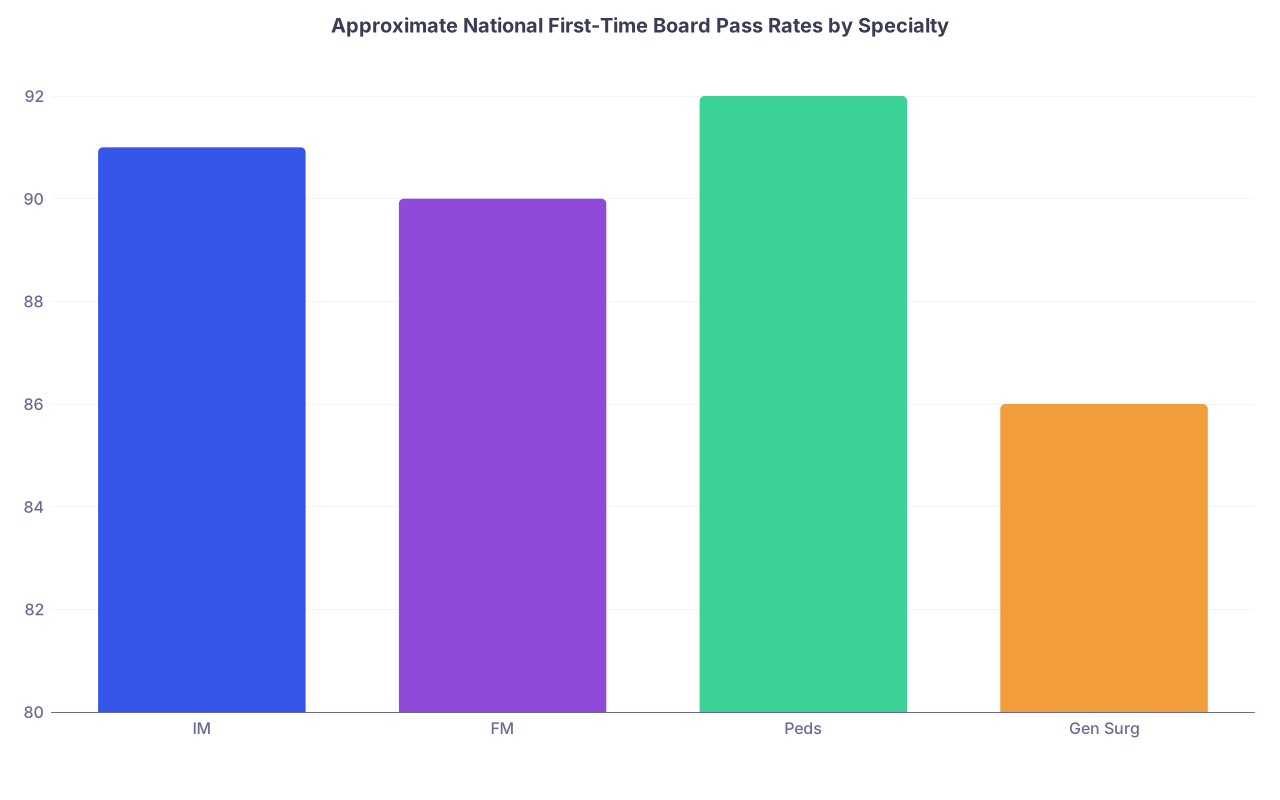
- First‑time board pass rates for accredited residency graduates typically hover around 85–95%.
- That already tells you something: the overwhelming majority of residents, including those from “lower-ranked” programs, pass.
| Category | Value |
|---|---|
| IM | 91 |
| FM | 90 |
| Peds | 92 |
| Gen Surg | 86 |
Now layer on this:
- Residents who complete accredited training but fail boards often share:
- Lower Step scores
- Weaker in-training results
- Significant life or stress disruptions during exam year
What you do not see is: “Everyone from lower‑ranked programs fails.” That narrative just does not show up in national data.
How to Respond if You Matched “Lower” Than You Wanted
If your match felt disappointing, your instinct may be to catastrophize. From a data analyst perspective, that is simply a misread of the risk.
Here is a structured response that actually aligns with the stats.
Quantify your baseline.
Pull your Step, shelf, and early ITE numbers. Place yourself roughly in the risk bands above.Audit your program reality, not its reputation.
Ask senior residents:- How many people fail boards here?
- What board prep structure exists?
- Do chiefs actually review ITE results with you?
Control the variables you can.
If your program is lighter on structure:- Create a Q‑bank schedule starting PGY‑1 or early PGY‑2.
- Track questions per week and ITE percentiles like vital signs.
- Treat your board exam as a multi‑year project, not a last‑minute cram.
Use early signals.
Your PGY‑1 and PGY‑2 ITE results are near-real‑time risk updates. If you are trending below national mean and you have a lower‑support program, your risk curve just shifted, and you need to respond with higher intensity prep.

| Step | Description |
|---|---|
| Step 1 | Match Result |
| Step 2 | Assess Step and Shelf History |
| Step 3 | Standard Study Plan |
| Step 4 | Enhanced Study Plan |
| Step 5 | Review Program Board History |
| Step 6 | Leverage Internal Resources |
| Step 7 | Add External Resources |
| Step 8 | Monitor ITE Scores |
| Step 9 | Maintain Course |
| Step 10 | Intensify Prep and Mentorship |
| Step 11 | High Baseline Risk? |
| Step 12 | Program Pass Rate >= 90%? |
| Step 13 | ITE Below Mean? |
You will notice program rank does not appear anywhere in that flowchart. Because it is a blunt, low-informational variable. You need finer-grained metrics.
The Bottom Line: Does a Lower-Ranked Match Hurt Your Board Chances?
If you want the clean answer, here it is:
Your prior exam performance is the dominant predictor of your board pass probability.
Higher Step / COMLEX scores and solid shelf performance translate to higher board pass rates across almost all programs.Program “rank” is a noisy proxy.
It partially captures resident selectivity and resources, but once you account for applicant profile and explicit board support structures, its independent effect on board outcomes is modest.What matters is educational quality, not prestige branding.
A so‑called lower‑ranked program with strong didactics, high historical pass rates, and structured ITE-based remediation will protect your board chances far better than a glamorous name with chaotic teaching and no exam culture.
If you matched lower than you hoped, your board destiny is not sealed. Your numbers, your study discipline, and the specific educational behavior of your program will drive your outcome—not the rank list you stared at on Reddit.