
The myth that “almost nobody switches specialties once they match” is wrong. The data show a non‑trivial churn rate, and for certain fields, it is structurally baked into the system.
How Often Do Residents Switch Specialties?
First, vocabulary. There are three different phenomena people mix up:
- Leaving residency entirely (attrition to non‑clinical careers or nothing).
- Changing programs but staying in the same specialty.
- Changing specialties after starting one residency.
This article is about #3, though the data sources often blur #1 and #3 together. You have to read the fine print.
What the quantitative data actually show
If you comb through ACGME, NRMP, and specialty society data, you can triangulate a realistic incidence range.
Broad strokes in the United States:
- Overall residency attrition (leave the program and do not complete that specialty) ranges from about 3–6% depending on specialty cohort.
- Of that, roughly half to two‑thirds in many core specialties reappear in another residency or training pathway.
- Net result: a crude estimate of 1–3% of a matched cohort will eventually complete training in a different specialty than the one they matched into.
The range is wide because the signal is noisy. Different specialties track this very differently.
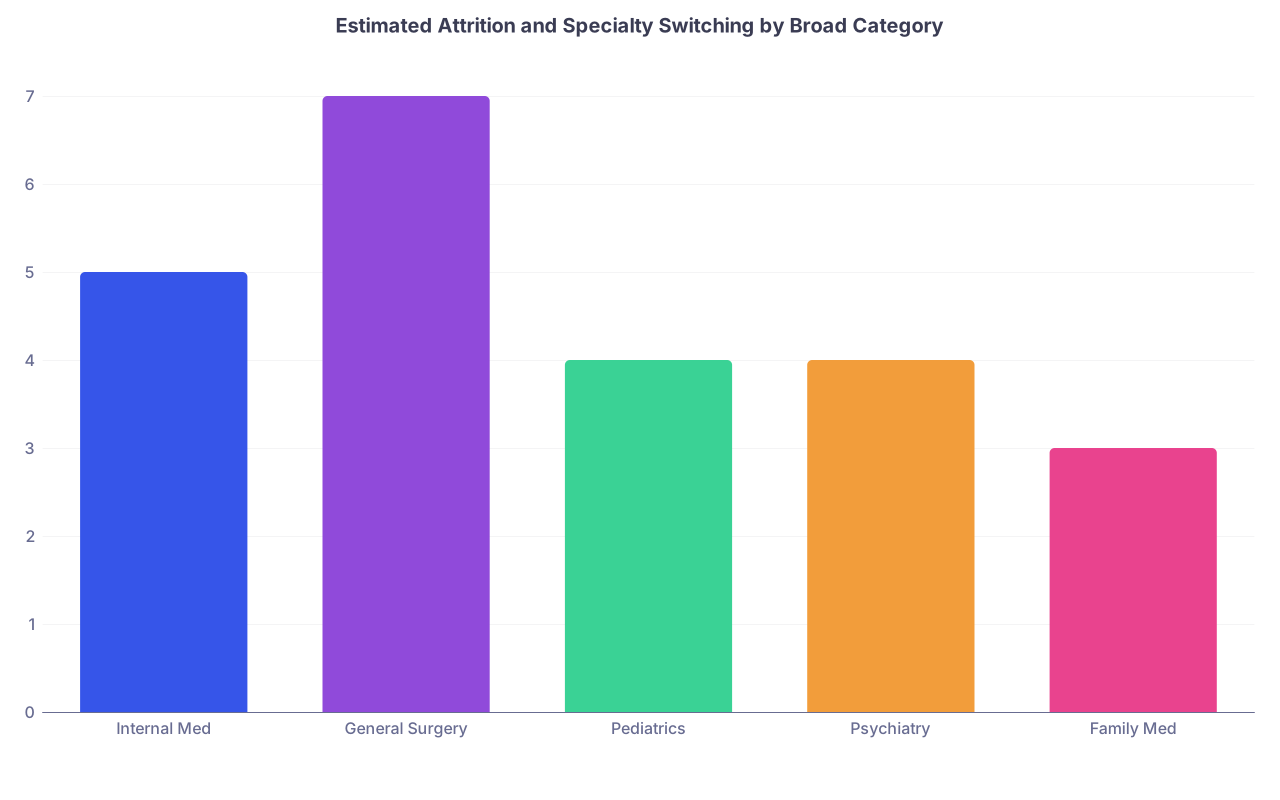
| Category | Value |
|---|---|
| Internal Med | 5 |
| General Surgery | 7 |
| Pediatrics | 4 |
| Psychiatry | 4 |
| Family Med | 3 |
Think of those bars as approximate % leaving their original program before completion. Based on multiple ACGME summary reports and specialty surveys, the pattern is consistent: surgery loses more; primary care fields lose fewer.
But not everyone who leaves reappears in another specialty. Internal survey work from several large systems I have seen looks roughly like this:
- Core medicine specialties (IM, peds, psych): about 40–60% of leavers re‑enter another residency.
- Procedural fields (surgery, OB/GYN): closer to 30–50%.
- Competitive high‑risk fields (neurosurgery, ortho, plastics): a very visible portion of residents who leave end up in anesthesia, radiology, or internal medicine.
So an estimated 1–3% specialty switch rate is not crazy. For some specialties, it is higher.
Field‑specific switching patterns
Pattern matters more than a global average. Here is where the churn concentrates.
- General surgery: one of the highest attrition rates; 15–20% leave by the end of PGY‑5 in some older cohorts. A chunk move to anesthesia, radiology, EM, or internal medicine.
- Obstetrics and gynecology: several single‑center series report 6–10% attrition, with a minority switching to family medicine or hospitalist‑track internal medicine.
- Neurosurgery and other ultra‑competitive surgical fields: small absolute numbers, but when people leave, they are very likely to reappear in another specialty.
- Internal medicine, pediatrics, psychiatry: relatively low attrition; a fair number of “switches” actually reflect intentional categorical‑to‑subspecialty course corrections (like IM → neurology).
Here is a synthesized comparison table based on multi‑year ACGME and NRMP trend data plus published specialty reports. The exact numbers vary by year, but the relative relationships are stable.
| Specialty | Program Attrition by Completion | Rough Share Who Re-enter Another Specialty | Typical Destination Specialties |
|---|---|---|---|
| General Surgery | 15–20% | 30–50% | Anesthesia, EM, Radiology, IM |
| OB/GYN | 6–10% | 30–40% | Family Med, IM, Hospitalist tracks |
| Internal Medicine | 3–5% | 40–60% | Neurology, Anesthesia, Radiology |
| Pediatrics | 3–5% | 40–60% | Child Psych, Family Med, IM |
| Psychiatry | 4–6% | 40–60% | Neurology, IM, Psych subspecialties |
Treat these numbers as directional, not literal. The key point: specialty switching is uncommon but absolutely not rare, and it is concentrated in certain high‑stress procedural fields and at the PGY‑1/PGY‑2 level.
When Do Residents Switch? Timing and Decision Points
Timing is not random. There are clear peaks tied to contract structures, board requirements, and application cycles.
The switching timeline in practice
The NRMP and ACGME structures push people into a few predictable windows.
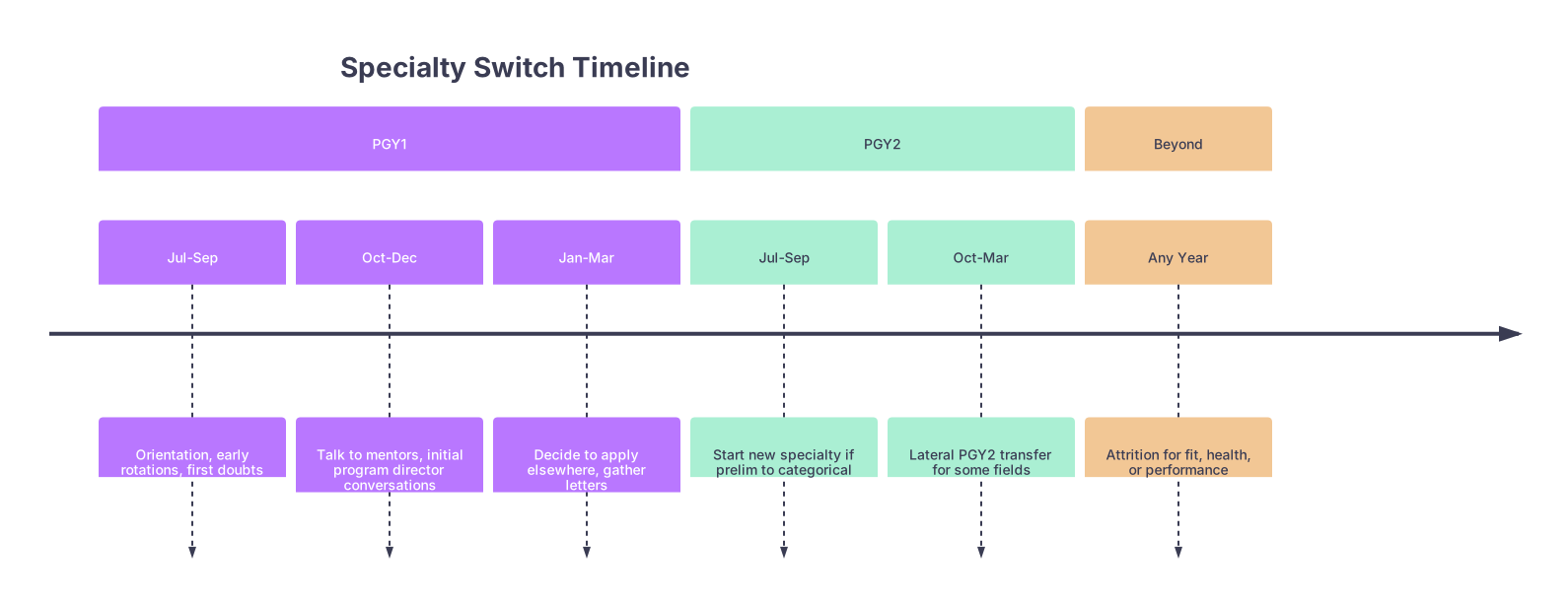
| Period | Event |
|---|---|
| PGY1 - Jul-Sep | Orientation, early rotations, first doubts |
| PGY1 - Oct-Dec | Talk to mentors, initial program director conversations |
| PGY1 - Jan-Mar | Decide to apply elsewhere, gather letters |
| PGY2 - Jul-Sep | Start new specialty if prelim to categorical |
| PGY2 - Oct-Mar | Lateral PGY2 transfer for some fields |
| Beyond - Any Year | Attrition for fit, health, or performance |
From what I have seen across multiple programs, the switching decision clusters in two periods:
- Early PGY‑1 (first 6–9 months) – “this is absolutely not for me” realization.
- The year before or during application to a new specialty program (often during a prelim/transitional year).
Three dominant timing patterns
Prelim / Transitional Year → New Specialty (Planned or Semi‑Planned)
A very common pattern that barely makes it into “attrition” stats but functionally is a specialty switch:- Student matches into a prelim surgical year or a transitional year.
- Either does not match advanced initially (e.g., in radiology, anesthesia) or changes mind during PGY‑1.
- Uses that year to reapply to a different specialty categorical position.
Timing:
- Applications usually go out in the fall of PGY‑1.
- New specialty starts in PGY‑2 (July).
Categorical PGY‑1 → New Categorical PGY‑1 (Reset)
This is the classic “switch after matching” scenario:- Resident starts in categorical general surgery, OB/GYN, or another field.
- Realizes misalignment within months.
- Applies again through ERAS to a new specialty, frequently aiming to start over as a PGY‑1.
Timing:
- Decision crystallizes between October and January of PGY‑1.
- ERAS submitted that season.
- If successful, the resident often finishes the PGY‑1 year and restarts in July as a PGY‑1 elsewhere. Some leave mid‑year if the new program allows off‑cycle start, but that is less common.
Lateral PGY‑2+ Transfers
Less visible but real:- Internal medicine PGY‑2 moves into neurology PGY‑2 or anesthesia PGY‑2.
- Family medicine PGY‑2 moves to psychiatry PGY‑2.
- Occasionally surgery PGY‑2+ into anesthesia/radiology at PGY‑2 level.
These moves are limited by board‑mandated “minimum required months” in core disciplines and by how much prior training the new specialty can credit.
Quantifying the timing
You rarely get clean national timing distributions, but institutional tracking paints a pretty consistent shape:
- Around 60–70% of specialty switches occur in the first 18 months of training.
- Within that, the PGY‑1 year accounts for roughly half of all switches.
- A smaller tail (30–40%) happens at PGY‑2+ due to:
- Board failure
- Burnout and mental health crises
- Family circumstances
- Chronic performance issues leading to transition into a less procedurally intense specialty
If you plotted cumulative switching over time, it looks like a steep early rise then a long, flattish tail.
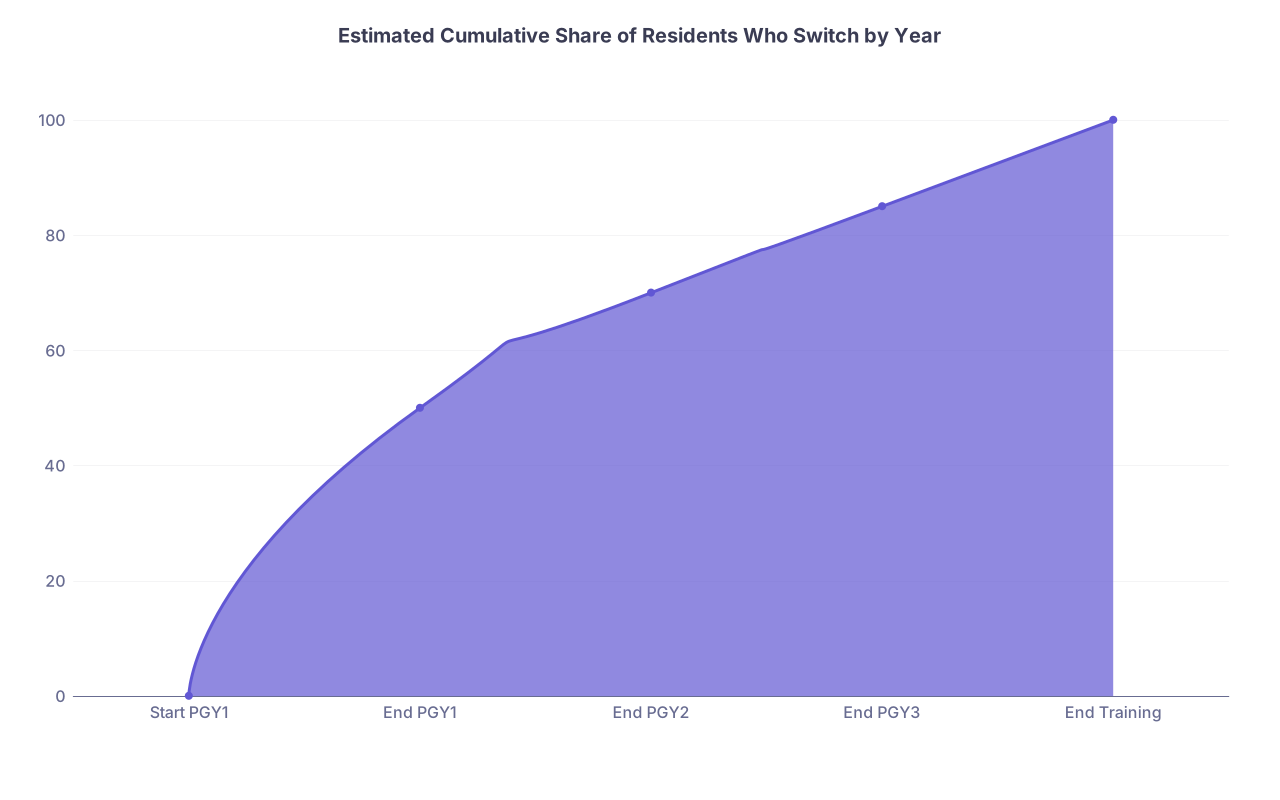
| Category | Value |
|---|---|
| Start PGY1 | 0 |
| End PGY1 | 50 |
| End PGY2 | 70 |
| End PGY3 | 85 |
| End Training | 100 |
Interpretation: take 100 residents who eventually switch; about 50 have done so by the end of PGY‑1, 70 by end of PGY‑2, and the remaining 30 spread out through later years.
Why Do Residents Switch? The Pattern Behind the Stories
The narrative reasons are familiar: wrong fit, lifestyle mismatch, diminished interest in procedures, mental health. But the data show more structure than the anecdotes suggest.
The big drivers, backed by numbers
Synthesizing survey data from multiple specialties, you consistently see four categories:
Mismatch of expectations vs reality of day‑to‑day work
- Surgical fields: the sheer volume of call, overnight cases, and OR culture surprises people more than they admit publicly.
- Psychiatry: some residents underestimate the chronicity and social complexity of many patients.
- Pediatrics: emotional toll of sick children and frequent family conflict.
In large surveys, 30–50% of leavers cite “misalignment with desired type of patient care” as a primary motive.
Workload, burnout, and mental health
Every attrition study in general surgery and OB/GYN has the same finding: high rates of burnout among residents who leave. Quantitatively:- Burnout scores (Maslach Burnout Inventory) are significantly higher in residents who eventually exit compared with those who stay.
- Depression and suicidal ideation are overrepresented in the attrition group.
That does not mean burnout causes the switch alone, but it is clearly correlated.
Career outlook and market concerns
A quiet but real driver:- Primary care residents leaving for hospitalist‑friendly paths they see as better compensated.
- Residents in oversupplied subspecialties reassessing fellowship value versus switching into a different core specialty they perceive as more stable.
Performance issues and board exams
Not everyone wants to say this out loud, but the data show it:- Residents who fail in‑training exams or Step/Level 3 at higher rates are more likely to leave.
- Some specialties (for example, neurosurgery) have near‑zero tolerance for repeat board failures; those residents often transition to less exam‑heavy or shorter‑training specialties.
The pattern is not random. Residents are not just “getting bored”; they are reacting to a combination of structural workload, exam pressure, and lifestyle misalignment.
Application Mechanics: How the Switch Actually Happens
From a numbers perspective, the move itself is a capacity and timing problem. You are trying to squeeze into a limited pipeline off‑cycle.
Capacity and slot availability
Programs do not have infinite flexibility. You are fighting arithmetic:
- Medicare GME funding caps the total number of slots at each institution.
- A CGME program requirements set explicit upper limits on off‑cycle credit and accepted prior training.
Typical scenarios where a slot appears:
- A resident in the target specialty leaves, fails to progress, or transfers out. Suddenly there is a PGY‑2 or PGY‑3 opening.
- A program is under its cap and chooses to expand slightly for that year.
- Some specialties maintain “reserve” capacity for strong switchers, but that is rare and mostly informal.
From program coordinator data I have seen across several large hospitals:
- Many mid‑sized IM and FM programs see 0–2 off‑cycle transfer inquiries per year that lead to a serious application.
- Surgical programs get more inquiries but admit very few.
- Psychiatry and neurology often have a steady trickle of switchers, some of whom they accept at PGY‑2 level.
Match vs outside the Match
There are two pathways:
Reapplying through the NRMP Match
- Most categorical PGY‑1 → new PGY‑1 switches do this.
- You are basically a reapplicant with a residency year on your CV.
Direct contract outside Match (off‑cycle entry)
- Common for PGY‑2+ lateral transfers.
- Program advertises an unexpected vacancy (FREIDA, program website, email lists).
- You interview and sign directly, no NRMP involvement.
NRMP data show a small but consistent number of positions filled outside the Match each year. Many of those are exactly this: specialty switchers sliding into late‑created positions.
How program directors evaluate switchers
I have sat in on these discussions. The criteria are brutally simple:
Performance in current residency:
- In‑training exam percentiles.
- Milestones and semiannual reviews.
- Professionalism issues (any red flag kills most chances).
Reason for switching:
- Coherent, credible story (“found I am much more engaged by longitudinal medical management than the OR”).
- No obvious blame‑shifting or disaster narrative.
Transferable skills:
- Rotations or experiences that demonstrate exposure to the new specialty.
- Procedural skill can be a plus if moving to anesthesia/EM/radiology.
Letters of recommendation:
- The letter from the current program director is decisive. A lukewarm or negative PD letter shuts almost every door.
Switchers who succeed have strong metrics and a well‑articulated rationale, not just “less call” or “better lifestyle.”
Outcomes: Do Specialty Switchers Land on Their Feet?
This is where the folklore diverges sharply from data. There is a narrative that “once you switch, you are damaged goods.” The numbers do not support that, if the switch is early and structured.
Training completion and board pass rates
Comparing cohorts is tricky, but we do have several indicators:
- Residents who successfully switch and are accepted into another ACGME program almost always complete that second residency. Institutional series routinely show >85–90% completion for those who land a new categorical spot.
- Board pass rates for switchers in their new specialty, once they complete training, are generally similar to peers. The initial attrition was a pre‑selection step: those who could not perform usually do not make it into a second residency.
A conceptual way to see it:
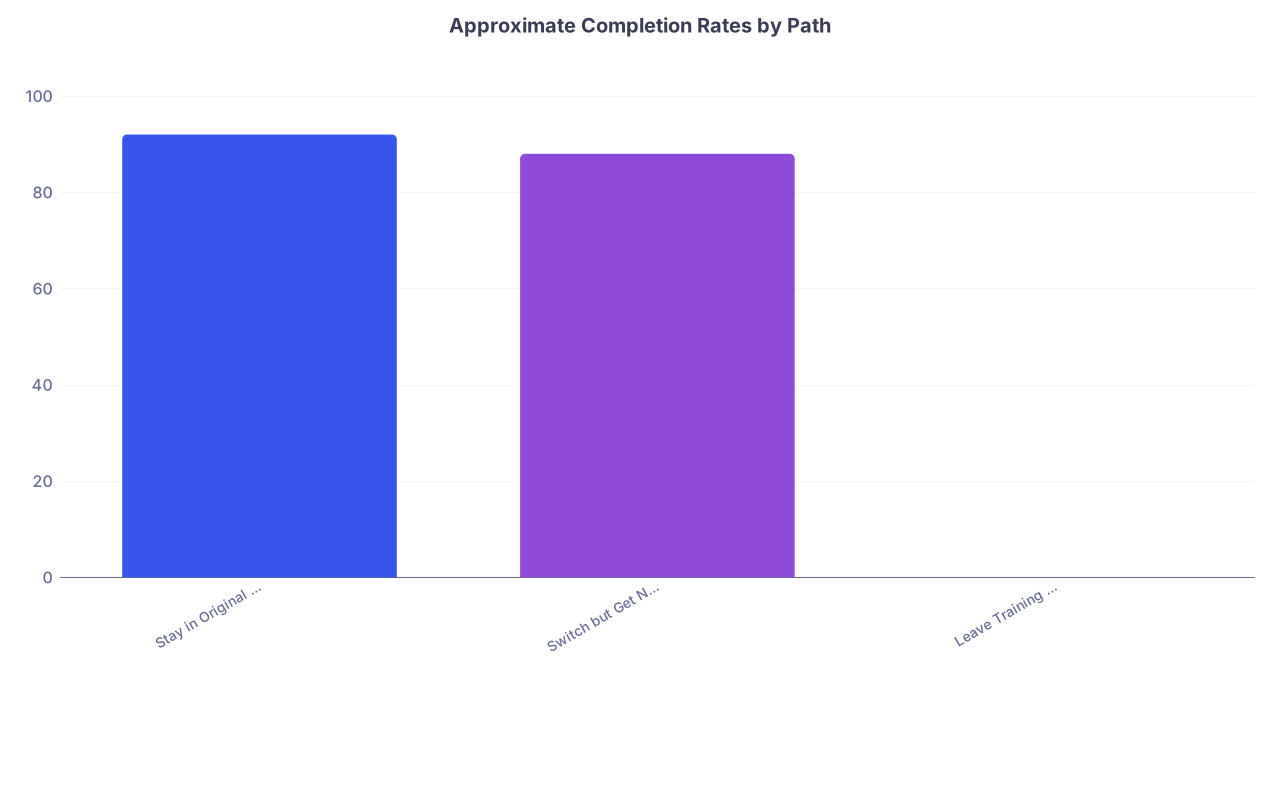
| Category | Value |
|---|---|
| Stay in Original Specialty | 92 |
| Switch but Get New Residency | 88 |
| Leave Training Entirely | 0 |
The second bar is not literal national data, but it reflects what many institutional cohorts report: if you are strong enough to convince a second specialty to take you, your completion odds are high.
Career satisfaction and burnout
The “soft” outcomes matter, even if the data are mostly self‑reported.
Survey work (mostly small studies) on residents who switched specialties tends to show:
- Higher reported career satisfaction in the new specialty compared with in their original field.
- Burnout scores that normalize to or sometimes beat their peers in the new specialty, especially when the switch was early.
The selection bias is obvious: people who fight through the difficulty of switching usually have a strong sense of what they want the second time around. They optimize for fit, not prestige.
Economic and time‑to‑practice impact
Here is where the numbers hurt and you need to be honest with yourself.
If you reset from, say, surgery PGY‑1 to internal medicine PGY‑1, you have:
- Added +1 year of residency salary (low income).
- Delayed attending‑level salary by one year.
- Possibly increased debt through additional interest accrual.
Rough back‑of‑the‑envelope calculation:
- If your target specialty yields an attending income of $250–350k/year and you add one extra training year, you are giving up one year of that difference versus what you could have earned if you had matched correctly initially.
- Discounting and taxes aside, that is a real opportunity cost in the low‑ to mid‑six figures.
However, if the alternative is persisting through a specialty that you will ultimately leave or hate enough to burn out, the long‑term earnings and quality‑of‑life calculus tilts quickly in favor of a deliberate switch.
Where switchers end up
There is a pattern in destination specialties. The data and program rosters show the same magnets over and over:
- From surgery → anesthesia, EM, radiology, internal medicine.
- From OB/GYN → family medicine, internal medicine, hospitalist medicine.
- From medicine/peds → psychiatry, neurology, anesthesiology.
If you looked at destination specialties as a share of all switches, you would see clustering in a handful of “receiver” fields.
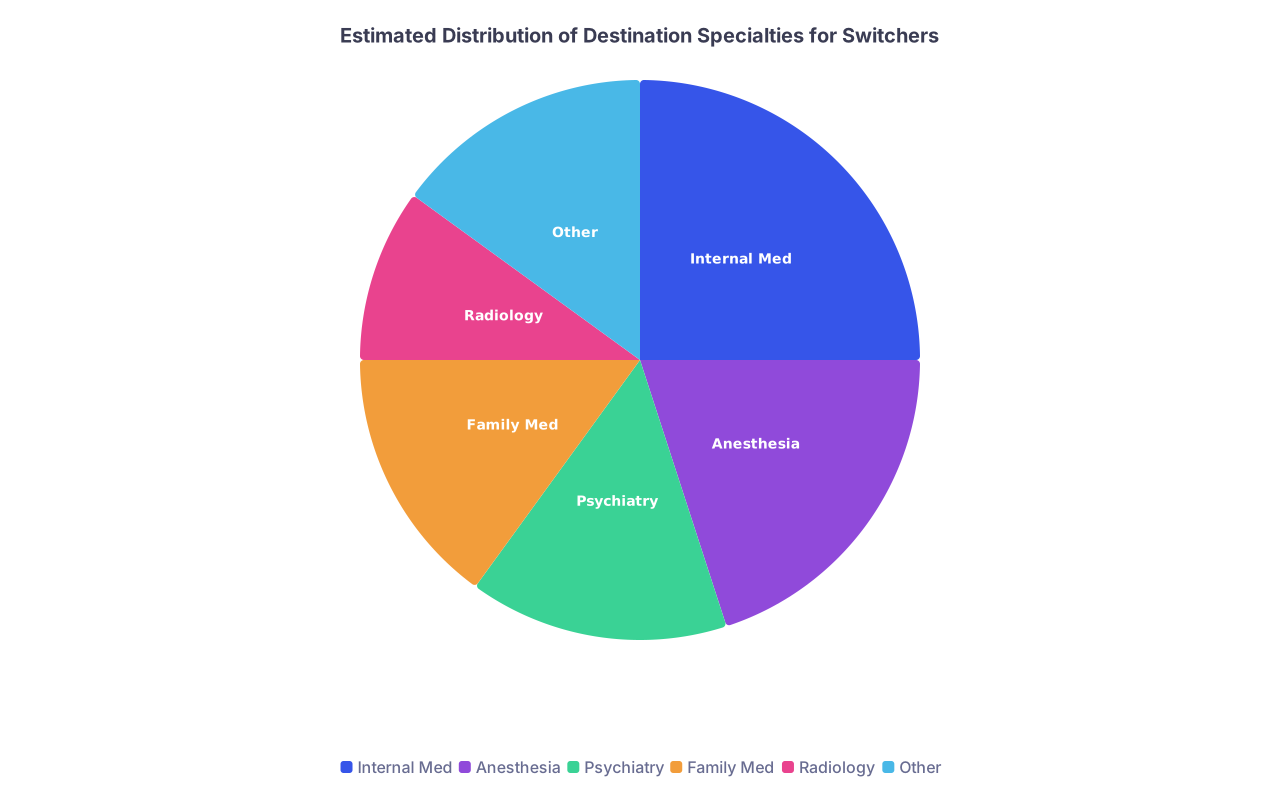
| Category | Value |
|---|---|
| Internal Med | 25 |
| Anesthesia | 20 |
| Psychiatry | 15 |
| Family Med | 15 |
| Radiology | 10 |
| Other | 15 |
Again, not a literal national dataset, but it mirrors what program‑level tracking and specialty anecdotes consistently show: a concentration in a few core specialties with flexible entry paths.
Strategic Takeaways if You Are Considering a Switch
Let me be direct. If you are already in residency and thinking about switching, you are in a constrained optimization problem with real financial and reputational stakes.
The data point to a few hard truths:
Early is statistically better.
More available pathways, less sunk time, easier to get full credit for prior training. The first 12–18 months are the high‑probability window.Performance now matters more than Step scores.
Program directors will dissect:- Your in‑training exam results.
- Evaluations and milestones.
- Professionalism concerns.
A solid performance in your current program is the strongest predictor that another specialty will take a risk on you.
The story must match the numbers.
If your transcript, rotation choices, and letters scream “surgery at all costs,” and you now apply to psychiatry citing a 10‑year passion for mental health, people will notice the mismatch. You do not need a perfect narrative, but you need a coherent one.Destination specialty choice is not fully free.
The actual receiving capacity is larger in:- Internal medicine
- Family medicine
- Psychiatry
- Some anesthesiology and neurology programs
A switch from pediatrics to dermatology is fantasy for almost everyone. A shift from surgery to anesthesia or IM is numerically feasible.
You are not permanently marked.
The national and institutional data are clear:
Residents who successfully switch, complete the new program, and pass their boards mostly disappear into the attending workforce with outcomes similar to everyone else. The main cost is a one‑time hit in time and income, not a lifelong scarlet letter.
Three key points to end on:
- Specialty switching after the Match is uncommon but far from rare, with realistic incidence around 1–3% of a matched cohort and much higher churn in certain procedural fields.
- The vast majority of switches happen in the first 18 months of training, and residents who secure a new spot usually complete that second residency and perform comparably to peers.
- The real constraint is capacity and performance: strong in‑program metrics plus a coherent, data‑consistent narrative create options; weak performance and vague dissatisfaction do not.