
The most dangerous problems for new residents are not the ones on the wards. They are the ones in your inbox. Housing, licensure, and paperwork derail more interns than any ward month ever will.
You can be a brilliant sub‑I, crush your interviews, and still start PGY‑1 exhausted, broke, and one email away from being pulled from the schedule—all because you treated logistics as background noise instead of critical path.
Let me walk you through the landmines, because hospitals will not do this for you.
The silent killers: deadlines you thought were “soft”
The biggest mistake new residents make is assuming every date is negotiable. It is not.
I have watched incoming interns:
- Show up for orientation without an active state license number
- Lose their reserved hospital housing to a waitlist applicant
- Miss payroll for the first month and live on credit cards
- Delay visa processing so long that HR quietly starts planning for a backup candidate
None of that happens because people are lazy. It happens because they misjudge what is “urgent.”
Programs send a blizzard of emails: “Complete this form,” “Upload your immunizations,” “Finish this background check.” You skim them, tell yourself you will knock them out this weekend, and then clutch an iced coffee on Match Day thinking you have “months” to sort it out.
You do not.
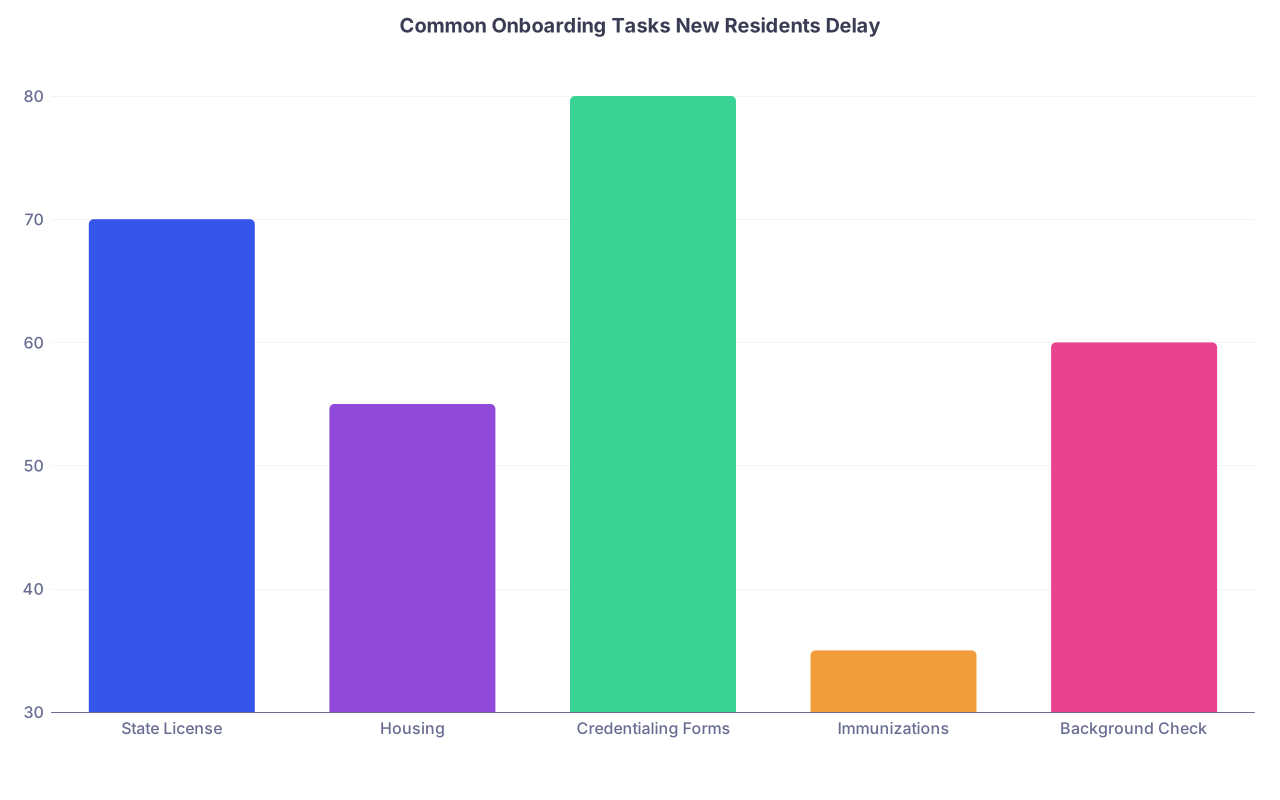
| Category | Value |
|---|---|
| State License | 70 |
| Housing | 55 |
| Credentialing Forms | 80 |
| Immunizations | 35 |
| Background Check | 60 |
That chart could be any large academic center I have worked with. Huge percentages of incoming residents delay core items. And the system is ruthless: missed tasks trigger real consequences—start delays, calls from GME, schedule changes, sometimes formal write‑ups.
The rule: if something affects your ability to legally touch a patient, to get paid, or to physically live near the hospital, you treat it like a Step 2 deadline. Not like an optional survey.
Housing: the “I’ll figure it out later” trap
Housing is the first trap because it feels simple. You think: I just need an apartment. Everyone finds an apartment. How bad can it be?
Bad enough that I have seen interns signing leases on their phones during orientation lunch because their previous deal collapsed the week before.
Mistake #1: Believing the “you will be fine if you start in June” myth
In competitive cities—Boston, NYC, San Francisco, Seattle, DC—June is not early. It is late.
By the time many residents get around to looking:
- Hospital‑adjacent buildings are full
- “Resident‑preferred” complexes are picked over
- Prices jump because you are closer to July 1
You also end up making desperate choices: 90‑minute commute, unsafe neighborhood, or absurd rent.
| Stage | Optimal Timeframe | Common (Bad) Timeframe |
|---|---|---|
| Research neighborhoods | March–April | Late May–June |
| Contact leasing offices | April | Early–mid June |
| Apply / secure unit | April–May | Late June |
| Move‑in / buffer time | Early–mid June | June 29–30 |
If you are signing a lease the week before orientation, you are already in damage‑control mode. You will be moving boxes and waiting for internet install when you should be memorizing pager numbers and figuring out the EMR.
Mistake #2: Ignoring commute fatigue
A lot of matched students think, “I can handle a 45‑minute commute. I did that in med school.”
You did not do that on 28‑hour calls in January, leaving the hospital at 2 a.m. on icy roads. You did not do that six days in a row on ICU.
A long commute is not just annoyance. It is a patient safety risk. You will cut corners on sleep. You will push yourself to drive when you should not. Fatigued driving after Q3 call is how people crash.
The hidden cost: more Uber/Lyft rides on post‑call days, higher gas/parking costs, and reduced time to do literally anything else. What looked financially smart on paper becomes a net loss.
Mistake #3: Not understanding local landlord expectations
Landlords do not care that you “matched at a great program.” They care about:
- Credit score
- Income proof (offer letter, contract)
- Move‑in date
- Lease length
Here is how residents sabotage themselves:
- They do not get a formal employment letter from GME early, so they cannot prove income.
- They try to negotiate July 1 move‑in “because that is when I get paid,” and lose the unit to someone taking it June 1.
- They have not checked their credit in years and get blindsided by an old collection or thin file.
Result: delays, extra deposits, needing a co‑signer, or losing decent housing options.
Mistake #4: Rolling the dice with “I’ll crash with friends at first”
I have heard this too many times: “I will just couch‑surf for the first month until I find something.”
Here is what actually happens:
- Your first month is your most cognitively overloaded. You will not “browse apartments at night” after a 14‑hour day.
- You cannot really rest in someone else’s home. Constant low‑grade stress.
- Every time you consider applying for a decent unit, your schedule or fatigue gets in the way, and it slips.
Do that for 4–6 weeks and suddenly you are in August, choosing from the scraps.
Licensure: the one delay you cannot talk your way out of
If you take nothing else from this: your state license and required training certificates are gatekeepers. You can not “explain your way around” not being legally allowed to practice.
Mistake #5: Starting your state license late
State medical boards can be glacial. Some are faster, but too many are:
- Under‑staffed
- Paper‑dependent
- Rigid about missing items
I have seen states take 8–12 weeks for a training license. Sometimes more if your background is not perfectly clean or your school is slow with verification.
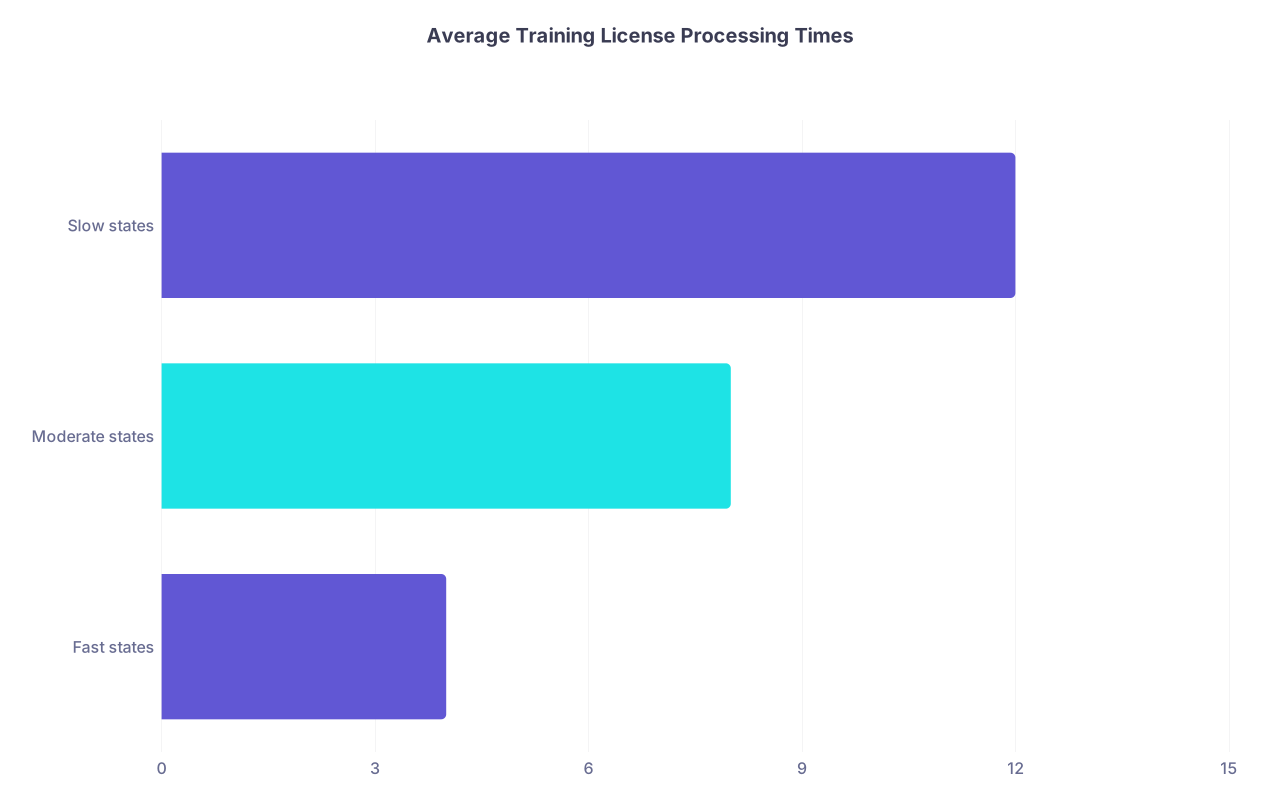
| Category | Value |
|---|---|
| Fast states | 4 |
| Moderate states | 8 |
| Slow states | 12 |
Now combine that with the typical new resident behavior:
- They do not open the licensure email for two weeks.
- They wait to submit until every last document is “perfect” instead of sending what they can and following up.
- They delay fingerprints or notarization because “it is annoying to schedule.”
Every week you wait to start is not a week. It is one full rotation of risk.
If your license is not issued by start date, your program has three choices, none good:
- Pull you from clinical duties and stick you in “non‑clinical orientation land.”
- Scramble to get you emergency permission (if the state even allows it).
- Delay your start and rearrange schedules.
Your co‑interns will now cover your shifts. Your PD will remember that.
Mistake #6: Treating background checks and drug screens as low priority
Background checks and drug screens are blockers for credentialing. Credentialing is a blocker for:
- EMR access
- Badge activation
- Procedure privileges
- Scrub access
Delay these, and you show up on day one as a ghost. No login. No badge. No ability to order labs or meds.
More than once I have seen interns stuck in a basement conference room, watching policy modules on a loaner laptop while their co‑interns actually start residency. Why? Because their background check completion hit HR’s queue a week too late.
Mistake #7: Assuming “I passed Step, so I am done with exams”
Programs and states often require:
- ACLS/BLS certification (sometimes PALS, NRP)
- Mandatory trainings (HIPAA, OSHA, infection control, abuse reporting)
- Sometimes a local “jurisprudence” or prescribing exam
You delay scheduling ACLS and suddenly the only open course is the weekend before orientation, 8 a.m.–6 p.m., when you had planned to move in. Now you are moving at night, showing up to PGY‑1 already behind on sleep.
These classes also sell out. If you wait, you drive two hours to the one remaining course slot or pay a premium frantic same‑week fee.
Paperwork: the thousand small cuts that become real money
Paperwork is where most new residents bleed financially. Not in big obvious ways, but in 20 tiny ones.
Mistake #8: Ignoring “optional” HR and benefits deadlines
People treat benefits enrollment emails as background noise. They skim, then archive.
Here is what that costs you:
- Default health plan that is more expensive and less appropriate for your needs
- Missed deadlines for HSA/FSA enrollment, costing you hundreds to thousands in pre‑tax savings
- No disability insurance or life insurance in place as you start a physically and emotionally punishing job
- No retirement contributions starting from day one (those lost months compound over decades)
I have seen residents miss their 30‑day benefits window and be locked into bad or default coverage for the year. One accident or illness in that gap and you are paying thousands out of pocket unnecessarily.
Mistake #9: Disorganized documentation
Programs and state boards ask you for the same types of documents repeatedly:
- Passport / government ID
- Social Security card
- Medical school diploma
- Dean’s letter
- Immunization records
- Step scores
Here is how you create chaos:
- You do not have a single, secure digital folder with PDFs of all of these.
- You keep them in random email chains or photos on your phone.
- You assume “I can always ask my school again” (and then the registrar takes three weeks to respond in June).
The result: last‑minute scrambles, fees for expedited transcripts or verifications, delayed application processing. Which loops back into delayed licensure and credentialing.
Mistake #10: Underestimating how many people need to sign something
Forms bounce. A lot.
Training license: school has to verify graduation.
Hospital credentialing: med school, previous rotations, sometimes references.
Visas: ECFMG, program, sometimes lawyers, sometimes outside agencies.
Each step is an opportunity for someone to sit on your form for a week.
Residents who avoid delays do something very simple and very rare: they track the chain.
They know exactly:
- When they submitted
- Who needs to sign
- How to follow up (politely but persistently)
Residents who get burned assume “no news is good news” until an exasperated coordinator emails, “We still do not have your verification from X” three days before the board deadline.
Financial damage: how delays quietly drain you
Delays are not just stressful. They are expensive.
Here is what new residents quietly pay for because of poor planning:
- Extra nights in hotels or Airbnbs because their lease starts after orientation
- Rush fees for licenses, transcripts, overnight shipping, notary services
- Lost income if start date or clinical privileges are delayed
- High‑interest credit card debt because first and sometimes second paychecks are offset by back‑to‑back upfront expenses
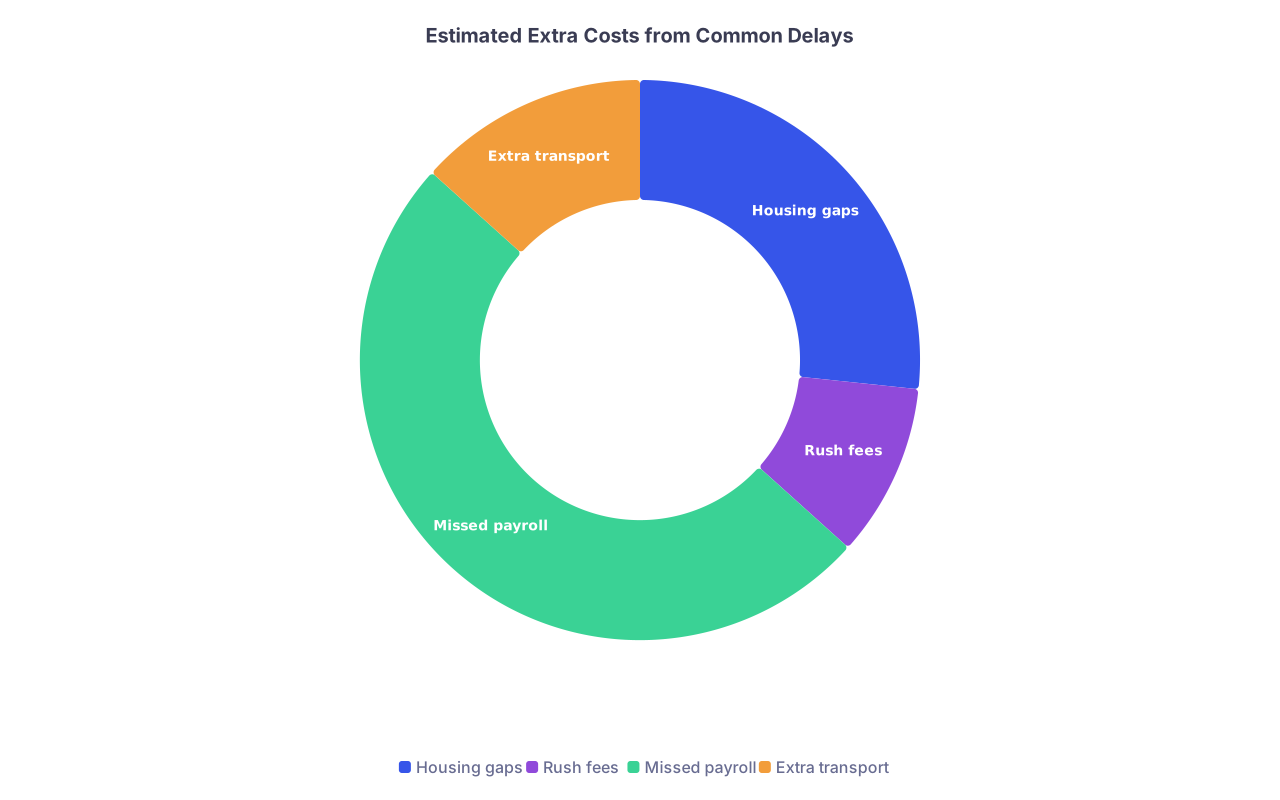
| Category | Value |
|---|---|
| Housing gaps | 800 |
| Rush fees | 300 |
| Missed payroll | 1500 |
| Extra transport | 400 |
That doughnut chart is not hypothetical. Those numbers are very close to what I have seen interns quietly admit in July: an extra $2,000–3,000 burned for avoidable reasons.
If you are already carrying loan debt, this is gasoline on the fire.
Immigration and visas: the delays that end careers
If you are an international medical graduate, everything I have said so far is amplified.
Mistake #11: Treating visa paperwork like “just more forms”
For J‑1 and H‑1B, you are now dealing with:
- ECFMG or USCIS timelines
- SEVIS or petition processing
- Consulate appointment availability
- Mailing times across borders
You cannot “start late” if your visa is not issued. You cannot physically enter the country.
Common self‑inflicted wounds I have seen:
- Delayed ECFMG document uploads
- Slow responses to program/lawyer questions
- Not checking consulate appointment backlogs and travel restrictions until May or June
- Booking flights before having visa in hand
If the visa process stalls, programs sometimes have no choice but to move on. I have seen residents lose positions entirely over preventable delays here.
For IMGs: your visa paperwork is not just paperwork. It is your ability to train at all.
A realistic high‑level timeline (that most people ignore)
People want a magic checklist. There is no universal one because states and hospitals differ. But there is a rhythm that does not change much.
Here is what a sane cadence looks like for most U.S. grads:
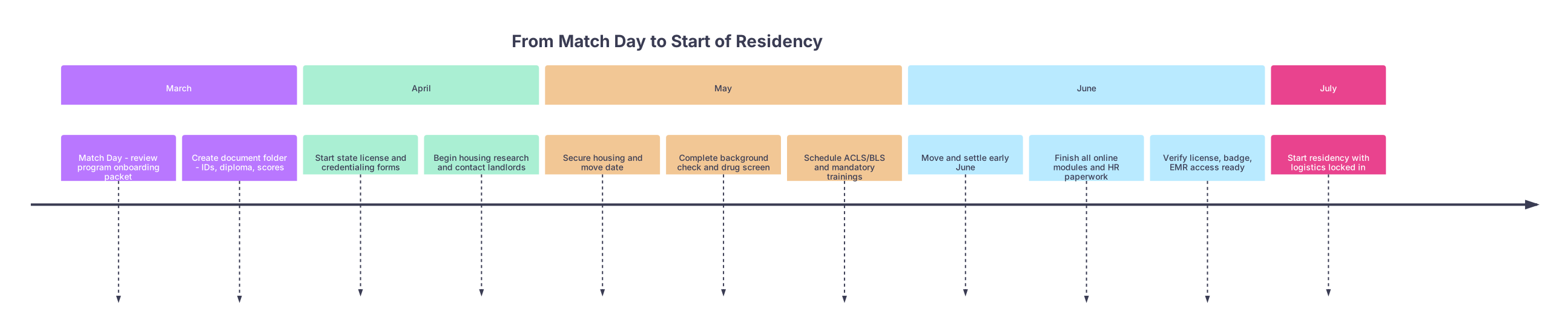
Most delays come from compressing April, May, and June into “I’ll take care of it after graduation.” Which is exactly when you are traveling, celebrating, and mentally checked out.
Treat these three months like a quiet, unpaid job. Because they are.
How to not be the cautionary tale
I will not insult you with generic productivity tips. You are capable. The problem is prioritization, not intelligence.
Here is what actually works, based on watching hundreds of people get this wrong:
- The moment you match, create one master onboarding document (or spreadsheet). Columns: task, who requested it, deadline, status, last follow‑up.
- Block off two high‑quality work sessions per week from March through May just for residency logistics. No multitasking.
- Submit anything that has a long processing tail (license, background check, visa) as early as the system allows, then follow up every 2–3 weeks.
- Lock housing by mid‑May if at all possible. Earlier if the market is nuts.
- Schedule ACLS/BLS and any mandatory in‑person training as soon as course dates open. Protect that time.
- Keep a single folder (cloud + local backup) with all IDs, diplomas, test scores, immunizations, and signed forms. Rename files clearly.
None of that is glamorous. But the payoff is starting PGY‑1 focused on patients, not panicking in HR with a dead badge and a stack of unsigned forms.
The bottom line
Three points, and then I will stop.
- Housing, licensure, and paperwork are not side quests. They are critical path. Treat their deadlines like exam dates, not suggestions.
- The costs of delay—financial, professional, and psychological—are real and far higher than the annoyance of handling things early.
- Residents who start strong are not “lucky.” They respected the logistics. Do that, and you will not become the horror story everyone hears in orientation.