
The idea that your ERAS application “dies” on Match Day is a lie we tell students so they sleep better.
Your file follows you. Into orientation. Onto rounds. Into the chief’s office when there’s a problem. And yes—into fellowship applications. Program directors and faculty do not forget what they read about you. They save it, quote it, sometimes weaponize it, and occasionally use it to bail you out.
Let me walk you through how that actually works, because nobody explains this honestly to applicants.
What Really Happens to Your ERAS File After the Match
Everyone remembers Match Day, but the important thing happens a week later, behind closed doors.
The NRMP sends the list. Your program coordinator pulls up your ERAS file. And from that point on, you’re not “a new intern we just met.” You’re the person they’ve been reading about for months.
Here’s the part students never see: in most decent-sized programs, there’s some combination of the following:
- A shared drive or secure folder with PDFs of every incoming resident’s ERAS application
- Local copies of your personal statement and MSPE (“Dean’s Letter”)
- An internal summary or “impression sheet” that attendings wrote during interview season
- Screenshots or notes from interview day: “Great with patients,” “Quiet,” “Seems burned out,” “Superstar,” “Red flag – professionalism?”
Does every attending read all of this? Of course not. But your PD, APDs, chiefs, and often your mentor will. And when there’s a question about you—good or bad—they go straight back to that file.
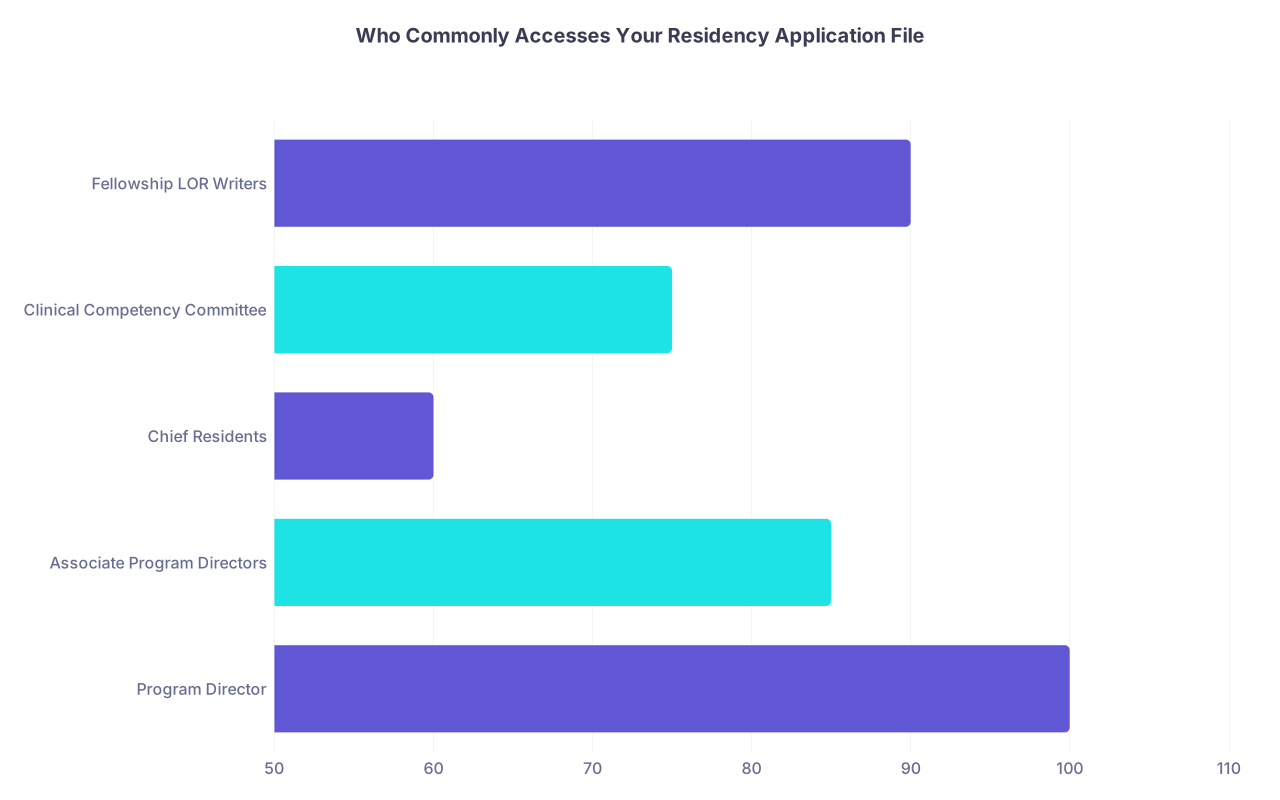
| Category | Value |
|---|---|
| Program Director | 100 |
| Associate Program Directors | 85 |
| Chief Residents | 60 |
| Clinical Competency Committee | 75 |
| Fellowship LOR Writers | 90 |
Those numbers aren’t from a published paper. They’re from the reality I’ve seen across multiple programs: almost all PDs and APDs re-open your file; chiefs and CCC members often do; anyone writing you a serious letter for fellowship definitely does.
You are not a blank slate when you walk in July 1. You’re a character they already formed an opinion about.
The Parts of Your Application That Haunt (or Help) You
Not every line of your ERAS follows you with the same weight. Some things fade. Others get resurrected whenever you come up in conversation.
Your Personal Statement: The Rosy Narrative You’ll Be Measured Against
Residents think the personal statement disappears after interview season. It does not. It becomes your origin story.
I’ve watched this happen:
- Intern says on day 3 of wards, “I actually hate inpatient medicine, I only want clinic.”
- APD pulls up their ERAS statement in the office:
“I feel most alive managing acutely ill patients on the wards, where the complex physiology comes together at the bedside…”
APD looks at me and says, “So what changed?”
You will be measured, informally, against the person you claimed to be.
If you wrote:
“I am deeply committed to working with underserved urban communities,”
and then spend three years grumbling about continuity clinic and trying to swap all your community elective time for research, that disconnect gets noticed. People will literally say in CCC meetings, “This is not the resident we thought we recruited.”
On the flip side, if your personal statement described specific hardships, resilience, or a late start—and then in residency you hustle, show up early, own your mistakes—people respect that your file was honest. PDs remember, “They came from a nontraditional path, but look how they’ve grown.”
Your future fellowship letter writers often re-read your statement. They use your original “why this specialty” to shape the narrative arc of your LOR. If your statements don’t match—if your residency and fellowship personal statements tell totally different stories—someone notices.
The MSPE and Clerkship Comments: The “Pattern Detector”
PDs absolutely look for patterns in your MSPE and clerkship narratives once you’re in trouble. Or in contention for something big.
- If you show up late a lot as an intern, and we see “sometimes late” or “issues with punctuality” or “needed frequent reminders about deadlines” in your third-year comments—that will be brought up. I’ve seen an APD literally read those words aloud in a CCC meeting.
- If a med school comment said “occasionally defensive in receiving feedback,” and now as a PGY-2 you’re known for arguing with attendings, that’s framed as “a longstanding pattern.”
The inverse is more powerful than you think:
If your MSPE called you “quiet and reserved but thoughtful,” and by PGY-3 you’re confident, leading rounds, teaching interns—that growth gets documented. PDs love a “distance traveled” story. It makes them look smart for ranking you.
Test Scores: They Don’t Define You, But They Do Echo
The nasty truth: Step and shelf scores are rarely used against you during residency, but they’re absolutely remembered when you apply out—to fellowship or competitive jobs.
Low Steps do not doom your training. I’ve seen residents with very average scores become absolute monsters of clinical excellence. But fellowship PDs still see those numbers on your original ERAS when they request your file or background.
What also happens internally:
- If you struggled with exams and then struggle with in-training exams, no one is shocked. The discussion shifts to: “Did we anticipate this? Did they have support?”
- If you had mediocre exams but crush your in-training scores, that becomes a bragging point in your fellowship letters: “Their in-residency performance far exceeded what their early test scores would suggest.”
Do not obsess over your old numbers. But don’t pretend they don’t exist in the file cabinet either.
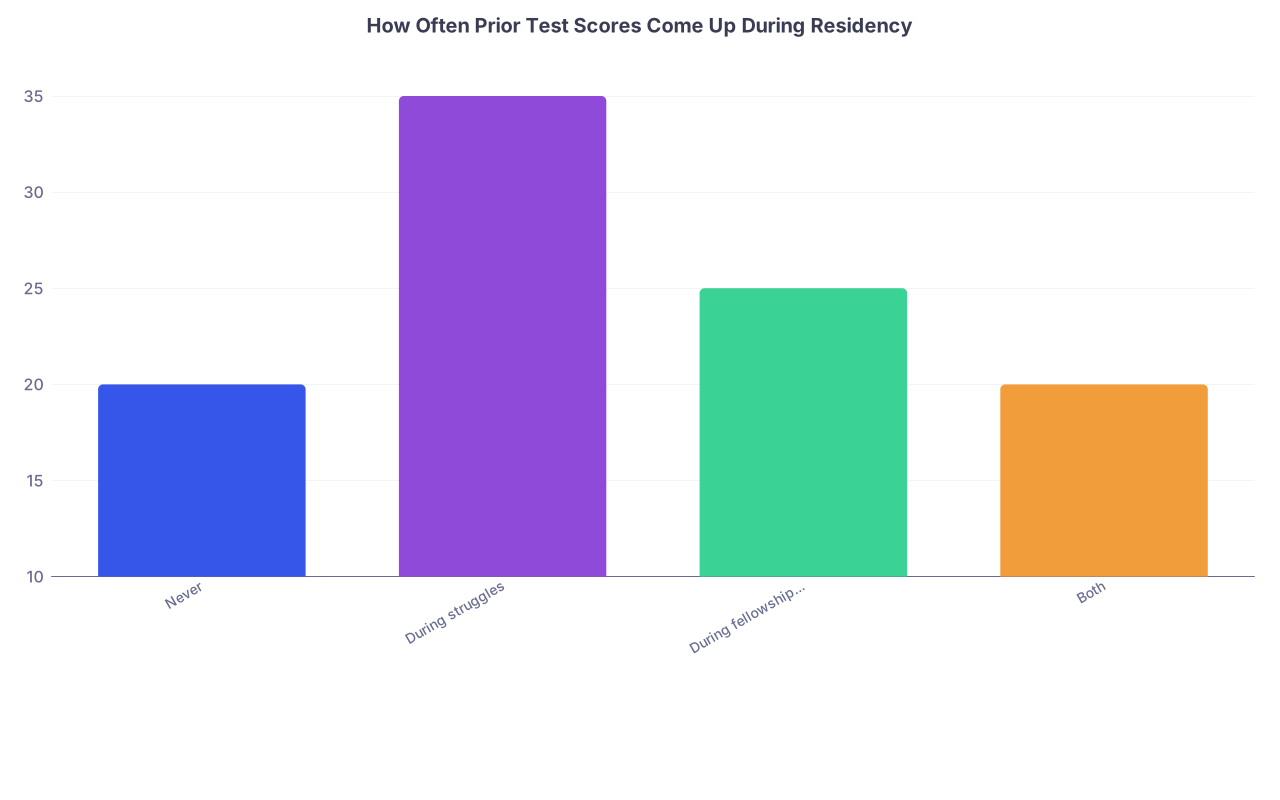
| Category | Value |
|---|---|
| Never | 20 |
| During struggles | 35 |
| During fellowship prep | 25 |
| Both | 20 |
How Your File Shows Up in Real Decisions
Let me be blunt: your ERAS file most often reappears in three scenarios.
- When you’re in real trouble
- When you’re up for something competitive
- When you confuse people
1. When You’re in Trouble
A resident misses shifts. Or there’s a patient complaint. Or a nurse reports a professionalism issue. The CCC or PD will almost reflexively say: “Pull their file.”
They’re looking for:
- Prior professionalism flags in med school
- Dean’s letter language like “needed additional coaching” or “concerns addressed”
- Inconsistencies between the “polished applicant” and the “current behavior”
I sat in one meeting where a PGY-1 had a bad pattern of not returning pages. The PD opened their MSPE and read: “On surgery, there were early concerns about response time to pages and completing tasks, which improved with close supervision.” Then she looked around the table and said, “So this is not new.”
That single sentence changed the tone from “sudden behavior” to “longstanding pattern.” That affects how harsh the remediation is. Or whether they think you’re worth the investment.
If your med school had documented remediation, trust me—your PD knows by the time you show up. They do not advertise it to everyone, but they remember. The question in their head is always: “Are we seeing the same thing here, or did they genuinely grow past it?”
2. When You’re Up for a Spot or Award
Flip side. You’re killing it. Strong evals, patients love you, chiefs love you. You express interest in:
- Chief resident
- Competitive fellowship
- Research year or special track
- Institutional awards
Guess what gets reopened? Your file.
They look for:
- Evidence you’ve been “special” for a while (honors, AOA, strong med school narrative)
- Alignment—did you say in your statement you loved teaching? Then we can highlight that now.
- Any subtle concerns that might not have mattered for rank but now matter for leadership
I watched a PD argue for a resident for chief with this exact line:
“I read back through her file. She was a top performer in med school, amazing comments, no professionalism noise anywhere. That plus what we’ve seen here—she’s a safe choice.”
“Safe choice” is code for “There are no landmines in the old paperwork.”
3. When You Don’t Match the Story They Were Sold
This one is more common than people admit.
You sold yourself on ERAS as “future clinician-scientist, passionate about research.” You arrive. You never set foot in the research office. You turn down every project. You complain about writing.
It comes up. Attending: “I thought this was the research person?”
Chief: “That’s what their file says.”
Or you wrote, “I grew up with very limited resources and am driven to serve similar communities,” and then your elective list is derm, plastics, private subspecialty clinics, zero community work. People notice.
Humans hate cognitive dissonance. When your behavior and your file don’t match, they resolve it one of two ways:
- “We misread the file. They over-sold.”
- “Something happened—burnout, life, priorities changed.”
Which story gets told about you depends on how you communicate during residency.
The Private Notes They Keep About You
Here’s the part no one tells you: the “official” ERAS file is only half the story. The other half lives in:
- Shared Excel sheets from interview season
- Ranking meeting notes
- Emails among PD/APDs about you
Those documents do not vanish. And yes, they’re sometimes pulled up years later.

I’ve seen summary notes that say things like:
- “Interview: great energy, borderline Step scores, but faculty felt strong clinical sense.”
- “Red flag: non-explained leave in MSPE, applicant vague.”
- “Absolutely outstanding, top choice if we can get them.”
- “Gut concern from multiple interviewers—could be high-maintenance.”
That “gut concern” line you never knew existed? It’s still there when they’re deciding whether to push you hard for a cardiology fellowship.
When you’re doing well, those positive notes get rediscovered and quoted in letters. When you’re not, those early concerns are used as confirmation bias.
How Your Application Is Used for Fellowship and Beyond
You think your fellowship PD only sees what you’ve done in residency. Not quite.
Many fellowship programs will:
- Ask your residency PD for your original ERAS application (or at least a summary)
- Ask explicitly: “Was there anything in their med school performance we should know?”
- Compare your current fellowship personal statement to your original specialty statement
If your narrative is consistent—“I’ve always loved critical care, here’s how that deepened in residency”—you look thoughtful and genuine.
If your narrative is whiplash—“I came to IM for outpatient primary care” in ERAS, then “I’ve always been drawn to highly procedural, ICU-level interventions” in fellowship—your PD has to explain the pivot in your LOR. They will sometimes literally write, “Although in their original application they emphasized outpatient care, during residency they discovered a true passion for critical care.” The word “although” is doing a lot of work.
Fellowship PDs are experienced. They know when a resident has been consistent over years versus when someone rewrote themselves last minute to chase a competitive field.
| Component | Typical Impact on Fellowship Review |
|---|---|
| Personal Statement | Consistency of motivation, story arc |
| MSPE / Clerkship Notes | Prior professionalism or patterns |
| Step Scores | Baseline comparison to in-training |
| Med School Honors / AOA | Extra “signal,” not decisive alone |
| Research in ERAS | Does your track record match your pitch? |
What You Can’t Change… and What You Still Control
Yes, your application follows you. No, you can’t rewrite it. But you’re not doomed by who you were at 25.
Here’s the insider truth: PDs care far more about trajectory than origin. They keep your old file around not to punish you, but to anchor your story.
The questions they silently ask are:
- Did this person grow past their weaknesses, or double down on them?
- Does the resident today make sense given who we thought we were getting?
- If we put our name on them for fellowship, will anyone be surprised—good or bad—when their old file is pulled?
You can’t erase:
- That unflattering surgery clerkship comment
- The average Step score
- The slightly over-dramatic personal statement
You can absolutely overwrite the narrative with three years of consistent behavior.
I’ve seen:
- A resident with known med school professionalism issues become a model chief because they got therapy, owned their crap, and changed. PDs gladly explained that growth to fellowship programs.
- A resident who looked “borderline” on paper (no honors, okay scores) become the star of the program. Their original file became evidence of “distance traveled,” not limitation.
- A resident who came in as “research heavyweight” but burned out and shifted to being an outstanding clinician. Was there disappointment? Yes. Was that held against them forever? No. But the ones who communicated honestly did far better than the ones who pretended that early narrative never existed.

| Step | Description |
|---|---|
| Step 1 | Original ERAS File |
| Step 2 | PD Expectations |
| Step 3 | Early Months of Internship |
| Step 4 | Positive Reinforcement |
| Step 5 | Closer Scrutiny |
| Step 6 | Leadership and Opportunities |
| Step 7 | File Reopened and Reviewed |
| Step 8 | Support and Advocacy |
| Step 9 | Remediation or Consequences |
| Step 10 | Fellowship Applications |
| Step 11 | Matches Expectations |
| Step 12 | Evidence of Growth |
How to Live With the Fact Your File Is Still in the Room
If you’re already matched, reading this with a pit in your stomach, let me pull you back from the edge.
You do not need a perfect application to have a great residency. I would take a flawed but self-aware, hardworking intern over a “perfect on paper” ghost any day.
What you should do is simple, but not easy:
- Know the story you already told. Re-read your ERAS personal statement and MSPE once before starting residency. Not to cringe—though you will—but to remember what version of yourself they think they hired.
- Decide what still fits. Some parts will. Some won’t. That’s allowed. Growth implies change.
- Be direct with your PD or mentor if your path has shifted. “I know I wrote a lot about research, but in residency I’ve found I really love inpatient teaching and clinical work. Here’s where I see myself now.” That sentence alone neutralizes a ton of cognitive dissonance later.
- Build a clear, consistent narrative from PGY-1 onward. Your evaluations, your choices, your elective scheduling, your projects—that’s your “new file.” It sits on top of the old one and, by PGY-3, it’s what matters most.

One more thing nobody admits: many PDs barely remember the details of your application after the first year. They’re too busy watching who you are on rounds, on nights, when things go wrong. The file is a reference point, not your destiny.
The residents who do best are not the ones with spotless applications. They’re the ones who:
- Act like their reputation is built from scratch every rotation
- Are brutally honest with themselves about their weaknesses
- Give their PD a coherent story when their path doesn’t quite match the brochure
Your ERAS file is the prologue, not the final chapter. It walks into the hospital with you on July 1, but it doesn’t speak for you unless you let it.
Years from now, you won’t remember every line of that personal statement you sweated over. You’ll remember the moments in residency where you either leaned into the person you claimed to be—or finally became the person you actually are.