
What actually happens if you match… and then realize you can’t start residency on July 1 like everyone expects you to?
Let me be blunt: programs plan on you walking through the door on July 1 ready to work. Anything else is an exception, not the norm. But exceptions do happen, every single year. Visa problems. Health crises. Pregnancy complications. Failed Step 2 CK. Family emergencies. Administrative delays.
The question is: will they work with you, or will they move on?
Here’s how this really plays out, what’s negotiable, what isn’t, and how not to accidentally blow up your residency slot.
First: What “Start on July 1” Actually Means
Programs and boards care about two related but different things:
- When your employment contract starts
- Whether your training meets board and ACGME requirements
Most residencies start contracts on July 1. Some orientation may begin a few days earlier in late June, but July 1 is the standard “PGY-1 start” date on paper.
Why that matters:
- GME offices set payroll, benefits, malpractice coverage, and EHR/ID access off that date.
- ACGME and specialty boards count months of training, not vibes. They expect a full year (usually 12 months) to credit a PGY year.
- The program’s schedule assumes “we have X interns on July 1 to cover the work.”
So when you say, “I can’t start on July 1,” what the PD hears is:
- “You’ll be short one body on day one,” and
- “We might need to negotiate with the board about your training credit.”
Neither is trivial.
The 4 Main Types of Delays – And How Bad They Are
Let’s sort this into real categories, not vague panic.
| Delay Type | Typical Risk Level | Program Flexibility |
|---|---|---|
| 1–2 weeks late | Low–moderate | Often workable |
| 3–8 weeks late | Moderate–high | Case-by-case |
| 2–6 months late | High | Rare, needs formal approval |
| Full-year deferral | Very high | Uncommon, often denied |
1. Short Delay (1–2 weeks late)
Common reasons:
- Visa appointment scheduled mid-July
- Short medical recovery after minor surgery
- Moving/immigration logistics that slipped
Reality check:
- Many programs can absorb a short delay. They hate it, but they can manage.
- You usually still start on payroll July 1, even if you’re physically a bit late.
- Training credit typically isn’t affected if you complete enough days in the year.
Risk:
- Annoyed PD and chiefs.
- Slightly rocky start (you miss part of orientation, have to catch up on EHR and policies on the fly).
If this is you and you already matched: this is probably survivable if you’re upfront early.
2. Moderate Delay (3–8 weeks late)
Now we’re into actual problem territory.
Typical causes:
- Serious but time-limited health issue (e.g., pregnancy complication, surgery recovery)
- Visa issuance dragging well past July 1
- Major family emergency requiring you to stay abroad or away
What programs worry about:
- Schedule coverage: other interns and residents pick up your missing shifts.
- Training credit: some specialties are strict about minimum time per year.
- Fairness: one person getting a long grace period means everyone else is working more.
Outcomes I’ve seen:
- Some programs let you start late and extend your PGY-1 end date (you finish a bit later the next year).
- Some insist on you repeating part or all of PGY-1.
- Some say no and petition NRMP to release the match and find a replacement.
This is no longer “fine, we’ll just manage.” It’s “maybe, but we need a formal plan.”
3. Long Delay (2–6 months late)
This is usually tied to:
- Prolonged medical illness or rehab
- Serious pregnancy/OB complications
- Major immigration/legal issues
- Licensing exam failure and needing time to retake
This often triggers:
- Formal leave of absence before you even start
- Talk of deferring your start to the next academic year
- In some cases, your spot being reallocated or delayed a full year
Some boards allow “off-cycle” starts, but:
- You may become the single off-cycle resident constantly out of sync with rotations.
- It can affect fellowship timelines and graduation dates.
Programs get very cautious at this stage. You’re asking them to redesign schedules, not just plug a gap.
4. Full-Year Deferral (start next July)
This is what most people mean when they say “deferral.”
Reasons:
- Extended medical leave (e.g., major surgery and recovery, chemo)
- Mental health crisis requiring real time off
- Pregnancy where you and your doctors believe starting is unsafe
- Military obligations
- Unresolved serious immigration/visa issues
- Needing a year to pass required exams (e.g., Step 2 CK failure with late score release)
This is rare and not guaranteed. There’s no automatic right to a deferral. Some programs will try to hold your spot. Others will say they can’t and will release you.
What the Rules Actually Say (NRMP, ACGME, Boards)
NRMP (The Match contract people)
Once you match:
- You and the program are contractually obligated to each other.
- They’re supposed to give you a position starting that year.
- You’re supposed to show up and complete the year in good faith.
But NRMP also realizes life happens. If both parties agree to change the plan (delay the start, release the match), NRMP isn’t going to drag anyone in chains.
If there’s disagreement (you want to delay, program wants you now or gone), it can escalate. But almost always this is handled locally before lawyers get involved.
ACGME and specialty boards
These groups care about:
- How many months of training you complete
- What kinds of rotations and experiences you have
- Whether your training is continuous enough to qualify for board eligibility
For a one- or two-week delay, no one panics. For multi-month gaps or big off-cycle starts, the PD usually has to:
- Check the specific board’s policies
- Document a plan for how you’ll meet time requirements
- Sometimes request a formal exception or clarification
This is where “I’ll just start in November” runs into “That’s not how IM board requirements work.”
Common Reasons People Can’t Start on Time – And How Programs React
Let’s go through the frequent ones.
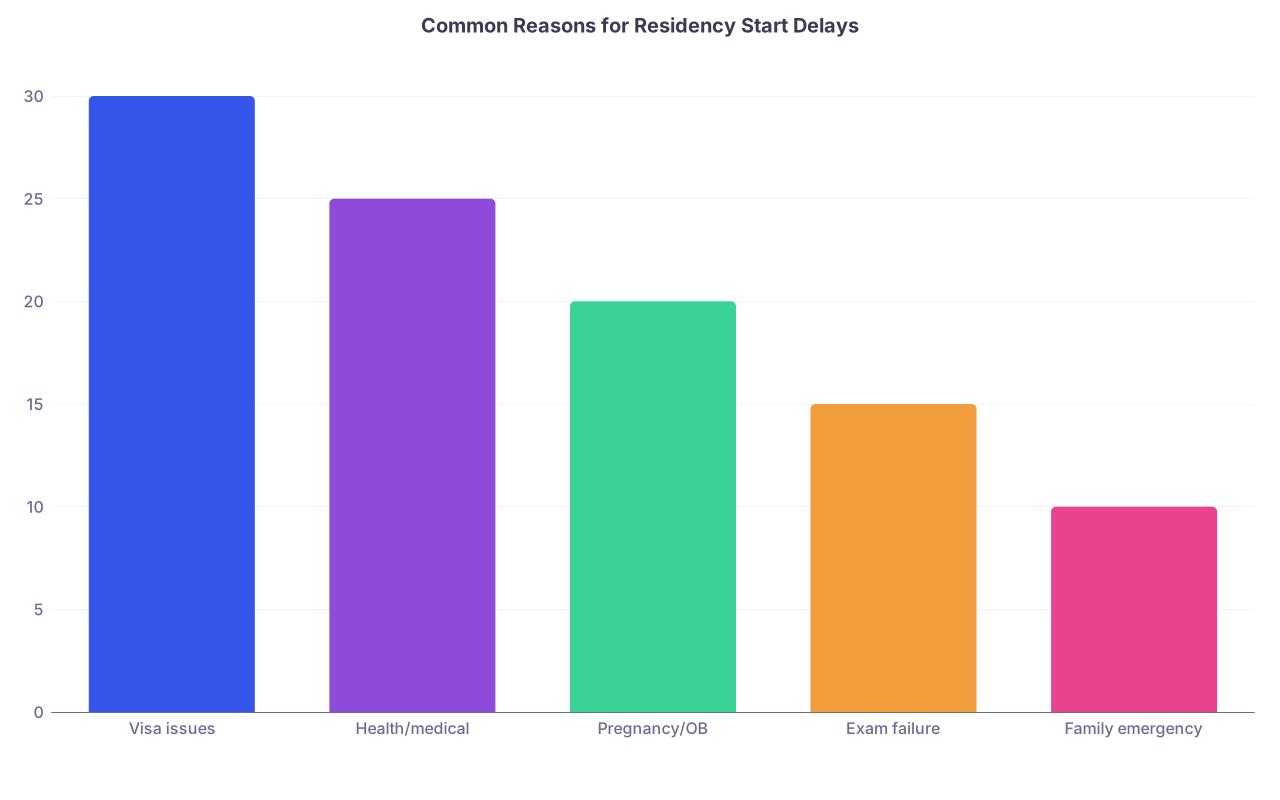
| Category | Value |
|---|---|
| Visa issues | 30 |
| Health/medical | 25 |
| Pregnancy/OB | 20 |
| Exam failure | 15 |
| Family emergency | 10 |
1. Visa and immigration problems
This is probably the most common real-world cause.
Pattern I’ve seen:
- IMG matches
- DS-2019 or H-1B paperwork starts late or gets stuck
- Visa interview date is July 10, or clearance is delayed
Programs that take a lot of IMGs typically:
- Have processes for this
- Know how to start you a little late
- May still pay you from July 1 if contractually obligated (varies)
What you should do:
- Tell the program the second you see a likely delay.
- Share every document and date you get (interview appointment, embassy feedback).
- Ask directly: “If my visa isn’t cleared until mid-July, what are my options?”
Some will say:
- “We’ll hold the spot; you’ll start as soon as you can; we’ll adjust your PGY-1 end date.” Others will say:
- “If you’re not here by X date, we may have to release the position.”
You don’t get clarity if you stay silent and hope.
2. Health issues and surgery
If you genuinely can’t safely work as an intern on July 1, your PD needs to know early.
Things programs look at:
- Is this time-limited (e.g., 4–6 weeks recovery) or long-term?
- Will you likely be able to perform essential duties (nights, long hours, call)?
- Do you have documentation from treating physicians?
Sometimes they:
- Put you on payroll July 1 and immediately place you on medical leave.
- Start your training clock when you’re actually able to work.
- Shift your end date and possibly your future PGY advances.
Sometimes, if prognosis is very uncertain, they’ll push for a full-year deferral or even suggest you don’t start at all.
3. Pregnancy and postpartum issues
Let’s separate two things:
- Being pregnant on July 1 (normal; lots of residents do this)
- Having serious complications, bedrest, or postpartum complications that make starting impossible
Most programs can handle:
- You being pregnant at start
- You taking maternity leave during internship
More complex:
- You needing to delay start several months due to high-risk pregnancy or postpartum complications.
There’s a lot of variability here. Some PDs are great, pragmatic, and supportive. Others… less so. But either way, it’s much easier to find a creative solution when you tell them early rather than the week before orientation.
4. Failed Step or licensing exams
Ugly but common scenario:
- You matched
- Step 2 CK or COMLEX Level 2 comes back as a fail in late spring
- Your state license/intern permit depends on that passing exam
Programs care about:
- Whether the state will even authorize you to begin
- Whether there’s enough time to retake before July 1 (often not)
Typical outcomes:
- If the state won’t license you, the program literally may not be allowed to employ you as a resident.
- Some will try to defer your start to the next year if you pass on retake.
- Others will terminate the contract and move on.
There’s no sugar-coating this: exam failure that impacts licensure can absolutely blow up your Match result.
How to Ask for a Delay Without Destroying the Relationship
If you think you can’t start on time, your sequence of moves matters.

| Step | Description |
|---|---|
| Step 1 | Realize you may not start July 1 |
| Step 2 | Confirm facts with doctors or government |
| Step 3 | Read your contract and GME policies |
| Step 4 | Email PD and program coordinator early |
| Step 5 | Propose concrete options and dates |
| Step 6 | Program discusses with GME and board |
| Step 7 | Get it in writing |
| Step 8 | Discuss release, next steps |
| Step 9 | Program offers path? |
Here’s how to do it like an adult and not a disaster:
Get the facts first
Don’t email, “I might have issues.”
Email, “My OB says I can’t work clinically until at least August 15. I have a note stating this.” Or “My embassy appointment is July 18.”Read your contract
Check:- Start date
- Requirements (licensing, exams, background checks)
- Any mention of deferrals or leaves
Contact the program early – PD plus coordinator
Subject line: “Time-sensitive: Start date and [visa/medical] issue”
Keep it clear, respectful, and specific.Offer realistic options, not demands
Example phrases:- “What are the options from the program’s perspective?”
- “If I’m able to start by [date], could I still join this class, with a later PGY-1 end date?”
- “If that’s not possible, is a one-year deferral ever considered here?”
Be prepared for any of these answers:
- “We can work with a short delay; you’ll start as soon as you arrive.”
- “We can’t hold your spot if you’re not here by [date].”
- “We might be able to defer you a year, but GME has to approve it.”
- “Given the uncertainties, we think it’s better to release you.”
And if they agree to any kind of modified plan: get it in writing. Email summary, GME letter, contract addendum—something.
Consequences: What Actually Happens to Your Career?
Let’s be honest about the fallout.
If you start late but still within PGY-1
Consequences:
- You may have to make up missed time later
- Your vacation/flex time might shrink that first year
- You might finish PGY-1 a few weeks later than your class
Usually doesn’t kill your career. It’s an annoyance and a little extra stress.
If you defer within the same program
Say they let you start the next July instead:
- You’ll likely have a gap year.
- You may need to explain that gap on future fellowship/job apps, but “medical reasons” or “visa resolution” are common and accepted.
- You’ll be slightly older than your co-interns. That’s it.
The big risk is not whether it looks bad later. It’s whether the program actually follows through and holds your position. Again: get formal documentation.
If your match is effectively canceled
This is the nightmare scenario, but it does happen.
What next:
- You might try to scramble into an open position (outside Match) if any exist.
- More likely, you’ll be applying again in a future cycle, with a very honest explanation.
Programs will absolutely ask: “What happened with your prior match?”
If the answer is:
- “I had a severe medical issue and couldn’t safely start,”
or - “My visa wasn’t approved in time; I couldn’t legally enter the country,”
most sane PDs can understand that.
If the story is:
- “I just decided I needed a break and told them in June I wouldn’t be there,”
your future options shrink. A lot.
Warning Signs You’re About to Mishandle This
I’ve watched people make the same mistakes repeatedly. Don’t be that cautionary tale.
Red flags:
- You’re thinking, “I’ll just tell them after graduation”
- You’re assuming, “They have to hold my spot; NRMP will back me”
- You’re ignoring emails from GME after they’ve heard a rumor about your plans
- You’re not looping in your medical school dean if you’re an MS4 with a big issue brewing
Programs are much more willing to help the resident who:
- Communicates early
- Brings documentation
- Shows they care about the team’s burden
And much less inclined to help the person who:
- Drops news last minute
- Is vague, evasive, or entitled
- Treats this like a hotel booking they can slide “just a bit”
Bottom Line: Can You Delay? Yes. Will You Keep Your Spot? Maybe.
Here’s the blunt summary:
- A short delay (1–2 weeks) is often manageable. Many programs will work with you, especially for visa or minor health issues.
- A moderate delay (3–8 weeks) is serious and needs explicit, early negotiation and probably some change to your training timeline.
- A long delay (months) or full-year deferral is possible but not standard. You are asking for a favor, not invoking a right.
- The earlier you tell the program and the more concrete your situation and dates are, the more likely they are to help instead of cut ties.
- Ghosting, hiding, or last-minute “by the way” emails are how careers get derailed.
FAQ (7 Questions)
Can a residency program cancel my contract if I can’t start on July 1?
Yes. If you can’t meet essential conditions (like licensure, visa, or ability to work), they can decline to proceed. Usually they’ll talk about alternatives first, but there is no guarantee they’ll hold your spot if you can’t start reasonably close to July 1.Do I automatically lose board eligibility if I start residency late?
No. Board eligibility depends on total months and content of training, not the exact calendar date. A short delay is usually fine if you make up time. Longer delays require careful planning with your PD to ensure you hit the board’s minimum training requirements.Can I ask for a one-year deferral just because I want a break or a research year?
You can ask, but don’t expect an automatic yes. Most programs are not excited about “I just want time off” after the Match. They built their schedules around you. True research years are usually arranged ahead of time, not sprung on them after Match.What if my visa is delayed and I don’t know when it’ll be cleared?
Tell your program immediately and give them every concrete date and document you have. Ask how late they can realistically hold the spot. Some will work with months of uncertainty; others have a hard cutoff where they must move on.If I fail Step 2 CK after matching, can I still start residency?
Sometimes yes, sometimes no. It depends on state licensing rules and program policy. If the state won’t allow you to be licensed or permitted as a trainee, the program often can’t start you. You’ll need an honest conversation with the PD and potentially your medical school dean about your options.Will a delayed start hurt my chances for fellowship later?
Usually not, if it’s well-documented and you complete all training requirements. Program directors writing your letters can easily frame a medical or visa-related delay as a life event, not a character issue. The bigger problem is if the delay leads to you leaving the program or repeating a year.Who should I talk to first if I know I can’t start on time?
If you’re still a student: your dean or student affairs first, then your PD. If you’ve graduated: your PD and program coordinator directly, and loop in GME if needed. Don’t sit on it. The earlier that email goes out, the more options you’ll have.
Open your email right now and draft a message to your PD or dean that honestly describes your situation and likely start limitations. You don’t have to send it yet—but if you can’t write it clearly, you’re not ready to handle this, and that’s your first problem to fix.