
You matched. You got the email. You exhaled.
Then the program sent the preliminary block schedule for PGY-1. And your stomach dropped.
You’re on nights your very first month. Your sister’s wedding is in September and they’ve got you on ICU. You and your partner already signed a lease in a different city… but your first rotation is at a satellite hospital 45 minutes away.
Now you’re staring at that PDF wondering:
“Is it OK to ask for schedule changes before PGY-1 starts, or will I look entitled and unprofessional?”
Here’s the answer you’re actually looking for, not the sugar‑coated version.
The Short Answer: Yes, You Can Ask. But You Need to Be Smart About It.
You are allowed to ask for schedule changes before PGY‑1 starts.
Programs change schedules all the time for:
- Medical issues
- Visa timing
- Maternity/paternity leave
- Weddings, religious holidays, and major life events
- Licensing delays
- Simple logistics (block imbalances, coverage issues)
What programs do not like:
- Vague “I’d just rather not start on X” with no reason
- Repeated asks that create extra work
- Anything that smells like you don’t understand you’re now an employee, not a customer
So the real question is not “Is it OK to ask?”
The real question is:
- Is my reason strong enough?
- Am I asking early and professionally?
- Am I showing I understand the program’s constraints?
If you do those three well, most reasonable requests get at least seriously considered. Some get granted quietly without drama.
When It Is Reasonable to Ask for a Schedule Change
Let’s sort this into buckets. I’ve watched PDs and chiefs respond to these for years.
1. Time‑sensitive, one‑time life events
These are usually the easiest:
- Your own wedding or sibling/parent wedding (especially if planned long before Match)
- Religious events that are major observances for you
- Pre‑paid, non‑refundable international travel that was clearly booked pre‑Match
- Immigration/visa appointments that are not flexible
If you email the program coordinator or PD early (April/May) with:
- Exact dates
- Clear prior planning (“this was booked in November, before the Match”)
- A simple ask (“If possible, could I avoid nights July 10–14 due to my sister’s wedding?”)
…you have a decent shot.
Not guaranteed. But decent.
2. Serious health or family issues
If:
- You have a chronic illness that makes starting on nights unsafe
- You have a disability that affects where you can rotate
- You’re caring for an ill parent/child requiring certain days
Programs are legally and ethically obligated to at least explore reasonable accommodations.
Here, you do not need to overshare, but you should:
- Communicate early
- Involve GME / HR if needed
- Frame it as: “I want to be safe and effective from day one; here’s what I need to do that.”
These are the cases I’ve seen programs bend over backwards for.
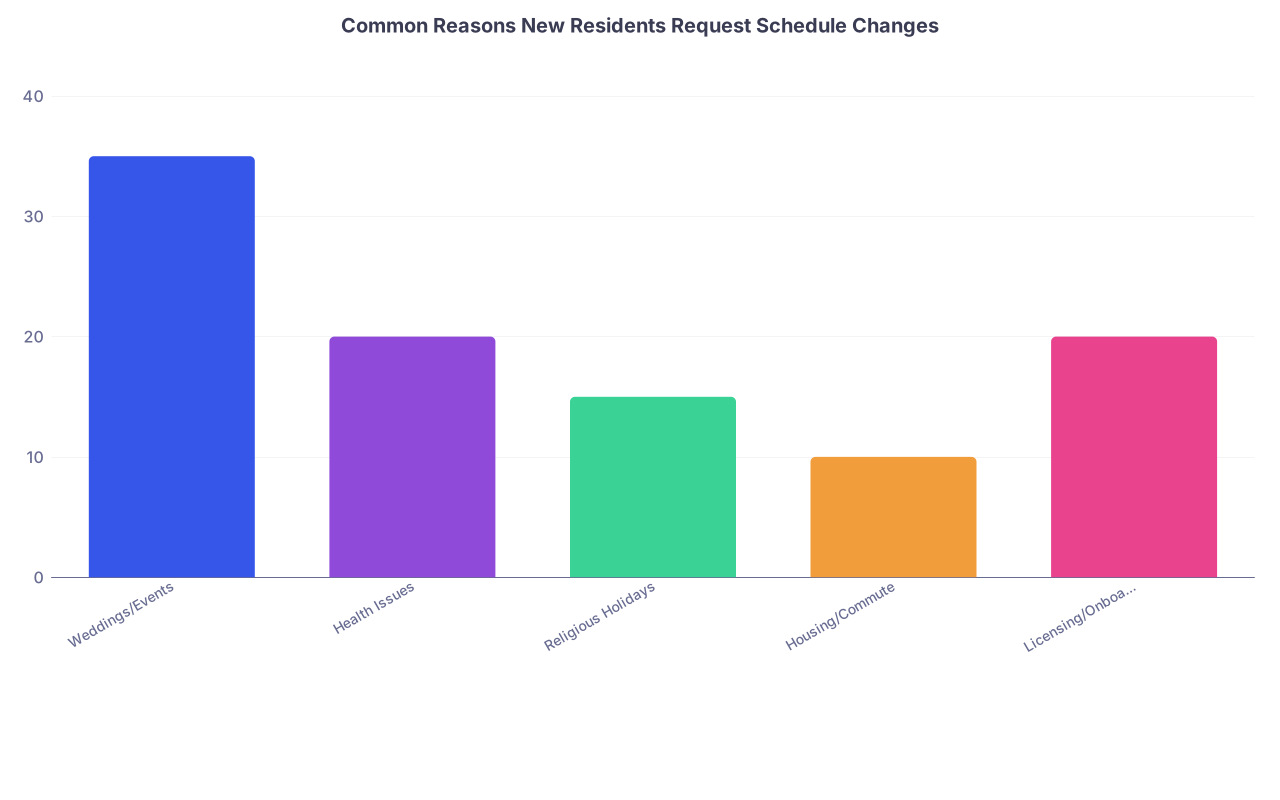
| Category | Value |
|---|---|
| Weddings/Events | 35 |
| Health Issues | 20 |
| Religious Holidays | 15 |
| Housing/Commute | 10 |
| Licensing/Onboarding | 20 |
3. Licensing and onboarding realities
Sometimes your start date or rotation location clashes with:
- State license processing delays
- Visa arrival
- Required orientation or EMR training
Programs care about this because it affects patient safety and billing.
If you’re not sure your license or visa will clear before July 1, talk to the program immediately. They may:
- Start you on a non‑billing rotation
- Delay certain rotations
- Adjust your first block to be more “orientation‑friendly”
Completely acceptable to bring this up.
4. Major commuting or housing conflicts… sometimes
If the schedule makes basic logistics impossible (not just annoying):
- You’re scheduled to start at a far‑away site before you even physically move to the city
- You don’t have a car yet but are placed first at a rotation that absolutely requires one
- Call schedule plus your known commute would make safe duty hours questionable
You can absolutely say:
“I’m happy to do that site later in the year, but I will not physically have a car until August 15. Is there any chance to shift that rotation out of July so I can reliably get there?”
Reasonable. Clear. Shows you’re trying to solve problems, not avoid work.
When Your Ask Is Probably Weak (But You Might Still Try)
Let’s be honest. Some reasons are soft.
These are the ones that make coordinators roll their eyes—but sometimes they still accommodate if you’re respectful and early.
“I don’t want to start on nights”
Everyone hates nights.
If your entire rationale is “I’d just prefer not to start on nights, I’m nervous,” that’s going nowhere 90% of the time.
However, you can gently ask if you attach specifics:
- “I am concerned about safety starting in the ICU nights my first ever month; if there’s any flexibility to switch with a ward month later in the year, I’d be grateful.”
Still may get a “no.” But that’s at least professionally framed.
“I wanted an easy rotation for Step 3/COMLEX 3”
Programs are lukewarm about this. They get it—everyone crams Step 3 somewhere—but they prioritize service coverage over exam convenience.
You might have better luck asking to schedule Step 3 around an outpatient/elective month later in the year after you start, rather than trying to rearrange the pre‑start schedule.
“I want to be on the same schedule as my partner/friend”
Very low priority. None of the service lines care that you and your partner want the same vacation block or inpatient month. And coordinators are not running a dating service.
If you ask this pre‑PGY1, assume “no” unless there’s a compelling reason tied to childcare or a shared car. And even then it’s not promised.
How to Ask: Exact Email Script and Tactics
This is where people blow it. Your tone either makes you look like a professional or like a high‑maintenance headache.
Who to email
Default:
- Program coordinator first
- CC: Associate PD or PD only if it’s substantial (health, licensing, visa, religious observance)
Do not start with a group email to every chief and attending. Too many cooks.
When to email
The earlier, the better:
- Ideal: Within 1–2 weeks of receiving the first draft schedule
- Acceptable: By late May / early June
- Weak: Mid‑June or later (“Oh hey can we redo July?”)
Late requests are much harder simply because everything is locked.
How to phrase it (use this template)
Subject: PGY‑1 schedule question – [Your Name]
Body:
“Dear [Coordinator Name / Dr. X],
Thank you for sending the preliminary PGY‑1 schedule. I’m very excited to start in July.
I wanted to ask if there is any flexibility around my [specific block: e.g., July rotation on ICU nights]. My [sister’s wedding / pre‑planned religious event / visa appointment] is on [date], and the current schedule would make it very difficult to attend.
If it is possible to switch this with another block later in the year, I’d really appreciate it. I completely understand if changes cannot be made given service and coverage needs, and I remain happy to follow whatever schedule is ultimately assigned.
Thank you for considering this request.
Best,
[Your Name]”
Notice the structure:
- Clear appreciation
- Specific dates and rotation
- Concrete reason
- Shows you understand they may say no
- No entitlement
That tone goes a long way.

| Step | Description |
|---|---|
| Step 1 | See PGY1 Schedule |
| Step 2 | Email coordinator early |
| Step 3 | Consider waiting or adjusting |
| Step 4 | Confirm in writing |
| Step 5 | Accept partial change |
| Step 6 | Stick with schedule |
| Step 7 | Is reason strong? |
| Step 8 | Program response |
How Programs Actually Think About These Requests
Here’s the part nobody tells you out loud.
Programs juggle:
- Coverage for high‑acuity rotations (ICU, ED, nights)
- ACGME requirements for rotation numbers
- Fairness across residents
- GME duty hour limits
- Their own sanity
They ask themselves:
- Does this request set a bad precedent?
- Will this piss off three other people to fix one person’s problem?
- Is this resident giving me drama before they even start?
- Is the reason legit enough that I’d be comfortable defending it if others ask, “Why did they get this special treatment?”
So your job is to make saying “yes” feel:
- Reasonable
- Defensible
- Low‑friction
If your ask requires a total rescramble of an entire service and will anger multiple chiefs, low odds. If your ask is basically a 1:1 swap that you even help arrange (e.g., a co‑intern willing to switch blocks), much better odds.
| Request Type | How Programs Usually View It |
|---|---|
| Pre-planned wedding | Generally sympathetic |
| Major religious holiday | Often accommodated |
| Starting ICU nights nervous | Typically low priority |
| Licensing/visa timing issue | Must be addressed |
| Want schedule like partner | Very low priority |
Red Lines: Things That Make You Look Bad
You’re entering a small world. You do not want to be “that new intern” before orientation even happens.
Avoid:
- Making demands: “I need this changed” or “I cannot do that rotation.”
- Threatening or hinting at backing out of the contract. That’s a nuclear option, not a negotiating tactic.
- Copying half the department to increase pressure. That just annoys people.
- Sending multiple follow‑ups within a few days. Schedules take time.
- Asking for multiple unrelated favors at once: “Can I change this block, also this vacation, and also not do nights in December?”
One clean, respectful, well‑reasoned request is fine. Three scattered requests screams “ongoing problem.”
Also: if they say no, accept it.
Reply with something like:
“Thank you for considering this and for explaining the constraints. I understand and will keep the current schedule. Looking forward to starting in July.”
Then move on.

How Much Risk Is There to My Reputation?
You’re probably overestimating the danger if you:
- Ask once
- Ask early
- Ask politely
A single reasonable schedule question will not tank your reputation. I’ve sat in resident meetings where people said, “Oh yeah, she asked to move her wedding week. Totally fine.”
The real risk is:
- Pattern recognition (you keep asking for exceptions)
- Tone (your emails read as demanding or entitled)
- Timing (you drop a big request in mid‑June or last minute)
Most PDs are normal people who remember their own weddings, visas, and kids. They just need to run a functioning program at the same time.
If They Say Yes: Confirm and Don’t Touch It Again
If your change is granted:
- Ask for written confirmation of the final schedule.
- Save the email and updated PDF.
- Do not come back and fiddle with that same block unless it’s a genuine emergency.
You got the win. Lock it in and be grateful.
If another issue crops up later, you want your reputation to be: “They only ask when it’s really necessary.”

If They Say No: What You Actually Do Next
If the program can’t accommodate you:
- Accept it.
- Fix what you can on your side (travel, family expectations, housing, etc.).
- Show up July 1, work hard, be low‑drama.
Later in the year, once you’ve built trust, chiefs are often more flexible with short swaps, days off for specific events, etc. You earn that flexibility by being reliable first.
FAQ: Schedule Changes Before PGY‑1 Starts
1. Will asking for a schedule change before PGY‑1 make me look unprofessional?
Not automatically. One clear, respectful request, especially tied to a serious reason (wedding, religious holiday, health, visa, licensing), is completely normal. You look unprofessional when you make repeated, poorly justified demands or pressure the program after they’ve clearly said no.
2. Should I offer to find another intern to swap with before I email the program?
If you already know your co‑interns and someone has said they’re open to switching, mentioning that can help: “I spoke with [Name], and they’d be willing to swap Block 1 and Block 4 with me if that works for the program.” But do not start trading like it’s fantasy football without involving the coordinator; all swaps must go through official channels.
3. Is it OK to ask for a different first rotation because I’m nervous about ICU or nights?
You can ask, but expect a lower success rate. Programs often intentionally alternate easier and harder rotations. You’ll get farther if you frame it around safety and learning (“I’d feel more effective starting with wards”) and make it clear you’re not trying to avoid hard work, just reshuffle. Still, be ready to accept a “no.”
4. Can I ask to move vacation or days off before residency starts?
If your program sends out a preliminary vacation schedule before you start, it’s fine to ask once if there’s flexibility, especially for fixed events (wedding, religious holiday). But vacation swaps are usually easier once you’re in the system and can coordinate with co‑residents and chiefs. Don’t try to micromanage every weekend from the outside.
5. What if I realize in June that my commute makes my first rotation unsafe?
Tell them as soon as you realize. Say exactly what the constraint is (“I won’t have a car until August; the July rotation requires 5 a.m. starts at a site 40 minutes away with no public transit”). Programs do not want residents driving exhausted at 4 a.m. for no reason. They may swap your first block or suggest temporary solutions. The later it is, the harder it is, but it is still better to speak up than silently fail.
6. Who should I contact first: the program coordinator, chiefs, or PD?
Start with the program coordinator. They live in the schedule. If it’s a substantive issue (health, disability, visa, licensing, major religious observance), CC or loop in the APD/PD as well. Chiefs may be involved later, but coordinators and PDs usually drive pre‑PGY1 changes.
Key points:
- Yes, it is acceptable to ask for pre‑PGY1 schedule changes—once, early, and for a clear reason.
- Tone and timing matter more than the perfect justification; be professional, specific, and low‑drama.
- If they say no, take the answer, show up, do the work, and earn flexibility later rather than fighting a battle you cannot win.