

The obsession with “university programs only” is one of the most damaging myths in the residency match. The data simply does not support the idea that matching at a university program automatically means a better career—or that a community program means you are stuck.
Let’s walk through what the numbers, not the flexing on Reddit, actually show.
The Core Myth: University = Success, Community = Dead End
You’ve heard this in the hallway:
- “If you want a competitive fellowship, you have to match at a big-name academic center.”
- “Community programs are where people with low scores end up.”
- “You’ll never be competitive for academics if you start community.”
Wrong, wrong, and partially wrong.
Do university programs have advantages? Yes. Academic exposure, built-in research infrastructure, name recognition in some circles. But community programs have counterbalancing advantages: more reps, more autonomy, and often much stronger clinical skills by graduation.
When you actually look at outcomes—board pass rates, fellowship placement, job prospects—the clean “university good / community bad” story falls apart fast.
What the Data Actually Shows (As Best We Can See It)
Here’s the first inconvenient truth: there is no single, clean, centralized dataset that perfectly compares every community vs university program on match and career outcomes. You will not find a magical ACGME PDF labeled “Definitive Quality Ranking of Programs.”
What we do have are:
- NRMP data on applicant preferences and match trends
- Program-level board pass rates (ABIM, ABS, etc.)
- Public fellowship match lists from many programs
- Studies in journals (e.g., internal medicine and surgery fellowship outcomes by program type)
- A lot of real-world patterns you see over and over again
Let’s start with what is actually trackable.
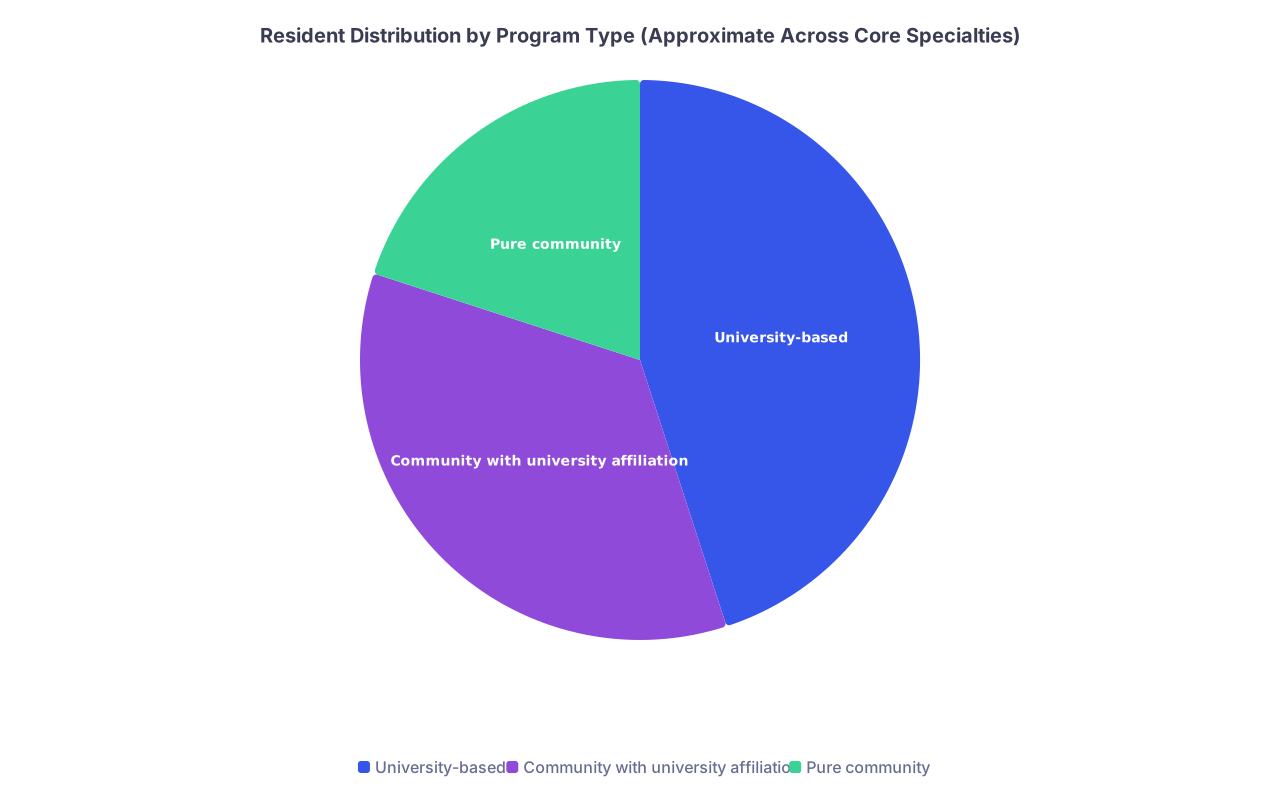
| Category | Value |
|---|---|
| University-based | 45 |
| Community with university affiliation | 35 |
| Pure community | 20 |
That pie chart isn’t exact to the decimal—because the categorizations vary—but it reflects the broad reality: a huge portion of U.S. training happens outside of pure university programs. If community-trained graduates were systematically handicapped, you’d see it clearly downstream in hiring and subspecialty pipeline. You don’t.
Board Pass Rates: The First Reality Check
For core specialties like Internal Medicine, Family Medicine, Pediatrics, and General Surgery, many community and university programs both have board pass rates in the 90%+ range.
Are there weak community programs with embarrassingly low pass rates? Yes.
Are there weak university programs also underperforming? Also yes.
What high-performing programs—of both types—actually share looks more like this:
- Strong in-service exam culture
- Structured didactics that actually happen (not just on paper)
- Consistent supervision and feedback
- Reasonable workload that leaves room to learn
Those are program-level variables, not “university” vs “community” labels.
The smartest thing you can do is to look up each program’s board pass rate history and not assume the academic logo guarantees quality.
Fellowship Outcomes: Where the Fear Really Lives
This is where the “prestige panic” goes nuclear: “If I ever want cards/GI/heme-onc/ortho/derm, I must be at a university program.”
Let’s separate two things:
- Getting into competitive fellowships (cards/GI/heme-onc, surgical subspecialties, etc.)
- Doing any fellowship vs going straight to practice
There are actually three key drivers of fellowship success that matter more than whether your badge says “Big U” or “Community Hospital of Somewhere”:
- Your individual performance (evaluations, letters, in-service scores)
- Research output and academic engagement (if you’re targeting academic-style fellowships)
- Mentor advocacy (who will pick up the phone for you)
Here’s what you actually see when you read fellowship match lists across a mix of programs.
| Outcome Type | University IM Program | Strong Community IM Program |
|---|---|---|
| At least one cards fellow per year | Common | Common or every 1–2 years |
| GI / heme-onc matches | Common | Common but slightly fewer |
| Top-20 academic center matches | Regular | Occasional but present |
| Majority straight to hospitalist | Yes | Yes |
Notice what’s missing? Any category that says “never” for community-trained residents. You absolutely do see:
- Cardiology fellows who trained at community IM programs
- Surgical subspecialists who started at non-name-brand places
- Community grads in academic positions at big centers later
The path may be easier from a university program if it’s known, respected, and has deep fellowship pipelines. But easier ≠ exclusive.
Why Community Programs Are Underrated (And Often Better Clinically)
Here’s the dirty little secret attendings talk about behind closed doors: a lot of community-trained grads hit the ground running faster as independent physicians.
Why?
- Higher volume, less competition from fellows
- More hands-on responsibility earlier
- More “real-world” pathology and logistics (no army of ancillary staff buffering everything)
- Often a stronger sense of ownership of patients
I’ve seen interns from mid-tier community programs run circles around PGY-2s from “prestige” institutions when it comes to bread-and-butter medicine: septic shock, DKA, chest pain workups, surgical floor management.
University programs sometimes degrade into this:
- Residents doing note-clicking while fellows and attendings run the show
- Residents getting pushed out of procedures in favor of fellows
- Overemphasis on niche zebras, underemphasis on mundane but critical basics
Not always. But often enough that pretending “university = automatically better training” is fantasy.
The Hidden Variable: Community vs “Community with University Affiliation”
Lumping all non-university programs into one bucket is lazy. There are at least three tiers:
- Pure university programs – main teaching hospitals of medical schools
- Community programs with university affiliation – “X Medical Center / Y University”
- Independent community programs – fully non-affiliated, often smaller, sometimes newer
That middle category is where a lot of the best “balanced” training happens. You often get:
- Solid academic presence (conferences, visiting professors, some research)
- A sizable patient volume and autonomy
- Pathways into fellowships via the affiliated university
Many of the residents from these affiliated community programs routinely match into fellowships at both their home university and other academic centers.
So when someone says “community program,” you have to ask:
Do you mean an independent 3–4 resident/year program in the middle of nowhere with zero research infrastructure?
Or a big tertiary hospital with an academic tie-in and strong fellowship match history?
Those are not equivalent. At all.
Where University Programs Do Have a Real Edge
Now, I am not going to pretend program type is irrelevant. It’s not.
University-based programs tend to have structural advantages in certain lanes:
- Research-heavy subspecialties: Rheum, pulm/crit, GI, heme-onc, cards, academic neurology, etc.
- People dead set on tenure-track academic careers
- Applicants who already have serious research and want to keep that momentum
You are more likely to find:
- NIH grants, lab infrastructure, and protected research time
- Established pipelines to T32-funded fellowships
- Faculty who sit on national guideline committees and fellowship selection panels
For someone gunning for “GI at a top-10 research institution then faculty,” trying to do that from a tiny, isolated community program is swimming upstream. Not impossible, but undeniably harder.
But even there, the useful question is:
“Can this specific community or affiliated program get people into good fellowships?”
Not:
“Is this a university program? If not, game over.”
The Real Hierarchy: Individual Program Quality > Label
The single most harmful simplification I see is:
university > community-affiliated > community
What actually matters far more:
- Program culture: malignant vs supportive
- Volume and case mix
- Teaching quality and consistency
- Board pass rates and in-service scores
- Historical fellowship/job outcomes
- How residents talk about the place when the PD is not in the room
You will find:
- Outstanding, high-powered community-affiliated programs with better outcomes than mid-tier universities
- Miserable, chaotic university programs coasting on old prestige
- Small, focused community programs that produce excellent generalists who are in high demand
When people say “But I need a university program,” what they usually mean is “I want optionality and status.” Fair. But those can come from multiple directions, not just chasing a name.
How Program Type Really Affects Your Career Trajectory
Let’s kill some specific fears.
“If I do residency at a community program, I can never work at an academic center.”
False.
Plenty of community-trained physicians later work:
- As academic hospitalists at big-name centers
- As fellowship-trained subspecialists in university groups
- As clinician-educators working with medical students and residents
What often happens is:
Community residency → solid fellowship (sometimes at a university) → academic or hybrid practice.
“If I want any fellowship at all, I must go university.”
Also false.
For moderately competitive fellowships (endocrine, nephrology, ID, rheum in some regions, many surgical subspecialties outside the super-elite), strong residents from community or affiliated programs match every year.
What changes is how wide your net is and how stacked your application needs to be. From a community background, you typically need:
- Very strong letters
- In-service scores at or above peers
- Some research or QI work—even if local/retrospective
- Clear, consistent narrative about your interest
The bar is higher if you’re aiming for the elite spots. Not nonexistent.
Practical Guidance: How You Should Actually Judge Programs
If you strip away the branding, here’s how you should be thinking.

| Step | Description |
|---|---|
| Step 1 | Identify Programs |
| Step 2 | Check Board Pass Rates |
| Step 3 | Review Fellowship Match Lists |
| Step 4 | Ask Residents Off Record |
| Step 5 | Deprioritize Program |
| Step 6 | Consider Highly |
| Step 7 | Good Clinical Volume? |
| Step 8 | Supportive Culture? |
You should be asking:
- What is their 5–10 year board pass rate trend?
- Do they have a track record of matching people into the kind of outcomes you care about? (Fellowship? Hospitalist jobs? Community practice?)
- How do current residents describe autonomy vs supervision, and how burned out do they look?
- Is there any research/QI support if you might want fellowship?
- Are there fellows at the site, and if so, do they steal all the good cases or help teach?
Then, and only then, you can use “university vs community” as a tiebreaker, not a primary filter.
Where Prestige Actually Matters (And Where It Doesn’t)
Let’s be honest: prestige is a currency. It buys you:
- Slightly easier networking
- A bump in initial credibility when cold-emailing people
- A bit of extra shine on a fellowship application
But it doesn’t compensate for:
- Mediocre evaluations
- Weak letters
- Poor in-service or board performance
- Minimal engagement or initiative
People overestimate how long prestige matters. Five years out, no one cares where you did residency if:
- Your outcomes are good
- Your colleagues like working with you
- You take good care of patients
Hospitals hiring for real-world jobs are far more interested in “Does this person function well?” than “Was this program technically university-affiliated?”
The Bottom Line: Stop Letting the Label Run Your Life
Strip it all down and the data + real-world outcomes point to a few blunt truths:
- “University vs community” is a lazy proxy for what actually matters: program quality, clinical volume, culture, and track record.
- Strong, motivated residents from community and community-affiliated programs match into good fellowships and academic jobs every year; the door is not closed.
- Prestige helps at the margins. It doesn’t rescue a weak application, and it doesn’t doom a strong one if you trained in the “wrong” place.
If you pick a solid program where you’ll actually learn, be supported, and not be crushed, you’ll do better than chasing a logo that looks good on Instagram but burns you out and teaches you less.
Choose reality over reputation. The match cares about your performance far more than the letterhead on your ID badge.


