

The belief that you have to match in a big city to land a competitive fellowship is lazy thinking dressed up as strategy.
Programs in New York, Boston, or LA are not golden tickets. They’re just addresses. And the data – plus actual match lists – show something uncomfortable for the prestige-obsessed: strong residents at solid, non–big-city programs routinely go to the same elite fellowships as their big-name peers.
Let’s dismantle the myth and talk about what actually moves the needle.
The Myth vs. The Match Lists
Here’s the story pre-meds and early med students get sold:
- “If you don’t match at a top-10 academic program in a major city, say goodbye to cards, GI, derm, heme/onc.”
- “Community or mid-tier university programs in smaller cities never place into top fellowships.”
- “Fellowship PDs only care if you trained at Brand Name Hospital X.”
Pull up a few real fellowship match lists and this collapses fast.
You’ll see:
- Mayo or MD Anderson taking residents from:
- University of Kansas
- Medical College of Wisconsin
- University of New Mexico
- Top cardiology fellowships matching:
- Residents from midwestern university hospitals
- Residents from community programs with strong case volume
- GI and heme/onc at brand-name places with:
- At least a couple trainees each year from “non-elite” residencies
Is there a trend that more people from big academic centers go to big-name fellowships? Yes. Is that because the zip code is magical? No. It’s because those programs cluster resources that actually matter: research infrastructure, faculty names, and higher applicant self-selection.
Let’s separate big city mythology from actual selection criteria.
What Fellowship Directors Actually Care About
Fellowship program directors aren’t sitting in a room saying, “Reject anyone not from a coastal city.”
They care about whether you will:
- Take excellent care of complex patients
- Handle high-acuity, high-volume work
- Be productive (academically or clinically)
- Not be a headache
Here’s how that translates into real selection factors.
| Factor | Impact Level |
|---|---|
| Strong PD/letters | Very High |
| Autonomy & case volume | Very High |
| Research output | High |
| Step/board performance | High |
| Program name/location | Moderate |
| City size/prestige | Low |
Program name matters some. City size? Mostly noise.
I’ve seen fellowship selection meetings where:
- A resident from a mid-sized Midwest university was ranked above multiple Ivy applicants because their letters screamed “top 1% of our residents, independent, runs the ICU like a senior.”
- A big-name Boston resident got pushed down the rank list because their letters were lukewarm and vague: “pleasant, interested in…” Translation: not a star.
The decision-making is a lot more brutal and a lot less romantic than “Harvard vs. not Harvard.” It’s: who can we trust at 2 a.m. with an unstable patient?
The Big City Advantage: Real, But Overstated
Let’s be honest: training in a big academic center can offer advantages:
- More subspecialty faculty per square foot
- Easier access to multicenter trials, big datasets, name-recognized mentors
- Built-in pipelines – PDs call each other, “I’ve got someone great for your cards spot.”
So no, I’m not going to pretend that a tiny, insular community program with zero research and no subspecialists is equivalent to Mass General for matching into advanced heart failure.
But the myth jumps from “big places have some advantages” to “you’re dead without them.” That leap is nonsense.
Here’s the part no one likes to hear: a motivated resident at a solid, non-coastal mid-sized university with decent subspecialty presence can absolutely outcompete a coasting resident at a famous zip code.
Because the important variables – mentorship, letters, case volume, your actual performance – are not exclusive to huge cities.
How Non–Big-City Programs Sneak into Elite Fellowships
Let’s stab directly into the question: how does someone at a “non-elite” residency end up in a top fellowship?
There’s a pattern. It’s not mysterious.
1. They Max Out Autonomy and Volume
Some of the highest-functioning fellows I’ve met came from places most pre-meds would never brag about on Reddit. But they showed up day one of fellowship and:
- Knew how to run a code without an attending hovering
- Had done more lines, scopes, or bread-and-butter procedures than many “elite” peers
- Were comfortable managing very sick, very complex patients with minimal handholding
This comes from programs where residents aren’t overly protected. They’re pushed. ICUs, busy EDs, underserved populations. Places that don’t market well on Instagram but produce killers clinically.
Fellowships notice this quickly. They remember which programs send workhorses vs. tourists.
2. They Weaponize Mentors and Letters
Even at non-marquee programs, there are almost always 1–3 subspecialists with national reputations or at least strong networks. Smart residents:
- Attach themselves early to those people
- Do real work with them (papers, QI projects, case series)
- Earn letters that say more than “hardworking and pleasant”
A single letter from a respected cardiologist at “no-name” University X, who calls the fellowship PD and says, “This is my best trainee in 10 years,” outweighs five generic letters from Name Brand U.
3. They Create Research Opportunities Instead of Waiting for Them
Do big centers have more research? Yes. But that doesn’t mean smaller places are deserts. It just means:
- You may do more retrospective chart reviews or single-center projects
- You may have to cold-email, hustle, and self-start instead of plugging into prebuilt machine-learning labs
Fellowships don’t need you to have a Nature paper. They want:
- Evidence you can finish a project
- That you understand basic study design
- That you care enough about your field to invest effort
Someone with three solid, first-author retrospective studies from a mid-sized program is usually more compelling than someone with their name buried as author #15 on a multicenter trial at a giant center.
Data: Do Top Fellowships Really Only Take Big-Name Residents?
Let’s talk patterns, not fairy tales.
Look at public match lists (cards, GI, heme/onc, PCCM) from top-heavy fellowships. You’ll usually see:
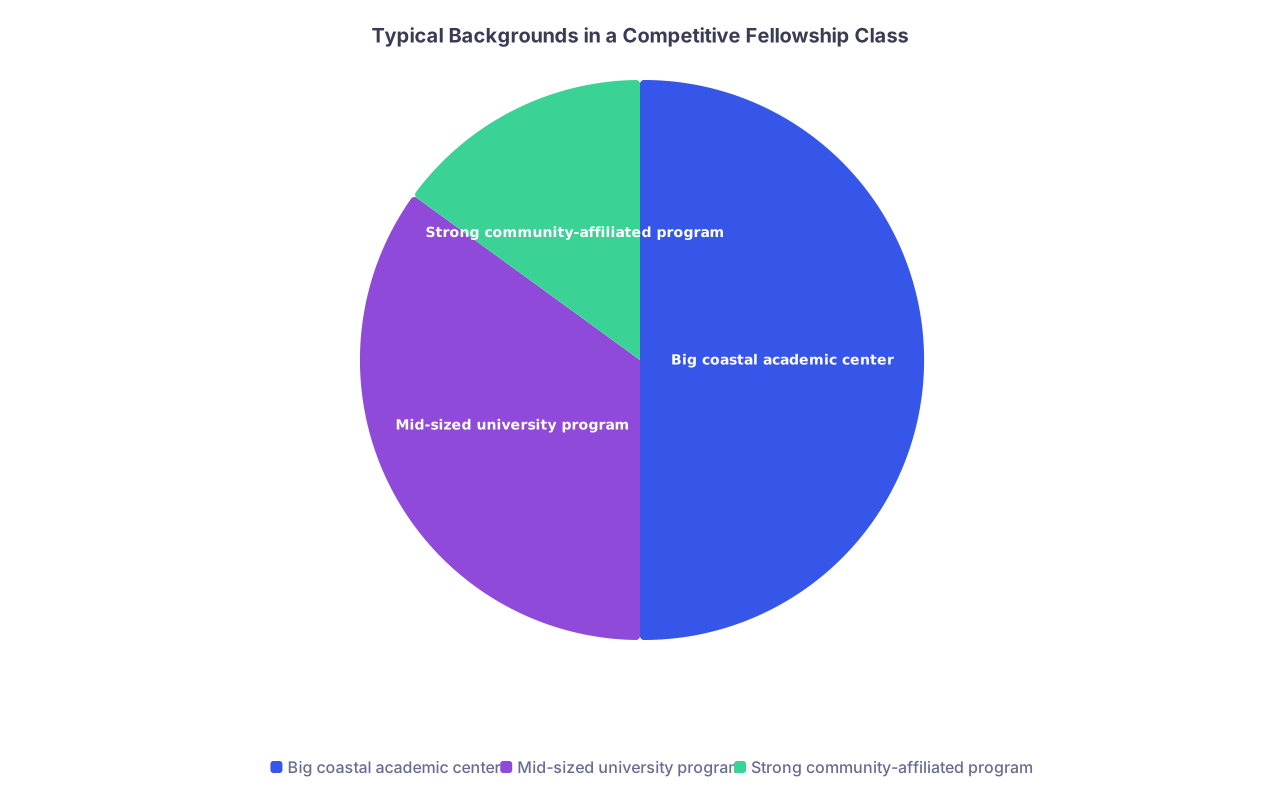
| Category | Value |
|---|---|
| Big coastal academic center | 50 |
| Mid-sized university program | 35 |
| Strong community-affiliated program | 15 |
Roughly half from big-name, big-city academic machines. Sure. But the rest?
- Mid-sized city university programs (think Iowa, Utah, Cincinnati, Colorado, Wisconsin)
- Community-affiliated programs with strong subspecialty services (think community programs tied to a university or regional referral center)
The myth treats that 50% as 100% and just deletes the rest from memory.
Are there specialties where it’s harder to break in from a weaker institution? Yes – think ultra-competitive procedural fields with tiny numbers of spots. But even there, people match from solid, smaller market residencies every year.
The bigger problem isn’t that smaller programs can’t place people. It’s that many of their residents buy into the myth, assume they’re doomed, and stop playing the long game aggressively.
Where Location Does Quietly Hurt You
Now the uncomfortable side for the “location doesn’t matter at all” crowd. There are real drawbacks to certain settings.
Red flags:
- A “community” program with zero subspecialty fellowships, no real research activity, and no faculty presenting at regional or national meetings
- Minimal exposure to complex cases – you stabilize and transfer everything interesting away
- PD and faculty who are disengaged from the fellowship world, don’t make calls, don’t know PDs elsewhere
In those situations, the problem isn’t that you’re not in a big city. The problem is you’re in an ecosystem with no output pipeline. Big city vs small city is just a proxy. The real issue is academic engagement and case mix.
If you’re choosing between:
- A mid-sized city university hospital with active subspecialty services, some research, decent ICU and procedure volume
- A big-city community program with no real academic activity and minimal complex care
The first is often better for competitive fellowship, even if it’s in a city no one puts in their Instagram bio.
Tactics That Matter More Than Your City
Let me be blunt: if you land in a decent program with:
- Subspecialists in your field of interest
- Reasonable volume and acuity
- Some research or at least data access
Then your fate is far more about your behavior than your zip code.
Here’s what actually shifts your trajectory.
Early, Clear Positioning
By the end of PGY1 you should:
- Know your likely target field (cards, GI, heme/onc, PCCM, etc.)
- Have met key faculty in that field
- Started at least one real project
Late, scattered interest is how you become “generic resident #7” instead of “our future cardiologist.”
Be the Resident Everyone Fights for
Fellowships talk. They know which programs send residents who:
- Show up early, stay late, carry the pager without whining
- Handle pressure, own mistakes, and do not melt in the ICU
You need your home PD and subspecialty attendings to want to pick up the phone and advocate for you. That comes from performance, not location.
Produce Something Concrete
Not aspirational. Not “working on a project.” Finished.
- Completed QI project with measurable outcomes
- A couple of posters or abstracts at regional or national meetings
- Ideally at least one manuscript (even a small retrospective)
This is doable at a huge range of programs if you start early and stop waiting for the perfect randomized trial.

| Step | Description |
|---|---|
| Step 1 | Start Residency |
| Step 2 | Choose Field by end PGY1 |
| Step 3 | Find Mentor |
| Step 4 | Start Project PGY1-2 |
| Step 5 | Strong Clinical Performance |
| Step 6 | Great Letters |
| Step 7 | Posters and Papers |
| Step 8 | Competitive Fellowship Match |
Reality Check: Who Actually Gets Burned by This Myth?
The people most hurt by “you must match in a big city” are:
- Students who rank big-name locations over better-fit programs with stronger mentorship or volume
- Residents who assume their non-major-city program is a dead end and give up on fellowships early
- Applicants who chase prestige over training environment, then end up under-supported, anonymous, and mediocre on paper at a name-brand place
I’ve seen residents at “top” urban programs fail to match into their dream fellowship because they were average in a big pond and never built real relationships.
I’ve also seen residents from midwestern or southern university programs match into:
- Interventional cards at big coastal centers
- Advanced GI at household-name hospitals
- Heme/onc at NCI-designated cancer centers
The difference? They ignored the noise, maximized their environment, and made it impossible to overlook them.
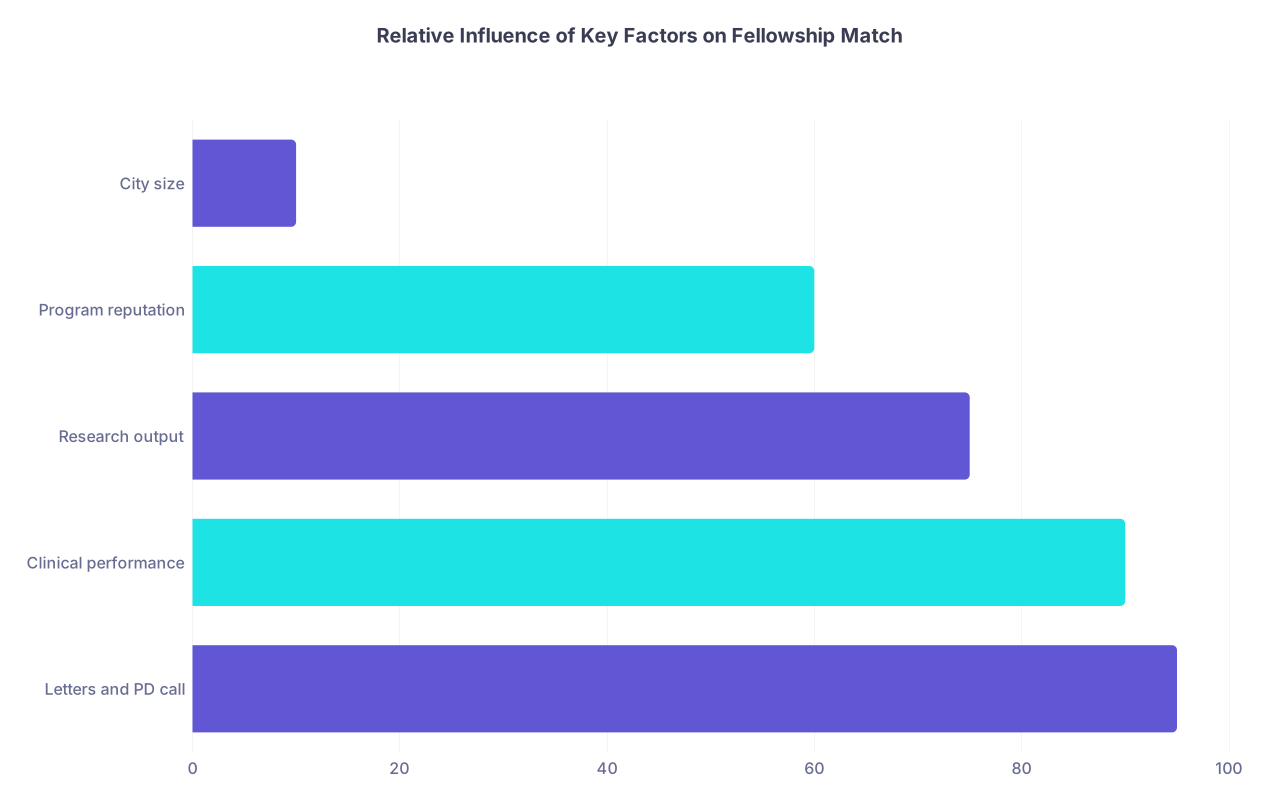
| Category | Value |
|---|---|
| Letters and PD call | 95 |
| Clinical performance | 90 |
| Research output | 75 |
| Program reputation | 60 |
| City size | 10 |
City size is basically statistical background radiation.
How to Judge a Program if You Care About Competitive Fellowships
Forget the skyline. Look under the hood.
Ask:
- Do they routinely place people into fellowships in my field? Where?
- Are there recognizable names in my target subspecialty on faculty? Do they publish? Present?
- What do current residents in my field of interest have on their CVs by PGY3?
- Do faculty actually mentor, or is it all brochure-speak?
A mid-sized city program that ticks those boxes beats a flashy ZIP code with none of them.
| Feature | Big City Community A | Mid-Sized Univ B |
|---|---|---|
| Subspecialty fellowships on-site | None | Cards, GI, Heme |
| Faculty publishing in field | Rare | Regularly |
| Research support | Minimal | Moderate |
| Recent matches to top fellowships | Almost none | 1–3 per year |
The myth would say pick A. The data say pick B.
The Bottom Line: City Size is a Distraction
Strip it down, and the “you must match in a big city for a competitive fellowship” line is just sloppy reasoning from people confusing correlation with causation.
Three points to walk away with:
- Big-city academic centers offer advantages, but they are not prerequisites. Solid residents at strong mid-sized or regional programs match into competitive fellowships every single year.
- Fellowship selection is driven by letters, clinical performance, autonomy, and tangible academic output – not your skyline or time zone.
- Choose and use a residency program based on mentorship, case mix, subspecialty presence, and track record of fellowship placement, not how impressive the city sounds on social media.
Stop worshipping the ZIP code. Start optimizing your environment. That’s how you win the fellowship game.


