
Your specialty choice does not just change your career—it hard‑wires how your very first year of doctoring actually feels.
Let me be blunt: “PGY‑1 is PGY‑1” is nonsense. The structure, pace, brutality, and even what “a hard month” means are wildly different for an intern in categorical surgery vs prelim medicine vs psych vs transitional year. If you do not understand this before ranking programs, you are flying blind.
I am going to break this down specialty by specialty, with a very specific lens: what your early PGY‑1 rotations look like and how your Match specialty shapes that structure.
The Two Big Axes: Categorical vs Prelim / TY
Before we zoom into each specialty, you need the basic map.
There are two big axes that define your early rotation structure:
Program type
- Categorical (you stay in this program/specialty through completion)
- Advanced with separate PGY‑1 (you match something like radiology, anesthesia, derm, ophtho, PM&R, then also need a prelim or transitional PGY‑1)
PGY‑1 design
- Heavy inpatient (med/surg wards, ICU, nights)
- Mixed inpatient/outpatient (e.g., FM, psych, TY)
- Outpatient‑dominant with targeted inpatient blocks (some FM, some prelims at community hospitals)
| Match Type | Typical PGY-1 Home | Inpatient-Heavy? | Outpatient Required? |
|---|---|---|---|
| Categorical IM | Same IM program | Yes | Yes |
| Categorical Surgery | Same surgery program | Very Yes | Minimal |
| Categorical Psych | Same psych program | Moderate | Yes |
| Categorical FM | Same FM program | Variable | Yes |
| Advanced (Rad, Anes, Derm, Ophtho, PM&R) | Separate prelim/TY | Depends on PGY-1 type | Sometimes |
Your specialty match locks you into one of these patterns. That dictates:
- How much call you take
- How many nights you do
- How much ICU vs clinic
- How supervised you are
- How fast you get exposure to your chosen field
If you are an MS4 creating a rank list and you do not know the call structure for your future intern year, that is a problem.
Internal Medicine: The Archetypal Inpatient Intern Year
Internal medicine is the reference point everyone uses when they say “a hard intern year.”
Typical Categorical IM PGY‑1 Structure
Most categorical IM programs (especially at academic centers) will roughly split your year into:
- General medicine wards (biggest chunk)
- ICU / CCU
- Night float / night wards
- Ambulatory blocks (continuity clinic + subspecialty clinics)
- Subspecialty inpatient (cards, GI, heme/onc, etc.)
A realistic breakdown at a mid‑to‑large academic program:
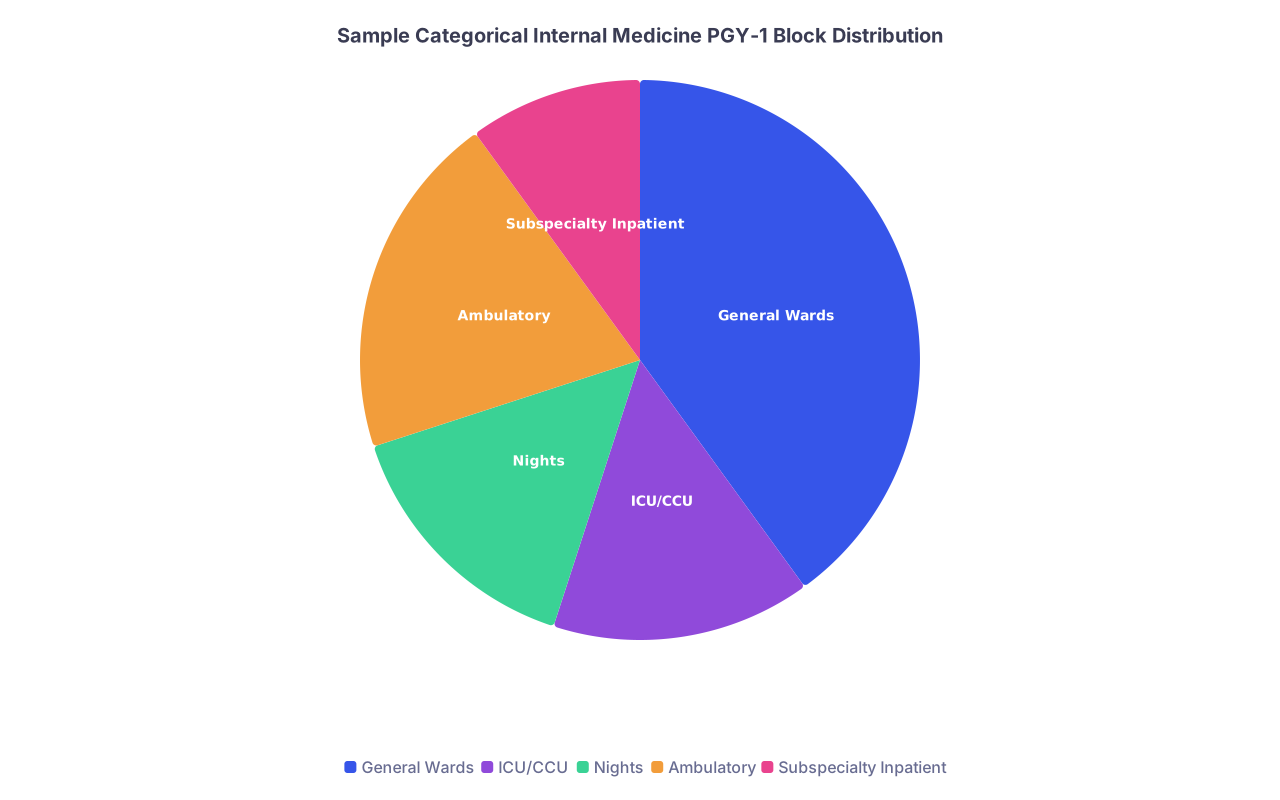
| Category | Value |
|---|---|
| General Wards | 40 |
| ICU/CCU | 15 |
| Nights | 15 |
| Ambulatory | 20 |
| Subspecialty Inpatient | 10 |
How this feels month to month:
- Wards months: 6–7 days/week, long days, lots of cross‑cover, constant admissions.
- ICU: Fewer patients, much sicker, procedures if your program allows it, higher stress. Your classic “I aged 5 years in 4 weeks” story.
- Nights: Either a month of night float or shorter stretches; brutal circadian disruption, but you stop waking up at 2 a.m. terrified you missed a page. Because you did not sleep anyway.
- Ambulatory: Your “catch your breath” time. More regular hours, continuity clinic, subspecialty exposure.
How Match Specialty Shapes IM Intern Structure
If you matched categorical IM, everything in PGY‑1 is designed to build you into a senior medicine resident:
- You get your own continuity clinic starting early PGY‑1.
- Your schedules are built around IM board requirements.
- You will have progressively more autonomy in medicine decisions. People expect you to become “the medicine person” in the hospital.
If you matched advanced (radiology, anesthesia, derm, ophtho, PM&R) but are doing a prelim medicine year, your life looks similar on paper, but the underlying culture is different:
- You often do fewer months of continuity clinic (some prelim programs do none).
- More ICU / wards heavy; less focus on long‑term primary care.
- Attendings subtly treat you as “passing through,” which can be freeing or demoralizing.
- The goal is: competent inpatient physician who will not kill anyone next year in your advanced specialty. Not future cardiologist.
That distinction changes which rotations you get stuck with and how people invest in your development.
Surgery: Front‑Loaded Pain and Service Identity
Surgical PGY‑1 structure is a different beast. The main change: your “ward” is now the surgical service, and you own a very different set of problems.
Typical Categorical General Surgery PGY‑1
Classic breakdown:
- Core general surgery service (consults, floor patients, ER consults, assisting in OR)
- Surgical ICU / trauma ICU
- Subspecialty surgery (vascular, colorectal, transplant, etc.)
- Off‑service rotations (ICU runs by anesthesia/trauma, a month of medicine, sometimes ER)
- Nights / night float on surgery
Rough pie chart:
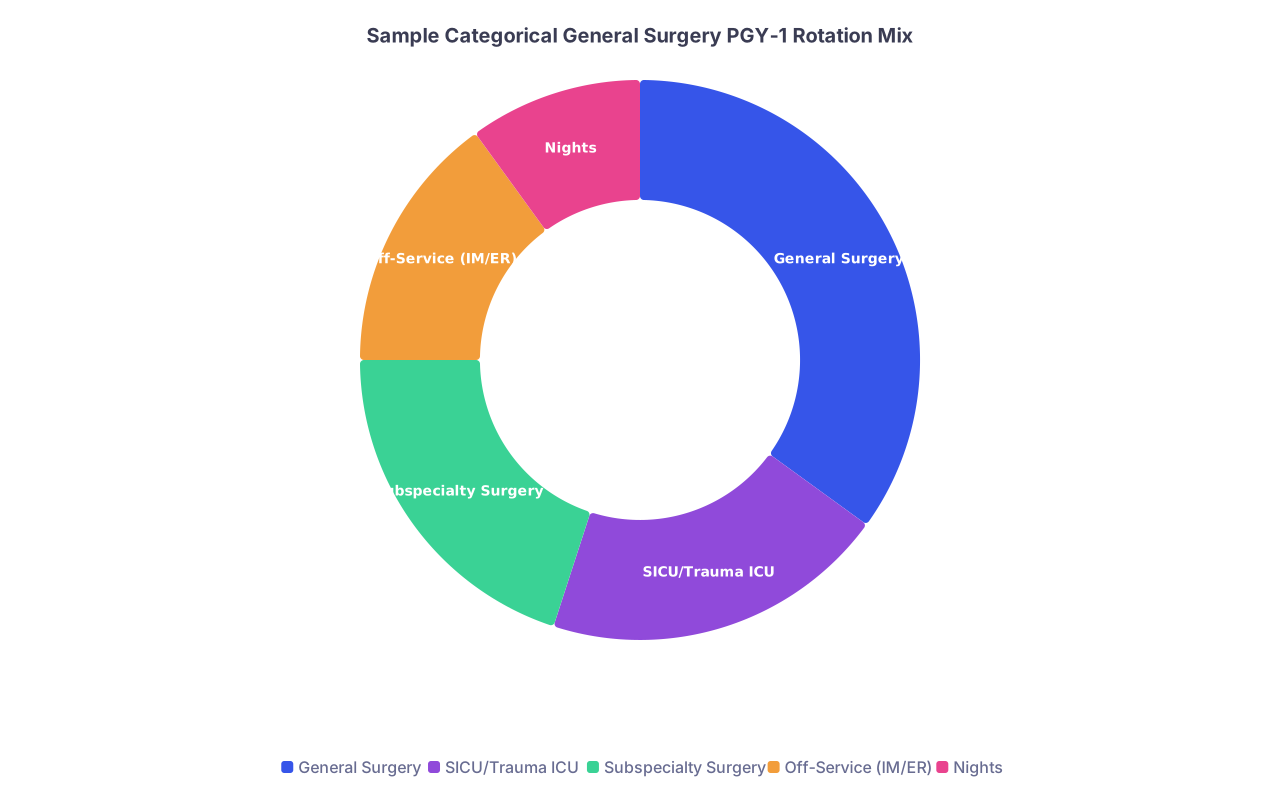
| Category | Value |
|---|---|
| General Surgery | 35 |
| SICU/Trauma ICU | 20 |
| Subspecialty Surgery | 20 |
| Off-Service (IM/ER) | 15 |
| Nights | 10 |
How it plays out:
- OR time is limited early; you are the one writing TPN orders, chasing drains, and trying to find that missing consent.
- Day starts early. “Be there at 4:45” early, depending on program culture.
- Call can still be 24‑hour q4 or q5 at some places, especially on trauma or transplant.
- Autonomy is different: you make lots of floor decisions, but every operative step is micromanaged (for good reason).
Prelim Surgery vs Categorical Surgery
If you matched categorical gen surg, the rotation structure is built to keep you in the surgical ecosystem:
- Heavy emphasis on time with your home general surgery service.
- You get early recognition as part of the “core” group. Chiefs and attendings invest in you.
- Deliberate progression from scut to responsibility: you are being molded into a chief.
If you matched prelim surgery (for something like ENT, urology, neurosurgery, or you are unmatched categorical), the structure shifts:
- More off‑service rotations (medicine wards, ICU) to satisfy broad requirements.
- Less protected OR experience with your “home” service.
- You are often covering more generic surgical floor work and consults rather than being groomed for specialized cases.
- Many prelims are stacked on the most service‑heavy rotations because someone has to do that work.
So the same call schedule on paper can feel very different depending on whether you are the future chief or the “prelim who’s here for a year.”
Family Medicine: Balancing Clinic with Enough Inpatient to be Safe
Family medicine PGY‑1 is all about balance. Most programs are trying to hit ACGME requirements while reflecting their practice model philosophy.
Typical Categorical FM PGY‑1
Common components:
- Family medicine inpatient service or “wards” (if they exist)
- Inpatient adult medicine (often on IM services)
- Inpatient pediatrics or NICU (varies by program)
- OB/GYN / L&D
- ICU exposure (shorter blocks than pure IM)
- Continuity clinic (longitudinal, multiple half‑days/week)
- ED and urgent care
Patterns differ a lot across programs. Some are inpatient‑heavy, almost like a lighter IM intern year with clinic attached. Others are heavily outpatient with short bursts of inpatient.
A moderate‑acuity FM program might structure PGY‑1 as:
- 3–4 blocks inpatient FM/IM
- 1–2 blocks inpatient peds / nursery / NICU
- 1–2 blocks OB
- 1 block ICU
- 2–3 blocks ED / urgent care
- 3–4 blocks primarily outpatient with continuity clinic
The rotation structure is directly shaped by how “full spectrum” your FM program wants you to be:
- Rural, OB‑heavy programs: more L&D, more inpatient nights.
- Urban, clinic‑focused programs: more chronic disease clinics, less L&D, fewer ICU weeks.
How the Match Specialty Choice Matters
If you matched categorical family medicine with no advanced specialty after, the program builds you to be a broad outpatient/inpatient doc:
- Clinic is non‑negotiable. You will have continuity clinic from the beginning.
- Early PGY‑1, you might feel pulled in two directions: being a decent ward intern and not neglecting clinic panels.
- Night call is often more ED/OB‑driven than medicine‑ICU‑driven, depending on program.
If you are using FM as a stepping stone (for example, very uncommon paths like some sports med preliminary year configurations), that drastically changes—but most people in FM are there to stay.
Psychiatry: Medicine Foundations, Then Psych Identity
Psychiatry interns are often surprised at how little “pure psych” they do in the first half of PGY‑1.
Typical Categorical Psych PGY‑1
ACGME requirements force a significant chunk of medicine and neurology:
- 4 months of primary care/internal medicine (inpatient and/or outpatient)
- 2 months of neurology (usually inpatient neuro + consults)
- Remaining months: inpatient psych, consult‑liaison, emergency psych, maybe addiction
Many programs front‑load the medicine and neuro:
- First 6 months: heavy on IM wards, ED, neuro.
- Last 6 months: mostly psychiatry.
So your first feeling as a psych intern may be: “Did I match the wrong specialty? Why am I living on medicine wards again?”
Match Specialty Drives Early Structure Hard Here
If you matched categorical psych:
- Your medicine rotations are meant to give you enough comfort with medical comorbidity that you are not afraid of QTc, lithium toxicity, NMS, and the “psych patient with chest pain.”
- You typically have less medicine volume and intensity than a full IM intern, but the days can feel almost identical in structure.
- Once you hit your psych blocks, your life changes abruptly: team structure, call type, documentation burden, and patient interaction all feel very different.
If you somehow are doing a prelim medicine year before starting psych (rare and usually not necessary), your PGY‑1 looks much more like classic IM, with much later transition to psych identity.
Transitional Year vs Prelim Medicine vs Prelim Surgery: The “Intern Year Before Your Real Career”
This is where people get the most confused before the Match, and where the specialty you matched for PGY‑2+ really shapes what kind of PGY‑1 you should target.
Your advanced specialty (radiology, anesthesia, derm, ophtho, PM&R, rad onc, etc.) expects certain skills on day 1 of PGY‑2. The intern year is the scaffolding.
Transitional Year (TY): The “Lifestyle” Intern Year (Usually)
Transitional year is usually:
- Mix of medicine wards, ICU, ED
- A lot of elective time
- More outpatient clinics
- Often lighter call and more 8–5 months
A classic TY might look like:
- 3 months medicine wards
- 1 month ICU
- 1 month ED
- 1 month surgery or subspecialty inpatient
- 6 months electives (many outpatient)
TYs are popular with derm, radiology, ophtho, PM&R, rad onc, anesthesia applicants who want one relatively humane year to get broad exposure without being chewed up by a full IM schedule.
But programs vary. Some TYs are basically prelim medicine in disguise. I have seen TY schedules that were 6 months wards, 2 ICU, 1 ED, and the rest tiny electives. That is not “cush.”
Prelim Medicine: Mini‑IM Without Longitudinal Clinic
Prelim IM year is for:
- Advanced specialties (rads, cards track, ophtho, etc.)
- People reapplying to advanced specialties
Structure:
- Heavy inpatient wards and ICU
- Less or no continuity clinic
- Few electives, most of them still inpatient‑centric
- Usually no long‑term primary care requirement
Good for people who need to be very strong at managing medical inpatients (anesthesiology, interventional specialties). Brutal if you wanted a gentle intro year.
Prelim Surgery: High‑Service, Low‑Autonomy (Often)
Prelim surgery is:
- Lots of floor work, consults, ICU
- Variable OR exposure, heavily program‑dependent
- Substantial night coverage, especially at busy trauma centers
- More off‑service rotations than categoricals (ICU, medicine, ED)
Match specialty shapes which you pick:
- Derm, Radiology, PM&R, Ophtho, Rad Onc – usually prefer TY or prelim IM.
- Anesthesia – split; some prefer prelim IM, some TY, some like prelim surgery if they want lots of procedural and ICU exposure.
- Neurology – many programs require or strongly prefer prelim medicine, sometimes coordinated categorical neuro+prelim spots.
How Different Specialties Sequence Early PGY‑1
Some specialties front‑load medicine. Others front‑load their own field. This is not random; it is deliberate.
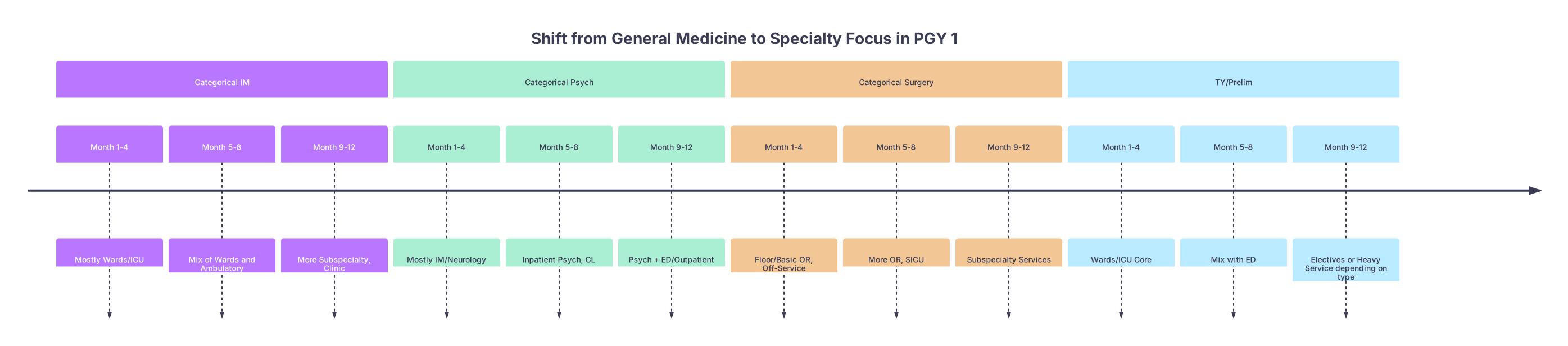
| Period | Event |
|---|---|
| Categorical IM - Month 1-4 | Mostly Wards/ICU |
| Categorical IM - Month 5-8 | Mix of Wards and Ambulatory |
| Categorical IM - Month 9-12 | More Subspecialty, Clinic |
| Categorical Psych - Month 1-4 | Mostly IM/Neurology |
| Categorical Psych - Month 5-8 | Inpatient Psych, CL |
| Categorical Psych - Month 9-12 | Psych + ED/Outpatient |
| Categorical Surgery - Month 1-4 | Floor/Basic OR, Off-Service |
| Categorical Surgery - Month 5-8 | More OR, SICU |
| Categorical Surgery - Month 9-12 | Subspecialty Services |
| TY/Prelim - Month 1-4 | Wards/ICU Core |
| TY/Prelim - Month 5-8 | Mix with ED |
| TY/Prelim - Month 9-12 | Electives or Heavy Service depending on type |
Key patterns:
- Psych: big shift mid‑year from medicine/neuro to psych.
- Surgery: early months may be lots of floor and off‑service; OR time tends to pick up gradually, but you are still junior.
- IM: less dramatic shift, more continuous medicine exposure with amb/clinic mixed throughout.
- TY/Prelim: early months mimic full IM or surgery, then divergence depending on electives.
Practical Consequences for You on Match Day
You care about this structure for three concrete reasons:
-
- A prelim medicine at a big tertiary center with 7+ ward/ICU blocks is a different physical and emotional tax than a TY with 3 months of electives in radiology, derm, or PM&R clinics.
- Surgery categorical PGY‑1 has an earlier start time, often more true 24‑hour calls, and more weekend work than almost any TY.
Skill set you bring into PGY‑2
- Radiology with a harsh prelim IM year: strong at sick inpatients, comfortable with lines, vents, pressors. Maybe exhausted but very clinically grounded.
- Derm with a cushy TY: more rested, less inpatient‑savvy. Might feel rusty with cross‑coverage decisions.
- Anesthesia with prelim surgery including heavy ICU: great with postoperative physiology and acute resuscitation.
Identity formation
- Categorical IM: you start seeing yourself as “the medicine doc” almost immediately.
- Categorical psych: identity delayed because of heavy early medicine.
- Advanced specialties: identity can feel fragmented because your intern year and PGY‑2 home programs are different institutions, cultures, and cities.
You will feel all three of these in the first 3–6 months.
Specialty‑Specific Snapshots: What Your PGY‑1 Actually Looks Like
Let me spell out a few common match outcomes and what your early PGY‑1 reality will be.
1. Categorical Internal Medicine at a University Hospital
- Structure: ~4–5 general wards months, 1–2 ICU, 1–2 nights, 2–3 ambulatory, 1–2 subspecialty.
- Call: Night float or q4–q6 night blocks; weekends on during wards (often 1 day off/week).
- Supervision: PGY‑2/3 above you plus attending; you are “the intern” but with real decision‑making.
- Specialty shaping: Deep immersion in medicine culture from day one; you will talk about troponins and diuresis in your sleep.
2. Categorical General Surgery at a Busy Program
- Structure: 3–4 general surgery months, 1–2 SICU/trauma ICU, 2–3 subspecialty services, 1–2 off‑service, blocks of nights.
- Call: Real overnight calls, trauma activations, emergent ORs, weekend post‑op rounding.
- Supervision: Hierarchical team: attending → chief → mid‑level → you. Decisions escalated up.
- Specialty shaping: Your schedule, sleep, diet, and social life all bend around the OR schedule and surgical service needs. There is no illusion that you are anything but a surgical trainee.
3. Transitional Year Before Dermatology
- Structure: 2–3 wards, 1 ICU, 1 ED, 1–2 medicine subspecialties, 4–6 months of electives (often derm, rheum, outpatient IM, radiology).
- Call: Usually lighter than full IM or surgery programs; sometimes mostly night float or ED shifts.
- Supervision: Similar to medicine interns on service months, but more independence on elective months.
- Specialty shaping: You get to see a broad slice of medicine while already mentally anchored in “I am going into derm.” Your rotation choices can be strategically dermatology‑adjacent.
4. Prelim Medicine Before Radiology
- Structure: 5–6 wards, 1–2 ICU, 1 ED, 1–2 electives (sometimes limited freedom).
- Call: Comparable to categorical IM at the same site.
- Supervision: No continuity clinic in many programs, but otherwise you function like IM interns.
- Specialty shaping: Dense immersion in inpatient medicine; you will read radiology reports constantly, which is secretly great prep. But the year is often more grueling than a TY.
5. Categorical Psychiatry at a Community‑Affiliated Program
- Structure: 4 months IM (inpatient and/or outpatient), 2 months neuro, 5–6 months psych (inpatient, CL, ED).
- Call: Starts on medicine (cross‑covering floor patients), then shifts to psych call (ED psych consults, inpatient cross‑cover).
- Supervision: Tight supervision on psych units; IM/neurology supervision depends on host departments.
- Specialty shaping: You quickly feel the contrast between purely medical wards vs psych units; by mid‑year, your day is mostly psych notes, risk assessments, and medication adjustments, not endless med recs.
How to Read a Sample Block Schedule Before Ranking
Programs will often show you something like:
- “PGY‑1: 4 inpatient medicine, 1 ICU, 1 ED, 1 nights, 5 electives”
Learn to interrogate it:
- Are those “electives” actually free choices, or preset like “cardiology, GI, nephro, heme/onc, radiology”?
- How many true days off per month on ward/ICU blocks?
- Is there night float, or are you doing 24‑hour calls?
- For categorical specialties: how soon do you actually get exposure to your field?
- For advanced specialties: will your PGY‑1 and PGY‑2 programs coordinate anything, or are they completely separate worlds?
I have sat in resident rooms where interns compare their “advertised schedule” with their actual year and just laugh. Ask current residents, not just read the brochure.
FAQs
1. If I matched an advanced specialty, is transitional year always better than prelim medicine?
No. TY is often more comfortable and flexible, but prelim IM may prepare you better if your specialty deals with acute medical issues (anesthesia, interventional radiology, some neuro). TYs also vary widely; some are essentially cush, others are indistinguishable from full IM intern years. You must look at actual block schedules and ask about call.
2. Will a brutal intern year in medicine or surgery make me a better radiologist, anesthesiologist, or dermatologist?
It will make you more clinically grounded and less rattled by sick patients. That is valuable. But there is a real trade‑off: fatigue, burnout, and less time to do research or reading in your chosen field. It is not automatically “better”; it depends on your goals, resilience, and how much hands‑on acute care your future specialty really requires.
3. I matched categorical psych but I hate inpatient medicine. Should I be worried about the required IM and neuro months?
Expect to dislike parts of them, but you will survive. Those rotations are finite, and you will gain just enough comfort with medical issues that show up constantly in psych: metabolic syndrome, cardiac side effects, neuro emergencies. Most psych interns are much happier once they hit their first pure psych blocks. It does not mean you chose the wrong specialty.
4. How much say do I have in my PGY‑1 rotations once I match?
Less than you think. Core requirements (wards, ICU, ED, IM/neurology for psych, OB/peds for FM) are fixed. You may have some choice in electives, timing of certain rotations, or which subspecialty services you see. But the skeleton of your PGY‑1 year is set by ACGME rules and program design. If the baseline structure is unacceptable, you do not fix that from inside.
5. On Match Day, what is the single most important structural question I should ask about my future PGY‑1?
“Across all PGY‑1s in my track, how many months are inpatient wards/ICU/nights vs outpatient/elective, and how many 24‑hour calls or night blocks will I realistically work?” That one question reveals the true intensity profile of your intern year far better than glossy recruitment slides.
Key takeaways:
Your Match specialty quietly dictates not just what you will become, but how your first year of real doctoring is structured—month by month, night by night. Categorical vs prelim vs TY, and medicine‑heavy vs outpatient‑heavy, are not cosmetic differences; they change your fatigue curve, your skillset, and your identity. Go into Match Day understanding exactly which PGY‑1 architecture you just signed up for.