
Most residents sign their first contract without actually understanding their benefits package. That is a financial mistake you will feel for years.
Let me break this down specifically. You are trading your twenties (or thirties) for 60–80 hour workweeks at a relatively low salary, yet you are surrounded by one of the most complex benefits ecosystems in the American workforce. If you do not understand your health insurance, disability coverage, and ancillary benefits as a resident, you are leaving real money and real protection on the table.
This is the handbook you should have been given on Match Day but were not.
The Resident Benefits Package: What Actually Matters
First principle: not all benefits are created equal. Some things move the needle in a serious way; others are fluff to make the brochure look thicker.
The “core” resident benefits that actually matter:
- Health insurance (medical + often dental/vision)
- Disability insurance (short‑term and long‑term)
- Life insurance (usually group term)
- Retirement plan (403(b)/401(k), sometimes pension or match)
- Paid time off (vacation, sick, parental leave)
- Malpractice coverage (tail vs occurrence is key for some specialties)
The “nice but marginal” extras:
- Meal stipends
- Parking/transit benefits
- CME/education funds
- Wellness programs / counseling
- Gym memberships and random discounts
You need to be ruthless: understand the core benefits in detail, then decide how to patch the gaps with your own money (especially disability).
Health Insurance: What You Are Actually Signing Up For
Most PGY‑1s pick a plan based on the monthly premium alone. That is shallow and sometimes flat‑out wrong. You want to understand the structure of the plan, not just the cost.
Typical Plan Types Residents See
You will usually be offered one or more of:
- PPO (Preferred Provider Organization)
- HDHP (High Deductible Health Plan, HSA‑eligible)
- HMO (Health Maintenance Organization)
Here is how they usually shake out in residency programs:
| Feature | PPO Plan | HDHP (HSA) | HMO Plan |
|---|---|---|---|
| Monthly premium | Medium–High | Lowest | Low–Medium |
| Deductible | Low–Medium | High | Low |
| Flexibility of docs | High | High | Limited network |
| HSA eligible | No | Yes | No |
| Best for | Frequent care | Young/healthy | In‑system care |
Residents often default to the PPO because it “feels safer.” But if you are young, have no chronic disease, and your program offers a real HDHP with a Health Savings Account (HSA), the HDHP can be the most financially rational option.
The Four Numbers You Must Actually Know
Or you are just guessing.
Monthly premium
What HR takes out of your paycheck. Lower feels good, but do not stop there.Deductible (individual and family)
Money you pay out of pocket each year before the insurance really starts paying. A $500 versus $3,000 deductible fundamentally changes your risk.Out‑of‑pocket maximum
The ceiling of what you will pay in a worst‑case year (excluding premiums). This is the number that protects you from financial catastrophe when you get appendicitis, break your leg skiing, or have a baby in PGY‑2.Co‑insurance and co‑pays
Once you hit the deductible, how much of each bill is your responsibility? 20% co‑insurance to the out‑of‑pocket max adds up quickly.
For a resident, the out‑of‑pocket max is more important than the deductible. You can cash‑flow a few hundred here and there; you cannot cash‑flow a $20,000 NICU bill without hitting financial trouble.
HSAs vs FSAs: Do Not Confuse Them
If your plan is a bona fide HDHP, you may have access to an HSA. This is not some minor benefit. HSAs are one of the few things the IRS did right.
- Money goes in pre‑tax.
- Money can grow invested, tax‑deferred.
- Money comes out tax‑free if used for qualified medical expenses.
- It is your money. It follows you after residency. Not “use it or lose it.”
Compare that to a Healthcare FSA:
- Money is pre‑tax.
- But it is mostly “use it or lose it” annually with only a small carryover or grace period.
- You usually cannot have both an HSA and a full‑purpose FSA.
If you are relatively healthy, an HDHP + HSA combo can be powerful. You max the HSA (even a partial contribution is fine in residency), pay most routine stuff out of pocket, and let the HSA grow. Later, as an attending, you essentially have a “stealth IRA” for healthcare.
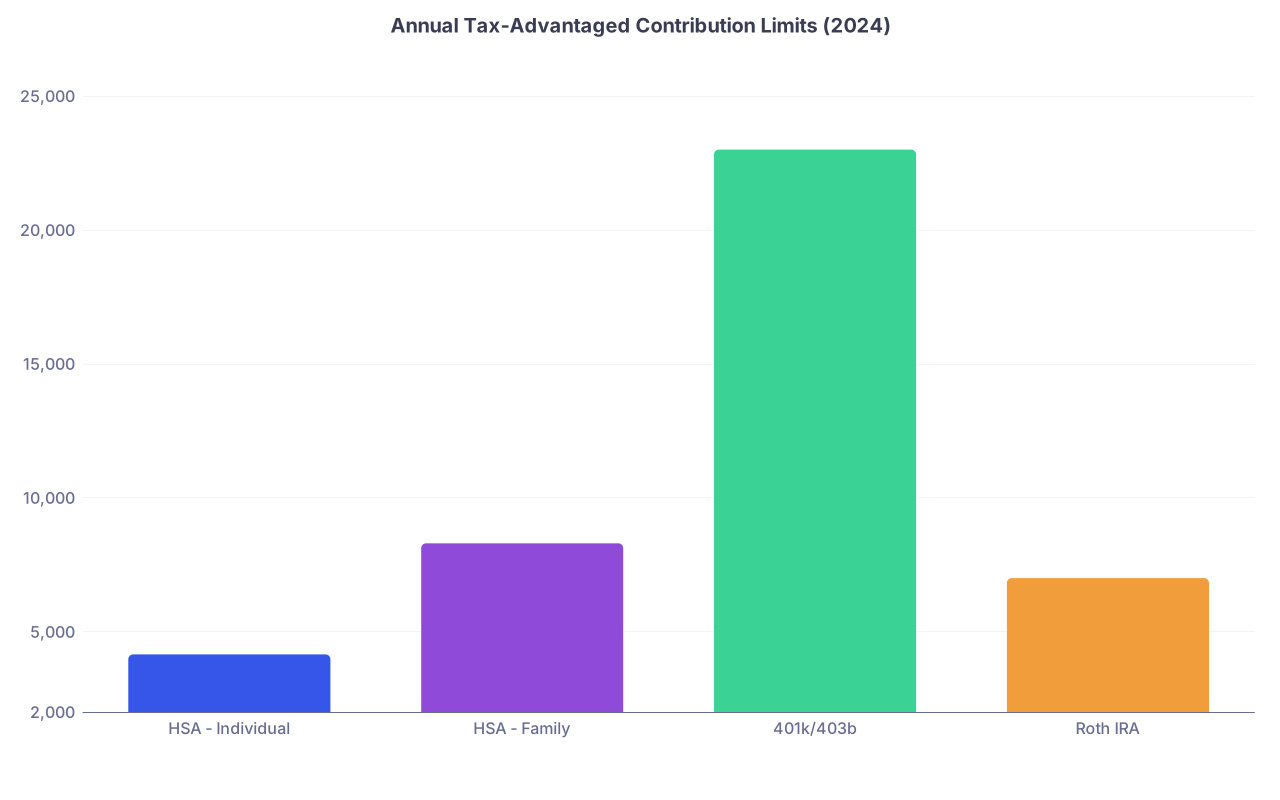
| Category | Value |
|---|---|
| HSA - Individual | 4150 |
| HSA - Family | 8300 |
| 401k/403b | 23000 |
| Roth IRA | 7000 |
You do not have to memorize the exact numbers; just understand the hierarchy: 401k/403b and HSA are where bigger money can go, Roth IRA is your personal backstop, and FSA is small and time‑limited.
Dental, Vision, and “Extras”
Dental and vision in residency are usually:
- Low premium, low benefit if you are young and healthy.
- Worth it if you know you need specific work: braces, wisdom teeth, frequent optometry.
Watch for three traps:
- “Free” dental that does almost nothing beyond basic cleanings.
- Vision discount plans that are basically glorified coupons.
- Having dental coverage but never using the two covered cleanings per year. That is literally burning money.
If you wear glasses/contacts and have any propensity for ocular issues (contact lens overwear, myopia progression), vision might be worth it. Otherwise, you can often pay out of pocket once every 2–3 years and be fine.
Disability Insurance: The Most Misunderstood Piece of Your Package
If you remember one line from this entire piece, remember this: The disability policy your hospital gives you is not enough for a physician career. It is a starting point, not a solution.
Why Disability Insurance Matters More Than Life Insurance in Residency
Blunt truth: the probability you will be disabled from your chosen specialty before retirement is higher than the probability you will die in residency.
You have invested:
- Undergraduate years
- Medical school
- Board exams
- Often research, sub‑internships, etc.
All for one income stream: your future attending salary. Disability wipes that out. The only reason residents ignore disability is because no one has made them do the math.
If you aim for a specialty paying $250,000–$500,000+ per year, you are insuring the present value of several million dollars in future income. And you are doing that at the only time in your life when disability coverage is relatively cheap: when you are young.
What Your Program’s Long‑Term Disability Actually Does
A typical hospital‑sponsored long‑term disability (LTD) benefit for residents looks like:
- Coverage: 60% of base salary
- Monthly cap: $2,500–$3,000 (sometimes 4k)
- Elimination period: 90 or 180 days (how long you are disabled before benefits start)
- Definition of disability: almost never true “own occupation”
- Portability: you cannot take it when you leave
Look at those numbers. If your PGY‑1 salary is $65,000:
- 60% of 65,000 ≈ $39,000 per year
- That is $3,250 per month before tax
- You are now disabled, maybe permanently, and making less than you did as an intern.
And that is if the insurer agrees you meet the definition of disability, which is not trivial if the definition does not clearly say “own occupation” or “own specialty.”
“Own Occupation” vs Garbage Definitions
You want this language in a policy at some point in your career:
If you cannot perform the material and substantial duties of your occupation (or medical specialty), you are disabled. Even if you can work in another job.
Many employer LTD policies instead do this dance:
- First 24 months: “own occupation” with heavy caveats
- After 24 months: “any occupation” you are reasonably suited for
So if you were a surgeon, had a tremor, and could no longer operate, under a bad policy the insurer could say: “You can work as a general practitioner or hospital administrator; therefore, you are not disabled under our definition.”
I have seen residents blindsided by this when a colleague has a stroke or severe injury. They assumed “long‑term disability” meant “I’m OK.” It does not, unless the definition is right.
Why You Still Need Individual Disability as a Resident
This is the unglamorous but critical move: buy an individual, own‑occupation disability policy during residency or fellowship.
Key reasons:
- You lock in insurability while young and (presumably) healthy.
- If you develop a condition in PGY‑3, getting a good policy later may be impossible or hugely restricted.
- You can usually add a future increase rider. That means as an attending, you can increase your coverage up to a higher cap without new medical underwriting. Essentially, you are buying a guaranteed right to insure your future income.
You do not need to go crazy on coverage in residency. Something like $4,000–$5,000 per month benefit with strong riders is a common starting target. Then you increase later.
Look for these features in an individual policy:
- True own‑occupation definition (ideally, “specialty‑specific” for fields like surgery, anesthesiology, radiology).
- Non‑cancelable and guaranteed renewable (they cannot change your rates or benefits as long as you pay).
- Residual/partial disability rider (if you can work part‑time / reduced capacity, you still get partial benefits).
- Future increase/benefit update rider.
- Cost of living adjustment (COLA) is nice but somewhat optional in residency if it prices you out.
Yes, the premium will hurt a little on a resident salary. I do not care. The trade‑off is that you are not financially annihilated if something happens in your 30s.
Life Insurance: Who Actually Needs It in Training?
Life insurance is emotionally charged but mathematically straightforward.
You need life insurance during residency if:
- You have dependents (spouse, kids) who rely on your income,
- You have co‑signed debt (parents on private loans, joint mortgage), or
- You have a partner planning a life based on your future attending income.
If you are single, no kids, no co‑signed loans, and no one will be financially harmed by your death beyond funeral costs, a huge life policy is unnecessary. Harsh but true.
Group Life Through Your Program
Most residency programs throw in a small group term life benefit:
- 1x salary (e.g., $65,000)
- Or a small flat amount ($25,000–$50,000)
This pays a lump sum to your named beneficiary if you die during employment. It costs you little to nothing and is automatic. That is fine, but it is usually not enough if you have a spouse and kids.
Individual Term Life: If You Actually Need It
If you do have dependents:
- Get a level term policy from a reputable insurer.
- 20‑ or 30‑year term, coverage often in the $500,000–$2,000,000 range depending on your situation.
- Avoid whole life or “cash value” life insurance in residency. It is expensive, complex, and rarely the right first tool for a trainee.
Do not let anyone sell you a combined disability + whole life package “for physicians.” Separate clean term life and a high‑quality individual disability policy are usually better.
Retirement and Financial Benefits: The Parts Everyone Skims
Here is the cynical truth: the hospital cares more about funding the defined benefit pension for their senior executives than making sure your 403(b) match is optimized. You have to look out for yourself.
Common Retirement Structures in Residency
You will typically see one of these:
- 403(b) (for non‑profit hospitals) or 401(k) (for for‑profit systems)
- Maybe a 457(b) plan if part of a larger health system
- Rarely, a small defined benefit / pension accrual
The key question to ask HR: “Do residents receive an employer match on retirement contributions?”
| Plan Type | Resident Eligible | Employer Match | Vesting Period |
|---|---|---|---|
| 403(b) | Yes | 0–4% | 0–3 years |
| 457(b) | Sometimes | None | None |
| Pension | Rare | N/A | 5+ years |
If you get a match, that is free money. Contribute at least enough to capture the full match, even during residency, if you possibly can.
No match? Then the decision becomes: 403(b) vs Roth IRA vs HSA (if available). For many residents, Roth IRA + HSA + minimal 403(b) is a reasonable order, because your current tax bracket is relatively low compared to attending life.
Vesting: The Quiet Detail That Matters
Some systems require 2–3 years of employment before their contributions are fully yours (vesting period). Residents doing a preliminary year or short transitional internship may never vest. That means you could see “employer contributions” on a statement that you do not actually keep if you leave early.
Ask explicitly: “What is the vesting schedule for employer contributions?”
The Rest of the Package: What’s Noise, What’s Signal
Not all “benefits” justify your attention. Some are just marketing noise.
PTO, Sick Time, and Parental Leave
You want exact numbers, not vague phrases.
- How many weeks of vacation per year? (3 vs 4 makes a real difference)
- Is vacation guaranteed or “subject to service needs”?
- Is there a separate sick bank? How many days before you start getting hassled?
- Do they have a paid parental leave policy for residents, or is it a patchwork of FMLA, sick time, and program goodwill?
Programs are getting better about parental leave, but policies still vary wildly. If you are planning to have a child during training, you cannot just “figure it out later.” You need the policy language.
Malpractice Coverage: Occurrence vs Claims‑Made vs Tail
Most residents are covered under the hospital’s malpractice umbrella. You usually do not pay a premium. However, for some higher‑risk specialties or moonlighting arrangements, coverage details matter.
Key issues:
- Is coverage occurrence‑based (simpler; no tail needed) or claims‑made (cheaper for them; tail might be an issue)?
- If it is claims‑made, who pays for the tail when you leave, if it is needed?
- Are you covered for moonlighting, or do you need separate coverage?
You do not need an actuarial degree. You just need to make sure you will not be personally on the hook for a tail policy bill or an uncovered moonlighting disaster.
Food, Parking, and “Wellness”
These are not trivial, but they are secondary.
Meal stipends:
A program that loads a badge with $200–$300 per month in cafeteria funds can effectively add a few thousand dollars per year to your real compensation. Others give you nothing and charge you for the worst cafeteria food in the state. Factor that in.
Parking/transit:
Paid parking in urban programs is another quiet tax on residents. A $200/month parking bill is $2,400/year out of your PGY‑1 salary. See if they offer pretax transit/parking benefits; it will not save you a fortune but every dollar helps at this stage.
“Wellness” benefits:
Free EAP counseling, gym stipends, therapy discounts—these can be meaningful if you actually use them. Ignore the fluffy wellness posters; pay attention to what is quietly covered for mental health and burnout.
How to Actually Audit Your Offer Before You Sign
You matched. You are excited. HR sends you a 20‑page booklet and a login to some benefits portal that looks like it was designed in 2004. Here is how to not zone out.
Step‑By‑Step Reality Check
Health insurance
- Identify the plan you are likely to choose.
- Write down: monthly premium, deductible, out‑of‑pocket max, HSA eligibility.
- Decide whether you can and will fund an HSA if applicable.
Disability
- Find the hospital’s LTD policy summary.
- Note: benefit percentage, cap, elimination period, and definition of disability.
- Assume this is insufficient for your long‑term career and plan to explore individual own‑occ coverage in PGY‑1/2.
Life insurance
- Confirm amount of group life (1x salary? fixed amount?).
- If you have dependents, get term quotes separately; do not rely on group only.
Retirement
- Determine if there is an employer match.
- If yes, decide how much you need to contribute to get 100% of it.
- Check vesting schedule; decide how likely you are to meet it based on residency length.
Leave and malpractice
- Read the vacation, sick, parental leave policies. Not the summary slide—the actual policy.
- Clarify malpractice type and any tail issues, especially if you intend to moonlight later.
“Extras”
- List meal stipends, parking costs, CME money, book funds, exams paid (Step 3, in‑training exams).
- These will not make or break your choice, but they do differentiate similar programs.
You are not trying to become an actuary. You are just trying to avoid being blindsided.
Frequently Asked Questions
1. I am starting PGY‑1 and money is tight. Should I prioritize individual disability or retirement contributions?
Individual disability first. Every time. The entire value of your future attending income depends on your ability to work. A serious illness or injury early in your career without proper disability coverage is financially devastating. You can always ramp up retirement contributions later as an attending; you cannot go back in time to buy disability before a diagnosis.
2. Is an HDHP with HSA really safe for a resident, or is it too risky with our income level?
For a generally healthy resident without dependents and no known expensive upcoming medical needs, an HDHP + HSA is often a rational choice. The key is having at least a mini‑emergency fund (even $1,000–$2,000) to cover early‑year expenses before the deductible is met. If you have chronic illness, ongoing therapies, or pregnancy planned, a lower‑deductible PPO may be more appropriate despite higher monthly premiums.
3. My program offers “60% long‑term disability.” Why is everyone saying I still need an individual policy?
Because 60% of a resident salary is not enough to live on long‑term, and that policy probably is not true own‑occupation and is not portable. If you become disabled from practicing your specialty five years from now, you want a policy that pays based on your attending‑level income and specialty definition, not whatever generic group policy your hospital happened to throw in while you were an intern.
4. How much individual disability coverage should I buy as a resident?
Typical starting range is $3,000–$5,000 per month benefit, with strong riders (own‑occupation, residual, future increase). The exact number depends on your budget and projected attending income. You do not need to hit attending‑level coverage on day one; the key is locking in insurability and a framework you can scale up later.
5. I am single with no kids and my parents are not relying on my income. Do I need extra life insurance beyond what my residency provides?
Probably not. In that scenario, your death would be an emotional tragedy but not a financial catastrophe for dependents. The small group term life policy your program provides is usually sufficient to cover final expenses and small obligations. Focus your limited dollars on disability coverage, modest emergency savings, and maybe Roth IRA contributions.
6. Can I negotiate my benefits package as a resident, or is it all take‑it‑or‑leave‑it?
You will not negotiate your health plan design or the hospital’s LTD structure. Those are set at the institutional level. What you can control is your selection within the offered options (HDHP vs PPO, contribution levels, etc.) and your own supplemental policies (individual disability, term life). Some flexibility exists around things like moonlighting coverage, scheduling vacation, or parental leave logistics, but the formal benefits menu itself is rarely negotiable at the individual resident level.
Key points to walk away with:
- Your hospital’s disability and life insurance are baseline, not full protection. Own‑occupation individual disability is the one policy most residents should seriously consider early.
- Do not pick health insurance by premium alone; understand deductibles, out‑of‑pocket max, and HSA eligibility, especially if you are young and relatively healthy.
- If your program offers a retirement match, capture it; if not, prioritize protection (disability) and flexibility (HSA/Roth) over stuffing pre‑tax accounts at a low trainee income.