

Most residents sign malpractice contracts they do not actually understand. That is a problem.
Let me be blunt. Malpractice coverage is one of those “we’ll handle that for you” items programs love to wave away. And residents nod along because they are exhausted and focused on surviving call. But the difference between occurrence and claims-made coverage, who pays tail, and what happens when you moonlight can absolutely come back to bite you later.
You do not need to be an insurance expert.
You do need a clean mental model of how this works before you sign anything, rank programs, or take that “easy” moonlighting gig across town.
This is that model.
1. Why Malpractice Coverage Matters During Residency (And After)
Residents assume, correctly, that “the hospital covers me.” The nuance lives in the fine print: how they cover you, when you are covered, and for what activities.
Here is the core reality:
- You can be sued years after you finish residency for care you provided as a PGY-2.
- The patient’s lawyer does not care where you are now. They care who insured you then.
- Your future attending job, fellowship, or licensing board may ask about prior claims going back many years.
So malpractice coverage in residency is not just about protecting PGY-1 you. It follows your name and your NPDB record for the rest of your career.
Typical resident malpractice exposure scenarios:
- Missed appendicitis in the ED during night float.
- Complication after a lap chole you did as primary under supervision.
- OB shoulder dystocia in your intern year, claim filed 5 years later.
- TPA given (or not given) on your neurology rotation, stroke outcome dispute.
You want to know:
- Am I covered when these things happen?
- Am I still covered if a claim shows up years later when I am in fellowship or private practice?
- Am I personally on the hook for any tail coverage?
To answer those, you must understand occurrence vs claims-made.
2. Core Definitions: Occurrence vs Claims-Made
Strip away the legal jargon. It comes down to what triggers the policy to cover you.
Occurrence Coverage – “When did the care occur?”
Occurrence insurance asks one question only:
Was the care provided during the policy period?
If yes, you are covered for that incident, even if the claim is filed years later, after the policy has ended, you left the hospital, or the group dissolved.
Example:
- You are a PGY-3 in 2026 with occurrence coverage through Hospital A.
- You treat a patient in October 2026.
- You graduate and move on in 2027.
- Patient sues you in 2030.
Because the care occurred during 2026 while you had an occurrence policy, that policy (or its successor) responds. No extra tail policy required from you.
Key feature:
Coverage is tied to the date of the incident.
Claims-Made Coverage – “When is the claim made?”
Claims-made insurance cares about when the claim is first reported to the insurer, and secondarily, when the incident occurred.
To be covered, both must be true:
- The incident occurred on or after the retroactive date (more on this in a minute), and
- The claim is first made and reported while the policy is in force.
If either fails, you are not covered by that policy.
Example:
- You are a PGY-2 in 2026 with claims-made coverage through Hospital B.
- Retroactive date: 7/1/2025 (your intern start).
- You treat a patient in October 2026.
- You graduate in 2028; the hospital stops covering you when you leave.
- Patient sues you in 2030.
The incident occurred after your retro date (good), but the claim is made after your policy ended (bad). You are not covered unless:
- The hospital or program bought tail coverage for you, or
- Your next employer’s insurer provides prior acts (nose) coverage reaching back to residency.
Key feature:
Coverage is tied to the date the claim is made and your continuous coverage history.
3. The Other Critical Piece: Tail and Nose Coverage
With occurrence coverage, tail rarely matters individually. With claims-made, tail is everything.
Tail Coverage (Extended Reporting Endorsement)
Tail coverage lets you report claims after a claims-made policy ends, for incidents that occurred during the policy period.
Think of it as “keeping the back door open” after you stop paying premiums, so later lawsuits can still get in and be covered.
- Policy years: PGY-1 to PGY-3, claims-made.
- Policy ends when you finish residency.
- Tail coverage covers claims arising from those years that are first reported after you leave.
In attending jobs, tail can cost 150–250% of the final year’s premium. For high-risk specialties, that can be six figures. For residents, programs usually negotiate this at the institutional level; you want to know what they promise.
Nose (Prior Acts) Coverage
Nose coverage is the opposite strategy:
Your new insurer agrees to cover your old acts by backdating the retroactive date.
Example:
- Residency: 2025–2028, claims-made, retro date 7/1/2025.
- New job in 2028 with a different insurer.
- New insurer issues a policy with retro date 7/1/2025.
Now, if a patient from 2026 sues you in 2030, your current insurer covers it as a prior act. That is nose coverage.
In practice for residents:
- Most residencies that use claims-made are self-insured or part of large systems and keep you under their umbrella for resident work even after you leave.
- Some community programs lease coverage through commercial carriers and may or may not provide tail.
You need to know which you are dealing with before you rank or sign.
4. How This Actually Shows Up in Resident Contracts
Hospitals rarely explain this clearly. Language is vague and maddening.
Typical contract phrasing you might see:
- “The institution shall provide professional liability coverage for house staff during the term of this Agreement, with limits of $1,000,000 per claim and $3,000,000 aggregate.”
- “Coverage shall be on a claims-made basis, and tail coverage shall be provided for acts performed within the scope of duties as a resident.”
- “Coverage shall be occurrence-based.”
Here is what you want to extract.
| Item | What You Need to Identify |
|---|---|
| Type of coverage | Occurrence or claims-made |
| Policy limits | Per claim / aggregate (e.g., 1/3) |
| Tail coverage | Provided? For how long? |
| Retroactive date | Start of residency or earlier? |
| Scope of coverage | Only program duties or more? |
You do not need the full policy document. You do need straight answers to:
- Is it occurrence or claims-made?
- If claims-made, who pays for tail and is it automatic?
- Does it cover me for moonlighting, elective outside rotations, and telehealth? Or only hospital-assigned duties?
5. Occurrence vs Claims-Made: Pros and Cons for Residents
Residents are not choosing their policy, but understanding the trade-offs helps you judge how well a program is protecting you.
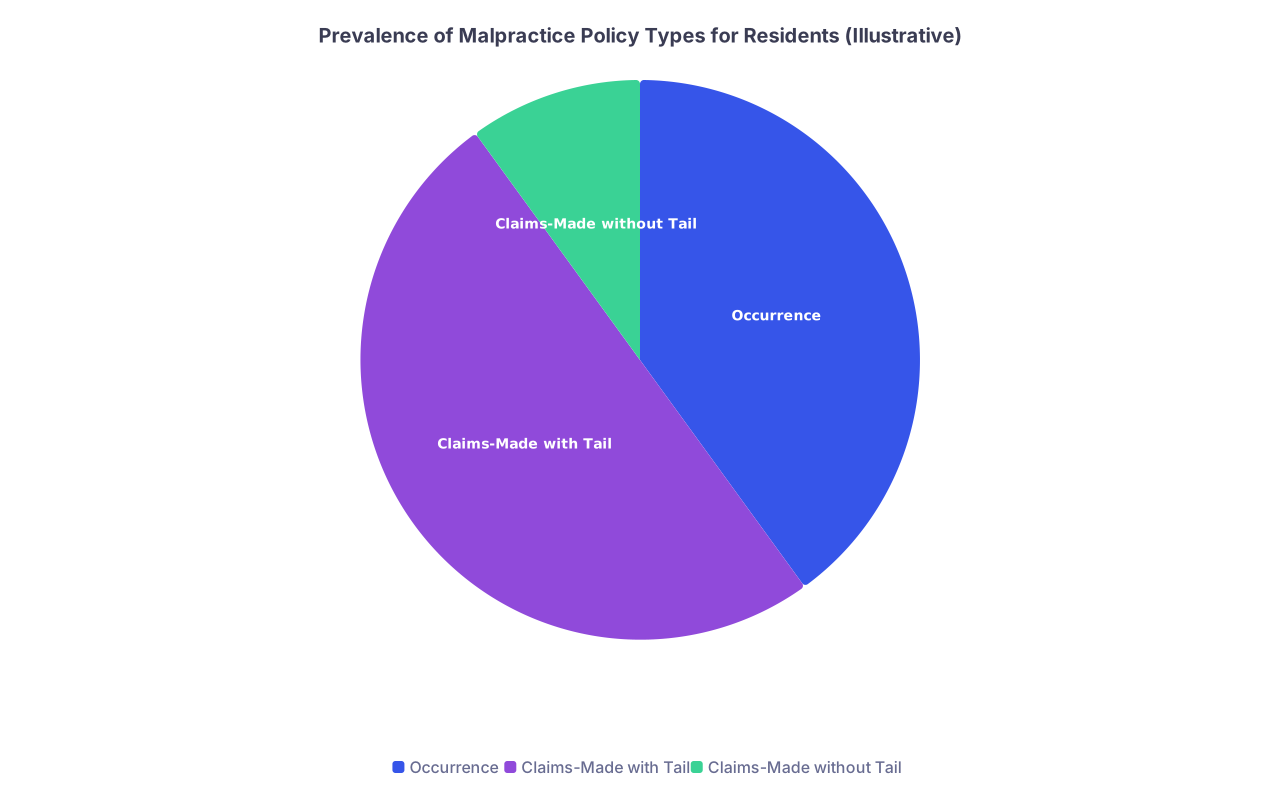
| Category | Value |
|---|---|
| Occurrence | 40 |
| Claims-Made with Tail | 50 |
| Claims-Made without Tail | 10 |
These numbers are illustrative, but they match what I have seen repeatedly: most academic centers either use occurrence or claims-made with institutional tail. The problematic cases are that last slice.
Occurrence Coverage – Advantages for Residents
- No need to worry about tail if you leave.
- Simpler concept: if the event happened during your residency, you are covered.
- No fights with future employers about who covers your “old” claims.
Disadvantage in practice: residents rarely feel it, but occurrence premiums are usually higher for employers. Some community hospitals avoid it for cost reasons.
Claims-Made Coverage – Advantages and Risks
Advantages for the institution:
- Cheaper early premiums.
- Flexibility if they switch insurers or adjust coverage.
For residents:
- If the program guarantees and funds tail coverage, you are functionally protected.
- Large systems may keep a single master claims-made program and just move your employment classification.
Risks:
- If tail is not guaranteed, you can be exposed after graduation.
- If coverage only applies while “employed as a resident,” and there is no separate tail provision, you have a problem.
- If a moonlighting gig relies on its own claims-made policy and that group collapses without buying tail, your name is still on the lawsuit.
6. Retroactive Date: The Silent Landmine
For claims-made, the retroactive date defines how far back the policy will cover your acts. Anything before that date is excluded.
For residents, you want the retro date to be:
- On or before your first day of residency, and
- Preserved (not reset) if you stay within the same system transferring from prelim to advanced, or into fellowship.
Common mistake: A resident does a prelim year at Hospital A (retro date 7/1/2025), then advances to Hospital B which issues a claims-made policy with retro date 7/1/2026. That gap year is exposed unless Hospital A’s coverage or tail covers that period.
When you move:
- Ask: “What is the retroactive date on my new policy, and does it reach back to my first day of GME?”
- For most ACGME programs in large systems, the answer is “yes” or “not applicable, we are occurrence.” Smaller or non-ACGME programs are less consistent.
7. Moonlighting, Outside Rotations, and “Scope of Duties”
Resident malpractice is usually limited to activities performed:
- As part of your training program,
- Under the control of the sponsoring institution,
- Within defined sites of practice or affiliated locations.
Everything else is a separate question.
Internal vs External Moonlighting
Internal moonlighting (extra shifts within your own institution / system):
- Often covered under the same institutional malpractice policy.
- Sometimes explicitly included in the “house staff” coverage, especially if duties are similar to your usual scope.
External moonlighting (a community ED, urgent care, telemedicine):
- Usually not covered by your residency policy.
- The external site is supposed to provide its own coverage.
- You need it spelled out in writing: claims-made vs occurrence, limits, tail responsibility.
I have seen residents burned when:
- The moonlighting site closed, did not buy tail, and the insurer denied later claims.
- The moonlighting contract said, “Malpractice insurance available,” but did not specify tail; years later, no one wanted to pay.
If you moonlight, you must ask:
- “Is this coverage occurrence or claims-made?”
- “If claims-made, do you provide tail when I leave or if the site closes?”
- “Will this policy list me by name, and what is the retro date?”
8. Fellowship and Job Transitions: How Residency Coverage Follows You
Residency is not an isolated bubble. Your malpractice history rolls right into fellowship and attending life.
Transition 1: Residency → Fellowship
Typically:
- Fellowship at same institution: coverage just continues. Not your problem.
- Fellowship at different institution:
- Your residency coverage should still respond to any claims arising from your residency years.
- Your new fellowship program provides coverage only for your fellowship duties.
If residency coverage was claims-made:
- Confirm the institution provides institutional tail or that their self-insured trust covers you indefinitely for acts as a resident.
- Get something in writing, even if just an email from GME or risk management: “Yes, you will remain covered for acts performed during your residency.”
Transition 2: Residency → First Attending Job
Here is where misunderstandings show up.
Attending contract negotiations often include:
- “We will cover your prior acts,” or
- “You are responsible for tail coverage from your previous employer.”
For you, that “previous employer” is your residency program.
If your residency used:
- Occurrence coverage: you should not need tail from residency.
- Claims-made with institutional tail: your residency years are locked in; your new job does not need to cover those years.
- Claims-made without guaranteed tail: your new employer may demand you show proof of tail or prior acts coverage for your residency period, or they simply exclude that period.
You do not want to discover at your first attending job that you lack coverage for your entire training history.
9. What You Should Actually Do as a Resident or Applicant
Let me narrow this down to actionable steps. This is what I tell MS4s and residents who send me their contracts.
Before Rank List or Signing a Contract
You are not negotiating the policy type as a resident, but you can and should know what you are signing into.
Ask your program (or GME office), in writing:
- “Is resident professional liability coverage occurrence-based or claims-made?”
- “If claims-made, does the institution provide tail coverage for acts performed during residency after I complete the program?”
- “Are internal moonlighting activities covered under the same malpractice policy?”
- “Are external moonlighting activities covered by the institution? If not, do you require proof of separate coverage?”
- “What are the limits of coverage per claim and in the aggregate?”
Red flags:
- Vague answers like “We have always had adequate coverage” or “No one has had a problem before.”
- No one in GME, HR, or risk management can clearly say “Yes, we provide tail for residents” or “We use occurrence.”
You do not need to rank a program lower just because they use claims-made. You should rank them lower if they cannot explain how you are protected years later.
During Residency
You are busy. Keep this minimal but intentional:
- Save any written documentation that confirms the type of coverage and tail promises.
- Before starting any external moonlighting, get a copy of that site’s malpractice declarations page and tail policy.
- If you transfer programs, ask your first program whether your coverage continues for acts during that partial year and in what form.
At Graduation
Do one email to GME or risk management:
“Please confirm in writing that I will continue to have malpractice coverage for acts performed within the scope of my duties as a resident between [dates]. If the coverage is claims-made, please confirm that appropriate tail coverage has been secured for that period.”
Save that email. Ten years from now, you will be glad you did if a letter from a plaintiff’s firm shows up.
10. Concept Map: How a Malpractice Claim Moves Through Time
Sometimes a visual timeline helps lock this in.
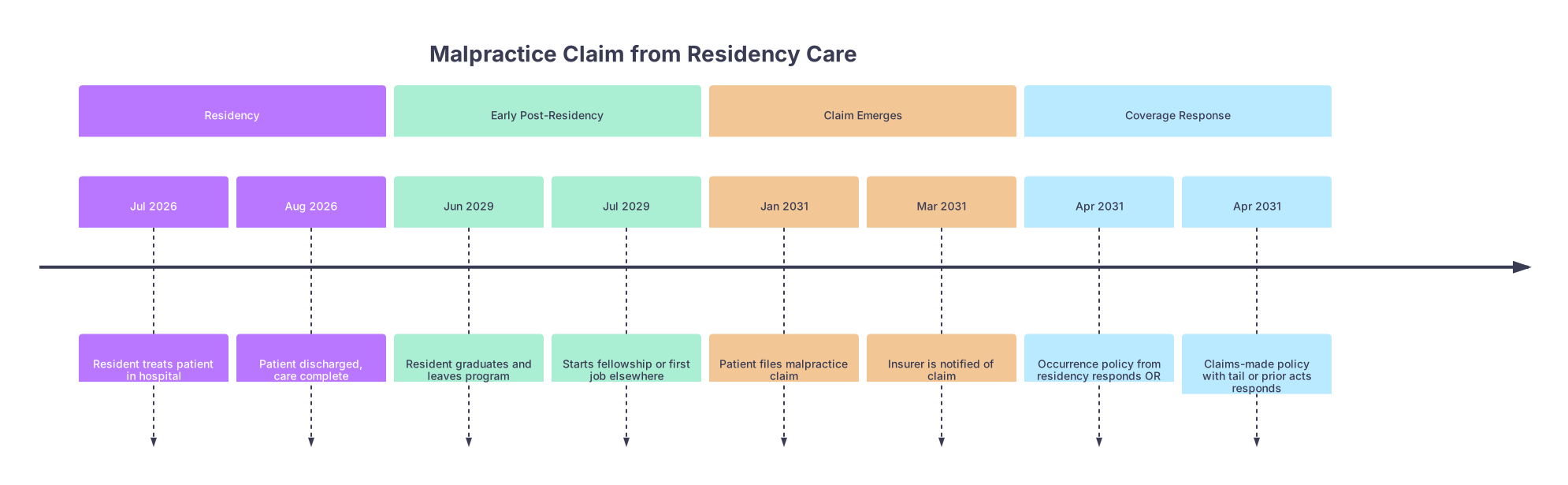
| Period | Event |
|---|---|
| Residency - Jul 2026 | Resident treats patient in hospital |
| Residency - Aug 2026 | Patient discharged, care complete |
| Early Post-Residency - Jun 2029 | Resident graduates and leaves program |
| Early Post-Residency - Jul 2029 | Starts fellowship or first job elsewhere |
| Claim Emerges - Jan 2031 | Patient files malpractice claim |
| Claim Emerges - Mar 2031 | Insurer is notified of claim |
| Coverage Response - Apr 2031 | Occurrence policy from residency responds OR |
| Coverage Response - Apr 2031 | Claims-made policy with tail or prior acts responds |
Notice where coverage must be “on”:
- For occurrence: on when you treated the patient.
- For claims-made: on when you treated the patient and on when the claim is reported (either via active policy or tail/nose coverage).
11. Quick Comparison: Resident-Facing Version
| Feature | Occurrence | Claims-Made (with Tail) |
|---|---|---|
| What triggers coverage | Date care occurred | Date claim is first reported |
| Need tail at graduation? | No | Yes, unless prior acts provided later |
| Common in academic centers? | Yes | Also common |
| Resident risk if done right | Very low | Low (if tail guaranteed by institution) |
| Resident risk if done badly | Usually still low | Potentially high if tail not provided |
And keep this separate issue in your mind:
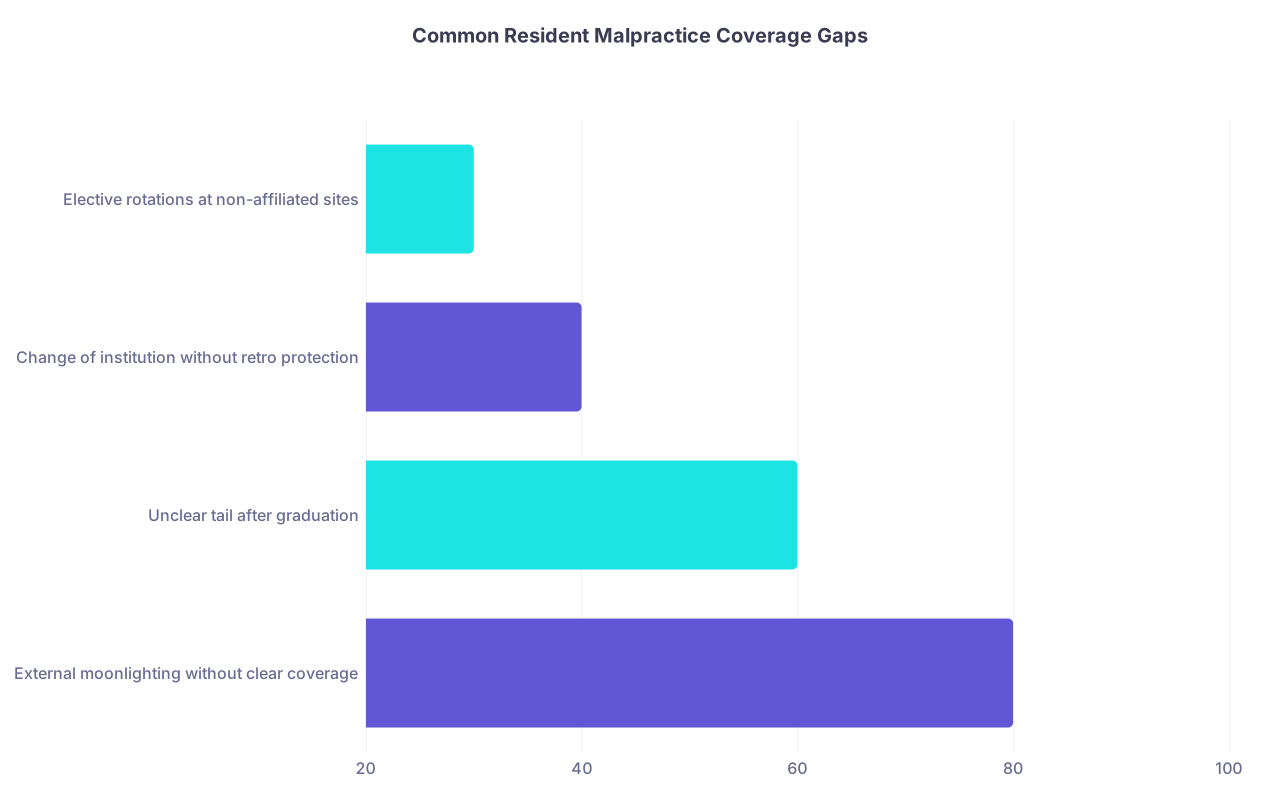
| Category | Value |
|---|---|
| External moonlighting without clear coverage | 80 |
| Unclear tail after graduation | 60 |
| Change of institution without retro protection | 40 |
| Elective rotations at non-affiliated sites | 30 |
Again, numbers are illustrative, but the ranking is accurate: moonlighting and tail ambiguity cause most resident-level coverage gaps I see.
12. What Programs Rarely Tell You (But You Should Understand)
A few hard truths:
- Hospitals structure coverage around institutional risk and cost, not resident education. You are incidental.
- Some programs themselves do not fully understand the nuances of claims-made vs occurrence; they offload this to a corporate risk office.
- “Self-insured trust” language can be opaque. It can function like occurrence or claims-made with tail, but you need someone to state clearly that former residents remain covered.
If you ask smart, concise questions, good programs will respect that. If a program is defensive or dismissive when you ask basic malpractice questions, that is its own kind of data point about their culture.
FAQ (Exactly 6 Questions)
1. As a resident, does it really matter to me whether the coverage is occurrence or claims-made?
Yes, but indirectly. You are not paying the premium, but the structure determines whether you are protected when a claim arises years after you leave. If it is occurrence, you are usually safe by default. If it is claims-made, then tail coverage or prior acts arrangements become critical. You do not want any ambiguity about who covers you for residency-era care once you graduate.
2. How can I tell if my residency program provides tail coverage?
Ask for it explicitly in writing from GME or risk management: “If our malpractice coverage is claims-made, does the institution provide tail coverage for residents after completion of training?” The answer should be direct. “Yes, the institution purchases tail for all residents,” or “Coverage is occurrence-based, so tail is not required.” Anything vague needs clarification. You do not need the policy details; you need a documented commitment.
3. If I switch programs mid-residency, what happens to my malpractice coverage from the first program?
Your first program’s policy should still cover you for acts performed while you were there. If it was occurrence, you are covered for those incidents without needing tail. If it was claims-made, the program or its insurer needs either to maintain coverage with an appropriate retro date or to provide tail for that period. Confirm in writing before you leave that you remain covered for your time there. Your new program’s coverage usually only applies going forward.
4. Do state licensure boards or hospitals care which type of malpractice insurance I had as a resident?
They care about your claim history, not the policy type. When you apply for privileges or a license, you must disclose any prior or pending claims. The policy type just determines which insurer handles those historical claims. But if you lacked coverage because of a tail gap or retro date problem, you can end up with uncovered exposure and a very complicated disclosure situation later.
5. For moonlighting, is the hospital’s certificate of insurance enough proof I am covered?
No. A generic certificate is not enough. You want confirmation that the coverage specifically applies to your moonlighting activities at that site, including policy type and tail arrangements. For external moonlighting, ask the site or group for a declarations page showing limits and whether coverage is occurrence or claims-made. If claims-made, ask clearly who pays for tail when you stop working there or if the site closes.
6. I am an MS4 making a rank list. How deeply should I push on malpractice questions with programs?
You do not need to grill every program, but you should ask targeted questions, especially at community or smaller hospitals. One or two concise questions to the program coordinator or GME office are enough: “What type of malpractice coverage do residents have (occurrence or claims-made)? If claims-made, is tail coverage provided after graduation?” Programs that handle this well will give clear, straightforward answers. If they cannot, that signals organizational sloppiness you should factor into your rank list.
Bottom line:
- Occurrence vs claims-made is not academic trivia. It determines whether you are protected when a claim shows up years after residency.
- Tail coverage (or nose/prior acts coverage) is the make-or-break detail for any claims-made policy. You want that guaranteed by the institution, in writing.
- Moonlighting and transitions between institutions are where resident coverage most often fails. Ask direct questions now so you are not the cautionary story later.


