
It is late June. You are in that dead zone between graduation and intern year. HR has you filling out forms you have never heard of, your program coordinator keeps mentioning “GME office,” and someone just told you, very confidently, that you need a personal DEA number before you can write a single Tylenol order.
They are wrong. But the real answer is more complicated than “yes” or “no.”
Let me walk you through it step by step, the way I explain it to interns who show up July 1st still thinking Step 2 was the last exam that mattered.
Big Picture: What Actually Lets You Prescribe as a Resident
Before you worry about DEA numbers, you need the hierarchy straight. Prescribing authority for a resident rests on several stacked pieces:
- Your state license status
- Your training/license exemption (if applicable)
- Your institutional credentials and privileges
- Your DEA and/or institutional/“hospital DEA” coverage
- Supervision and hospital policy
If any one of these is missing, you are not writing legal prescriptions, no matter what your badge says.
| Step | Who Manages It | Typical Timing |
|---|---|---|
| State medical license/permit | State board + GME | 1–3 months pre-July |
| Credentialing & privileges | Hospital/GME | 4–8 weeks pre-July |
| Institutional DEA linkage | Hospital pharmacy | Late June–early July |
| Personal DEA (if needed) | You | PGY1–PGY3, if ever |
| eRx & EPCS token setup | IT / Pharmacy | Orientation week |
The order is not negotiable. You cannot meaningfully do DEA paperwork if your state license is not recognized yet. You cannot prescribe electronically even with a DEA if IT has not provisioned your EHR account and EPCS token.
So we start at the state level.
Step 1: State Licensure – Full, Training, or Exempt?
Every resident sits in one of three legal buckets, depending on state and year of training:
- Full unrestricted license
- Limited / training license
- Institutional exemption / no license but allowed in training
Full Unrestricted License
You are treated like any other physician in that state, at least from a licensing standpoint.
You generally:
- Can prescribe independently within your scope and institutional policy.
- Can apply for a personal DEA number covering that state.
- Are personally on the hook for standard-of-care and documentation; no “resident umbrella” excuses.
Internal medicine PGY2 in Texas with a full license? Or a PGY3 anesthesiology resident in New York who obtained full licensure? You are in this group.
Limited / Training License
This is the most common setup for early residents.
Typical features:
- License valid only for ACGME-approved training at specified institutions.
- Cannot moonlight outside of program (or only with explicit board approval).
- Prescribing authority is tied to your role as a trainee at your institution, not to you as free-standing physician.
In many states, you still prescribe like a normal physician inside the hospital and clinics—your EHR signature and training license number plus the institution’s DEA coverage carry the legal weight.
Institutional Exemption (No Standalone License)
A few states and systems rely on statutory exemptions where trainees are legally allowed to practice under the hospital’s umbrella without an individual license.
This is rarer now but still exists in some places.
Bottom line:
You must know which category you are in by June, not July. Your GME office or program coordinator will tell you, but do not just accept “we’re handling it” and tune out.
Step 2: Understanding DEA Numbers vs Institutional DEA Coverage
This is where residents get confused—and where attendings sometimes give terrible advice.
What a DEA Number Actually Is
A DEA registration is permission from the federal government (DEA) for a practitioner or institution to handle controlled substances in a specific state and at a specific location or practice type.
For an individual physician:
- It is tied to your license type and state.
- It is not a “prescribing license.” It sits on top of your state license.
- It controls which schedules (II–V) you can handle.
For an institution (hospital/clinic):
- The hospital can have its own DEA number(s).
- Residents often prescribe under this number with an internal suffix or unique identifier.
- This is why many PGY1s can write controlled meds without ever filling out a DEA form.
Three Main Configurations for Residents
Let me sort programs into three archetypes.
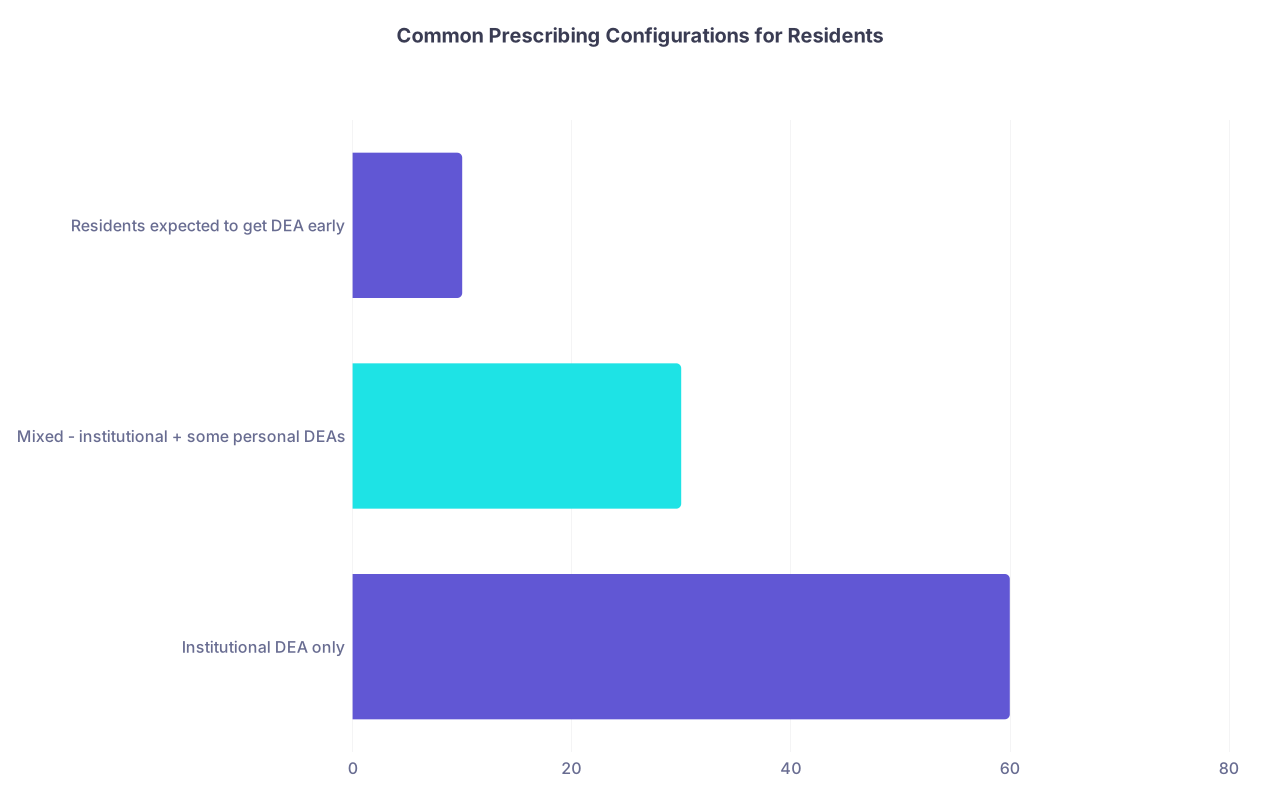
| Category | Value |
|---|---|
| Institutional DEA only | 60 |
| Mixed - institutional + some personal DEAs | 30 |
| Residents expected to get DEA early | 10 |
Institutional DEA only
Most university hospitals and many community programs use this.
Residents:- Do not have individual DEA numbers.
- Prescribe controlled substances under the hospital DEA, with an internal code.
- Are fully authorized to order inpatient narcotics, benzos, etc, through the EHR.
- Can often write discharge C-II prescriptions that print with the hospital’s DEA and their unique suffix.
Mixed model
Some systems allow or encourage senior residents/fellows to get personal DEA numbers if they are:- Moonlighting.
- Practicing in off-site clinics or community practices not fully under hospital DEA.
- Nearing graduation and planning to stay in state.
DEA required early
A minority of programs—especially in certain states or private systems—expect residents to obtain a personal DEA by PGY2, sometimes PGY1, particularly if:- Their outpatient clinics bill as independent practice sites.
- State law or payer requirements push them to use individual DEA numbers for certain prescriptions.
Your program will fit into one of these three. Do not assume what your friend at another program does applies to you.
Step 3: Timeline from Match to Prescribing Authority
Let us lay this out chronologically, from Match to actually sending a controlled Rx from the clinic.
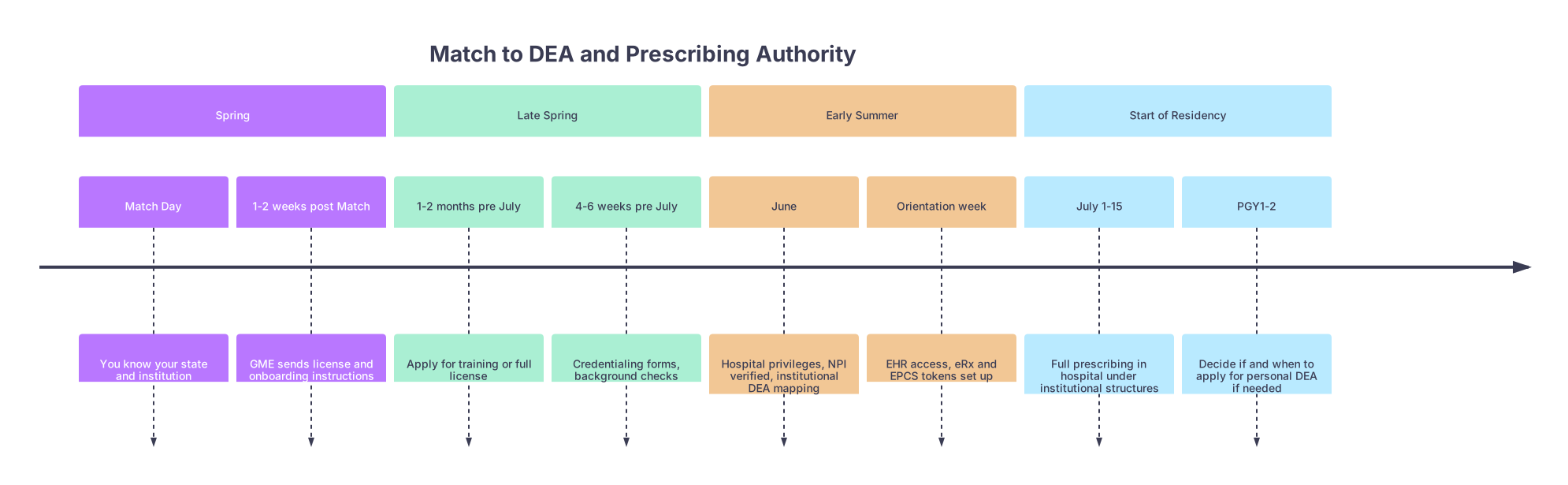
| Period | Event |
|---|---|
| Spring - Match Day | You know your state and institution |
| Spring - 1-2 weeks post Match | GME sends license and onboarding instructions |
| Late Spring - 1-2 months pre July | Apply for training or full license |
| Late Spring - 4-6 weeks pre July | Credentialing forms, background checks |
| Early Summer - June | Hospital privileges, NPI verified, institutional DEA mapping |
| Early Summer - Orientation week | EHR access, eRx and EPCS tokens set up |
| Start of Residency - July 1-15 | Full prescribing in hospital under institutional structures |
| Start of Residency - PGY1-2 | Decide if and when to apply for personal DEA if needed |
March–April: Post-Match Reality Check
You match. You now know:
- State of practice.
- Likely start date (almost always July 1).
- Program type (university vs community vs private).
This is when GME/HR usually sends a long email with:
- Instructions for state training license or full license.
- Deadlines (take these seriously: licensing boards move slowly).
- Background check, fingerprinting, sometimes drug screening.
Your first job: submit license paperwork fast. I have seen residents almost delayed in starting because they sat on a notarized form for three weeks.
April–June: Licensure + Credentialing
Two parallel tracks:
State license processing
You:- Give them med school transcripts, USMLE/COMLEX scores, etc.
- Pay the fee.
- Wait, then periodically nag them (politely).
Hospital credentialing
Hospital/GME:- Verifies your education, training, references.
- Obtains an institutional NPI if needed or records your individual NPI.
- Assigns your trainee category and privileges.
During this time, you are not prescribing anything yet. Your job is paperwork compliance.
Step 4: NPIs and Why They Matter Before DEA
Every resident should know their NPI number by heart. Or at least have it bookmarked.
Two NPIs can exist in your world:
- Your Individual NPI: you get this once; it follows you for life.
- Institutional or practice organizational NPIs: used for billing the site or group.
You can (and should) apply for your NPI as a med student or right after Match if you do not already have one. It is free and quick via NPPES.
Why it matters:
- Many EHRs are keyed to your NPI.
- e-Prescribing systems often require your NPI + license info for identity proofing.
- DEA applications require identifiers that link you as a real prescriber.
In practice, your program may help you confirm or obtain your NPI during onboarding. If not, do it yourself in May or June and send it to your coordinator.
Step 5: DEA vs No-DEA: Should You Apply as a Resident?
Now the question everyone keeps asking:
Do you need your own DEA number as a resident?
The honest answer: Often no. Sometimes yes. Occasionally it is a really bad idea.
Let me break it down by scenario.
You Likely Do NOT Need a Personal DEA if:
Your program explicitly says: “Residents prescribe under the hospital DEA; do not apply for your own.”
All your clinical activity is:
- In the main teaching hospital
- In hospital-owned clinics or FQHCs fully under that system
- In training settings where your prescriptions are routed via institutional DEA numbers.
You are PGY1 just trying to survive q4 call; moonlighting is not allowed.
Here, applying for a DEA is just lighting money on fire. DEA fees are not trivial, and you also carry full responsibility from day one.
You Probably SHOULD Get a DEA if:
- Your program allows/encourages residents to moonlight at external sites that are not under your hospital system.
- You are a senior resident or fellow planning to stay in the same state and your attending role will start soon.
- Your outpatient continuity clinic or satellite practice requires an individual DEA for electronic controlled prescriptions—this is program- and state-specific.
You Should PAUSE and Ask Before Applying if:
- You only have a limited/training license and are not sure if your state board permits DEA registration on that license.
- You are in a specialty with intense scrutiny around controlled substances (pain, psychiatry, addiction) and do not yet fully understand your hospital’s policies.
- Someone “heard from a friend” that you should get one, but your official paperwork from GME has not mentioned DEA once.
Talk to:
- Your program director
- A chief resident who actually prescribes in your clinics
- Pharmacy leadership / clinic medical director
One five-minute conversation can save you a pointless application.
Step 6: The Mechanics of Getting a DEA Number (If You Do)
If you do reach the point where a personal DEA is appropriate, here is the real sequence. No fluff.
Prerequisites
You must have:
- A valid state medical license in that state (full or training, if permitted).
- A practice site (address) associated with your prescribing.
- A plan for who is paying the DEA fee (you, institution, or group).
You go to the DEA Diversion Control Division website and complete the online application for a new registration:
- You choose the correct business activity (individual practitioner).
- You indicate the schedules you want (usually II–V).
- You list your state license number and expiration.
- You submit and pay.
Processing time varies from very fast (days) to irritating (weeks), depending on volume and whether anything flags for manual review.
Once issued, you now have:
- A DEA number usable only in that state and location scope.
- Obligations for record-keeping and appropriate prescribing consistent with federal and state law.
Do not apply again when you change jobs in the same state; you modify or add locations. When you move states, that is a different discussion.
Step 7: How Residents Actually Prescribe: Inpatient vs Outpatient
Let me separate how this plays out in the two worlds you live in.
Inpatient Prescribing
On the wards, the workflow is usually:
Your EHR login is tied to your identity, training license, NPI (if present), and resident status.
When you order a controlled med, the system associates that order with:
- Your user ID
- The hospital’s or facility’s DEA number
- Possibly an internal code that identifies you to pharmacy
You are legally prescribing under the combination of:
- Your authorized role (licensed trainee or licensed physician)
- The institution’s DEA registration
- Hospital policies and supervision requirements
You almost never need a personal DEA to prescribe inpatient C-II/III/IV/V as a resident. It is handled through institutional structures.
Outpatient Prescribing
Outpatient is where the confusion erupts.
Different models:
Hospital-owned clinic using same institutional DEA
Your Rx prints or e-sends under the clinic/hospital DEA. You are fine without a personal DEA.Clinic requires individual DEA for controlled eRx
Some states or payers require the prescriber DEA to match the individual for certain outpatient controlled scripts.
In those cases:- Early in residency, the clinic may route controlleds through attendings.
- Later, they may want you to have your own DEA.
Moonlighting or “side job”
You are working at an urgent care, outside ED, or community practice not under your program.
They almost always expect:- Full license
- Individual NPI
- Individual DEA
If you are not sure which category your continuity clinic falls into, ask them explicitly:
“How are controlled medications prescribed here by residents—do we use institutional DEA, or do residents ever need individual DEAs?”
Step 8: E-Prescribing Controls and Two-Factor (EPCS)
Controlled substances are increasingly locked behind Electronic Prescribing of Controlled Substances (EPCS) rules. This is where a lot of residents hit snags early July.
Typical setup:
You must undergo identity proofing (ID check, license verification) for EPCS enrollment.
IT or pharmacy provisions a second factor:
- Hardware token
- Phone app
- Badge swipe plus pin
Without EPCS enrollment, you may:
Be able to prescribe non-controlled meds electronically.
Be blocked from sending controlled substances electronically and forced to use:
- Attending co-sign workflows, or
- Paper Rxs (in states where still allowed), or
- Attending-only prescribing.
Orientation week is when you want to be very clear:
- Am I fully enrolled for EPCS?
- If not, how are my patients getting legitimate controlled meds at discharge or in clinic?
Step 9: Common Pitfalls and How to Avoid Them
Let me be blunt about the most common messes I see:
Late licensing
Resident waited too long to send fingerprints or transcripts. State board delayed. Start date is now at risk.
Fix: Submit license application as soon as program allows. Track every step.Assuming you need a DEA and applying blindly
Resident PGY1 pays out of pocket for DEA number in a system where they will never use it.
Fix: Confirm institutional policies first. If GME says “we cover you,” believe them.Moonlighting with no or wrong DEA
Resident moonlights out-of-system, prescribes controlleds, but their DEA registration address/state do not match the practice site.
Fix: Ensure DEA registration scope matches where you are working.Not understanding supervision requirements
Resident with training license prescribes outside allowed context or without required attending involvement.
Fix: Know your state and hospital rules about supervision and scope.IT / EHR access not ready July 1
Resident shows up, can log into EHR, but cannot sign orders or prescriptions because credentialing data was incomplete.
Fix: Confirm with GME in mid-June that all steps for EHR prescribing access are complete.
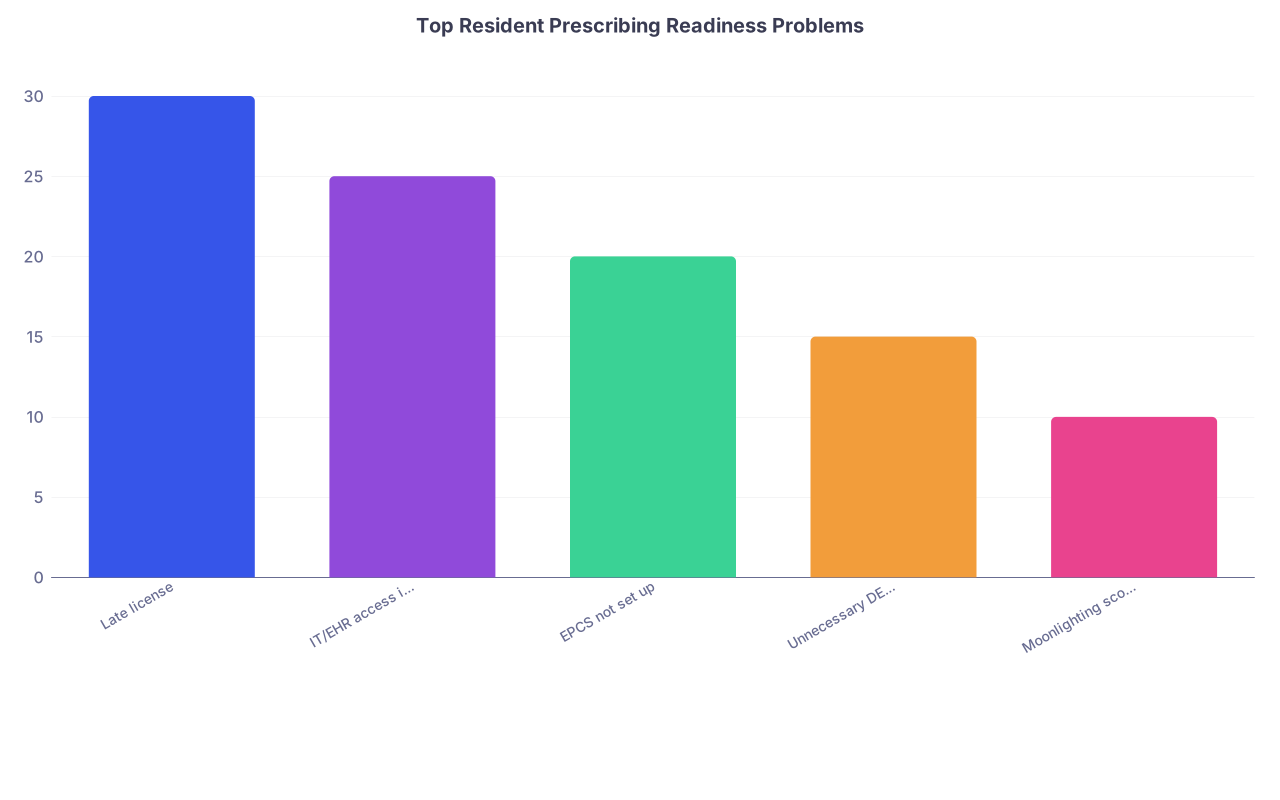
| Category | Value |
|---|---|
| Late license | 30 |
| IT/EHR access issues | 25 |
| EPCS not set up | 20 |
| Unnecessary DEA application | 15 |
| Moonlighting scope issues | 10 |
Step 10: Specialty-Specific Nuances
A few specialties live closer to the regulatory fire than others.
Psychiatry
- Heavy outpatient controlled prescribing (stimulants, benzos, some schedule IVs).
- Clinics may insist on clear DEA pathways.
- EPCS friction can directly affect patient care.
You should clarify during PGY1:
- Who writes initial vs continuation controlled Rx.
- When, if ever, you are expected to get a DEA.
Anesthesiology, Pain, and PM&R with pain focus
- Deep overlap with opioid regulations and monitoring.
- Documentation and state PDMP use are heavily scrutinized.
- Even under institutional DEA, your individual pattern of ordering is not invisible.
You should know:
- How your state’s PDMP integrates with your EHR.
- Local rules on pre-op and post-op controlled prescribing.
Emergency Medicine and Urgent Care
- You will hand out short-course opioids, benzos, and other controlleds constantly.
- Institutional DEA typically covers you in the main ED; moonlighting outside is another story.
Focus on:
- Understanding department prescribing policies.
- Clarifying DEA expectations before you sign any moonlighting contract.
FAQs: Five Questions Residents Keep Asking
1. Do I need to have my DEA number before starting PGY1 on July 1?
Usually no. In most programs, you will prescribe under the hospital’s DEA coverage from day one, as long as your state training license (or exemption) and credentialing are complete. You only need a personal DEA if your program explicitly requires it or you plan outside moonlighting where an individual DEA is mandatory.
2. Can I apply for a DEA number if I only have a training license, not a full license?
Sometimes, but not always. Some states allow DEA registration on a training license; others do not. You must check your state medical board’s rules and either speak with GME or review the board’s written guidance. Never submit a DEA application until you are certain your license type is eligible.
3. How do pharmacies see my identity if I am prescribing under the hospital’s DEA?
The EHR and pharmacy systems tie your name, NPI (if present), and internal identifier to the hospital DEA registration. The physical or electronic prescription will show your name as prescriber plus the institution’s DEA (often with an internal suffix). To the outside pharmacy, you look like a properly credentialed prescriber attached to that institutional DEA.
4. If I get a DEA in residency and then move states after graduation, can I use the same DEA?
No. A DEA registration is state and location specific. When you move states, you generally need a license in the new state first, then you apply for a new DEA registration there (or modify/add a registration if you maintain multistate practice in certain configurations). You cannot keep using a DEA registered to your residency state once you are practicing solely in another state.
5. Who do I actually ask if I am unclear about any of this?
Start with three people, in this order: your program coordinator (they know the process details), your program director or associate PD (they know expectations and policies), and your institution’s pharmacy or GME office (they know the DEA and EPCS specifics). If you are still getting inconsistent answers, ask for the written institutional policy or state board reference; it exists, and it settles arguments quickly.
Key points to walk away with:
- Your prescribing authority as a resident comes from stacked layers: state license status, institutional credentialing, and DEA coverage—personal or institutional.
- Most PGY1s do not need an individual DEA; they prescribe perfectly legally under hospital DEA structures and EHR controls.
- Before you spend money or sign moonlighting contracts, confirm—specifically—what your state, your institution, and your specialty clinic require for controlled prescribing.