
Most residents sign their first contract without really understanding what they just agreed to. That is a mistake.
Let me be very clear: your residency contract is not a “formality.” It is an employment contract with real legal, financial, and lifestyle consequences. You would not sign a mortgage by skimming it on your phone between cases. Stop doing that with residency contracts.
I will walk you through the key clauses line by line, the way a program director, hospital lawyer, or union rep reads them. The goal is simple: when you read your own contract, you know exactly where to zoom in, what is negotiable (rare, but sometimes), and what should make you pause hard.
1. Big Picture: What Your Residency Contract Actually Is
Most residents think: “This is my contract with the program.” No. Technically, in almost all cases:
- You are an employee of a hospital or health system (or a GME consortium).
- The ACGME-accredited program is housed within that employer.
- Your contract is an employment agreement between you and that entity.
That means:
- Labor law applies.
- State employment rules apply.
- Hospital policies (often not attached to the contract) are incorporated by reference.
You are not a “student” anymore. You are paid labor with training obligations attached.
Typical names you will see at the top:
- “Resident Physician Agreement”
- “Graduate Medical Education Training Agreement”
- “House Officer Employment Contract”
- “Appointment Agreement”
The title does not matter. The content does.
2. Parties, Term, and Renewal: The “Who” and “How Long”
This is usually the first real section.
a. Parties
You will see something like:
“This Agreement is made between XYZ Medical Center (‘Hospital’) and John Smith, MD (‘Resident’ or ‘House Officer’).”
Check:
- Legal name of the employer (XYZ Medical Center vs XYZ Health System vs ABC GME Consortium).
- Your legal name is correct and matches your license documents.
Why you should care:
If you ever have to escalate a legal issue, file a complaint, or apply for disability, the precise entity matters. I have seen residents waste weeks because they did not know who the actual employer was.
b. Term of Appointment
Clause will say something like:
“The term of this appointment shall commence on July 1, 20XX and conclude on June 30, 20XY.”
You are not signing a 3–7 year contract. You are signing a one-year contract, renewed annually at the program’s discretion, contingent on performance and funding.
Key phrases to look for:
- “Annual appointment”
- “No guarantee of reappointment”
- “Subject to satisfactory performance and institutional funding”
Do not assume “intern year” guarantees PGY‑2. The contract will specifically say reappointment is contingent.
3. Position, Level, and Duties: What You Are Actually Being Hired To Do
There is usually a section called “Appointment and Responsibilities” or similar.
You will see language like:
“Hospital appoints Resident as a PGY‑1 in the Internal Medicine Residency Program. Resident agrees to fulfill all educational and clinical responsibilities assigned by the Program Director, in accordance with ACGME requirements and Hospital policies.”
You want to see:
- Your PGY level explicitly stated.
- The program/specialty specified (Internal Medicine, General Surgery, etc.).
If you are in a prelim or transitional year, this should be crystal clear. Not “categorical.” Not ambiguous.
Then the duties paragraph will look intentionally vague, something like:
“Resident shall perform patient care, on-call duties, administrative tasks, documentation, and other responsibilities as determined necessary…”
Translation: They are reserving the right to assign night float, off-service rotations, clinic, cross-cover, administrative tasks, and occasionally less glamorous work. That is standard.
Red flags:
- Language allowing reassignment to another specialty or site “at employer discretion” without clear educational rationale.
- Anything suggesting you must stay beyond ACGME duty hours “as needed to meet service needs” without qualification.
4. Salary and Pay Structure: What You Actually Take Home
This is the part everyone jumps to first. Fine. But read it like an adult, not like someone checking if the number “feels okay.”
Most contracts show a table, either in the contract or as an attachment.
| PGY Level | Annual Salary (USD) |
|---|---|
| PGY-1 | $62,000 |
| PGY-2 | $64,000 |
| PGY-3 | $66,000 |
| PGY-4 | $69,000 |
| PGY-5 | $72,000 |
Core things to check:
Your PGY level is correct for the coming year.
Whether salary is:
- Fixed for the year, or
- Subject to “institution-wide adjustments” mid-year.
Pay schedule:
- Bi-weekly vs monthly.
- First paycheck timing (many interns get burned by a delayed first paycheck).
Stipends:
- Housing stipend?
- Meal stipend?
- Education stipend?
- Are they guaranteed in the contract or just “current benefits,” which can change?
If you see “per employer policy,” and the policy is not attached, that means they can change it without redoing everyone’s contracts. Mildly annoying but common.
5. Benefits: Health, Disability, Retirement, and Leave
This is always more complicated than it looks in orientation PowerPoints. The contract will either outline benefits or incorporate them by reference to a “House Staff Manual,” “GME Handbook,” or HR policy.
a. Health, Dental, Vision
Typical language:
“Resident shall be eligible to participate in Hospital’s health insurance plans under the same terms as other full-time employees.”
Questions you should answer:
- Is coverage effective on your start date or after a waiting period?
- Are dependents covered? At what cost?
- Do you have to choose between multiple tiers or plans?
If there is a waiting period, you may need gap coverage. This has caught more than a few interns off guard.
b. Disability Insurance
Absolutely under-read, and then suddenly very relevant for the unlucky few.
Look for:
- Short-term disability (STD): covers part of your salary for a short period.
- Long-term disability (LTD): what happens if you cannot practice long term.
Key points:
- Waiting period before LTD kicks in (typically 90–180 days).
- Percentage of salary covered (often 50–60%).
- Whether this is specialty-specific (true own-occupation) or broader.
Residents almost never realize how limited institutional disability coverage is. If you get a career-ending injury during residency, this clause matters more than your Step score.
c. Retirement
Most PGY contracts technically make you eligible for a 403(b) or similar. Many institutions:
- Offer no employer match for house staff.
- Or offer a token match after a year or more.
Do not expect private-attending-style retirement benefits. Just know whether you can contribute and whether there is any match, so you are not leaving free money on the table.
d. Leave: Vacation, Sick, Parental
This is one of the most important sections. You will see:
- “Paid Time Off” or “Annual Leave”
- “Sick Leave”
- “Parental Leave”
- Sometimes a generic “Other Leave”
There are three different frameworks that interact:
- Hospital policy (what is in your contract/house staff manual).
- Board eligibility rules (ABIM, ABS, etc. requirements for time in training).
- State or federal law (FMLA, state paid leave laws).
The contract usually only explicitly covers #1. But #2 and #3 still apply to your life.
Typical vacation clause:
“Resident shall be entitled to 15–20 days of paid vacation per academic year, scheduled in accordance with program requirements.”
Check:
- Exact number of days.
- Whether holidays are separate.
- Whether vacation can be carried over or must be used within the year.
Sick leave:
- Usually a bank of days per year (5–10), sometimes pooled with vacation as PTO.
- Note if it can be used for mental health. Often phrased as “illness, injury, or medical appointments.”
Parental leave:
- Some contracts simply say you are eligible for leave under FMLA, plus any applicable state law.
- Others spell out a dedicated paid parental leave (increasingly common at larger systems).
Pay attention to:
- Paid vs unpaid components.
- Whether using extended leave requires extension of training (it often does if you exceed board-allowed time away).
6. Duty Hours, Moonlighting, and Work Rules
Now we get into where the contract actually intersects your daily life.
a. Duty Hours
Language will typically mirror ACGME standards:
“Resident duty hours shall comply with ACGME requirements and institutional policies.”
This sounds good. In practice:
- It does not mean you will never work 82 hours.
- It does mean the program has an obligation to structure rotations to meet ACGME constraints and to respond to systemic violations.
If the contract has language like:
“Resident agrees to work additional hours as necessary to ensure patient safety, which may exceed the ACGME limits,”
that is problematic. It conflicts with ACGME expectation and is worth raising with your GME office or union (if present) before signing.
b. Moonlighting
Most contracts have a specific moonlighting clause. Something like:
“Moonlighting by Residents is permitted only with written approval of the Program Director and must not interfere with the Resident’s ability to meet program requirements. All internal and external moonlighting must be counted toward duty hours.”
Variations:
- Flat ban on moonlighting for PGY‑1.
- Some programs ban moonlighting for all residents.
- Others technically allow, but require so much paperwork that almost no one does it.
Check:
- Is moonlighting allowed at all?
- Does the contract claim the right to your earnings from certain types of internal moonlighting?
- Is malpractice coverage provided for internal moonlighting? (Often yes.)
- External moonlighting: Are you responsible for your own malpractice? (Often yes.)
If there is unionization, moonlighting terms are often more explicit and somewhat more resident-friendly.
7. Professionalism, Evaluations, and Promotion
This is where the contract quietly gives the program a lot of power over your future.
Clauses usually say something like:
“Reappointment and promotion are contingent upon satisfactory clinical performance, professionalism, adherence to policies, and the availability of funding as determined by the Program Director and Clinical Competency Committee.”
Hidden realities:
- The Clinical Competency Committee (CCC) has major influence on whether you advance each year.
- “Professionalism” can be interpreted broadly: lateness, documentation issues, conflict with staff, etc.
- You have very limited legal ability to challenge a non-renewal if due process has been followed.
Some contracts (especially academic centers) spell out:
- You will receive written evaluations at specified intervals.
- You will have access to your evaluations.
- You will be notified in writing if performance is unsatisfactory.
If the contract references a separate “policy on academic deficiency” or “remediation policy,” try to get that document. It usually explains the steps:
- Verbal warning
- Written warning
- Remediation plan
- Probation
- Non-renewal / termination
You want transparency in this process as much as the institution will give you.
8. Termination and Non-Renewal: The Ugly Sections You Cannot Skip
Residents love to skip this part. You should not.
There are usually two subsections:
- Termination “for cause” during the contract year.
- Non-renewal at the end of the contract term.
a. Termination During the Contract Term
“Cause” is broad. Examples you will see:
- Gross negligence or incompetence.
- Unprofessional conduct.
- Violation of hospital policies.
- Loss of license or inability to obtain required credentials.
- Failure to follow remediation or probation terms.
What to look for:
- Does the contract require written notice of termination?
- Is there any appeal process? Sometimes they refer to a GME due process or grievance policy.
- Is there an emergency termination clause “to protect patient safety”? (Almost always yes.)
Good practice (not all places do this):
- Clear, stepwise progression from warning → probation → termination, except for egregious cases.
- Right to appear before some committee or use a grievance mechanism.
If absolutely no appeal or due process is referenced, that is a bad sign about institutional culture, even if legally permissible in your state.
b. Non-Renewal
Non-renewal is technically different: they are simply not offering you next year’s contract.
Contracts will usually say:
“Hospital may decide not to renew this Agreement for a subsequent year. Resident will be provided advance written notice of intent not to renew in accordance with ACGME requirements.”
ACGME requires “written notice of intent not to renew as early as circumstances reasonably allow,” but does not set a rigid timeline. Some institutions specify 3–4 months’ notice for routine non-renewals.
Key points:
- The reason for non-renewal is often “educational” rather than “employment,” which makes legal challenges harder.
- You should have some access to an appeal or grievance process. Contracts often reference a GME policy here.
9. Malpractice Coverage and Legal Protections
You do not want to be learning this during a lawsuit.
There is usually a section titled “Professional Liability Insurance” or similar:
“Hospital shall provide professional liability coverage for Resident’s activities within the scope of the residency program, including extended reporting (‘tail’) coverage for claims arising from acts or omissions during training.”
You want clarity on:
- Limits (often something like $1M per claim / $3M aggregate).
- Scope:
- Covers activities as part of the residency program at approved sites.
- Does it clearly include required rotations at outside institutions?
- Tail coverage:
- Are you covered for claims filed years later relating to your residency work?
- Most hospital-based GME programs do provide tail by default.
Critical nuance:
Malpractice coverage for moonlighting is often different.
- Internal moonlighting is sometimes covered under the same policy, sometimes under a separate institutional policy.
- External moonlighting usually requires you to obtain your own malpractice.
Read the words “within the scope of duties under this Agreement.” That is the legal fence line.
10. Restrictive Covenants (Non-Compete) and Post-Training Restrictions
Now we get to one of the most misunderstood sections.
Residency contracts historically did not include non-competes. Recently, a minority of systems have tried to slip restrictive language into resident or fellow contracts. You must read carefully.
Look for any language that says:
- “Resident agrees not to practice medicine within X miles of Hospital for Y months after separation.”
- “Resident shall not solicit patients or staff from Hospital upon completion or termination.”
For pure residency positions, I view a non-compete as inappropriate at best. Some states outright prohibit non-competes for physicians, or for employees below a salary threshold. The federal government has also moved to severely limit non-competes, but enforcement and carve-outs can be messy.
If you see a non-compete:
- Clarify with GME or HR whether it actually applies to residents, or if it is boilerplate from attending contracts.
- Consider getting local legal advice. Many of these clauses are unenforceable, but you want clarity, not vibes.
Solicitation clauses (not poaching staff or patients) are more common and usually less problematic for residents.
11. Educational Support: Conferences, Exams, and Boards
This section is not always labeled well, but it matters for your wallet.
Things to look for:
- Funding for USMLE Step 3 / COMLEX Level 3.
- Payment or reimbursement for ABIM/ABS/ABP (or other board) exams at the end of training.
- Annual CME/education fund: amount, what it can be used for (books, boards, stethoscopes, subscription services, etc.).
- Conference support: whether the program or hospital pays if you present at a national meeting.
Sometimes the contract is vague and just says:
“Resident may be eligible for educational funds and conference support in accordance with institutional policy.”
Translation: this is controlled by the program or department budget and can change. Ask your seniors how it actually works in practice.
12. Grievances, Harassment, and Safety
There will almost always be a boilerplate equal-opportunity and anti-harassment statement, plus something about reporting mechanisms.
You want to know:
- Is there a GME-specific grievance policy? Or are you thrown into the same HR process as every other employee?
- Are there multiple reporting pathways (PD, DIO, HR, anonymous hotline)?
- Is there explicit protection from retaliation? Many contracts or policy manuals include that language now.
On paper, these sections all look very pretty. I care less about the exact phrasing in the contract and more that:
- A specific grievance mechanism exists.
- It is accessible to residents, not just theoretical.
- You know where that policy lives (GME handbook, HR portal, etc.).
13. “By Reference” Documents: The Stuff They Do Not Print
This is where programs quietly hide most of the rules.
Common line:
“Resident agrees to abide by all policies and procedures of Hospital, Medical Staff, and the Residency Program, as may be amended from time to time.”
That one sentence incorporates:
- The GME handbook
- House staff manual
- Institutional policies (drug use, social media, EMR documentation, etc.)
- Medical staff bylaws (for some functions)
And they can all be changed without re-signing contracts.
You should at least:
- Get the current GME/house staff manual.
- Skim the sections on:
- Duty hours
- Leave
- Moonlighting
- Evaluations and remediation
- Grievances/due process
- Fatigue mitigation, health, and wellness
The mistake is thinking “if it is not in the contract, it does not exist.” Plenty exists. Just elsewhere.
14. Where Negotiation Is (And Is Not) Realistic
Let me be blunt: for a standard categorical residency spot, you are not negotiating like a private practice attending.
Most of the contract is standardized for all residents. HR is not changing base salary or benefits for one PGY‑1. However, you are not completely powerless.
Reasonable things to question or push on:
- Start date adjustments (rare but sometimes flexible for visa or personal reasons).
- Clarification of moonlighting terms.
- Clarification of whether a sketchy non-compete actually applies to residents.
- Access to parental leave details and how training time is handled.
- Ensuring the contract aligns with what you were told during recruitment (e.g., call frequency, site assignments).
How to do it without burning bridges:
- Direct your questions initially to the program coordinator or GME office, not by firing off a legalistic email to the PD.
- Phrase as clarifications, not demands.
- If something feels truly off (like a non-compete), quietly consult with:
- A resident union (if present),
- Your state medical society,
- Or a local attorney who does healthcare employment.
15. A Quick Mental Checklist When You Read Yours
Here is how I would skim a new residency contract in order:
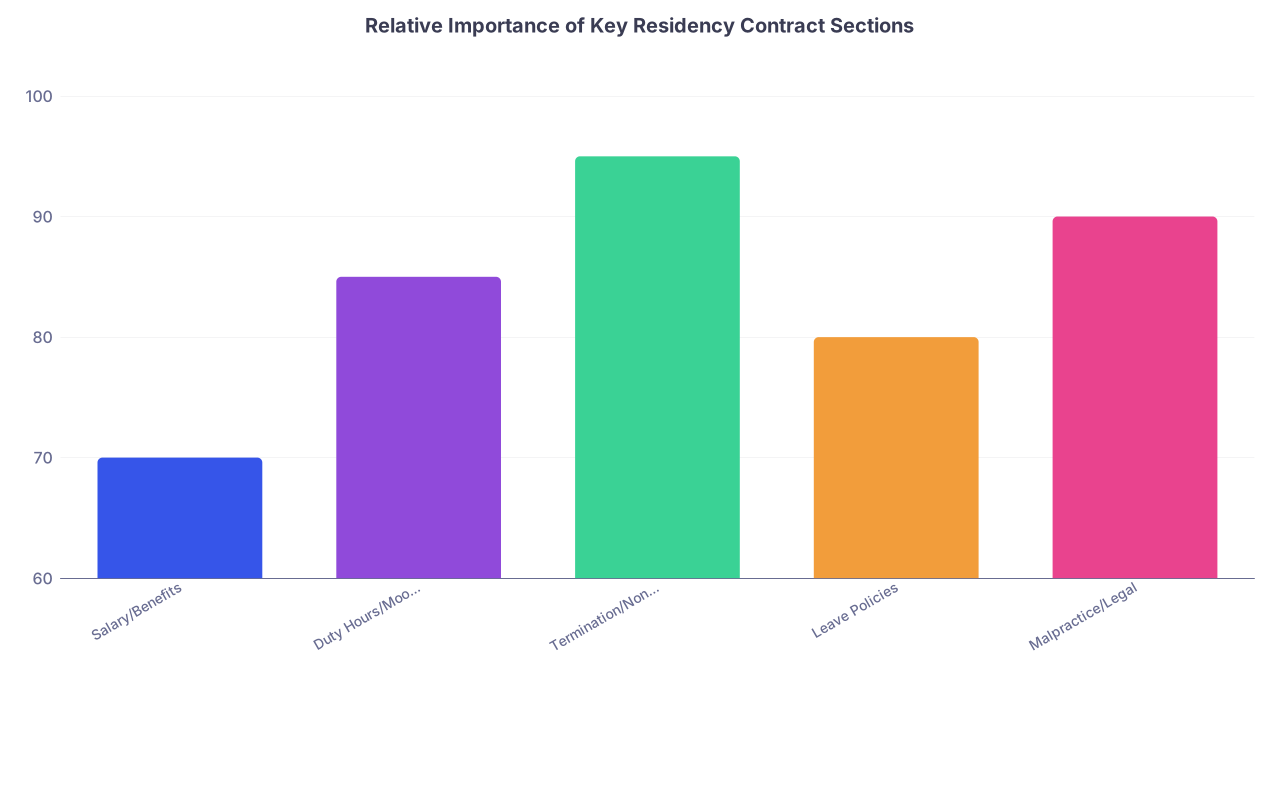
| Category | Value |
|---|---|
| Salary/Benefits | 70 |
| Duty Hours/Moonlighting | 85 |
| Termination/Non-Renewal | 95 |
| Leave Policies | 80 |
| Malpractice/Legal | 90 |
Confirm:
- Correct PGY level
- Correct specialty
- Correct dates
Salary and benefits:
- Annual salary number
- Health coverage start date
- Vacation and sick days
- Parental leave availability and whether paid
Work and moonlighting:
- Duty hour clause
- Moonlighting permission and coverage
Legal and safety:
- Malpractice and tail coverage
- Any non-compete or restrictive covenants
- Termination and non-renewal processes
- Grievance/due-process pathway
“By reference” materials:
- Get the house staff manual / GME handbook.
- Skim remediation and leave policies.
If you cannot find an answer in the contract or attached documents, you ask. In writing. Politely. But clearly.

| Step | Description |
|---|---|
| Step 1 | Receive Contract |
| Step 2 | Check Position and Dates |
| Step 3 | Review Salary and Benefits |
| Step 4 | Review Duty Hours and Moonlighting |
| Step 5 | Review Termination and Nonrenewal |
| Step 6 | Scan for Noncompete Language |
| Step 7 | Obtain GME Handbook |
| Step 8 | Sign and Keep Copy |
| Step 9 | Ask GME or Legal for Clarification |
| Step 10 | Consider Further Advice or Alternatives |
| Step 11 | Questions or Red Flags |
| Step 12 | Satisfied? |
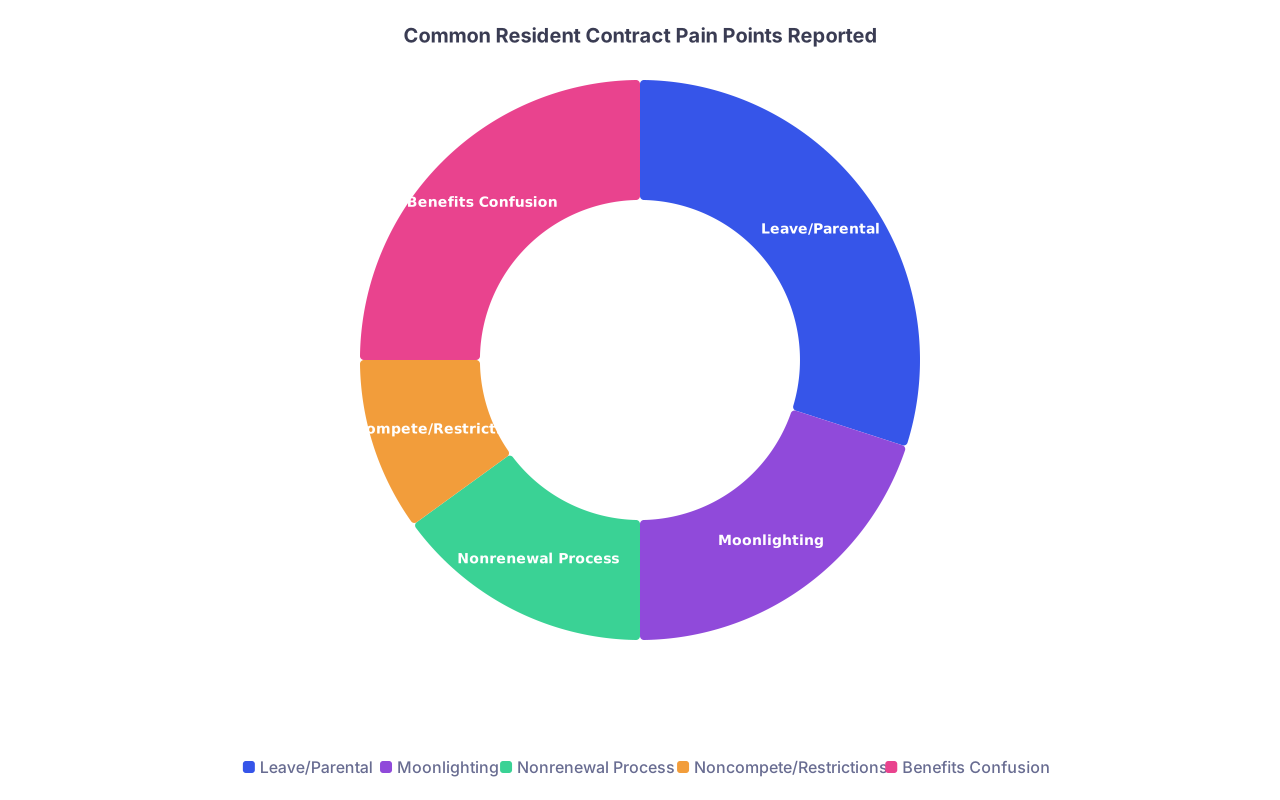
| Category | Value |
|---|---|
| Leave/Parental | 30 |
| Moonlighting | 20 |
| Nonrenewal Process | 15 |
| Noncompete/Restrictions | 10 |
| Benefits Confusion | 25 |


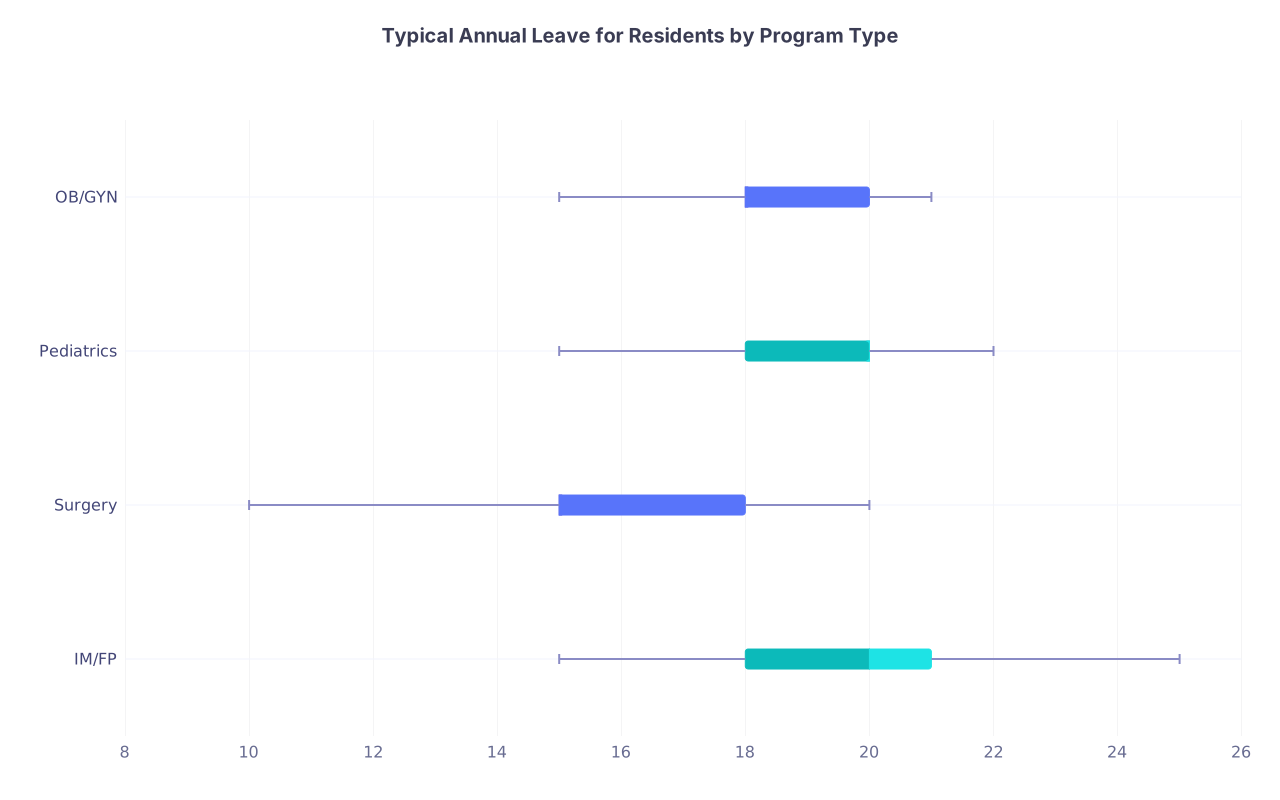
| Category | Min | Q1 | Median | Q3 | Max |
|---|---|---|---|---|---|
| IM/FP | 15 | 18 | 20 | 21 | 25 |
| Surgery | 10 | 15 | 15 | 18 | 20 |
| Pediatrics | 15 | 18 | 20 | 20 | 22 |
| OB/GYN | 15 | 18 | 18 | 20 | 21 |
FAQs
1. Should I have a lawyer review my residency contract?
For most standard residency contracts at large academic centers, you do not need a lawyer to tell you the salary is non-negotiable and the leave policy is boilerplate. However, if:
- There is any non-compete or restrictive covenant language.
- Your situation is unusual (visa issues, prior dismissal from a program, disability accommodations).
- You are entering a nonstandard training pathway or combined program with unusual obligations.
Then yes, a brief review by a healthcare employment attorney in your state is sensible. The goal is not to “negotiate like a CEO,” but to understand risk and catch landmines.
2. What if the contract conflicts with what the program told me on interview day?
This happens more than anyone admits. Verbal statements like “we never work more than 60 hours” are worthless if the contract just references ACGME max hours. If the conflict is material:
- Politely email the program coordinator or PD, referencing the discrepancy.
- Ask for clarification of the current actual practice and whether there is a plan to change.
- If something major (like call frequency, parental leave, or required off-site rotations) differs from what was represented, decide whether that is a dealbreaker.
If they refuse to clarify or brush you off, treat that as an early data point about the culture.
3. Can I refuse to sign or ask for changes without losing my spot?
You technically can refuse to sign anything. The hospital can also interpret that as you declining the position. For minor clarifications (“does moonlighting include internal shifts at the VA?”), programs are usually happy to answer and sometimes even add a brief explanatory letter.
For structural items (salary, benefits, leave policy), a single resident will not drive change. If you have a resident union, some contract details are already set in a collective bargaining agreement, and the GME contract must be consistent with that. In that scenario, your leverage is through the union, not direct one-off negotiation.
4. How long should I keep my residency contracts and related documents?
Indefinitely. Keep:
- Each year’s signed contract.
- Final GME verification letters.
- Any written remediation or probation documents.
- Letters related to leaves of absence or extensions.
Store scanned copies in a secure cloud folder. When you apply for hospital privileges or state licenses years later, they will occasionally ask for training verification details or dates that are easiest to answer if you still have your original paperwork.
Key points, distilled:
- Your residency contract is a real employment contract, not a ceremonial welcome letter. Treat it like one.
- Read every clause on salary, leave, termination, malpractice, and any hint of restrictions on your future practice.
- Anything referenced in the contract (GME handbook, policies) matters just as much as the contract itself. Get those documents and actually look at them before you sign.