
Most residents understand their duty hours better than their paychecks. That is a problem.
Let me break this down specifically: Graduate Medical Education (GME) payroll is not a simple “salary” the way a typical job works. It is a hybrid of institutional budgeting, federal funding rules, opaque HR systems, and historical inertia. If you are matching into residency and you do not understand how resident compensation actually works, you are walking into the single largest financial relationship of your 20s essentially blind.
We are going to fix that.
1. Who Actually Pays Residents (And Why That Matters)
Residents are not paid by “the Match,” not by the AAMC, and not directly by the federal government. You are an employee of the institution that sponsors your residency program.
That usually means one of these:
- Academic medical center (university hospital)
- Large health system / teaching community hospital
- VA medical center (for some or all rotations)
- Safety‑net or county hospital tied to a university program
On paper, it is straightforward: hospital hires you, HR puts you on payroll, you get a paycheck. Underneath that, though, there are three major funding streams that drive everything about your compensation:
- Direct GME (DGME) payments from Medicare
- Indirect Medical Education (IME) adjustments from Medicare
- Hospital/system dollars and supplemental sources (state, VA, private)
The Medicare piece: DGME and IME in real life
Medicare’s GME payments are the quiet engine behind your paycheck.
DGME (Direct GME) is meant to cover:
- Resident salaries and fringe benefits
- Teaching physician costs related to GME
- GME administrative costs (DIO, coordinators, etc.)
IME (Indirect Medical Education) is an add‑on to hospital DRG payments to account for higher costs of teaching hospitals (sicker patients, inefficiencies of training, etc.). IME is not earmarked for your salary specifically, but it absolutely affects how much money the hospital has tied to GME.
Key point: Medicare does not say “Pay each PGY‑1 $X.”
Medicare says, “Here is a pot of money to support training.” Then the institution decides how to slice that pie among residents, faculty, and overhead.
This is why:
- The same specialty at different hospitals in the same city can have very different salaries.
- Prestigious ≠ higher pay. I have seen residents at elite university programs making less than residents at scrappy community programs 10 miles away.
The resident cap and why older programs often pay better
Medicare caps the number of funded residency positions per hospital, based largely on 1990s numbers. Positions beyond that cap receive little or no DGME funding. Hospitals either:
- Eat the cost from their own operating budget, or
- Find alternative funding (state, VA, health system)
Older, established programs often:
- Have long‑standing DGME baselines
- Have grown within their caps historically
- Built resident salary norms years ago and only adjust incrementally
Newer or expanding programs may:
- Have more “over‑cap” positions funded directly by the hospital
- Be tighter on salary growth or benefits
- Tie more pay decisions to hospital financial performance
So your paycheck is partly a reflection of Medicare policy from before you were born. Glamorous, I know.
2. How Resident Salaries Are Set: PGY Levels and Pay Scales
Let’s talk numbers and structure.
Residency compensation is typically built around:
- A fixed salary by PGY level
- Annual contract periods (usually July 1 – June 30)
- Standard increases each year of training
| PGY Level | Typical Range (USD/year) |
|---|---|
| PGY‑1 | $58,000 – $72,000 |
| PGY‑2 | $60,000 – $75,000 |
| PGY‑3 | $62,000 – $78,000 |
| PGY‑4 | $65,000 – $82,000 |
| PGY‑5+ | $68,000 – $88,000 |
These are realistic but generalized ranges as of mid‑2020s for U.S. programs.
Key structure points:
Pay is tied to PGY level, not specialty.
- A PGY‑2 in psychiatry and a PGY‑2 in general surgery at the same hospital usually earn the same base salary.
- Fellowship years (PGY‑4+ or PGY‑5+) move up the same step ladder.
Stepwise increase each year
Typical year‑to‑year raises are:- $1,500–$3,000 per year
- Sometimes expressed as a percent (2–5%)
Loan payments, moonlighting, bonuses are separate
Base salary is what HR uses for payroll and benefits calculations. Everything else stacks on top (or not at all).
Why one city pays more than another
Two main drivers:
- Cost of living
- Local competition / unionization
New York, Boston, San Francisco, LA often have higher nominal salaries. But once you include housing, residents there are often not “better off” than someone making $62,000 in a Midwestern city with cheap rent.
Some regions have active resident unions (CIR/SEIU, or independent house staff associations). Less guesswork there: contracts are negotiated, with published salary scales and step increases.
3. Payroll Mechanics: How Your Money Actually Shows Up
The Match letter does not pay your rent. Payroll does. And payroll does not care that you were on nights.
Typical structure:
- Pay frequency: Biweekly or monthly
- Status: Full‑time exempt employee (not hourly, not overtime‑eligible in most states)
- Pay basis: Annual salary divided by pay periods
Example:
PGY‑1 salary: $65,000/year
Paid biweekly (26 checks) → Gross per check: $2,500
You never actually see $2,500. Let’s walk through a simplified breakdown for a biweekly check in a typical U.S. resident:
- Gross pay: $2,500
- Federal income tax withholding
- State income tax withholding (if applicable)
- Social Security (6.2% up to the wage base)
- Medicare tax (1.45%, plus additional for high earners – not an issue in residency)
- Employee health insurance premiums
- Retirement contributions (if you opt in)
- Union dues (if applicable)
Net pay? Often in the ballpark of 60–70% of gross. Sometimes less.
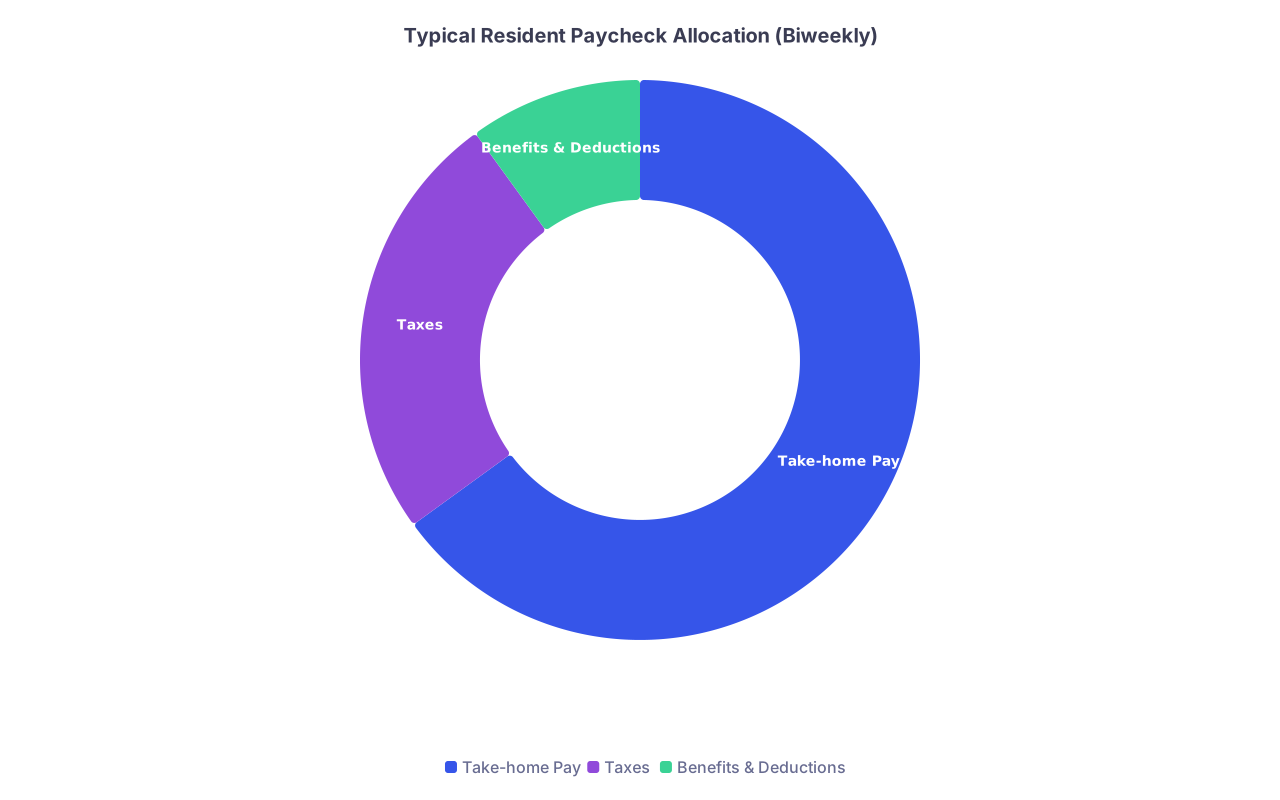
| Category | Value |
|---|---|
| Take-home Pay | 65 |
| Taxes | 25 |
| Benefits & Deductions | 10 |
Start date, first paycheck, and cash‑flow shock
Most programs start July 1. Payroll cycles do not care that you are a new grad who just moved.
Common patterns:
- If payday is July 5 and the pay period covers June 16–30, you will not be paid (you were not employed).
- First real paycheck may be mid‑ or late‑July, covering your first period actually worked.
Translation: You might work 2–4 weeks before seeing your first check. I have watched new PGY‑1s realize this on orientation day and feel their stomach drop.
Ask these questions before you move:
- What is the pay frequency?
- When is the first paycheck?
- What dates does that check cover?
- Do they offer a relocation advance or interest‑free bridge loan?
Many do not. Plan like they will not.
4. Benefits, Deductions, and “Hidden” Compensation
Your apparent salary is only part of the picture. Hospitals love to talk about “total compensation.” Some of that is fluff. Some is real.
Core benefits you should actually care about
-
- Premiums (how much comes out of your paycheck vs how much the hospital pays)
- Deductibles and out‑of‑pocket max
- Spouse/partner and dependents coverage cost
Residents with families feel this acutely.
Disability insurance
- Short‑term: covers you for temporary disability
- Long‑term: crucial hedge against career‑ending injury/illness
Rarely optimized. Often a weak group policy. Many residents later purchase individual policies.
Life insurance
- Basic group coverage (often 1x salary)
Not life‑changing, but real.
- Basic group coverage (often 1x salary)
Retirement plan
- 403(b) or 401(k)
- Some programs: no match for residents
- A few: small percentage match or defined contribution
-
- Usually claims‑made with tail coverage included while you are in training
- You rarely see the premium, but it is a big part of GME cost.
“Education” benefits that quietly affect your real earnings
Resident education benefits vary wildly. Some are generous. Some are borderline insulting.
Common items:
Educational stipend ($500–$2,000/year)
Can apply to:- Textbooks and board review resources
- Exam fees (USMLE Step 3, specialty boards)
- Conferences and travel (if presenting)
Conference funding
- Fixed pool per resident vs discretionary by program director
- Policy about national vs regional meetings
Technology
- Provided iPad or laptop
- OR nothing, with expectation you bring your own.
These do not hit payroll directly but reduce how much of your taxed salary you must spend on career‑necessary expenses.

5. Call Pay, Moonlighting, and Other Add‑Ons
Here is where residents usually get confused or misled. Your base salary is only the starting point. The extras depend heavily on hospital culture, state law, accreditation rules, and your own PGY level.
In‑house call vs home call: rarely extra pay
For most programs:
- In‑house overnight call is included in your salary.
- Night float weeks are included in your salary.
- Home call is also included, though reimbursements for driving back in may exist.
A few institutions will:
- Pay an additional “call stipend” per month
- Or provide meal stipends / parking reimbursement as pseudo‑compensation
But if you are imagining overtime pay for your 80‑hour week? Forget it. Residents are usually exempt salaried employees, not paid hourly.
Moonlighting: when you actually get paid more per hour
Moonlighting is where the numbers change dramatically. Typical scenarios:
- PGY‑2+ or PGY‑3+ residents approved to work extra shifts
- Shifts as a hospitalist extender, urgent care, or ED coverage
- Rates often $60–$120/hour (sometimes lower, rarely higher during training)
Two critical distinctions:
Internal moonlighting
- Work within your own hospital system
- May or may not count toward duty hours
- Paid through hospital payroll (shows up on your W‑2 from the same employer)
- Sometimes taxed at a higher effective withholding rate if HR runs it as a separate earning code
External moonlighting
- Work for outside clinics or hospitals
- Separate employer or as an independent contractor (1099)
- You are responsible for self‑employment tax if paid as 1099
- Stronger risk profile, more paperwork, often higher hourly rate
Most programs:
- Require program director written permission
- Restrict moonlighting in PGY‑1 entirely
- Tie moonlighting eligibility to being in good standing and under work hour limits
Be honest: moonlighting does help cash flow and debt management. It also burns people out when layered on a heavy base schedule. I have watched excellent residents sabotage their board prep and sleep in exchange for a slightly nicer apartment.
6. Why Pay Varied So Much Between Programs (And What You Can Do About It)
The resident salary “market” is not a real market. You cannot spontaneously negotiate your PGY‑1 salary at a big academic center. It is fixed by policy.
But there are levers upstream and choices you control.
The real drivers of pay differences
Regional cost of living
- Big coastal cities pay more nominal dollars but often less real disposable income
- Some Midwestern or Southern cities have surprisingly competitive salaries
Unionization and house staff associations
- Union programs usually have:
- Published salary scales
- Clear raise structures
- Overtime / extra duty safeguards
- Better parental leave and wellness benefits
- Union programs usually have:
System financial health
- Profit‑positive health systems may be more generous with across‑the‑board adjustments
- Safety‑net hospitals sometimes lag on pay but may offer loan repayment or state‑based perks
Specialty length, not specialty prestige
- Pay is not higher because you are in neurosurgery or cardiology
- Pay is higher because you are PGY‑5, PGY‑6, PGY‑7
A neurosurgery PGY‑1 and a pediatrics PGY‑1 in the same institution earn essentially the same.
What you can actually evaluate pre‑Match
During interview season, you are not powerless. You just have to ask the right questions.
You should compare:
| Category | What to Ask For |
|---|---|
| Salary | PGY‑specific salary table |
| Deductions | Health premiums, parking, union dues |
| Education support | Annual stipend, exam fee coverage |
| Leave | Vacation, sick, parental leave policy |
| Moonlighting | Policy, approval process, typical rates |
If a program cannot or will not give you a clear salary and benefits sheet, that tells you something about how they view residents.

| Step | Description |
|---|---|
| Step 1 | Identify Programs |
| Step 2 | Request Salary Scale |
| Step 3 | Review Benefits |
| Step 4 | Flag as Risk |
| Step 5 | Compare Cost of Living |
| Step 6 | Ask About Moonlighting |
| Step 7 | Assess Total Package |
| Step 8 | Transparent? |
7. How Payroll Interacts With Loans, Taxes, and Real Life
Once GME payroll hits your bank account, you are juggling three big systems: taxes, student loans, and actual cost of living.
Student loans: income‑driven repayment with resident income
Most residents are on some income‑driven repayment plan:
- SAVE (successor to REPAYE)
- PAYE or IBR (legacy for some cohorts)
Your AGI (adjusted gross income) drives the monthly payment. Lower PGY pay → lower payments. That sounds good, but:
- Some residents choose to file “married filing separately” to keep payments down if their spouse earns more.
- Pre‑tax deductions (retirement, HSA, FSA) can slightly lower AGI, nudging loan payments down.
Your hospital payroll:
- Determines your W‑2
- That drives your tax return
- Which drives next year’s loan payments
You cannot negotiate the salary, but you can be intentional about benefit elections and how they interact with your loan strategy.
Taxes: W‑2 employment, no 1099 tricks (usually)
Residents are W‑2 employees. That means:
- Taxes are withheld automatically
- You are not “self‑employed” for base salary
- You do not suddenly get massive deduction flexibility like a 1099 contractor
Deductible items:
- State‑specific rules for unreimbursed employee expenses have narrowed
- Board exams and licensing often not easily deductible under post‑2017 rules for many residents
Huge misconception: “I will deduct my scrubs, textbooks, and mileage.”
In practice, after the 2017 Tax Cuts and Jobs Act, most residents take the standard deduction and do not see major benefit from itemizing small professional expenses.
Moonlighting as 1099 is different. Then:
- You pay both employer and employee side of FICA on that income (self‑employment tax)
- You can deduct work‑related expenses against that moonlighting income
- You must make quarterly estimated tax payments in many cases
Most residents do not have the time or appetite to manage complex tax strategy. Just understand how your status interacts with your paycheck.

8. Common Pitfalls and Red Flags I Have Seen
You do not need a horror story, but you do need pattern recognition. I will give you both in brief.
Payroll pitfalls
Delayed first paycheck
- Residents who moved cross‑country, signed a lease, bought furniture, then realized pay starts weeks later.
Always verify first check date in writing from HR.
- Residents who moved cross‑country, signed a lease, bought furniture, then realized pay starts weeks later.
Misclassified benefits coverage
- Residents whose spouse/dependents were left off coverage due to incomplete forms
- Double‑check benefit elections during onboarding, not six months later
Under‑withholding on moonlighting
- Residents shocked by tax bills in April because moonlighting income had low or no withholding
Fix: Explicitly ask payroll about withholding setup on additional earnings codes.
- Residents shocked by tax bills in April because moonlighting income had low or no withholding
Over‑committing to pricey housing
- Using gross, not net, pay to set “affordable rent,” then feeling underwater by month two
Use your actual net estimate from a pay calculator.
- Using gross, not net, pay to set “affordable rent,” then feeling underwater by month two
Program red flags around compensation
- No clear GME policy document with salary and benefits
- “We are working on updating our salary scale” with no numbers
- Repeated complaints from current residents about delayed reimbursements for conference / exams
- Vague answers about moonlighting like “people figure it out later”
Your future program will show you who they are in how they handle money and time. Believe them.
9. Practical Strategy: How To Approach GME Payroll As An Incoming Resident
Let me be blunt: you are not going to “hack” GME payroll. But you can:
- Choose programs with transparent, reasonable compensation packages.
- Understand the timing so you have adequate cash buffer.
- Use the parts you control (housing, moonlighting, benefits elections) intelligently.
Concrete steps:
During interview season, collect salary/benefit PDFs and keep them in one folder.
For top programs on your rank list, run a quick “resident budget”:
- Net monthly income estimate
- Expected rent range
- Loan payment ballpark
- Transportation and basic living costs
Before moving, save:
- 1–2 months of living expenses if possible
- Enough to cover moving and deposits without credit card panic
At orientation:
- Confirm your HR classification, pay frequency, and first paycheck date
- Verify your benefits enrollments
- Ask the chief residents how conference money and stipends actually work in practice (not just on paper)
Residents who enter with their eyes open make cleaner decisions and feel less trapped.
Quick Reality Check
Is resident compensation “fair” relative to workload and training? No. Not by any sane per‑hour metric.
But you do have agency in:
- Which program context you enter
- How you structure your financial life during those years
- How well you understand the system that writes your checks
You cannot fix Medicare policy from your call room. You can absolutely stop being confused by your own paystub.
FAQs
1. Can I negotiate my resident salary when I match?
No. Resident salaries are set at the institutional level, usually published as a PGY salary scale. Individual residents do not negotiate base pay like an attending offer. Trying to “negotiate” your PGY‑1 salary will just mark you as someone who does not understand how GME is structured.
You can, however, clarify:
- Step increases by year
- Whether prior training or research years count toward PGY level
- Stipends or additional compensation for chief resident roles
2. Do residents get paid extra for working more than 80 hours per week?
Almost never. Residents are salaried exempt employees in most states. The 80‑hour duty limit is an ACGME educational and safety standard, not an overtime threshold. If your program consistently has you over 80 hours, that is a work‑hour violation issue, not a payroll one. The “penalty” is for the program’s accreditation status, not in the form of overtime pay to you.
3. Does my fellowship pay come from the same GME funding as residency?
Often, yes. Many fellowships are also funded through GME mechanisms, though the DGME/IME details can differ by specialty and program. From your perspective, the pattern is similar: PGY‑4, PGY‑5, etc., with salaries rising one step per training year. Some non‑ACGME fellowships (like certain research or hospitalist fellowships) may be funded directly by departments and can have more variable pay, occasionally higher than standard PGY rates.
4. What happens to my pay if I change specialties or repeat a year?
Your pay usually follows your PGY level, not the specialty name. If you:
- Switch from surgery PGY‑2 to internal medicine PGY‑1 at the same or a new institution, many programs will pay you as a PGY‑2 because you have one prior year of accredited GME.
- Repeat a year in the same specialty due to performance or leave, you often remain at the same PGY pay level while repeating the training year.
There are exceptions. Some programs or funding constraints may force you into a lower PGY pay level when changing tracks, but that is less common and should be spelled out in writing.
5. Are sign‑on bonuses or loan repayment common for residents?
True sign‑on bonuses are rare for standard residency positions. A few situations where extra money appears:
- Hard‑to‑fill programs or locations may offer modest signing incentives.
- Some state or federal programs provide loan repayment tied to working in underserved areas, but these are usually post‑residency commitments.
- A very small number of institutions offer limited loan repayment assistance during residency, usually as part of a broader retention strategy.
For the typical categorical resident, do not expect a sign‑on bonus. Focus instead on understanding base salary, benefits, and any realistic moonlighting options.
Key takeaways:
- Your resident paycheck is the product of your institution’s GME funding, policies, and payroll structure, not individual negotiation.
- Base salary, benefits, education support, and any moonlighting together form your true compensation package; you need to understand each piece.
- Planning around timing (first paycheck, deductions) and realistic net income will save you a lot more stress than chasing mythical “resident perks” that usually do not exist.