

Commuter Med Student: Making Long Travel Time Study-Efficient
It’s 6:05 a.m. You’re on a half-empty train or inching through traffic on the highway, badge clipped to your bag, coffee already lukewarm. Campus is 45–60 minutes away on a good day. You’re doing the math: that’s 1.5–3 hours of your life every single day in transit while everyone else “just walks to the library.”
You’re wondering: am I just burning this time? Or can I turn this commute into something that actually moves the needle for exams and Step?
You can. But you have to be ruthless and intentional about it. Commuting through med school is survivable. Done right, it can actually be an advantage on certain fronts.
This is the playbook.
Step 1: Decide What Your Commute Is For (And What It’s Not)
First thing: you cannot treat commute time like regular library time. That’s where commuters screw this up.
You’re not going to:
- Watch dense pathology lectures on your phone in stop-and-go traffic
- Do long question blocks on a shaky bus
- “Read” First Aid cover to cover on the train while half-asleep
Your commute is specialized time. It should serve a small number of repeatable purposes.
Here’s the frame I recommend:
- Morning commute: input and activation (light new content + recall)
- Evening commute: review and decompression (consolidation + stress downshift)
You pick 1–2 allowed activities for each direction. And you stick to them unless there’s an emergency (exam tomorrow, you’re behind, etc.).
Example setup:
Morning (to school):
- 20–40 minutes: Anki reviews / short recall-based stuff
- Remaining time: audio content (lectures, review podcasts, recorded notes)
Evening (back home):
- First half: Anki “light” or reviewing missed questions from earlier
- Second half: mental unload (music, non-medical podcast, silence)
If you don’t assign roles like this, the commute becomes a vague “I’ll study if I feel like it” window—and you’ll just scroll your phone.
Step 2: Match Your Commute Type to the Right Study Tasks
Your vehicle situation matters. Be honest about what you can actually do safely and repeatedly.
| Commute Type | Best Tasks |
|---|---|
| Driving | Audio review, active recall out loud, mental cases |
| Train/Bus | Anki, light questions, PDFs, audio with notes |
| Walking/Biking | Audio only, mental recall, mnemonics |
If you’re driving
You’re not looking at your phone. Period. “I’ll just quickly flip through Anki at the red lights” is how people rear-end each other.
Use:
Audio review:
- Boards & Beyond audio-style content (rip from video if allowed / or similar)
- Lectures exported to audio only
- Question bank explanations read to you (you can copy them to a note app and use text-to-speech)
Active recall out loud:
Pick 3–5 topics before you start the car. On the drive, quiz yourself:- “List the causes of nephritic syndrome.”
- “Walk through the coagulation cascade.”
- “What are the side effects of amiodarone?”
You’ll look like you’re talking to yourself in the car. That’s fine. You’re in med school—people already think you’re odd.
If you’re on train/bus/metro
This is commuter gold. You can use screens, type, read.
Your best tools:
- Anki (with mobile app, synced carefully)
- PDFs / slides in a good reader (GoodReader, Notability, OneNote, etc.)
- Question bank app (short, timed or untimed questions)
- Audio + light note viewing
For trains and buses, you want “modular” tasks:
- 5–10 minute chunks of Anki
- Small sets of 5–10 UWorld-style questions
- One page or one section of lecture notes
Don’t plan “I’ll do a 40-question block and review all of it” on a 30-minute bumpy ride. It’ll get interrupted, you’ll get annoyed, and you’ll abandon the plan.
If you’re walking or biking
This is audio-only territory; safety first.
Good commute tasks here:
- Audio lectures
- Step/subject review podcasts
- Your own recorded notes or checklists
- Simple recall: walking and listing causes, pathways, treatments
Do not try to read slides while crossing streets. I’ve seen someone almost step into traffic doing this.
Step 3: Build a Commute-Specific Study System
You want your commute to run on rails—no decisions, minimal friction.
1. Create “Commute Decks” or Tags in Anki
On mobile, you don’t want all your cards. You want the right cards.
Set up:
- A tag or filtered deck for:
- “Commute – Easy/Medium review” for mornings
- “Commute – Light review” for tired evenings
Use your main deck on your laptop for heavy-duty learning. Use filtered decks on your phone for quick reviews and retention.
Example:
- Morning filtered deck: new-ish cards and recently learned topics
- Evening filtered deck: older cards due for long-term retention
2. Pre-load your content the night before
If your commute depends on internet, you’re going to waste time fighting Wi-Fi, logins, and loading.
Before bed or when wrapping up studying:
- Sync Anki
- Download key PDFs to your tablet/phone
- Open your question bank app and preselect a short block
- Queue the next podcast episode / audio file
Morning brain is dumb and rushed. Make the choices the night before.
3. Use “offline-friendly” tools
You need apps and systems that don’t fall apart without Wi-Fi:
- Anki with fully synced decks
- Offline PDFs in a reader app
- Downloaded podcasts or audio
- Offline versions of flashcards (e.g., Osmosis, Anki, Quizlet)
Don’t rely on streaming 100% unless your connection is rock-solid.
Step 4: What Exactly To Do in Different Phases (Preclinical vs Clinical vs Step)
Your commute use should shift across med school. Preclinical vs clerkships vs Step is not the same game.
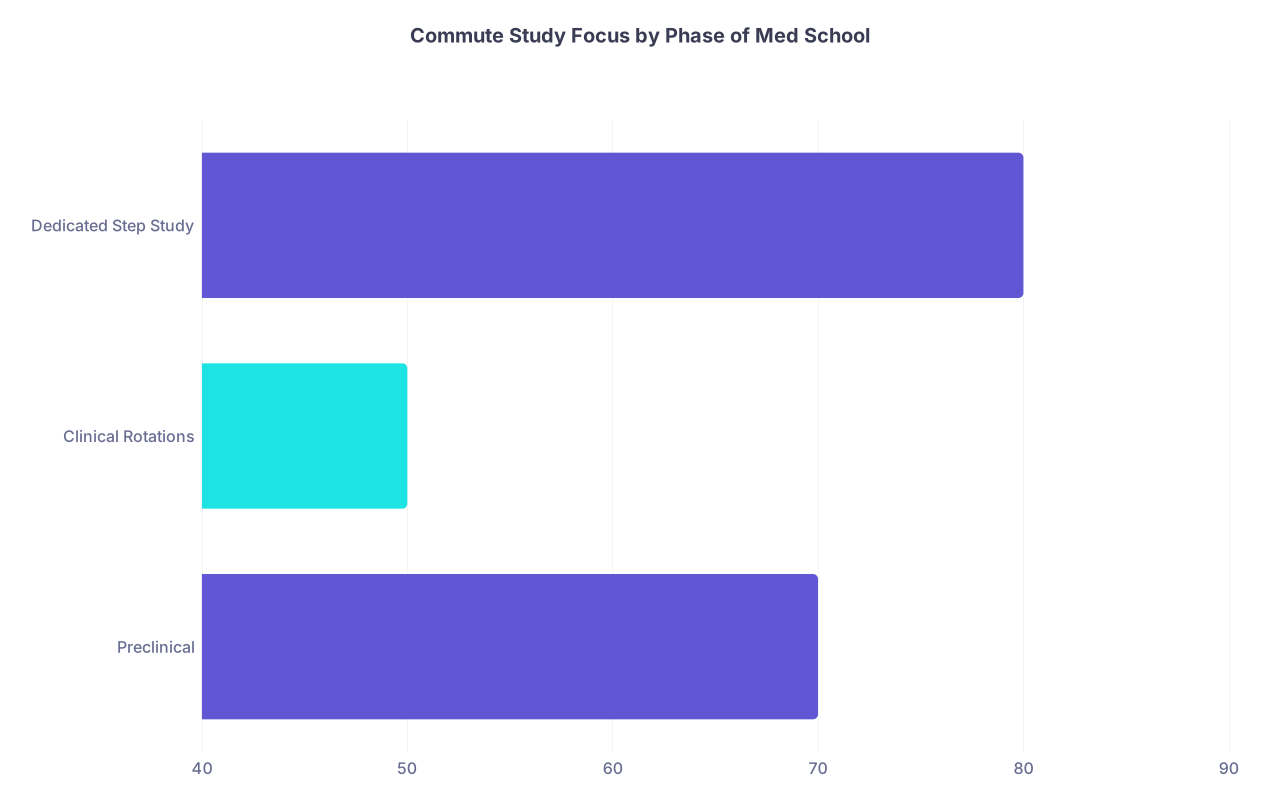
| Category | Value |
|---|---|
| Preclinical | 70 |
| Clinical Rotations | 50 |
| Dedicated Step Study | 80 |
Preclinical years (MS1–MS2)
You have heavy content volume and lots of new material.
Use commute for:
Morning:
- Anki reviews of yesterday’s content
- Quick pass of key lecture slides for today (high-yield figures, bolded lists)
- Short concept audio (physiology, biochem explanations)
Evening:
- Close the loop on Anki due cards
- Review a few missed question explanations (read your notes, not full vignettes)
- Light recap audio of big topics (renal, cardio, neuro)
Avoid:
- Starting brand-new, high-density material from scratch on the commute
- Trying to “cram” entire lectures just on the train
Commute = reinforcement and preview, not your primary learning block.
Clinical years (MS3–MS4)
Now you’re exhausted, and your time is more fragmented. Commute becomes:
- Shelf exam booster
- Case recall time
- Guideline / management refresh
Morning:
- Run through:
- Common presentations for that rotation
- Top differentials for “chest pain / abdominal pain / shortness of breath”
- Dosing and first-line vs second-line treatments
Evening:
Quick review of what you saw today:
- “What was that weird rash? Let me Anki that.”
- “We saw DKA—let me solidify management steps in flashcards.”
Short shelf-focused questions if you have mental energy
Or just audio shelf review if you’re fried
Dedicated Step study
This is where commute time can give you a legitimate edge.
Your main daytime blocks are for:
- Full question sets
- Heavy review
- Integration
Your commute should be:
Morning:
- Anki reviews only (keeping the spaced repetition machine running)
- Audio breakdowns of weak subjects (e.g., micro, pharm)
Evening:
- Review of the day’s most-missed concepts via flashcards
- Passive audio or very light review if brain is mush
Do not try to stuff full-length timed blocks into your commute. Terrible ROI.
Step 5: Protect Your Brain: Avoid Commute Burnout
Here’s the trap: commuters feel guilty for “wasting” time, so they try to max-study every second of the commute. Then they melt down three weeks later.
Your commute has to respect your brain’s limits.
Build in “off” days
Hard rule I like:
- 1–2 commutes per week are study-light or study-free
Maybe that’s Friday afternoon and one random midweek morning where you:
- Listen to music
- Call a friend
- Sit in silence and let your brain reset
That’s not laziness. That’s maintenance.
Use “half-and-half” sessions
Even on study days, you don’t have to go all-in.
Example for a 60-minute commute:
- 30 minutes: Anki / focused review
- 30 minutes: decompression (podcast, music, silence)
You’re still getting a solid extra 5 hours of studying per week from commuting without frying yourself.
Step 6: Make Your Setup Physically Easy and Fast
If it takes you five minutes to pull out your tablet, find your headphones, login, and load a PDF, you’ve just lost half your usable time.
Pack a “commuter study kit”
In your bag:
- Phone with:
- Anki synced
- Offline PDFs or note viewer
- Downloaded audio
- Wired or wireless headphones (and a backup cheap pair)
- Small power bank + short cable
- If you use it: small tablet instead of a full laptop (lighter, faster, easier to open on a bus/train)
Pre-open what you’ll use
Before you leave home or the hospital:
- Open Anki and sync
- Open your PDF to the correct page
- Queue your question bank block
- Have the audio file paused at 0:00
You want to sit down, hit play or start, and be rolling in 5 seconds.
Step 7: Deal With the Mental Side: FOMO, Guilt, and “Everyone Else Has More Time”
You’re going to hear classmates say stuff like:
“I’m so glad I live 5 minutes from campus; I can stay late whenever I want.”
“I just go home between classes and nap.”
And you’re thinking: yeah, must be nice.
You can’t change your commute right now. But you can change what you benchmark against.
Here’s the truth: tons of people with zero commute still waste 1–3 hours a day on random nonsense (YouTube, doomscrolling, pretending to study on their laptop while chatting). Your commute just forces you to put that time into a box.
If you use your commute in a focused, sustainable way:
- You will retain content better through repetition
- You’ll be forced into predictable routines (which is actually an advantage)
- You may have clearer boundaries—home is more “off,” commute/homework blocks are more “on”
The key is to stop fantasizing about the schedule you don’t have and optimize the one you do.
Step 8: Sample Weekly Commute Plan (So You’re Not Guessing)
Let’s make this real. Assume:
- 45–60 minutes each way
- Train commute
- MS2, systems-based curriculum, plus Step 1 in 6 months

| Step | Description |
|---|---|
| Step 1 | Morning Commute |
| Step 2 | Anki Review |
| Step 3 | Audio Review |
| Step 4 | Evening Commute |
| Step 5 | Light Anki |
| Step 6 | Decompression |
Monday–Thursday
Morning (45–60 minutes):
- 30–40 minutes Anki filtered deck: cards tagged “yesterday’s lectures”
- Remaining time: audio review of the system you’re in (e.g., renal physiology podcast)
Evening (45–60 minutes):
- 20–30 minutes: Anki “old” cards (mature cards for long-term retention)
- 10–15 minutes: review screenshots or notes of 2–3 missed Qbank questions from daytime
- Remaining: non-medical podcast / music
Friday
Morning:
- Light Anki for 20–30 minutes
- Rest of commute: music, mentally planning your weekend studying
Evening:
- No studying. Full decompression. You’ll study later at home if needed, but mark at least this commute as “off.”
Weekend (if you still commute to the library/hospital)
Use commutes for:
- Preview of the day’s plan in your head
- Audio review on weak topics
- Or nothing. Weekend brain often needs a reset.
Step 9: Common Mistakes Commuter Med Students Make
Let me save you from a few I’ve watched play out:
Trying to do everything on the commute
They try to watch lectures, do full Qbank blocks, write notes, all while exhausted. They burn out, then do nothing for two weeks.Not separating morning vs evening tasks
They do heavy stuff at night when their brain is dead, then wonder why nothing sticks.Commuting + excessive on-campus downtime
They stay on campus for every tiny gap “so they don’t waste time driving,” then end up too tired to use their commute productively. You’re a commuter—sometimes going home earlier is smarter.Zero offline prep
Every day is a fight with Wi-Fi, logins, and missing downloads. Eventually they give up and just scroll social media.Never building in rest commutes
They treat themselves like robots, then crash just before exams.


