
The way most clerks “learn EKGs” is broken. You do a random YouTube binge the night before internal, memorize a few buzzwords, then stare at a telemetry strip on rounds pretending it makes sense.
Let me give you something that actually works: a 10‑minute‑a‑day micro‑curriculum built for real clerk life, not fantasy study schedules.
The Core Premise: Tiny, Relentless Daily Reps
You do not need a weekend retreat or a 400‑page EKG book right now. You need:
- A fixed, repeatable 10‑minute daily block
- A narrow, pre‑defined skill for that day
- Immediate application to real strips when you are on the wards
EKG interpretation is pattern recognition on top of a small amount of structure. The mistake most students make: they chase exotic arrhythmias before they can reliably tell rate, rhythm, axis, intervals, and ST‑T changes in a systematic way.
So the micro‑curriculum is built around three pillars:
- One rigid, universal approach you use for every single tracing
- A rotating set of focused 10‑minute tasks (not “study everything”)
- Constant exposure to real clinical strips, even if you do not yet “fully understand” them
If you stick to this for 4–6 weeks, you will be miles ahead of your average clerk, and honestly ahead of a chunk of interns.
Your Universal 7‑Step EKG Approach
You must stop “vibing” your way through EKGs. One checklist. Every time. No exceptions.
Here is the framework I push on students:
- Confirm basics: patient, date, calibration (25 mm/s, 10 mm/mV), limb lead placement
- Rate
- Rhythm + P‑QRS relationship
- Axis
- Intervals (PR, QRS, QTc)
- Morphology: QRS, ST segments, T waves
- Synthesis: “This is most consistent with…”
You can compress that mentally into:
“Basics – Rate – Rhythm – Axis – Intervals – ST/T – Summary.”
You will spend most of your 10‑minute blocks drilling pieces of this.
The Weekly Micro‑Curriculum Structure
Think in weeks, not days. One “theme” per week, with a specific micro‑focus each day. You can recycle the same 4‑week block throughout the year.
Week 1: Rate, Rhythm, and Basic Walkthrough
Goal: Build muscle memory for the 7‑step approach and stop guessing rate/rhythm.
Daily 10‑minute breakdown (example):
Day 1 – Pure rate:
10 strips. Only task: estimate rate quickly (6‑second method, big box method) and say it out loud. Do not care about anything else.Day 2 – Rhythm ID only:
8–10 strips. Label: sinus vs AF vs atrial flutter vs supraventricular “something” vs obvious VT. No fine distinctions, just big buckets.Day 3 – Full 7‑step structure on 2 strips:
Spend ~4–5 minutes per strip walking through all seven steps out loud. Do not rush. This is about sequence, not speed.Day 4 – Rhythm + P‑QRS relationships:
6–8 strips. Only look at lead II and V1. Ask: Are there P waves? Are they before each QRS? Consistent PR? More QRS than P or more P than QRS?Day 5 – Mixed drill:
5 strips. First pass: rate + rhythm only (fast). Second pass: full 7‑step on 2 of them.Day 6 – Tele/real EKG day:
On the wards, grab 2 actual tracings (or telemetry strips). Even if you only have 5 minutes, walk them with the 7‑step approach.Day 7 – Short consolidation:
One “challenge” strip that looks messy (wandering baseline, artifact). Only job: still force the same structure.
You can do this with any EKG workbook or online database. I have seen students do it with:
- Dr. Smith’s ECG Blog (clinical, high yield, sometimes advanced)
- Life in the Fast Lane (LITFL) ECG Library
- ECG Wave‑Maven (good for practice cases)
Pick one and stick with it.
Week 2: Axis and Intervals Without the Drama
Clerks catastrophize axis. Axis is not mysterious; it is a crude vector direction with 2–3 simple pattern rules that cover 95% of cases.
Axis: keep it stupid‑simple
Use this mental cheat:
- Look at I and aVF:
- I positive, aVF positive → normal
- I positive, aVF negative → left axis
- I negative, aVF positive → right axis
- Both negative → extreme axis (rare, usually very sick)
If you want one more refinement, use lead II to distinguish “borderline” left axis, but for clerk level boards and wards, the simple version is enough.
Intervals: know normal numbers cold
You must know these values without thinking:
- PR: 120–200 ms (3–5 small squares)
- QRS: < 120 ms (3 small squares)
- QTc: roughly < 440 ms men, < 460 ms women (and clearly prolonged > 500 ms)
Now the micro‑curriculum:
Daily 10‑minute breakdown (example):
Day 1 – Axis only:
15 strips. Check I and aVF only. Label: normal / left / right / extreme. Do not interpret anything else.Day 2 – Axis + clinical hint:
For each strip: axis + 1 likely clinical correlate.
Example: Right axis → think RV strain, PE, chronic lung disease, lateral MI.Day 3 – PR interval day:
10 strips. Measure PR without calipers: eyeball 3–5 small boxes. Label: normal, short, prolonged. Identify any obvious AV block (first‑degree only).Day 4 – QRS width + morphology:
8 strips. Measure QRS. Label as narrow or wide. If wide, ask: looks like bundle branch block or ventricular?Day 5 – QTc awareness:
Use strips with printed QTc if possible. Read QTc quickly, classify: normal vs high‑risk (>500 ms or very close). Name one QT‑prolonging drug each time.Day 6 – Mixed: axis + intervals:
5 strips. For each: axis type + PR/QRS/QTc classification. Do not interpret ST/T.Day 7 – Real‑world:
On the wards, for any EKG you see: quickly call out axis and intervals before anyone else. That is how you become “the EKG person” on your team.
By the end of Week 2, you should be able to walk into rounds, glance at the top of an EKG, and say: “Normal axis, PR 220 first‑degree block, QRS 90, QTc 470.”
Week 3: ST‑T Changes and Classic Pathologies
This is where most students feel lost. You see some squiggles in V2–V4, the resident says “anteroseptal STEMI vs early repolarization,” and you nod without understanding.
We fix that with focused pattern drills, not random EKG surfing.
First, define the big buckets you care about
For a clerk level:
Ischemia / infarction patterns:
- ST elevation (STEMI)
- ST depression / T‑wave inversion (ischemia, reciprocal changes)
Repolarization variants:
- Early repolarization
- LVH strain pattern
“Dangerous but not MI”:
- Pericarditis (diffuse ST elevation, PR depression)
- Hyperkalemia (peaked T waves, widening, sine wave)
Now the micro‑curriculum.
Daily 10‑minute breakdown (example):
Day 1 – ST elevation only:
8–10 strips. For each:- Is there real ST elevation?
- If yes, which anatomic territory? (Inferior – II/III/aVF; Anterior/septal – V1–V4; Lateral – I/aVL/V5–V6)
Do not worry about criteria details, just pattern recognition.
Day 2 – STEMI vs early repolarization:
6 paired strips if possible. For each: pick one: “STEMI” or “Benign early repol.” Look for:- STEMI: localized, reciprocal depression, evolving pattern
- Early repol: diffuse concave ST, healthy young patient, no reciprocal changes
Day 3 – ST depression + T‑wave inversion:
8 strips. Decide: global ST depression (e.g., demand ischemia), localized reciprocal changes, or nonspecific. Force yourself to state a likely cause.Day 4 – LVH strain pattern vs ischemia:
6–8 strips. Identify criteria for LVH (big voltages) then look for ST depression/T‑wave inversion in lateral leads (V5–V6, I, aVL). Decide: LVH with strain vs ischemic pattern.Day 5 – Pericarditis and hyperkalemia day:
6 strips. Half pericarditis, half hyperkalemia. Recognize:- Pericarditis: diffuse ST elevation, PR depression, no reciprocal ST depression except maybe aVR
- Hyperkalemia: peaked T waves, QRS widening, eventual sine wave
Day 6 – Mixed “danger” drill:
6 strips. Label each: “immediate call cardiology,” “urgent but not STEMI,” or “probably benign but follow up.” This mirrors real‑life urgency decisions.Day 7 – Case‑based recap:
Use an online case set (e.g., ECG Wave‑Maven). Read the short vignette + EKG. Give a one‑line diagnosis and next step (e.g., “Inferior STEMI – call cath lab”).
This week is where your confidence jumps. You will start recognizing patterns before seniors open their mouths. That is the goal.
Week 4: Arrhythmias and Ward‑Relevant Scenarios
By now you can walk through structure, axis, intervals, and basic ST‑T. Time to make you functional on tele and cross‑covers: “Hey, the patient is in something on the monitor, what do we do?”
You do not need to be an electrophysiologist. You do need to spot dangerous rhythms and not confuse AF with sinus tach every time.
Core arrhythmia set for clerks
You must identify these instantly:
- Sinus tachycardia / sinus bradycardia
- Atrial fibrillation
- Atrial flutter (especially 2:1)
- SVT (narrow‑complex regular tachy)
- Ventricular tachycardia (monomorphic, wide‑complex)
- Torsades de pointes
- Mobitz I, Mobitz II, complete heart block
- Idioventricular rhythm
Daily 10‑minute breakdown (example):
Day 1 – AF vs sinus irregular vs flutter:
10 strips. For each: AF, atrial flutter, sinus arrhythmia, or premature beats causing “irregularly irregular?” Force yourself to trace P waves in lead V1.Day 2 – Regular narrow‑complex tachycardias:
8 strips. Distinguish sinus tach vs SVT vs atrial flutter with fixed block. Key cues: visible P waves? Start/stop pattern? Rate > 150 regular?Day 3 – Wide‑complex tachy:
8 strips. Decide: VT vs SVT with aberrancy. For the clerk level, over‑call VT if unstable. Learn a couple of quick rules (e.g., AV dissociation, extreme axis).Day 4 – AV blocks focus:
8 strips. Identify:- First‑degree (PR prolonged)
- Mobitz I (PR lengthens, then drop)
- Mobitz II (fixed PR, drop)
- Third‑degree (P and QRS dissociated)
Day 5 – Torsades and brady‑danger:
6 strips. Half torsades, half brady with high‑grade block. Ask two questions each: “What electrolyte/med issue?” and “What is the emergency treatment?”Day 6 – Real tele day:
Shadow the nurse or intern for 10 minutes during your down time. Ask to see last few tele events. Try to label each rhythm before they tell you.Day 7 – Integrated scenario:
Use 3 short vignettes + EKG: “70‑year‑old on sotalol, syncopal, this is the strip—what’s happening and what is your first order?” This forces pattern to action.
The Daily 10‑Minute Template
No matter which week you are in, your 10‑minute block should feel the same structurally. That consistency is what makes it sustainable during crazy clerkship days.
Here is a simple template you can stick to:
| Segment | Duration | Task Focus |
|---|---|---|
| Warm-up | 2 minutes | 1 familiar strip, full 7-step approach |
| Drill | 6 minutes | 4–10 strips on that day’s specific micro-skill |
| Application | 2 minutes | 1 real or board-style case, brief summary & diagnosis |
You are not trying to “finish a chapter.” You are building a daily physiological habit: eyes see EKG → brain runs checklist → pattern emerges.
Do this at:
- Start of day before prerounds, or
- Right after lunch, or
- Before bed as your last “academic” action
Same 10‑minute slot. Every single day.
How to Use Real Wards to Supercharge This
The worst EKG learning mistake I see: students separate “study EKGs” from “clerkship life.” Then they wonder why nothing sticks.
Fold EKGs into your actual day:
On internal/cardiology:
Any time an EKG gets printed on rounds, ask for a copy or take a photo (without identifiers). That becomes tomorrow’s “warm‑up strip.”On surgery/OB:
Ask anesthesia if you can glance at pre‑op EKGs and call out rate/rhythm/axis before they document.On family/emergency:
Anytime you see “chest pain,” “shortness of breath,” “palpitations,” go find that patient’s EKG and run your 7 steps quietly, even if no one asked you.On night float:
If tele alarms or someone says “they’re tachy on the monitor,” walk over, look at the rhythm strip, and label it to yourself before the covering provider does.
This is not about impressing anyone (though you will). It is about constant, low‑stakes exposure to the real messiness of clinical tracings.
Tool Stack: What You Actually Need (and What You Don’t)
You do not need five textbooks. You need one core resource, one practice source, and one quick reference.
Here is how I usually set it up for students:
| Role | Resource Type | Example Option |
|---|---|---|
| Core concepts | Short book / PDF | "Rapid Interpretation of EKG's" (Dubin) or similar |
| Practice bank | Online case sets | ECG Wave-Maven, LITFL ECG Library |
| Quick reference | Pocket card / app | MDCalc EKG reference, ECG Guide app |
Use the book only to clarify concepts you keep missing during drills. Do not sit and passively read it for an hour; that is low‑yield at this stage.
How to Track Progress in 15 Seconds a Day
If you want to stay honest, track actual improvement, not vague feelings of “I guess I am better.”
Use a 0–5 self‑rating right after your 10‑minute block:
0 – I understood nothing
1 – Recognized one obvious pattern
2 – Could walk through 7 steps but struggled
3 – Got the main diagnosis with help
4 – Independent diagnosis, maybe minor nuance off
5 – Independent and fast, could teach it to a junior
Jot one number in your notes app daily. That is it.
Over a month, you should see your average climb from 1–2 up to 3–4. If you plateau at 2, do not add more resources. Tighten your structure:
- Slow down on 1–2 strips and verbalize every step.
- Pick 1 weakness (e.g., axis) and spend 3 extra days there.
- Ask a senior during a quiet moment: “Can we read two EKGs together so I can check my approach?”
Common Failure Patterns (And How to Avoid Them)
I have watched dozens of clerks attempt to “get serious about EKGs” and then flame out. The failures are predictable.
Binge‑and‑bust pattern:
They do 2–3 hours on a free afternoon, then nothing for 10 days. EKG skills decay fast without repetition. Ten minutes daily beats three hours randomly.Over‑focusing on zebras:
Brugada, Wellens, epsilon waves in ARVC… fun to know, utterly useless if you cannot first recognize AF with RVR and inferior STEMI.Over‑reliance on computer reads:
“Normal sinus rhythm; consider anterolateral MI.” That line has misled more students than I can count. Use the machine reading last, as a check, not a crutch.Passive watching:
Sitting through 50‑minute YouTube tutorials without touching an actual EKG. You remember almost nothing the next day because you never engaged.
Avoid those by holding the line on your micro‑curriculum: 10 minutes, real strips, active decisions.
Example: How This Looks On an Actual Clerk Day
Let me show you a realistic day on internal:
5:55 a.m. – You are at the team room computer, coffee in hand. Before opening Epic, you run your 10‑minute session:
- Warm‑up: yesterday’s patient’s inferior STEMI EKG, full 7 steps.
- Drill: 6 new ST‑elevation strips, label territory only.
- Application: one vignette case from ECG Wave‑Maven.
9:20 a.m. – On rounds, your attending pulls up a telemetry event. “Looks like the patient went into something overnight.” You quickly see irregularly irregular, no P waves → you say quietly: “AF with RVR.” Attending nods. You are now the “EKG person.”
1:30 p.m. – Nursing calls: “Room 12 HR 160 on the monitor.” You go, look at the strip. Narrow‑complex, regular, no obvious P waves: likely SVT. You report that to your resident, who chooses adenosine. They start to trust your eyes.
8:45 p.m. – You are home. No guilt about not “studying an extra hour of EKG.” You already banked your 10 minutes and applied them three times. That is what builds pattern recognition.
You are not chasing heroics. You are building a quiet daily skillset.
Visualizing Skill Growth Over a Month
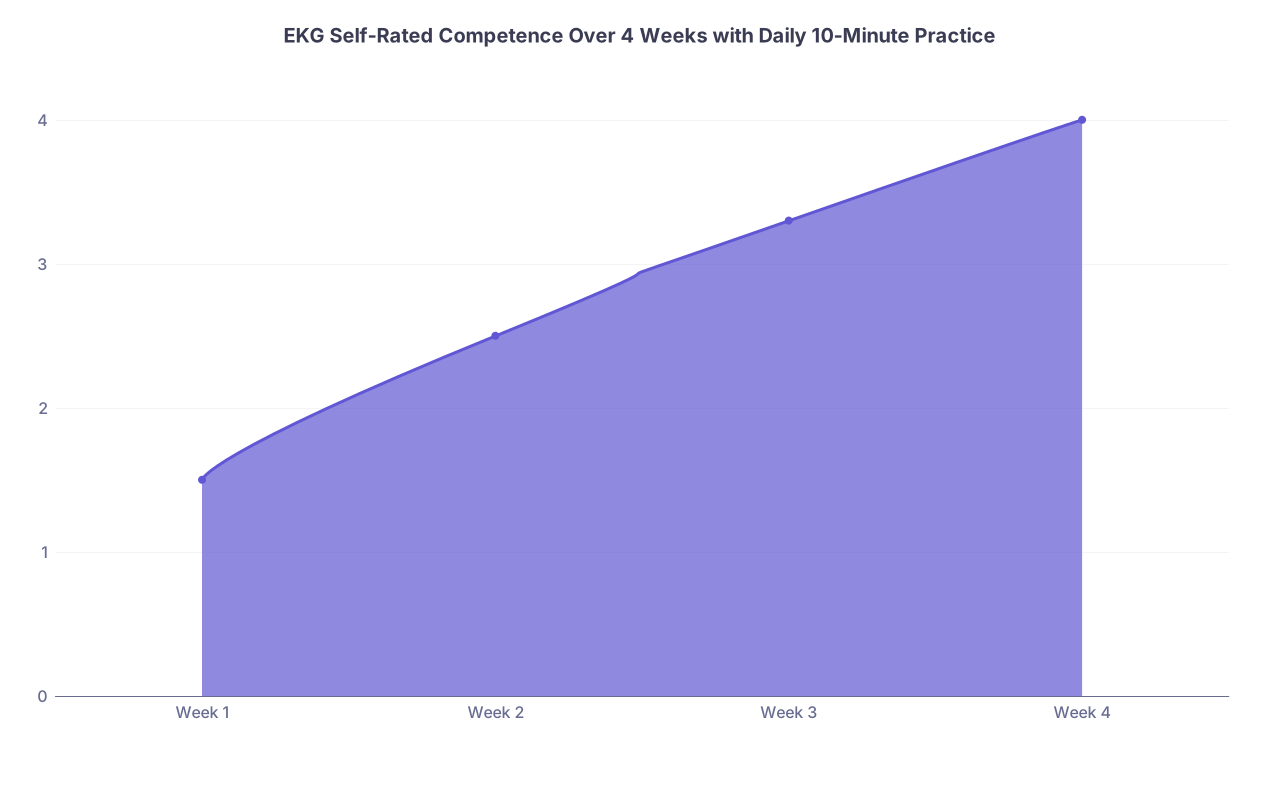
| Category | Value |
|---|---|
| Week 1 | 1.5 |
| Week 2 | 2.5 |
| Week 3 | 3.3 |
| Week 4 | 4 |
If your curve looks roughly like that—slow start, then steady climb—you are doing it right. If you stay flat, you are either skipping days or just passively staring at strips.
How to Stretch This Beyond the First 4 Weeks
After the initial 4‑week run:
- Cycle back to Week 1, but use harder strips (e.g., from cardiology sites)
- Add a “teaching day” once a week where you explain an EKG to a junior or peer
- Start timing yourself: aim for a coherent 30‑second summary per EKG
You can also start tagging your learning to exam formats:
For shelf exams:
Focus more on classic MI territories, drug‑induced changes (digoxin, TCA overdose, hyper/hypokalemia), and AV blocks.For Step 2/CK:
Emphasize management implications: what to do with AF with RVR in sepsis, how to treat torsades, what pacemaker indications look like on EKG.
This is still 10 minutes a day. You are just turning the difficulty dial up slowly.
A Simple Daily Decision Flow for EKGs on the Wards
Use this mental flowchart whenever someone hands you an EKG and stares expectantly.

| Step | Description |
|---|---|
| Step 1 | Receive EKG |
| Step 2 | Check basics & rate |
| Step 3 | Rhythm & P-QRS |
| Step 4 | Axis & intervals |
| Step 5 | ST/T changes |
| Step 6 | Call senior immediately |
| Step 7 | Form one-line impression |
| Step 8 | Suggest next step or no change |
| Step 9 | Life-threatening finding? |
Run that same internal script for every tracing. Over time, it becomes automatic.
FAQs
1. I am already overwhelmed on rotations. Is 10 minutes daily actually realistic?
Yes, if you treat it like brushing your teeth, not like “bonus studying.” You are not adding a new 1‑hour block. You are reclaiming one of the tiny dead spaces in your day: before prerounds, while waiting for sign‑out, or right before you leave the hospital. Set a recurring 10‑minute alarm and commit to doing at least 2 strips even on brutal days. Consistency beats intensity.
2. Should I start with a full EKG textbook before doing this?
No. That is backwards. Start with the micro‑curriculum and only open a book when you repeatedly miss a concept (e.g., you keep misclassifying AV blocks). Use the book as a “reference patch,” not as the primary training ground. Most students who start with textbooks never transition to high‑volume, active practice, which is where real EKG skill comes from.
3. How many total strips should I aim to see before I feel comfortable?
For basic clerk competency, you want at least 300–500 strips under your belt, spread across weeks. That sounds like a lot until you realize 10 minutes daily with 6–10 strips per session gets you there within a couple of months. The brain needs this volume for pattern recognition. There is no shortcut: the more strips you see, the less “mystical” they seem.
4. I keep getting intimidated when attendings read EKGs in 10 seconds. Should I try to be that fast?
Not yet. Speed without structure just makes you confidently wrong. Early on, it is perfectly fine if it takes you 2–3 minutes to walk through all seven steps. The goal is accuracy and consistency first. Once your approach is automatic, speed increases on its own. The attendings you see calling it in 10 seconds? They did years of slow, methodical reads before it looked effortless.
Key takeaways: Build one rigid EKG approach and use it for every strip. Protect a real 10‑minute daily block for focused micro‑drills. Tie that practice directly to the tracings you see on the wards. If you do that, you will stop faking EKG competence and actually earn it.