
The biggest mistake M1s make about the M1→M2 summer is pretending it’s still “summer break.” It’s not. It’s a three‑month head start on the single exam that will define the first half of your career.
You don’t need to grind like it’s dedicated. But you do need a blueprint. Week by week. Or you’ll drift, dabble in question banks, and hit M2 already behind.
Here’s the structured, chronological plan I give students who want to be board‑ready without burning out.
Big Picture: Your M1→M2 Summer in Phases
At this point, you should stop thinking “random studying” and start thinking “phased build.”
- Phase 0 (Last 2–3 weeks of M1) – Set the stage
- Phase 1 (June) – Rebuild foundations + light questions
- Phase 2 (July) – Systems integration + ramp questions
- Phase 3 (August to M2 start) – High‑yield consolidation + test‑day behaviors
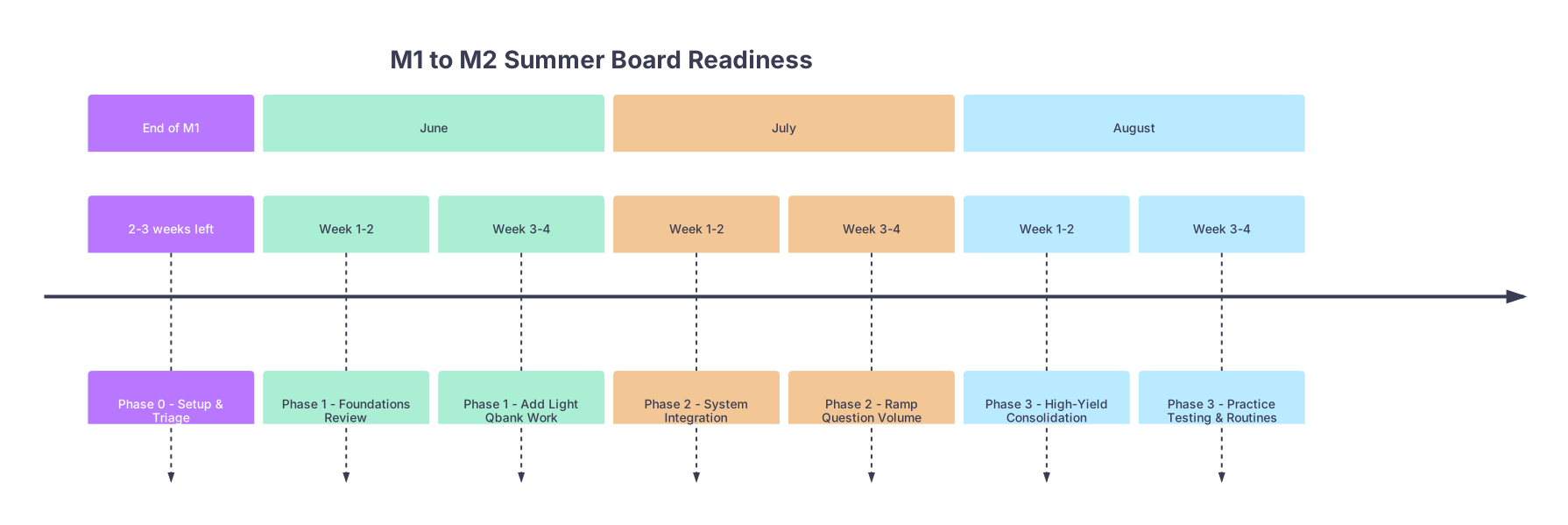
| Period | Event |
|---|---|
| End of M1 - 2-3 weeks left | Phase 0 - Setup & Triage |
| June - Week 1-2 | Phase 1 - Foundations Review |
| June - Week 3-4 | Phase 1 - Add Light Qbank Work |
| July - Week 1-2 | Phase 2 - System Integration |
| July - Week 3-4 | Phase 2 - Ramp Question Volume |
| August - Week 1-2 | Phase 3 - High-Yield Consolidation |
| August - Week 3-4 | Phase 3 - Practice Testing & Routines |
Aim for 10–15 focused hours/week of Step studying in June, 15–20 hours/week in July, and 10–15 hours/week in August as M2 approaches and your school work restarts (or rises).
Phase 0 – Last 2–3 Weeks of M1: Set the Board Stage
At this point, you’re still in exams. Fine. You’re not starting real Step prep yet. But you are setting the rails.
Week -3 to -2 (Relative to Summer Start): Triage & Tools
Your priorities:
Pick and secure your core resources
Do this now so you don’t waste June “researching” instead of studying.Non‑negotiables for most people:
- Boards‑style question bank (UWorld or Amboss)
- An Anki ecosystem (e.g., AnKing/Lightyear style) if spaced repetition works for you
- A condensed text or video set (Boards & Beyond, Pathoma, Sketchy, or your school’s system videos)
Core Board Resources to Lock In Before Summer Resource Type Go-To Option Backup/Alternative Question Bank UWorld Step AMBOSS Qbank Videos Boards & Beyond Pathoma (path-heavy) Spaced Repetition AnKing Deck Self-made high-yield Rapid Review First Aid-style book Boards & Beyond PDF notes Honest subject triage
Grab your course grades, old NBME/CBSE feedback, and ask:- Which 3 subjects scare you most? (Usually: neuro, micro, biochem)
- Which systems did you rush or cram? Those become your summer anchors.
Light integration only
If finals aren’t crushing you:- 15–20 Anki cards/day from a global Step deck just to start recognizing the style
- 5–10 random board‑style questions once or twice a week (no pressure on % correct)
The goal: when M1 ends, you already know your weak spots and you’ve touched the tools you’ll use all summer. No fumbling.
Phase 1 – June: Rebuild the Foundation, Don’t Sprint
June is about rebuilding fundamentals you sort of learned during M1, this time in board language.
Target: 10–15 hours/week, broken into 4–5 sessions.
Week 1: Reset & Baseline
At this point, you’ve just finished M1. Brain is fried. You’re not a machine. So:
Day 1–2: Do almost nothing academic.
Sleep. Move. Touch grass. Then:
Day 3–4: Set your baseline and schedule.
Take a short, low‑stakes baseline:
- 1–2 blocks of 40 questions in “tutor” mode from your Qbank, mixed subjects
- Ignore the score. You’re just seeing how questions feel and where you panic.
Build a simple weekly template:
- 2 days focused on basic sciences (biochem, genetics, immunology)
- 2 days focused on core systems (cardio, pulm, renal)
- 1 flexible day for misc/cleanup or totally off
Example June Week Template:
- Mon – Biochem / Molecular / Genetics (videos + light questions)
- Wed – Cardio review (path + phys)
- Fri – Pulm review
- Sat – Immunology / micro basics
- Sun – Off or 20–30 Anki + short catch‑up
Week 2: Basic Sciences Deep Clean
This week you clean up the conceptual stuff that ruins Step questions later.
Focus areas:
- Biochemistry (metabolism, enzymes, nutrition)
- Molecular biology (replication, transcription, translation, DNA repair)
- Genetics (inheritance patterns, linkage, penetrance)
- Immunology basics (innate vs adaptive, MHC I/II, antibodies, cytokines)
Plan for each “content” block (2–3 hours):
- Watch/skim 1–2 short targeted videos (Boards & Beyond / similar)
- Take notes in board language, not course language
(“Mismatch repair → Lynch,” “Nucleotide excision repair → xeroderma pigmentosum,” etc.) - Do 10–15 questions tied to that topic
- Mine your misses into:
- Short Anki cards
- Or a running “stupid list” doc of high‑yield facts you always forget

Week 3: Intro Systems + Light Qbank Rhythm
At this point, you should start blending in system‑based review.
Pick two systems you already took in M1, usually:
- Cardio
- Pulm
For each system this week:
- 1 session: Physiology refresh (pressure-volume loops, lung volumes, etc.)
- 1 session: Pathology basics (atherosclerosis, heart failure, obstructive vs restrictive disease)
- 1 session: 20–25 system‑based questions in tutor mode
Your weekly target:
- 60–80 total Qbank questions
- 3–4 content sessions (2–3 hours each)
Week 4: Reinforce & Checkpoint
By end of June, you should:
- Have revisited:
- Biochem, molecular, genetics, immuno basics
- At least 2 major systems (cardio, pulm ideally)
- Completed 150–250 Qbank questions total
This week:
- Add renal or GI as a new system
- Continue questions:
- 15–20 questions, 3–4 days/week, still mostly tutor mode
Do a mini‑assessment:
- 1 block of 40 mixed questions timed (no pausing, ~1 hour)
- Post‑block: 1.5–2 hours reviewing every question, right or wrong
You’re not chasing a specific % yet. You’re training:
- Stamina
- Question interpretation
- Comfort with vignettes
Phase 2 – July: Integration & Volume
July is when you shift from “I remember facts” → “I can apply them quickly in board format.”
Target: 15–20 hours/week, more heavily weighted toward questions.
Week 5: Commit to a Question Rhythm
At this point, questions should be a default, not a side dish.
New baseline:
- ~120–150 questions/week
- That’s 3–4 blocks of 40, split however you like.
Example weekly structure:
- Mon – 1 block (40 Qs timed) + 2 hours review
- Tue – Content (video + notes) on a weaker system (e.g., neuro)
- Wed – 1 block (40 Qs mixed/timed) + review
- Thu – Content on micro or pharm
- Fri – 1 block (40 Qs timed) + review
- Sat – Flexible: focus on weakest area, extra questions, or true day off
- Sun – Light review: Anki, quick notes pass
Content focus this week:
- Start neuro or endocrine, whichever is weaker for you
- Micro: cover at least gram positives + gram negatives basics
Week 6: Systems Integration
Now you should step up integration.
Pick 3–4 systems you want “solid enough” before M2:
- Cardio
- Pulm
- Renal
- GI
(Or swap in neuro if it’s a glaring weakness.)
For each system this week:
- 1 targeted content session (video/notes)
- 1 focused question set (15–20 questions on that system)
Then add 1–2 mixed timed blocks for global integration.
This is where patterns start to lock in:
- You see how anemia shows up in heme and in GI bleeding vignettes.
- You connect kidney pathology with HTN with cardio outcomes.
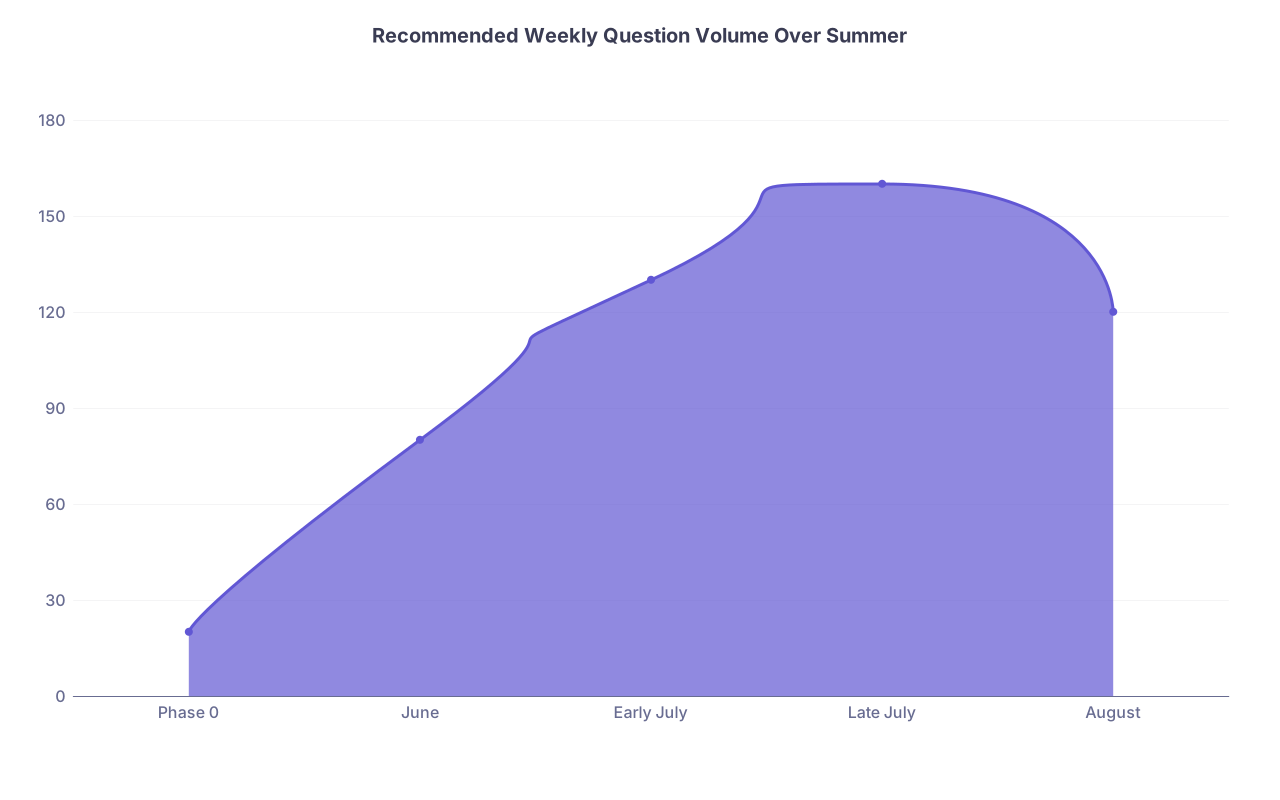
| Category | Value |
|---|---|
| Phase 0 | 20 |
| June | 80 |
| Early July | 130 |
| Late July | 160 |
| August | 120 |
Week 7: Push a Bit, Then Reassess
By mid‑July, a lot of students either:
- Get motivated and push too hard, or
- Get tired and start ghosting their Qbank.
Don’t do either. Instead, plan a deliberate “test week.”
This week:
- Aim for 150–180 questions
- Make at least half of them mixed, timed blocks
- Pick one day for a “mini‑NBME day”:
- 2 consecutive blocks of 40 questions each, timed, no long breaks
- Treat it like a test: quiet space, no phone scrolling between blocks
Your review:
- Identify:
- Top 3 content weak spots
- Top 3 test‑taking problems (rushing, misreading, second‑guessing)
Write those out. Those become your targets for August.
Phase 3 – Late July to August: Consolidation & Test Behavior
By this point, you should have:
- Several hundred questions under your belt (ideally 500–800 by end of August)
- Touched all major systems at least once
- A list of chronic weaknesses that keep showing up
Now you turn from “learning everything” to “locking in what matters most and how you behave under test conditions.”
Target: 10–15 hours/week plus whatever your M2 coursework requires.
Week 8: High-Yield Cleanup
This is a surgical week. You’re not doing broad content anymore.
Your targets:
- Pharm:
- Autonomics
- Cardio drugs (HTN, HF, antiarrhythmics)
- Antibiotics (MOA + major side effects)
- Micro:
- Big bacterial patterns
- Viruses by clinical syndrome
- Sketchy or equivalent is useful here
Your structure:
- 2 days: Pharm heavy (video → focused notes → 15–20 pharm questions)
- 2 days: Micro heavy (same pattern)
- 1 day: Mixed timed block (40 questions) + 2 hours review

Week 9: Simulate & Adjust
At this point, you should run a more realistic practice:
- Option A: If your school offers a CBSE/NBME-style practice, use that.
- Option B: Do 3 blocks of 40 questions over a single day:
- Block 1: 40 questions timed
- 10–15 min break
- Block 2: 40 questions timed
- 10–15 min break
- Block 3: 40 questions timed
Don’t review in between. Just like a real exam day.
Then:
- Spend the next 2 days dissecting every single question:
- Create a “never again” log of:
- Facts you’ll simply memorize (e.g., specific enzyme deficiencies)
- Concepts you misinterpreted
- Traps you fell for (e.g., changing answers from right to wrong)
- Create a “never again” log of:
Week 10: Align with M2 Curriculum
By now, M2 might be starting or about to start.
At this point, you should stop pretending board prep is separate from school. You want them aligned.
- Look at your M2 syllabus:
- First 2–3 systems you’ll hit (often neuro, renal, heme/onc)
- For each of those, plan:
- To pre‑read/watch 1–2 board‑level sessions before the block starts
- To do 10–20 related Qbank questions/week in parallel with your course
Shift your Qbank use:
- From “global summer project”
- To “M2‑integrated practice”
Your weekly plan now:
- 2–3 short Qbank sessions (20–25 questions) linked to whatever system you’re in
- 1 mixed block every 1–2 weeks to keep global context fresh
- Daily (or near daily) low‑volume Anki (50–100 reviews max) to keep drift away
Week 11–12: Maintain, Don’t Cram
Late August, your focus is sustainable habits, not heroics.
You want:
- A steady trickle of:
- Qbank (40–60/week minimum)
- Anki or rapid‑review
- One half‑day every 1–2 weeks for:
- A mixed block + deep review
- Updating your weakness list
At this point, you should:
- Know your chronic blind spots
- Have workflow muscle memory:
- Read stem → identify the ask → eliminate → commit
- Feel that questions are familiar even when they’re hard
Daily & Weekly Micro‑Habits That Actually Matter
People obsess over perfect resource combinations and then sabotage themselves with chaotic habits. Here’s what I’ve seen actually move scores.
Your “Step Light” Day Template (2.5–3.5 hours)
At this point in training, a good light day could look like:
Block or half‑block of questions (40 or 20 Qs) – 1–1.5 hours
- Timed if you’re used to it, tutor mode early on
Review – 1.5–2 hours
- For each question:
- Why was the right answer right?
- Why was your answer wrong?
- What clue in the stem should have tipped you off?
- For each question:
Small dose of spaced review
- 20–50 Anki cards
- Or a 20‑minute pass through your “never again” log
Red Flags You’re Using Summer Wrong
If these are true for more than 2 weeks in a row, you’re off track:
- You’re watching more videos than doing questions
- You “review” questions by only reading explanations for wrongs
- You keep doing untimed tutor mode because “timed is stressful”
- You finished “all of micro” but can’t answer basic micro questions consistently
Fix those first before you add more content.
A Realistic Summer Snapshot (What It Feels Like Week-by-Week)
To make this concrete, here’s what your July Week 2 might look like.
- Monday
- 40 mixed questions, timed (1 hour)
- 2 hours deep review
- Tuesday
- 2 hours neuro videos (cortex, basal ganglia, movement disorders)
- 20 neuro questions in tutor mode (45–60 min)
- Wednesday
- 40 cardio/pulm questions, timed (1 hour)
- 1.5 hours review
- Thursday
- 1.5 hours pharm (ANS drugs)
- 20 pharm questions (45–60 min)
- Friday
- 40 mixed questions, timed (1 hour)
- 2 hours review
- Weekend
- One day off, no guilt
- One light day: 30–50 Anki reviews + skim micro notes (30–45 min)
That’s ~16–18 hours. Very doable. But pointed.
Quick Reality Check: What “Board-Ready” After Summer Actually Means
By the time M2 is properly underway, your summer will have done its job if:
- You’ve done 500–800+ quality Qbank questions, all carefully reviewed
- You’ve touched every major system once, with 2–3 of them feeling solid
- You’ve built test routines: how you sit, read, eliminate, and commit
- You’ve aligned your board prep with M2, not treating them like separate universes
You will not know everything. No one does. The goal of the M1→M2 summer is not omniscience. It’s to make sure Step studying during M2 starts at a jog, not a crawl.
Core Takeaways
- Treat the M1→M2 summer as a structured head start, not a chaotic cram or a total vacation.
- Prioritize questions + honest review over endless content; use each month with a clear focus shift: June = foundations, July = integration + volume, August = consolidation + alignment with M2.
- Build sustainable systems (Qbank rhythm, spaced review, test habits) that roll straight into M2, so when dedicated starts, you’re refining—not starting from zero.