
It is 8:12 a.m. Your first patient is not until 8:30, but you are already behind. The lab called. The printer jammed. Someone double-booked a new patient visit into a 15‑minute slot labeled "nurse only." You walk past the waiting room, braced for eye rolls and huffs.
Instead, you hear it.
Receptionist: "You survived the parking lot. That is the hardest part of this clinic. Everything else is easy."
The patient laughs. Real laugh, not the polite one. Shoulders drop. You watch two other people in the waiting room look up from their phones and smirk.
That one throwaway line just bought you about 10 minutes of grace with everyone who overheard it.
This is what I want to break down: that strange, underappreciated ecosystem of front-desk humor, and how it sets the tone for the entire day—clinically, emotionally, and yes, even operationally.
What Actually Happens in a Waiting Room (When Humor Works)
Forget the glossy patient experience brochures. The waiting room is usually fluorescent lighting, coffee that tastes like burnt anxiety, and a half-broken TV stuck on daytime talk shows.
Front-desk staff sit right in the blast radius. They hear:
- "How much longer?"
- "I have been waiting 40 minutes."
- "If I was this late, you would cancel my appointment."
Three dozen times a day.
The difference between a tense waiting room and a tolerable one is often not the physician, not the decor, not the flat screen displaying patient education slides. It is the person at the desk and how they handle that constant emotional friction. Humor is one of their only high-yield tools.
Let me break it down into real patterns I have seen.
The “We Are All in This Together” line
Example:
"You are in luck. We are only running on 'clinic time' today—not 'ER time.' That saves you at least an hour."Translation: YES, we are late. NO, you are not crazy. But we see you, and we can acknowledge it without getting defensive.
The Micro‑Apology with a Joke Attached
"I promise we did not forget you. We just like you so much we wanted to keep you a little longer."Used with the right tone and the right patient, this turns what could be an escalated complaint into a shared eye roll at "how clinics are."
The Environmental Joke
Patient walks in drenched from the rain.
"Perfect day to come see us. You are already halfway to the 'drowned rat' look; we do the rest."People will forgive a lot of delay if they feel personally seen and lightly entertained along the way.
This is not stand‑up comedy. Nobody is paying a two-drink minimum. These are micro‑jokes—5‑second doses of levity that change the emotional temperature of the room.
Why Front-Desk Humor Works (Psychologically, Not Just Anecdotally)
Strip away the scrubs and the EHR, and you still have a basic human environment governed by pretty predictable cognitive and social processes. Humor plugs directly into those.
1. It decompresses perceived threat
A waiting room, for a lot of people, is a low‑grade threat environment:
- Fear about test results
- Worry about a diagnosis
- Financial anxiety
- Loss of control over time
Humor is a signal: "You are not under attack here."
I have watched patients walk up to the desk with shoulders tight, voice sharpened: "How much longer?"
Receptionist smiles and says: "So I checked. Doctor is on patient number six. You are number eight. That puts you at 'complain now' or 'complain later'—your choice."
Nine times out of ten, the patient laughs, shakes their head, and says, "I will complain later." Threat level drops. The same message delivered deadpan—"About 20 minutes"—does not have the same effect when someone is already keyed up.
2. It humanizes the system
Most outpatient practices feel like faceless bureaucracies to patients. Insurance forms, checkboxes, portals. The front desk is the first (and often only) place where the system looks like actual people.
Humor is a fast way to signal: "I am not just a keyboard with a name badge. I am a person, talking to you as a person."
Once that connection is there, patients are far more forgiving:
- They accept delays more readily.
- They are more honest about why they missed their last appointment.
- They complain less aggressively and with fewer threats of leaving negative reviews.
And that last one matters because the people who catch the verbal abuse are usually not the physicians. It is the front desk.
3. It changes the perceived length of the wait
The actual clock time does not change. But the felt wait time does.
If you can get someone to engage, even briefly, the brain marks that interval as "less wasted." A 25‑minute silent, tense wait feels longer than a 35‑minute wait where you had a few shared laughs and some clear updates.
This is not theoretical. Retail and call center research has shown exactly this: meaningful interaction shrinks perceived wait time. Clinics are not special here. We just pretend we are.
Good Humor vs Bad Humor: The Thin Line Between Helpful and Disastrous
Let me be blunt. Not all humor is good. I have seen front-desk staff defuse near-explosions with one well-placed joke. I have also watched someone almost get written up because they tried to be “funny” with the wrong person at the wrong time.
We need to talk about that difference explicitly.
| Situation | Helpful Humor | Harmful Humor |
|---|---|---|
| Running 30+ min late | Light self‑deprecating clinic joke | Blaming doctor or patient |
| Insurance confusion | Simple, relatable comment | Mocking plan or finances |
| Anxious patient | Validating plus gentle humor | Dismissing fear as silly |
| Repeat late patient | Soft, relationship-based tease | Shaming or public call-out |
| Elderly patient | Slow, kind, concrete jokes | Age-based stereotypes |
What helpful front-desk humor usually looks like
Patterns I have seen work reliably:
Self‑deprecating. Joking about the system or yourself, not the patient.
"Our printer is on strike again. We are negotiating with snacks and threats."Inclusive. "We" jokes instead of "you" jokes.
"We both know this check‑in tablet hates everyone."Small and quick. One line, then you move on. No extended routine.
Anchored to reality. Jokes that follow a clear explanation, not instead of an explanation.
What gets people in trouble
You can blow up a whole day with one bad attempt at “being funny”:
Sarcasm under high stress.
Patient: "This is ridiculous; I have been here an hour."
Staff: "Well, you are not the only one who exists, you know."
That is not humor. That is a fight invitation.Joking about identity: age, weight, race, language, mental health, disability, finances.
No. Hard stop.Humor that blames:
"If you had come earlier, you would not have to wait now."
Even if it is true, and even if they are chronically late, you do not make that the center of the joke unless you know them very well and it happens privately.Punching down. The moment your joke makes the patient feel small, you lost.
Think of it this way: good front-desk humor punches up (at the system, the schedule, the broken printer). Bad humor punches down (at the patient) or sideways (at the clinician, which poisons trust).
How Front-Desk Humor Quietly Shapes Clinic Operations
This is not only about vibes. There are hard downstream effects.
1. Complaint volume and intensity
A front-desk team that uses effective humor and warmth will still get complaints. But they are different complaints:
- Less likely to escalate to “I want to speak with the manager.”
- More likely to include, “I know it is not your fault, but…”
- Less likely to end up as nuclear Google reviews.
I have watched two clinics in the same building with almost identical wait times and visit lengths. One had a receptionist who was dry, efficient, and technically perfect. The other had someone who blended competence with easy humor. Same delays. Very different complaint patterns.
2. Provider perception and burnout
You know that sensation when you finally walk into a room 35 minutes late and the first thing the patient says is: "They told me you were on an emergency at the hospital, do not worry"?
That is your front desk framing your delay in a way that preserves your therapeutic relationship.
Humor plays into this:
- "Doctor is running a few minutes behind. I told her we are starting the timer on your future five-star review."
- "He is moving fast but not 'unsafe fast.' We like to keep everything legal."
These lines buy trust for you, whether you ever hear them or not.
On the flip side, if the front desk vents their own frustration by rolling their eyes and saying: "Yeah, she is always late like this," you inherit all that irritation the moment you open the door.
Over time, this matters for provider burnout. Starting half your visits in a defensive crouch, apologizing for things you cannot fix that day, is emotionally draining. A front-desk culture that uses light humor + clear explanation can soften that impact.
3. Patient flow and no-shows
Here is where people underestimate the cumulative effect of front-desk personality.
Patients who feel:
- welcomed
- recognized
- amused, at least a little
are more likely to:
- show up again
- reschedule instead of disappearing
- tolerate the one bad visit without firing the entire practice
You do not need a randomized trial for that one. Any seasoned scheduler will tell you that "their people" come back for the humans at the desk just as much as for the doctor.
A receptionist saying, "Hey, Mr. Jones, good to see you again. You did not bring me coffee this time? I am hurt," is doing two things:
- Making Mr. Jones feel like an actual known person
- Embedding a tiny ritual that makes future visits stickier
Humor becomes part of the glue that holds the long-term relationship.
The Quiet Skillset Behind “Being Funny” at a Medical Front Desk
People outside healthcare hear "front-desk humor" and think: easy, just crack a joke.
Anyone who has sat behind that glass knows it is not that simple. You are juggling triage, HIPAA, insurance, and intermittent rage. You cannot just be a casual comedian.
Let me lay out what the good ones actually do.
1. Micro‑triage of personalities
Within about 3 seconds of someone walking up, an experienced receptionist is running an internal flowchart:
- Are they joking already? → Yes: ramp up slightly, mirror their energy.
- Stone-faced, stiff shoulders, clipped speech? → Humor dial stays low, start with clear facts.
- Anxious, tearful, or holding a folder of new-onset oncology results? → You do not lead with comedy.
They test with one safe, low‑stakes line:
"How is your morning going so far—survived the parking lot?"
If they get:
- A laugh or a relaxed, "Barely" → Green light: mild humor is welcome.
- Flat, distracted "Fine" with zero eye contact → Back off. Prioritize clarity, not entertainment.
2. Timing around bad news
The worst front-desk humor missteps I have seen all share a pattern: joking blind, without reading the context.
If someone is:
- Being checked in for a miscarriage follow‑up
- Here for an oncology consult
- Bringing a child in after an assault
- Holding a stack of denial letters from their insurer
You keep the humor very neutral or leave it out entirely. Any comedy that is not anchored in their reality risks sounding tone‑deaf or cruel.
On the other hand, after a particularly heavy visit, I have watched a receptionist crack the smallest, gentlest joke about the weather, and you could see the patient almost gratefully latch onto that tiny bit of normal.
This is not a script. It is judgment.
3. Rehearsed-but-fresh one-liners
The best front-desk humor is, frankly, semi‑recycled. They have:
- 3–5 lines about parking
- A couple about wait times
- A few about the portal, the printer, or the blood draw
The art is in delivering them like it is the first time, then retiring them if they start sounding stale or insincere.
It is exactly like having a handful of stock phrases for explaining lab turnaround times or refill policies—but for emotional regulation.
Humor, Power, and Boundaries: Knowing When to Shut It Off
Let me be crystal clear: front-desk staff are not cruise-ship entertainers. Their job is not to keep everyone smiling at all costs. Their job is to manage access, information, and expectations in a stressful environment. Humor is just one tool.
There are times it should go back in the drawer.
When a patient is escalating
Once someone moves from irritated to actively angry—voice raised, leaning over the desk—jokes are gasoline.
You pivot to:
- Clear boundaries: "I want to help you, but I need you to lower your voice."
- Procedural language: "Here is what I can do. Here is what I cannot do."
- Safety where needed: including calling for backup.
If you are still trying to be funny when someone is throwing insults, you are going to look flippant and unprofessional, and you might make the situation dangerous.
When power dynamics are too skewed
Patients are already in a vulnerable position. Add in language barriers, low health literacy, or mental health crises, and humor can feel risky.
If there is any hint that your joke depends on them understanding some nuance of English, American culture, or insurance bureaucracy, do not use it. Confusion is the last thing you want to layer on.
When the team is burned out
Here is the part nobody likes to admit: sometimes the front-desk staff are just done. They are underpaid, yelled at, and short‑staffed. "Being funny" becomes one more fake performance asked of them.
You can hear the difference when humor is coming from resentment instead of generosity. The edges get sharper. Sarcasm creeps in. Patients feel it immediately.
If you are a clinician or manager and you want that front‑desk levity, pay attention to their workload and emotional support. You cannot squeeze charm out of pure exhaustion.
The Future: Will Robots Ruin Waiting Room Comedy?
We are already seeing the early wave:
- Self check‑in kiosks
- QR‑code registration
- AI‑driven scheduling
- Virtual waiting rooms in patient portals
So what happens to front-desk humor when half the interaction is a touchscreen?
Short answer: badly designed systems will flatten it. Thoughtful ones will make it even more valuable.
The risk: removing the only human buffer
I have already seen clinics proudly roll out full self-check-in, then wonder why their online reviews tanked. Yes, people liked the speed. But when something went wrong, there was no human face at the literal front line to soften the blow with:
"Okay, that tablet hates you today. Let us tag team it."
In a fully automated front end, frustration goes straight from the patient into the physician room. No buffer. No softening. No “we're in this together” moment.
The opportunity: re‑focusing human energy
There is a smarter way to do it:
- Let the portal and kiosk handle the pure data: addresses, copays, signatures.
- Protect front-desk staff time for the exceptions: anxious patients, complex check‑ins, language issues, tech trouble.
Then you train, hire, and value those front-desk humans as actual patient-experience professionals, not just data-entry workers. Their emotional and comedic skills become higher leverage, not less.
You might see fewer front-desk staff per clinic in the future—but the ones who remain need to be much better at this interpersonal layer.
Could software fake the humor?
You know someone is going to try:
"Kiosk: We see you have been waiting 19 minutes. That is only 4 cat videos long."
Let me be honest. Most patients will roll their eyes at that in 0.3 seconds. Generic algorithmic humor is rarely funny in a context where fear and vulnerability are in the air.
What might work:
- Subtle, customizable prompts that let clinics insert their own style.
- Staff‑recorded messages with real voices, not robotic text-to-speech.
- Very light, opt‑out "tone" options: straightforward vs "lighthearted," chosen by the patient during setup.
But the irreplaceable piece is improvisation. That moment when a receptionist notices the kid clutching a stuffed dinosaur and says, "Good, our dinosaur specialist is in today." No algorithm is matching that in a context‑appropriate way any time soon.
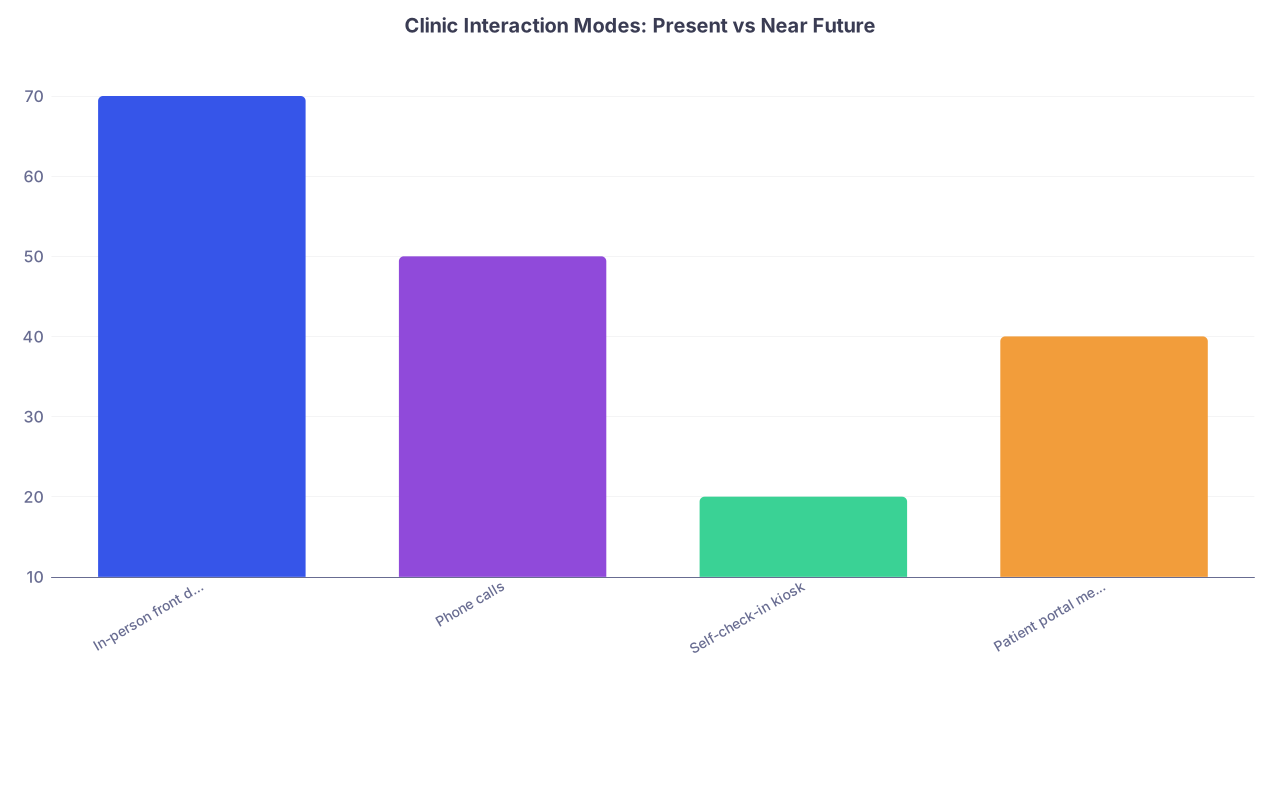
| Category | Value |
|---|---|
| In-person front desk | 70 |
| Phone calls | 50 |
| Self-check-in kiosk | 20 |
| Patient portal messages | 40 |
Training and Culture: If You Want This, You Have to Build It
You cannot just tell your front desk, "Be more funny," and expect anything but cringe. Humor in a clinical setting needs scaffolding.
Hire for it, do not just demand it
When you interview for front-desk roles, stop only asking:
- "Can you use Epic?"
- "Do you have billing experience?"
Ask things like:
- "Describe a time a patient was really upset and you had to respond."
- "Give me an example of something small you do to make patients more comfortable while they wait."
If their eyes light up talking about little jokes, remembering names, or easing tension, that is a good sign. If they emphasize "I just tell them the rules," be honest about whether that fits the culture you are trying to build.
Give them permission and protection
Front-desk humor requires a bit of risk. They will occasionally misfire. You need a culture where:
- Minor, good-faith missteps are coached, not punished.
- Staff know leadership has their back when they set limits, even with "difficult" patients.
- Doctors reinforce and compliment good humor they overhear.
I have seen clinics where receptionists were terrified to say anything unscripted because every complaint call led to disciplinary notes. Those places are humor deserts. Patients feel it, whether they can articulate it or not.
Offer real guardrails
You do not need a 40‑page policy. But you do need a few bright lines:
- No humor about protected characteristics.
- No mocking diagnoses, symptoms, or medications.
- No jokes that blame the patient for their health issues.
- No undercutting colleagues ("You know her, she is always late").
Then give examples of “safe” humor topics:
- Shared dislike of the parking lot
- The universal hatred of forms and passwords
- Mild self‑deprecating humor about the clinic systems
That is usually enough.

| Step | Description |
|---|---|
| Step 1 | Patient approaches desk |
| Step 2 | Read body language |
| Step 3 | Stick to clear info |
| Step 4 | Test with small neutral line |
| Step 5 | Use brief light humor |
| Step 6 | Return to task and updates |
| Step 7 | Open to engagement |
| Step 8 | Positive response |
Why This Matters More Than It Looks
If you are a clinician, it is easy to dismiss all of this as "soft stuff." You are thinking about guideline updates, prior authorizations, quality metrics.
Here is the reality I have seen:
- A front desk with effective, well‑placed humor often buys you 10–15% more emotional room with every patient.
- That margin is the difference between a visit that starts as an apology tour and one that starts as, "Thank you for seeing me."
- It directly affects whether patients come back, follow instructions, and rate their experience as tolerable or miserable.
You can be technically brilliant in the exam room and still have a "bad clinic" reputation if the front end feels cold, inflexible, and humorless.
On the other hand, I have seen mediocre physical spaces, average wait times, and no fancy tech—but a front-desk crew that uses warmth and small, sharp bits of humor—and patients talk about that clinic like it is a refuge.
They are not praising the EMR uptime. They are remembering the receptionist who, on a day they felt awful, looked up, smiled, and said:
"Good. You are here. That means we can start making today slightly less terrible."
That line costs nothing. But it shifts the whole day—for them, and for you.
With that lens, clinic waiting room comedy stops being background noise. It becomes part of the clinical ecosystem, a small but potent form of emotional triage.
You do not have to turn your practice into a comedy club. You do need to decide whether you want a waiting room that feels like a DMV or one that feels like a place run by actual humans with a sense of perspective.
Get that right, and you set the stage for everything that follows: the exam room conversation, the follow‑up, the long-term relationship. How you build that front‑desk culture—especially as automation pushes in—is the kind of quiet decision that shapes the future of medicine more than most committees want to admit.
With that foundation in place, you are far better positioned for the next wave: virtual visits, hybrid care, and digital “waiting rooms” that still somehow need to feel human. How we carry humor into those spaces is the next chapter.