Radiology and pathology are what happens when introverts weaponize IQ and quiet rooms.
You already know this intuitively. Every hospital has its own ecosystem of personalities: surgery yells, EM sprints, pediatrics over-smiles, anesthesia naps (they say they “vigilantly monitor,” but we all know the legend). And then there is radiology and pathology—sitting in the dark or in the lab, saying eight words that destroy a month of someone else’s “clinical impression.”
Let me break this down specifically: the funniest people in medicine are often the ones whose jokes you do not get until 3 hours, 3 days, or 3 lawsuits later. That is radiology and path. Their humor is not loud. It is not meme-based. It is slow-burn, savage, and written in reports, slide labels, and “helpful” addenda.
This is not just culture. It is almost structural. The way radiologists and pathologists work practically forces their humor to be quiet, delayed, and viciously precise.
We will walk through:
- Why their humor ends up so “silent but savage”
- The specific formats their jokes take (phrases, pitfalls, “recommendations”)
- How trainees get hazed with microscopic cruelty
- Where AI and the “future of medicine” might ruin—or supercharge—this kind of humor
And yes, I will call out specific lines and report phrases you have probably seen. Or written. Or been crucified by.
1. Why Radiology and Pathology Breed Quiet Assassins
Let’s start with environment and workflow, because that shapes everything.
1.1 The physical setup: dark rooms and back halls
Radiology: you sit in a dim room, staring at 3–6 high-resolution monitors, chained to PACS. You live in grayscale. People whisper if they speak at all. Half the communication is via the EMR, text, or a phone call that starts with, “Can I bother you for a quick read?” after they have already bothered you.
Pathology: you are surrounded by microscopes, paraffin blocks, gross specimens, and that one resident with an unholy number of colored pens. Similar isolation. Different fluid types.
You learn two habits to survive:
- Think several moves ahead.
- Communicate with weaponized brevity.
Put a certain kind of mind into that environment for long enough and the jokes stop being verbal. They become structural. Embedded in the workflow. You are not standing in the OR making everyone laugh. You are placing a surgical strike in a line of text that will haunt someone at M&M. That breeds a distinct form of humor: quiet, delayed, and razor sharp.
2. Radiology: Sniper-Level Shade in 3 Sentences or Less
Radiology humor lives in the gap between what you write and what you are actually thinking.
2.1 The classic phrases that are 80% shade
Some “innocent” report lines that are basically subtext with contrast:
“Clinical correlation is recommended.”
Translation: Your HPI made no sense and the indication was ‘pain’. Do better.“Findings are nonspecific.”
Translation: I see something. I refuse to own it. Good luck.“Differential includes infection, inflammation, or neoplasm.”
Translation: One of these will be right when you finally biopsy it. You are welcome.“Suboptimal exam due to motion artifact.”
Translation: Your patient moved like they were on a trampoline. I cannot fix that.“Small hiatal hernia of doubtful clinical significance.”
Translation: The only reason I am mentioning this is because your attending will ask if I looked for it.“Correlate with prior imaging if available.”
Translation: If your system did not lose the priors, my job and your life would be easier.
That language developed for medical-legal precision. But radiologists quickly realized it can also function as deadpan sarcasm if you read it with the correct tone.
2.2 The “indication” problem: source of 50% of radiology jokes
Radiologists read so many ridiculous indications that they basically have a private stand-up routine nobody else hears.
Actual-style indications I have seen or heard of:
- “Abdominal pain – please rule out something.”
- “Nausea and vomiting – CT head.”
- “Weakness. Evaluate entire body.”
The savage but silent responses show up as:
- “Normal CT abdomen and pelvis. No imaging explanation for the reported symptoms.”
- “Noncontrast CT head within normal limits. Consider nonstructural etiologies.”
In English: You ordered the wrong study for the wrong reason and now my report is your punishment.
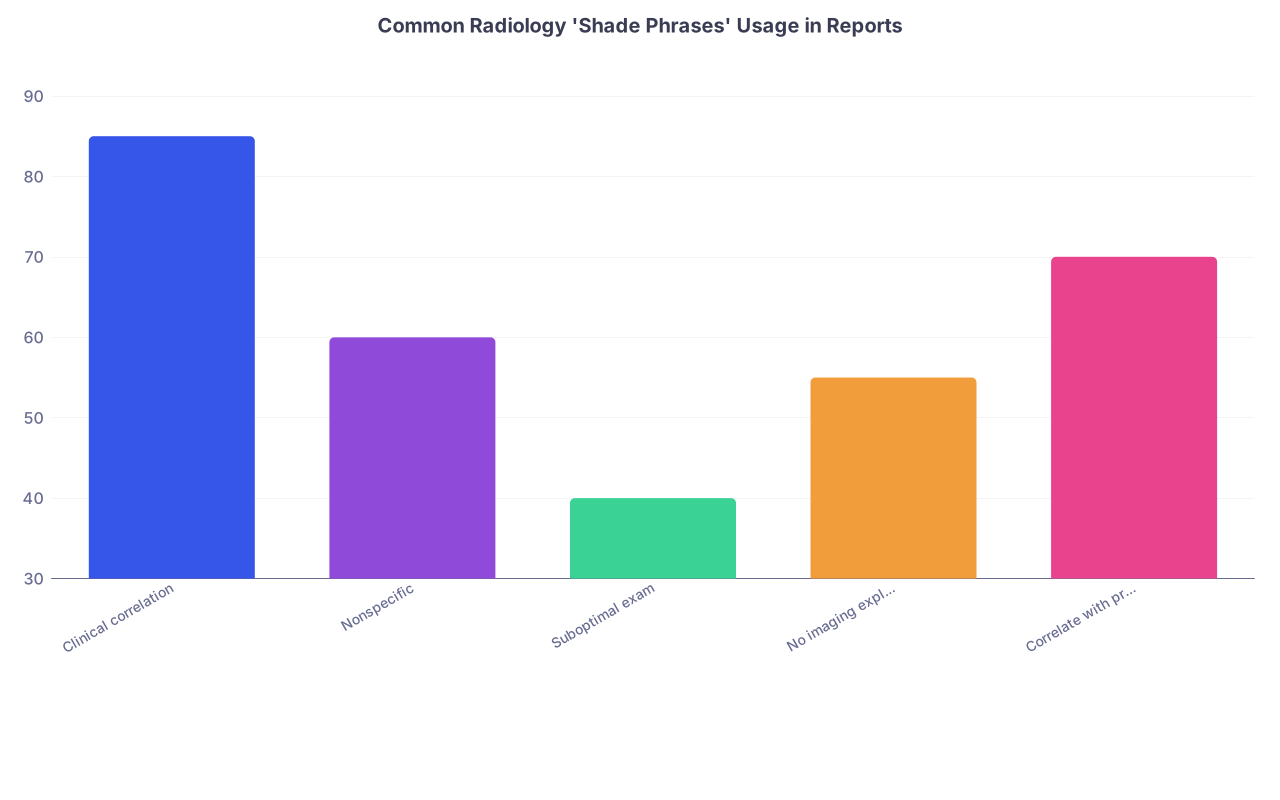
| Category | Value |
|---|---|
| Clinical correlation | 85 |
| Nonspecific | 60 |
| Suboptimal exam | 40 |
| No imaging explanation | 55 |
| Correlate with priors | 70 |
Numbers are fake, but if you read enough reports, you know that ranking feels disturbingly accurate.
2.3 The “suggested management” nuclear bomb
Modern radiologists are pressured to “add value” with management recommendations. Some take the opportunity to be… pointed.
Example:
- “Indeterminate 4 mm pulmonary nodule in a low-risk patient. No follow-up is required per Fleischner criteria.”
Savage, because it is subtly saying: Do not even think about ordering annual CTs for this. The guidelines are not on your side.
Or:
- “Delayed-phase imaging may be helpful, if clinically warranted.”
That “if clinically warranted” is radio-speak for please do not reflexively order another scan just because I mentioned it.
And then there is the truly brutal:
- “Multiple chronic fractures and degenerative changes. No acute abnormality. Clinical management as per primary team.”
That last sentence? A polite game of hot potato. With your consult note.
3. Pathology: The Quiet Final Boss of Every Diagnosis
If radiology throws darts from a distance, pathology is the final judge and executioner. Their humor is even drier because it lives in the space between tissue and terror.
3.1 The “benign” email that ruins someone’s day
You know this scenario:
Surgeon: “We think it is benign but weird. Just send it to path.”
Path report: “Invasive poorly differentiated carcinoma with lymphovascular invasion. Margins involved.”
No exclamation points. No drama. Just a PDF that detonates a patient’s entire staging, a surgeon’s self-esteem, and sometimes an oncologist’s weekend.
Pathologists do not need to be loud to be savage. Their calm is the joke.
3.2 Classic pathology phrases that cut deep
Some greatest hits:
“The diagnosis is best rendered as…”
Translation: Everyone argued about this at the multihead scope for 25 minutes. I am planting a flag.“Borderline features are present.”
Translation: You will quote this line three times in tumor board and no one will feel reassured.“These findings may represent reactive atypia; however, early dysplasia cannot be entirely excluded.”
Translation: I am not going down on this ship with you. Watch it more.“Recommend correlation with imaging and clinical findings.”
Translation: You are not dragging me into this alone.“Frozen section interpretation: deferred.”
Translation: You wanted an answer in 3 minutes on marginal tissue. No.
Pathologists mastered “polite distance.” Their humor is the self-protective layer between themselves and constant diagnostic uncertainty.

3.3 Labeling and gross room humor: dark, specific, and very real
You see:
- A formalin container labeled “Giant Mass – previously known as ‘small lump’ by surgeon.”
- A whiteboard column labeled “Specimen of the week,” featuring something so bizarre half the department comes to look.
- The occasional passive-aggressive container annotation: “Unlabeled laterality. Please correlate with operative note.”
Is it dark? Yes. Does it keep people functional while handling literal organs all day? Also yes.
4. The Art of the “Silent Roast”: Multidisciplinary and Interdepartmental
The best radiology and pathology humor is not actually private. It is shared. But indirectly.
4.1 Tumor boards: where subtle shade goes public
Tumor board is the Olympics for silent but savage humor. You have:
- The surgeon who is “pretty sure” it was T1.
- The radiologist quietly pulling up a scan that looks like a tumor ate three organs.
- The pathologist calmly saying, “Margins positive at multiple locations. Perineural invasion is extensive.”
Nobody yells. Instead you get:
Radiologist: “On retrospect, there was early local invasion visible on the prior scan from 18 months ago.”
That “on retrospect” is doing a lot of emotional damage.
Pathologist: “The original biopsy showed high-grade features. This progression is therefore not entirely unexpected.”
Hidden transcript: We told you. You assumed otherwise.

| Step | Description |
|---|---|
| Step 1 | Clinician order |
| Step 2 | Radiology report |
| Step 3 | Pathology result |
| Step 4 | Tumor board |
| Step 5 | Clinician reflection |
The feedback loop is real. After a few of these, attendings start pre-emptively cleaning up their documentation because they know someone will quietly put the receipts on screen.
4.2 Phone calls: the quiet “are you sure?” checkmate
A very real radiology conversation:
Radiologist: “Hi, calling about the CT head for your ‘syncope, r/o bleed’ patient.”
Clinician: “Yes, anything acute?”
Radiologist: “No hemorrhage. But there is a 4.5 cm mass in the lung apex.”
Silence.
Radiologist: “Was lung pathology part of your differential?”
Clinician: “Uh… not exactly.”
No sarcasm. No laughter. But that pause? That was the joke.
Same with pathology:
Pathologist: “I am signing out that colon polyp as an invasive carcinoma.”
GI: “Oh. The note says ‘hyperplastic-appearing’.”
Pathologist: “…Yes.”
That “…Yes” is a masterclass in letting someone bury themselves.
5. Resident and Fellow Hazing: How Trainees Learn Silent Savagery
You do not wake up one day with this kind of humor. It is implanted during training.
5.1 Radiology pimping: “Describe the abnormality”
Scene: Dark room. Attending scrolling at light speed through a CT chest.
Attending: “Tell me what you see in the left upper lobe.”
Resident: “Uh… somewhat ground-glassy density?”
Attending (after long pause): “And the other 4 things?”
Resident: dying internally.
Later, you see the finalized report:
- “Large left apical mass with satellite nodules, mediastinal adenopathy, and small left pleural effusion, highly suspicious for primary malignancy with regional spread.”
The resident learns two lessons:
- You missed everything.
- The attending will not scream. They will immortalize your miss in the most elegantly phrased report possible.
That gap—between your weak description and the final polished phrasing—is where radiology humor lives.
5.2 Pathology sign-out: microscopic humiliation with a smile
At the multihead scope:
Attending: “Diagnosis?”
Resident: “Uh… chronic gastritis?”
Attending: “And the H. pylori?”
Resident, sweating: “I do not… see them.”
Attending: “You are looking at the lymph node. Gastric mucosa is three slides down.”
Everyone chuckles, a little too kindly. No yelling. Just the quiet sting of knowing your error will be a footnote in the report (“H. pylori organisms identified on special stain”).
, Frozen sections](https://cdn.residencyadvisor.com/images/articles_svg/chart-settings-where-trainees-experience-silent-savage-t-4882.svg "Settings Where Trainees Experience 'Silent Savage' Teaching")
| Category | Value |
|---|---|
| Radiology readouts | 90 |
| Path sign-out | 85 |
| Tumor boards | 70 |
| [Nighthawk calls](https://residencyadvisor.com/resources/medical-humor/cross-cover-nights-the-distinct-comedy-culture-of-night-float) | 60 |
| Frozen sections | 50 |
The intensity is highest where the learning curve is steep and the feedback has to be fast, accurate, and documented.
6. Why This Humor Is So Specific to Radiology and Path
Other specialties have jokes. Surgery has swagger. EM has gallows humor. Psych has existential irony. But the “silent but savage” flavor is unusually concentrated in radiology and pathology for a few structural reasons.
6.1 They are gatekeepers of reality
Radiologists and pathologists do not just “consult.” They define reality.
- Radiology turns shadows into staging.
- Pathology turns cells into labels (benign, malignant, dysplastic, in situ, etc.).
When you control the diagnostic language, humor becomes part of how you manage being the arbiter of bad news all day. You cannot joke in front of the patient. You can joke in how you phrase: “Findings are compatible with metastatic disease.”
You never see a rad report say, “This is a total disaster; you are cooked.” Instead: “Extensive multifocal metastatic involvement of the liver, bones, and lungs.” That is the professional version of, “This is very, very bad.” The restraint is the point.
6.2 They live downstream of everybody else’s errors
Radiology and pathology live in the drainage basin of the entire hospital. Everything flows to them.
- Missing labels.
- Wrong side.
- Nonsense indications.
- Incomplete clinical histories.
- Botsched biopsies.
You cannot yell at everyone who sends you something stupid. You can, however, protect yourself with cold, neutral phrasing that doubles as a subtle rebuke.
Example:
“Specimen received labeled ‘left ovary’; however, operative note describes right-sided mass. Correlation is advised.”
That sentence may actually save the patient. It also gently torches the OR documentation.
| Specialty | Style of Humor | Volume Level | Weapon of Choice |
|---|---|---|---|
| Surgery | Blunt, in-your-face | Loud | OR comments |
| EM | Rapid, dark, chaotic | Loud/Medium | Team banter |
| Internal Med | Self-deprecating, nerdy | Medium | Progress notes, rounds |
| Radiology | Precise, delayed, dry | Quiet | Report phrasing |
| Pathology | Forensic, icy, final | Quiet | Diagnostic wording |
Radiology and pathology humor is not performance. It is commentary.
7. The Future: AI, Structured Reports, and Will the Jokes Survive?
Now the uncomfortable part: we are marching toward structured reporting, AI decision support, and “value-based documentation.” Does that kill silent but savage humor?
Not entirely. It just changes the terrain.
7.1 Structured reports: strangling the art… partly
As radiology shifts into checkbox-heavy templates (“Lung nodule: Y/N, size, location, follow-up per X guideline”), two things happen:
- The raw personality in prose shrinks. Less room for sly lines like “No acute cardiopulmonary abnormality.”
- The shade moves to other locations: recommendations, comments, and free-text “impression” sections.
Pathology is also being nudged into synoptic templates for cancer reporting (CAP, etc.). So instead of free-flowing narrative, you see:
- Tumor size: 4.2 cm
- Type: Invasive ductal carcinoma
- Margins: Positive – posterior
- Lymphovascular invasion: Present
The cruelty now lives in checkboxes instead of rhetoric. Because the message “You did not get clear margins” does not need sarcasm. It stings on its own.
7.2 AI-generated language: comedy or catastrophe?
Let us be blunt: early AI report generators are bland. Painfully so. They overuse phrases like “There is evidence of…” and “may represent,” without nuance.
Two real risks:
- AI will normalize generic, inoffensive language that erases the human “voice” in radiology and pathology.
- Clinicians, drowning in AI-generated mediocrity, will start ignoring the fine print where the real warnings hide.
But there is also a twisted upside:
You can absolutely imagine a future where AI flags absurd indications and quietly roasts them.
Think about a decision support pop-up:
- “Indication: ‘chest pain – rule out everything.’
System suggestion: Targeted imaging modality recommended. Current order is low-yield for stated indication.”
That is already savage. It is just algorithmic.
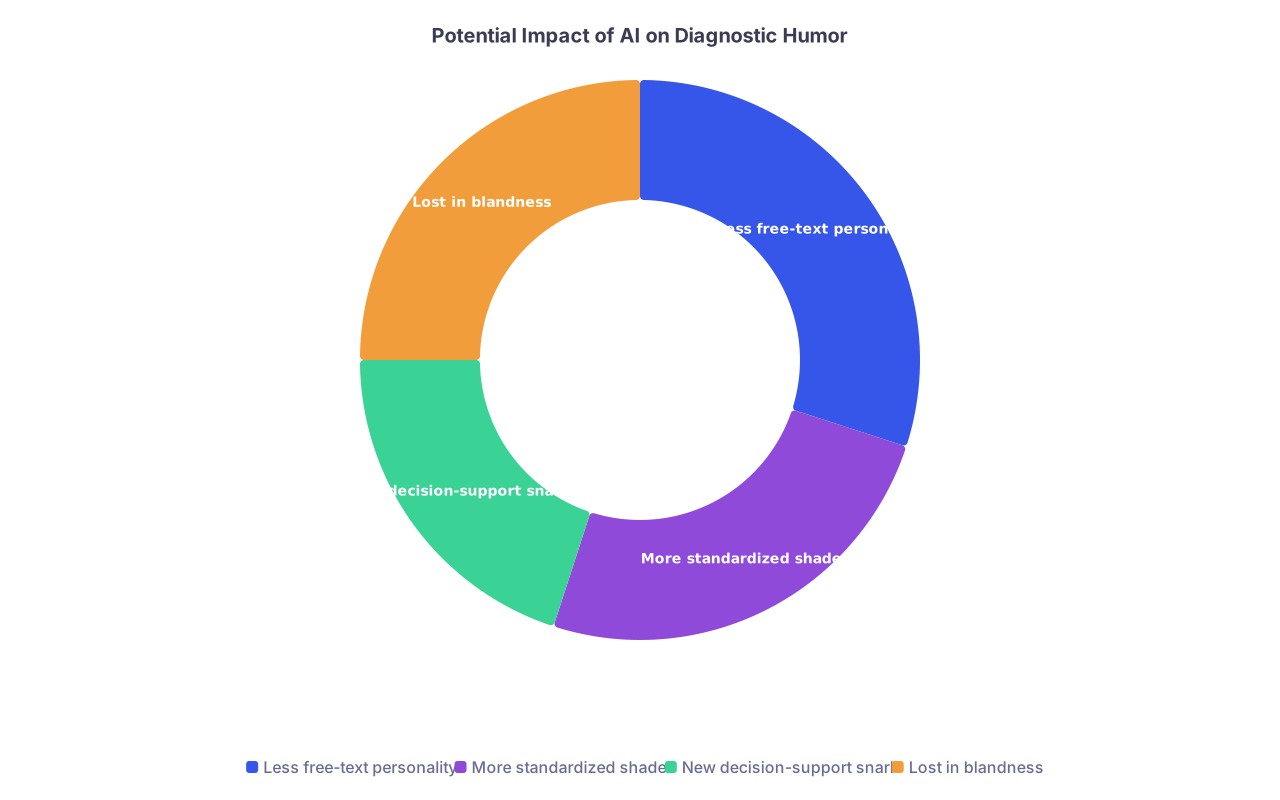
| Category | Value |
|---|---|
| Less free-text personality | 30 |
| More standardized shade | 25 |
| New decision-support snark | 20 |
| Lost in blandness | 25 |
The highest risk is that everything becomes flat and “safe.” But if human radiologists and pathologists stay in the loop, they will find new spaces to tuck in wry lines, especially in impressions and addenda.
7.3 Future of silent savagery: moving from text to structure
I suspect the next generation’s jokes will be:
In how aggressively someone cites guidelines:
“No additional imaging follow-up is indicated per widely accepted consensus and society guidelines.”In curated “smart phrases” that carry departmental culture:
“Study is limited by suboptimal technique; if clinical concern persists, consider repeat imaging with appropriate protocol.”In tumor board slides where AI “overcalls” a lesion and radiology calmly says, “This was reviewed by both human and algorithm and remains indeterminate.”
The humor will not vanish. It will just be buried in:
- Which guideline you choose
- How strongly you recommend follow-up
- Where you explicitly punt (“Management to be determined by the referring team”)
8. How to Read—and Survive—Silent but Savage Humor
If you are not in radiology or pathology but you interact with them, here is how to stay on the right side of their quiet brutality.
When they say “nonspecific,” read: We are not going to stick our necks out because your question is vague or the findings are mushy.
Action: Improve your clinical question or indication next time.When path says “cannot entirely exclude,” read: There is a whisper of something ugly, but the tissue is borderline.
Action: Respect the uncertainty. Do not pretend this is a clean bill of health.When radiology writes, “No imaging explanation for symptoms,” read: Stop ordering scans instead of thinking.
Action: Revisit your differential. Maybe talk to the patient again.When anyone recommends “clinical correlation,” read: We are handing the responsibility back to you, as we must.
Action: Accept that imaging and path are pieces, not oracles.
The point: this humor is not just entertainment. It is also a boundary. A way for radiologists and pathologists to say:
“We see what you are trying to make us say. We will not say it.”
9. The Real Reason This Humor Matters
Underneath the jokes, something serious is going on.
Radiologists and pathologists sit at the convergence of:
- High diagnostic responsibility
- Low direct patient contact
- Constant exposure to error—others’ and their own
You cannot survive decades of telling people, in effect, “This is cancer” or “You missed this 18 months ago” without some defensive detachment. Silent, precise humor is part of that detachment. It creates just enough distance to keep doing the work well.
You see it in:
- The deadpan way a pathologist calls a surgeon to say, “Your margins are not clear.”
- The dry tone of a radiologist saying, “There is a large pneumothorax on the prior study that was not mentioned.”
- The dark chuckle in a gross room when a container arrives labeled “tissue?”
That humor is not cruelty. It is a pressure valve.
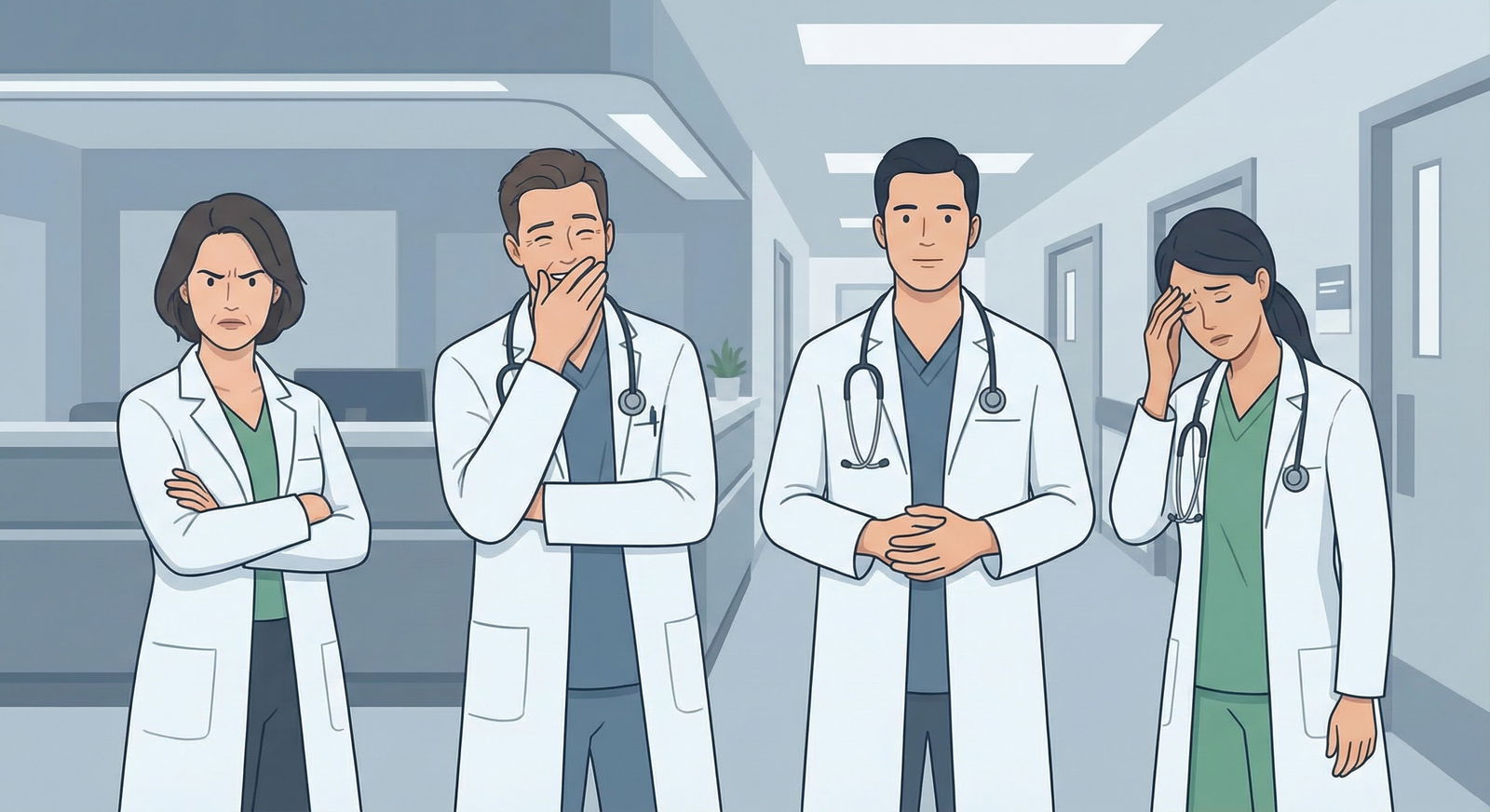
If you are in these fields, you already know: the quiet jokes are rarely about the patient. They are almost always about the system. The absurdity. The misorders. The fact that someone wrote “r/o brain mass” on a CT sinus order.
And if you are not in these fields, but you deal with their reports: read them more carefully. Some of the smartest commentary in the hospital is hidden between “limited but” and “cannot exclude.”
FAQ (Exactly 5 Questions)
1. Are radiologists and pathologists actually trying to be funny in their reports, or am I just reading into it?
Most of the time, they are trying to be precise and defensible, not overtly funny. The “humor” emerges from the contrast between how serious the content is and how restrained the phrasing must be. But yes, occasionally a radiologist or pathologist will deliberately choose a slightly pointed phrase (“no imaging explanation for symptoms”) as a very controlled form of pushback.
2. Is this kind of humor unprofessional or dangerous?
When done well, no. The language stays medically appropriate and legally safe. The savagery is mostly in interpretation, not explicit content. The real danger would be using jokes that confuse meaning or minimize serious findings. Seasoned radiologists and pathologists know the line extremely well: clarity first, catharsis second.
3. Why do radiology and pathology seem more “savage” than other specialties?
Because they are final common pathways. They constantly see the downstream consequences of vague histories, wrong tests, mislabeled specimens, and delayed diagnoses. They rarely have the time or positional leverage to lecture every clinician individually. So the culture evolved toward dry, minimally emotional documentation that still communicates, “We see the problem.”
4. Will AI and structured reporting kill this kind of humor completely?
It will blunt the more literary, free-text style, yes. But the mindset will persist. Silent but savage commentary will shift into which guideline is chosen, how forcefully follow-up is recommended, and which borderline findings are highlighted. Also, as AI starts flagging low-yield orders or bad indications, automated decision support may actually introduce its own form of bureaucratic “snark.”
5. As a trainee, how can I avoid being on the receiving end of this subtle roasting?
Three things: give specific, thoughtful indications (“sudden right-sided weakness, r/o hemorrhage or stroke” beats “neuro deficit”); read the full report, not just the impression; and when a path or rad attending calls you, stop what you are doing and really listen. If you take their work seriously and show you are learning from it, the “savage” edge softens fast—and sometimes, they start sharing the jokes with you instead of about you.
Key takeaways:
- Radiology and pathology humor is quiet, delayed, and embedded in precise language—more sniper than stand-up.
- Their “shade” reflects structural realities: high responsibility, low direct contact, constant exposure to system failures.
- AI and structured reporting will change the form but not the instinct; the art of silent but savage commentary is not going anywhere.