You just sat down at 6:59 a.m. for sign-out. You log into Epic. By 7:04 a.m. you have opened twelve different windows, clicked through nineteen alerts, signed eight meaningless orders, and you have not laid eyes on a single actual patient.
But you have clicked “Accept” on “You have acknowledged that influenza season is Oct–Mar.” For the fourth time this week.
Let me break down what is actually going on here. Not the policy talk, not the “EMRs improve safety” brochure language. The lived reality. The micro-memes that every intern, hospitalist, and night float nurse could draw from memory on the back of a napkin.
This is the anthropology of modern EMR life: Epic, Cerner, and the thousand cuts of the single left-click.
1. The Core Meme: “One More Click” Syndrome
There is one universal EMR experience: the sense that everything is just one… more… click… away. Always.
You want to write a progress note.
- Click into patient.
- Click “Notes.”
- Click “New Note.”
- Click “Progress Note.”
- Select template.
- “Are you sure you want to use this template?” – click Yes.
- “Would you like to pull in yesterday’s note?” – click Yes.
- “This will overwrite existing text.” – click OK.
- Now your cursor is in the hospitalist section even though you are ortho.
None of this is catastrophic. That is the point. These are micro-irritations, each individually defensible, collectively insane.
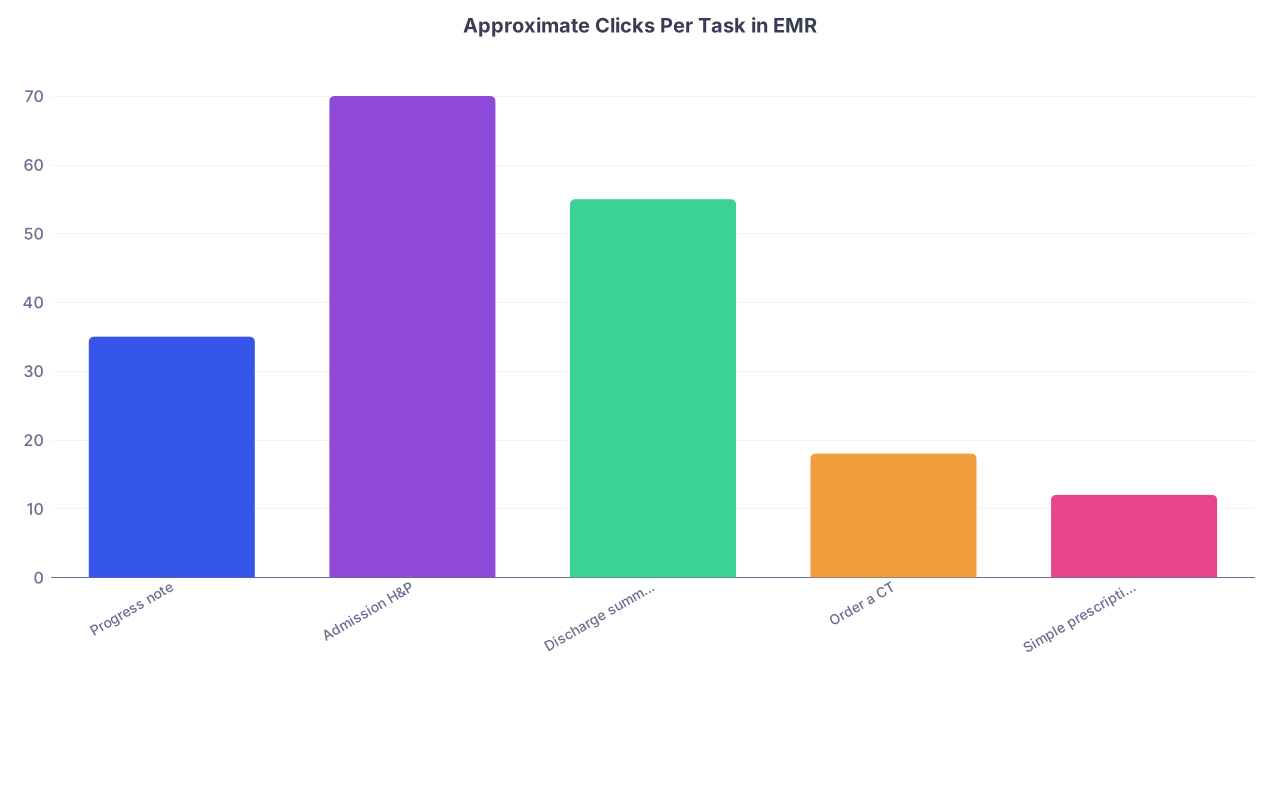
| Category | Value |
|---|---|
| Progress note | 35 |
| Admission H&P | 70 |
| Discharge summary | 55 |
| Order a CT | 18 |
| Simple prescription refill | 12 |
And it is not just the number. It is the unpredictability. Epic vs Cerner vs “Our health system’s custom front-end that definitely made it better” all rearrange the same ten pieces in ten different patterns. So your brain never fully automates the sequence.
You get:
- Progress note flows that jump your cursor to the review of systems first.
- Admission orders that automatically check boxes you would never have chosen.
- Signature workflows that flip between “Sign all” and “Sign selected” depending on which tab you came from.
Individually, you adapt. Together, they turn into the background radiation of your day—constant, slightly toxic, and slowly cumulative.
2. Epic vs Cerner: Two Flavors of the Same Headache
I will say this bluntly: the “Epic is so much better than Cerner” debate is overrated. It is like arguing about which airline coach seat is more ergonomic. They will both still destroy your back on a five-hour flight.
Here is the real differentiation from the user point of view.
| Feature | Epic (typical feel) | Cerner (typical feel) |
|---|---|---|
| Visual layout | Busy but somewhat coherent | Busy and slightly chaotic |
| Learning curve | Steep then plateaus | Mostly steep, never fully smooth |
| Order sets | Powerful, often overloaded | Variable, sometimes half-baked |
| Chart review | Strong timeline tools | More fragmented, many tabs |
| Customization | High but often locked down | High but inconsistently applied |
Epic: “We Can Do Everything. We Will Show You Everything.”
Epic’s core meme is bloat masquerading as power.
You can, in theory:
- Build custom smart phrases that produce beautiful, lean notes.
- Configure personal preference lists that match your practice perfectly.
- Design streamlined order sets that cut hundreds of clicks per week.
Reality for most residents: you inherit a Frankenstein build created by five committees, three chiefs from 2016, and a quality officer who has never rounded.
So your simple CAP admission order set now includes:
- Procalcitonin
- Urine antigens
- A nursing communication to “encourage incentive spirometry q1h while awake”
- Telemetry “just in case”
- Daily BMP “until discontinued,” which no one will ever remember to discontinue
The meme: “Sure, I could fix this. Or I could survive my shift.”
Cerner: “Where Did That Thing Go Again?”
Cerner’s meme is spatial disorientation.
I have watched competent attendings freeze at the Cerner interface, cursor hovering, muttering the classic line: “It was here last week.”
You get:
- Results in one tab, then a different name for the same tab on the next unit.
- Order entry paths that change depending on which screen you came from.
- Half five-click workflows, half thirteen-click workflows for the same task.
Functionally, both systems accomplish the same tasks. The meme-level difference is tone.
Epic feels like: “We can do anything; you are the limiting factor.”
Cerner feels like: “We can do anything; good luck finding it.”
Neither actually respects clinician cognitive bandwidth.
3. Alert Fatigue: The EMR’s Native Language
You know you are deep in EMR culture when your reflex upon seeing a red dialog box is not “What is wrong?” but “Where is the button to make this go away?”
Alerts are the clearest example of how good intentions die by a thousand non-critical notifications.
Common genres of alerts:
- Allergy interaction that is technically real but clinically irrelevant.
- Duplicate therapy warnings for meds intentionally overlapped.
- Renal dosing alerts for one-time doses that you are absolutely giving.
- “This medication is non-formulary” followed by “Substitution chosen automatically.”
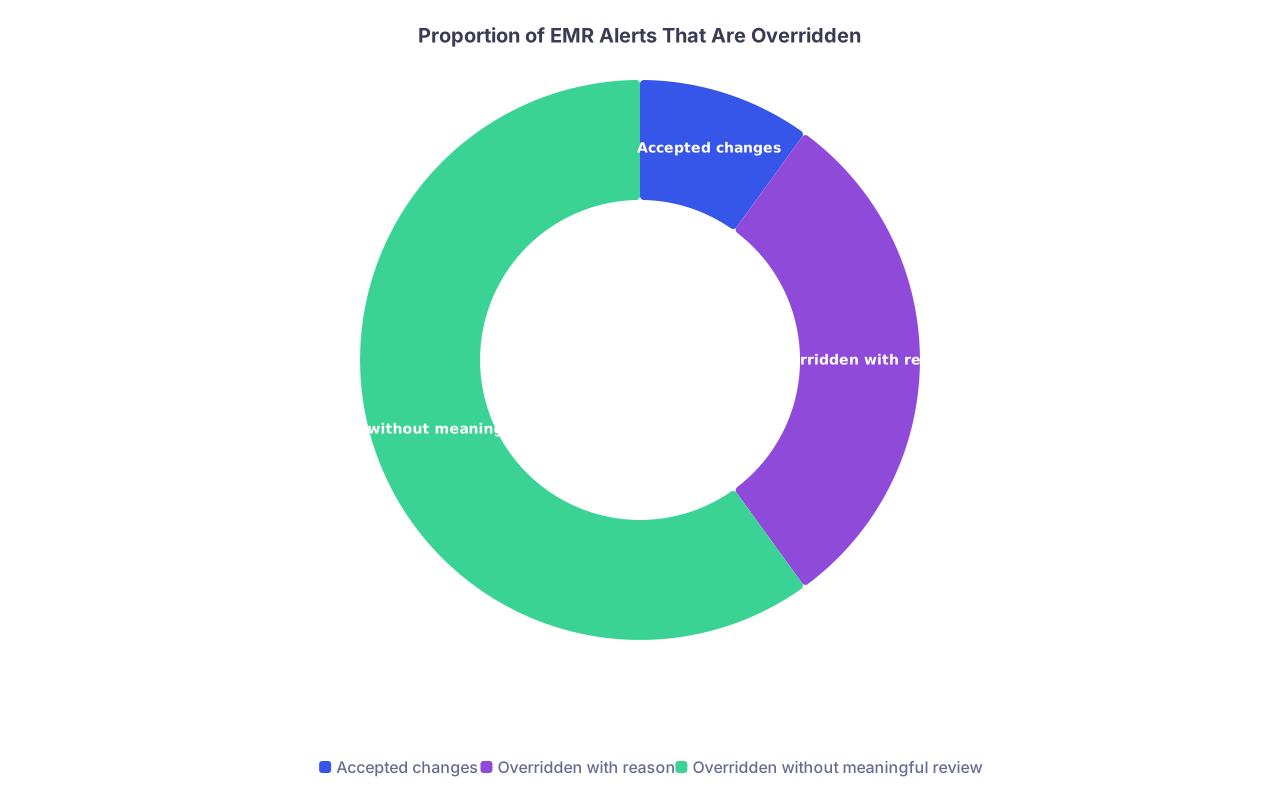
| Category | Value |
|---|---|
| Accepted changes | 10 |
| Overridden with reason | 30 |
| Overridden without meaningful review | 60 |
You click “Override” so often that your muscle memory outruns your actual perception. You start to override before reading. That is the definition of alert fatigue, and EMRs hardwire it into you.
Then, once every few months, there is an actually important alert. Something like:
- “This patient has a history of malignant hyperthermia.”
- “Therapeutic INR > 5 in a patient you are about to anticoagulate further.”
- “Previous heparin-induced thrombocytopenia—avoid heparin.”
And you have trained yourself to hit “Accept / Override / Ok” like a lab rat pressing the food lever. That is not user error. That is design failure.
The micro-meme version: the eye roll + double-click combo on any red box before the brain even engages.
4. Macros, Smart Phrases, and Note Bloat as a Lifestyle
The first time a senior shows you .hpi in Epic and it vomits a perfectly formatted history from your last 30 patients, your eyes light up. The fiftieth time you read a note containing half the chart history, six hospital stays of pasted labs, and a ROS that says “negative for chest pain” on a patient who was admitted for unstable angina, you are less impressed.
Everyone knows the evolution:
Intern discovery phase
“Wait, I can make.tnoteand it will auto-fill my entire trauma template? Genius.”Efficiency high
You build a few sensible macros. They save you minutes per note. Life is good.Copy-paste creep
You start reusing yesterday’s assessment and plan. “I will edit it.” Sometimes you do.Institutional sludge phase
Entire services share a set of macros nobody understands but everybody uses.
Notes turn into legal artifacts, not communication tools.
Here is the actual tradeoff that almost no one spells out to you:
- Good macros cut your keystrokes.
- Bad macros inflate your cognitive load, because you have to verify giant blocks of canned text each time.
So you see “The patient denies shortness of breath” on a patient wearing 4 L nasal cannula, leaning forward, breathing 26/min, and you know exactly what happened. Last admission’s text, mindless copy-over, no one sanity-checked.
There is a reason attending physicians now say things like, “I do not read the notes; I read the med list, vitals, and last 24 hours of events.” They are not lazy. They are responding to a documentation ecosystem that has prioritized volume over meaning.
The meme variant: You scroll for three full swipes on the mouse wheel and you are still in the physical exam section.
5. Order Sets: Clinical Decision Support or Click Farms?
If EMR notes are the written fan fiction of clinical care, order sets are the conveyor belts. They look efficient—one click, dozens of standardized orders. But they are where a lot of the weirdness lives.
You open a “Sepsis” order set:
- Lactate q6h (sure).
- Blood cultures x2 (fine).
- Broad-spectrum antibiotics (ok).
- Tele + continuous pulse ox on a patient who is obviously going to the ICU.
- “Consider” CT imaging pre-checked with contrast.
- DVT prophylaxis, GI prophylaxis, a random PT/OT eval on day 1.
The design intent: bundle best practices, reduce omissions.
The operational reality: list every possible “quality metric” item in a single monster template, and let the clinician uncheck what does not apply.
When it is 2 p.m. and you are well rested, you might curate the list thoughtfully. When it is 3:17 a.m. and you have two more admissions waiting, you hit “Accept” and clean up later. Spoiler: later does not come.
| Pitfall | Example |
|---|---|
| Over-inclusion | CT scans defaulted for low-risk patients |
| Hidden defaults | Telemetry auto-checked in generic orders |
| Metric chasing | VTE prophylaxis orders in clearly bleeding |
| Misplaced hypotheticals | “Consider” boxes that are pre-checked |
| Copy-forward building | Old bad habits fossilized into templates |
The EMR meme here is “just uncheck what you don’t want.” But unchecking requires more time and attention than hitting “next.” And the system is calibrated around the assumption that clinician time is free.
6. Timelines, Flowsheets, and the Art of Never Seeing the Whole Patient
Here is one of the quietly cruel things about modern EMRs: they fragment time.
On paper charts, you literally saw the weight of history. Old volumes on the shelf. Yellowed pages. You had a tactile reminder that this person has been here before, many times.
In EMRs:
- Labs live in one tab, with time compressed into a graph.
- Notes live in another tab, generally useless for actual clinical reasoning.
- Imaging in another viewer, with context stripped away unless you go hunting.
- Orders somewhere else, with status and timing hidden in submenus.

| Step | Description |
|---|---|
| Step 1 | Think of clinical question |
| Step 2 | Open Results tab |
| Step 3 | Check labs trend |
| Step 4 | Switch to Notes tab |
| Step 5 | Skim last two notes |
| Step 6 | Open Imaging |
| Step 7 | Scroll report |
| Step 8 | Open Orders tab |
| Step 9 | Confirm meds and timing |
| Step 10 | Return to main view and decide |
Ask yourself: how many times a day do you reconstruct the last 24 hours for a patient by hopping between three to five windows? That is not just mildly annoying. That is heavy cognitive work.
The micro-meme is staring at the screen, having 90% of the data you need “accessible,” and yet feeling like you do not actually understand what happened to the patient between 2 a.m. and 6 a.m.
Much of the resentment toward EMRs comes from that gap. You are drowning in data, starving for a coherent narrative.
7. Training, Shadow IT, and the Underground Hacks
Almost no one learns the EMR from the actual manual.
You learn it from:
- The PGY-3 who has found exactly three efficient workflows and ignores everything else.
- The nurse who knows the one obscure shortcut to see real-time vitals correctly.
- The pharmacist who shows you the one screen that actually displays renal dosing logic.
So you get a shadow culture of whispered EMR hacks:
- “Never use that order; it fires a useless consult every time.”
- “Use this admit order set, then manually add the antibiotics. The sepsis set is a mess.”
- “This screen looks nice but is slow; use the ugly flowsheet view instead.”

Every hospital develops its own micro-memes:
- “The ICU board is lying—refresh it twice.”
- “The MAR view is the only thing that is actually accurate for meds.”
- “Never trust the problem list; it is a landfill.”
This is what happens when a system is powerful but not humane. Users build folk wisdom to survive it.
8. Humor as Coping Mechanism: The EMR Micro-Memes Themselves
Let us name a few of the classics you will see on every med meme page because they are just that universal.
“Epic is down. Everyone suddenly remembers how to talk to each other.”
For that brief golden hour of a downtime, you see notes written on paper, phone calls about actual plans, and people rediscovering eye contact.“The patient is stable; the EMR is not.”
You have a hemodynamically perfect post-op, but you cannot place a Tylenol order because “Medication reconciliation is incomplete on this encounter.”“My work RVUs vs. my click RVUs.”
The concept that if you got paid for each mouse click, you would be attending-level speed by October of intern year.“Discharge summary: Ctrl+C, Ctrl+V, new date.”
Everyone has seen it. The “updated” 12-paragraph discharge summary that still says “pending MRI” on day of discharge, MRI long done three days ago.“EMR: ‘Please describe why you are overriding this alert.’ Me: Because I went to medical school.”
That beautiful, petty, internal dialogue you do not actually type into the text box, but you think it.
9. The Future: Smarter or Just More?
People like to say AI will fix this. I am not that optimistic yet.
Right now, most “AI in EMR” demos look like:
- Autogenerated notes that perfectly repackage all the same noise, just with better grammar.
- Clinical decision support that adds more alerts, not fewer, because “now we can detect more edge cases.”
- Voice assistants that translate your spoken chaos into beautifully structured, still bloated templates.
Here is what would actually move the needle, from a front-line perspective:
Alert triage
An alert budget. Hard cap. The system must decide which 20 alerts per day it is allowed to show me. That forces genuine prioritization.Time-based skin in the game
Measurable, visible metrics: “Average clicks per order set,” “Average seconds to complete discharge.” Put those on dashboards. Not vanity metrics about “orders completed,” but raw friction metrics.Genuine narrative tools
A single “what actually happened in the last 24 hours” view: vitals, events, key notes, imaging, interventions, all in human-readable sequence. Less spreadsheet, more timeline.Default humility
EMRs should assume the clinician is the brains of the operation and their job is to get out of the way as much as possible. Right now the power dynamic is flipped.
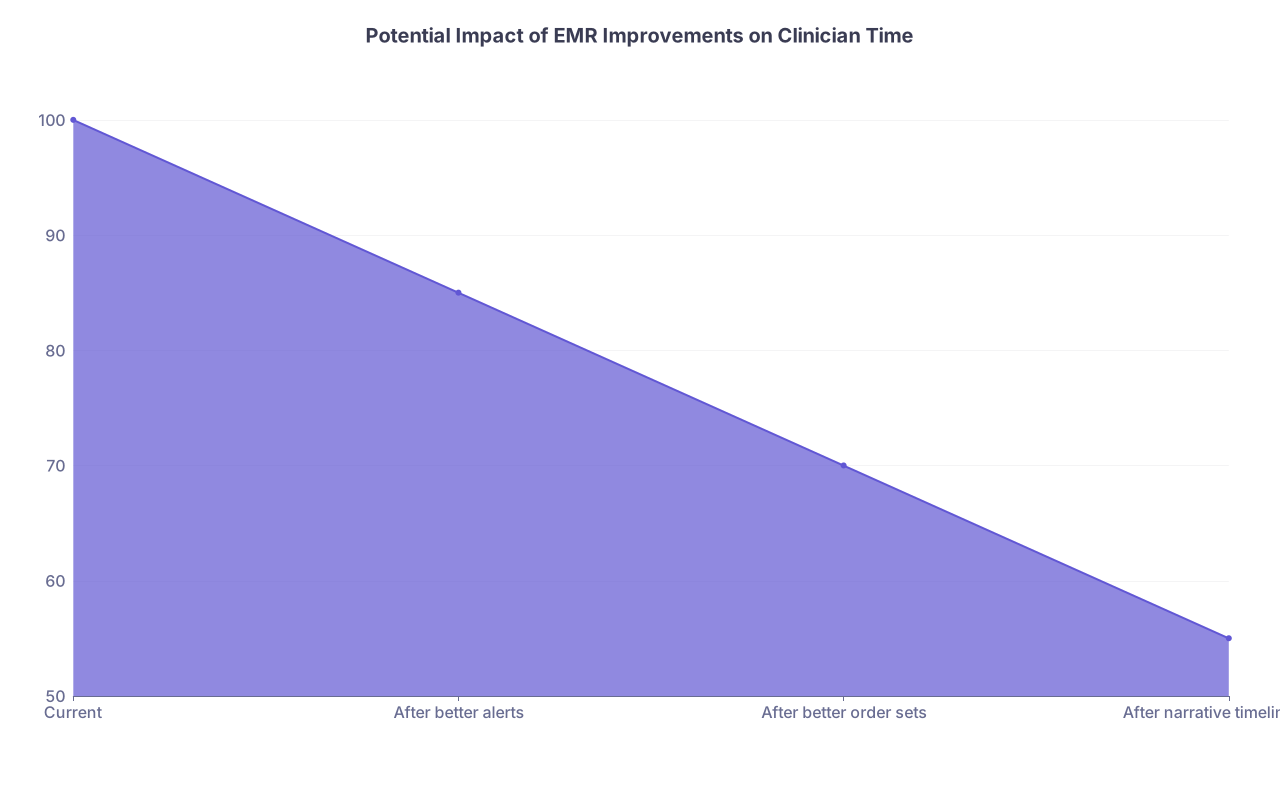
| Category | Value |
|---|---|
| Current | 100 |
| After better alerts | 85 |
| After better order sets | 70 |
| After narrative timeline tools | 55 |
I have seen small pockets where this is starting—ICU flows redesigned by intensivists, oncology order sets actually pruned quarterly, primary care clinics with real-time scribes using the EMR as a backend only. Those environments feel very different. The clicks are still there, but they stop dominating consciousness.
FAQ (4 Questions)
1. Why do EMRs feel so much worse than older paper systems, even though they “do more”?
Because EMRs externalize complexity onto the user. All the billing, quality metrics, safety checks, and reporting obligations that used to be distributed across coders, clerks, and separate systems now sit in front of the clinician as extra clicks, alerts, and fields. You feel the weight of the entire system in your hands every time you open a chart. Functionality increased; cognitive friction skyrocketed.
2. Is Epic actually better than Cerner, or is that just cultural bias?
Most users who have worked extensively in both will say Epic is generally more coherent and customizable. But the difference is smaller than the marketing suggests. A well-configured Cerner instance can easily beat a poorly configured Epic build. The real determinant of user experience is how your institution has shaped templates, order sets, and alerts—local governance matters more than the vendor sticker on the login screen.
3. Are macros and smart phrases “bad” practice or just necessary survival tools?
Macros are neutral tools. Used well, they reduce clerical tedium and free mental energy. Used lazily, they create unsafe documentation that misrepresents the actual exam or thinking. The line is simple: if you paste text that does not match reality and you do not correct it, that is bad practice. If your macros are short, specific, and always edited to reflect the patient in front of you, they are not just acceptable—they are rational.
4. Will AI-generated notes and “ambient documentation” actually fix the problem?
They will fix the keystroke problem, not the information overload problem. Voice assistants and AI scribes will reduce the number of times you touch the keyboard. They will not, by default, make notes shorter, more clinically meaningful, or less repetitive. Unless they are explicitly designed to summarize, prioritize, and compress, they will just automate the production of even more elaborate note bloat. The hard work is not transcription; it is deciding what does not need to be in the chart.
Two key points to leave you with.
First, your frustration with EMR clicks, alerts, and nonsense workflows is not a personal failing. It is a rational response to a system that treats your attention as an infinite resource.
Second, the micro-memes matter. They are not just jokes; they are field reports. Every “one more click” meme is a data point about friction. The day someone starts taking those seriously at the design table, EMR life will get a lot less ridiculous.