
Night float humor is its own subspecialty, and most people completely misunderstand it.
Not “medicine is hard, let’s giggle about it” humor. I mean a very specific, sleep-deprived, cross-cover‑powered comedy culture that only exists between about 7 pm and 7 am, in those fluorescent-lit corners of the hospital where every pager sound is both a threat and a punchline.
Let me break this down specifically. Because if you have not lived cross-cover nights, you are missing an entire dialect of medical comedy.
1. Why Night Float Humor Feels So Different
Night float is not just “the same job, different hours.” The whole psychological and social environment flips.
Day teams have:
- Attending presence
- Consultants everywhere
- Multidisciplinary rounds
- Family meetings and scheduled chaos
Night float has:
- Skeleton staff
- One or two cross-cover residents holding 40–80 patients they only sort of know
- Nurses who have seen everything and have a ranking of which residents panic fastest
- A shared assumption: “No one wants to be here, so we might as well laugh before we cry.”
The humor that emerges is shaped by three forces:
Anonymity of responsibility
You did not admit these patients. You did not make the plan. You inherited a census of strangers with one-liner sign-outs and a prayer. That distance makes certain absurdities funnier. It is not your grand strategy; you are just trying to keep it from catching fire overnight.Compression of decision making
You have minutes, sometimes seconds, with a non-zero chance that the problem is trivial and a non-zero chance that it is catastrophic. The brain copes with that ambiguity through dark, fast, self-deprecating humor.Selective audience
Day-shift humor must be semi-professional and attending-safe. Night float humor is almost always audience‑filtered: fellow residents, night nurses, maybe an RT. Everyone is in the same foxhole. The bar for what is “too dark” shifts noticeably after midnight.
That combination builds a strange little culture with its own memes, scripts, and inside jokes.
2. The Core Character: The Cross-Cover Resident
Cross-cover nights revolve around one archetype: the resident who is covering “everything that buzzes.”
You know the character. They are:
- Holding the cross-cover pager(s)
- Fielding calls for patients they met exactly 14 seconds ago from a sign-out list
- Texting the night intern: “If anyone codes, I’ll be on my way; I’m in 3C trying not to admit this syncope”
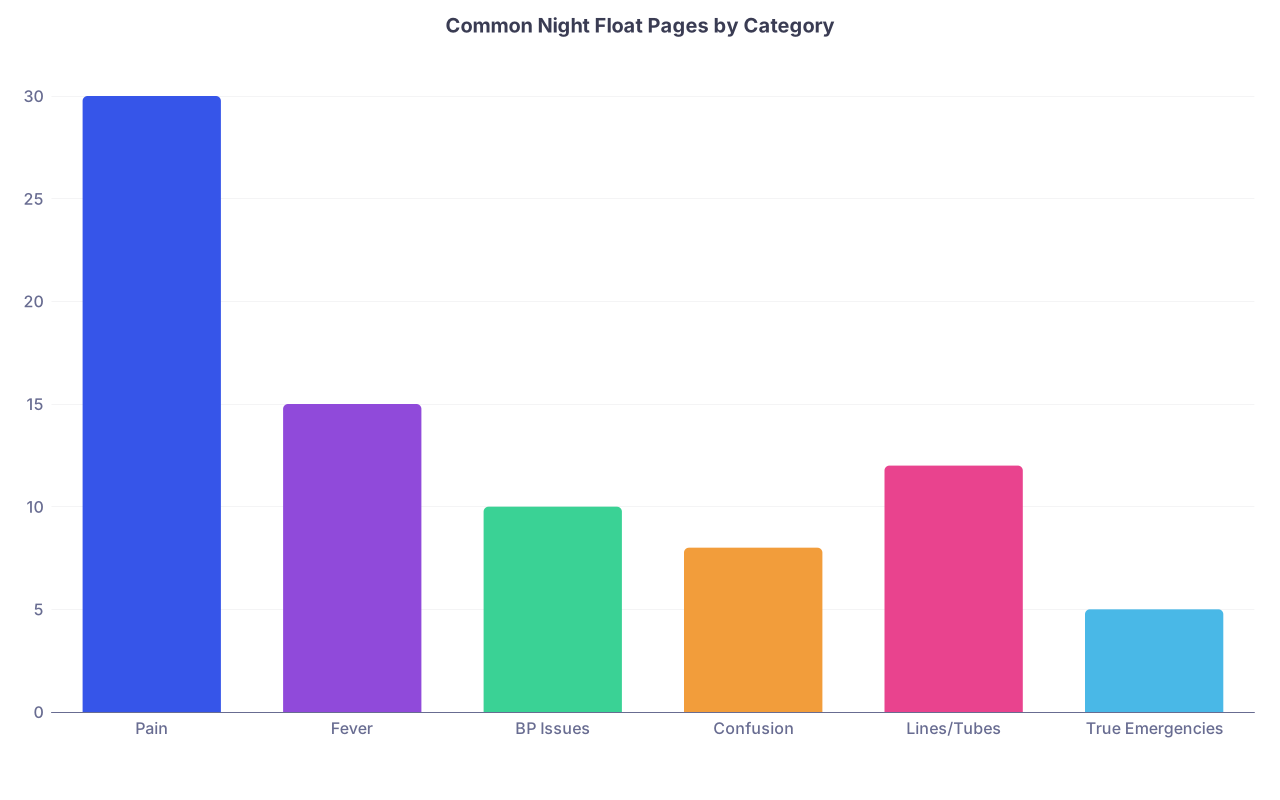
| Category | Value |
|---|---|
| Pain | 30 |
| Fever | 15 |
| BP Issues | 10 |
| Confusion | 8 |
| Lines/Tubes | 12 |
| True Emergencies | 5 |
Most cross-cover humor starts from the mismatch between the gravity of the pager alert and the actual reason you were called.
Example sequence everyone recognizes:
- PAGER: “STAT!”
- Caller: “Room 421, it is urgent, can you please come now?”
- You sprint down the hallway, mentally rehearsing ACLS…
- Nurse, completely calm at bedside: “We just wanted to know if you could change the melatonin to 6 mg instead of 5. He takes 6 at home.”
The comedy is not the request. The comedy is your heart rate of 150 for a melatonin titration.
Night float humor is mainly three types:
Expectation vs reality gags
The way the page is framed vs the triviality or irrelevance of the problem.Hyper-literal interpretations of absurd workflows
“So let me get this straight. He is DNR/DNI, comfort-focused, but you want trops, CT PE, and a stat echo… because the family is curious?”Self-roasting
The standard night-float mantra: “I’m not the doctor you deserve, I’m the doctor who answered the pager.”
3. The Greatest Hits: Classic Cross-Cover Comedy Scenarios
Let me walk through some specific, painfully accurate categories. If you recognize these, you have done real night float.
3.1 The 2 AM Vital Sign Panic
This one is universal.
Pager:
“BP 89/52 on your 87-year-old, can you come urgently, please?”
You show up, slightly breathless, to find:
- Patient asleep, comfortable
- Saturating 98% on room air
- MAP 65–70
- Nurse already has the fluid bolus pulled up “because we always give 500”
The internal script:
- You: “Has it been low like this before?”
- Nurse: “Yeah, his baseline is about this.”
- You: “Did you try rechecking manually?”
- Nurse: “Oh, it’s actually 102/60.”
- You: “So we have all decided to meet for this 102/60?”
The humor is the ceremony. Everyone had to participate. The page. The shoe covers. The manual cuff. The documentation. All to discover the patient is a little hypotensive on a beta-blocker at 2 am. Shocking.
Daytime, this is mildly annoying. Night float, this becomes a recurring bit. People start rating hypotension pages like restaurant reviews.
“Four stars. Very dramatic entrance, but resolution was a manual recheck and a snack.”
3.2 The “PRN Order That Time Forgot”
Classic line:
“Nurse: Can we get some Tylenol? The order expired at 23:59.”
You look. The patient:
- Is POD 1 from a laparoscopic cholecystectomy
- Has “Tylenol x 24 hours” written in a proud, decisive attending note
- Has pain 3/10
- Has six other non-expired PRNs no one has touched
You reorder the exact same medication with the exact same dose and route, now valid until the next unfortunate cross-cover shift.
There is no real conflict here. The comedy is structural. Night float exists partly to renew things that expired with the Earth’s rotation, not with any clinical rationale. Residents joke that half of cross-cover is “extension of orders that died of old age.”
3.3 The “New Fever” Page
This one has its own ritual.
Pager:
“Fever 38.3. He is on your list. Can you put orders?”
You log in. You scroll.
Timeline of events:
- Patient is on hospital day 19.
- Multiple cultures in the past 72 hours.
- Already on broad-spectrum antibiotics.
- Attending note: “If febrile again, likely inflammatory; treat symptomatically unless unstable.”
- Last BPs: 120s–130s systolic. HR 85–95. Saturating well.
You have two options:
- Order the full septic workup because that is the path of least pushback, or
- Follow the day plan, which says: if vitals stable, manage fever symptomatically, no repeat pan-scan.
Night-float humor often lives in the eye-roll your co‑resident gives you when you say, “I pan-cultured the day 19 cellulitis again.” The team knows you did it to avoid a 3 am three-way argument about whether or not to order a lactic acid.
The punchline is predictable:
Next morning, the day team says, “We did not really need all that,” as if cross-cover exists to make philosophical distinctions about inflammatory biomarkers instead of surviving the pager war.
4. The Night Float Lexicon: Phrases and Micro-Jokes
There is a vocabulary that only makes sense at night.
Common phrases:
“Stable for the floor… allegedly.”
Translation: Someone upstream cleared this patient out of their unit. You now own the bargain.“Not my circus, but definitely my pager.”
Translation: This problem started before my shift and will end long after; I am here for the annoying middle part.“We will watch and wait… because I do not want to touch this.”
Translation: Medically appropriate minimal intervention, but delivered with self-awareness that you are also protecting your own sanity.“I am writing the note so that Future Me cannot sue Past Me.”
Translation: Defensive documentation humor. The note is mainly to prove that, at 03:12, you were not entirely irresponsible.“Page me if they stop breathing or start levitating.”
Translation: Reassurance to the nurse that yes, you are okay with stable silliness continuing through the night, with clear boundaries.
The lexicon is loaded with sarcasm, but it is functional. It signals shared experience and shared frustration without hostility.

5. The Cross-Cover Workroom: Where the Real Comedy Happens
The workroom is the stage. If you stick a microphone in a night float room at 2:30 am, the transcript will read like a mix of stand‑up, group therapy, and a clinical case conference.
Standard patterns:
5.1 Pager Story One‑Upmanship
Someone walks in:
“You all are not going to believe this page.”
They describe your classic “STAT call for a laxative” scenario. Everyone laughs, not because it is rare, but because it is painfully common.
Then the escalation begins.
- “That is nothing. I once got a page ‘STAT, patient wants another blanket but the blanket warmer is locked and I do not have the code.’”
- “Oh yeah? Last week I got called to explain to family why we were not doing a repeat CT head, when the patient was actively waving at me and eating pudding.”
This is not pointless complaining. It is how residents metabolize the cognitive dissonance between what all the training is for (life‑threatening pathology) and what the majority of night pages are about (comfort, documentation, bureaucracy, anxiety).
5.2 Real-Time Scriptwriting
Sometimes residents pre‑write their own night:
- “Okay, gang. Place your bets. How many repeat trops on the stable NSTEMI tonight?”
- “Over/under on inappropriate telemetry orders: 3.5.”
They turn patterns into predictions and then check them off. Humor as a probability game.
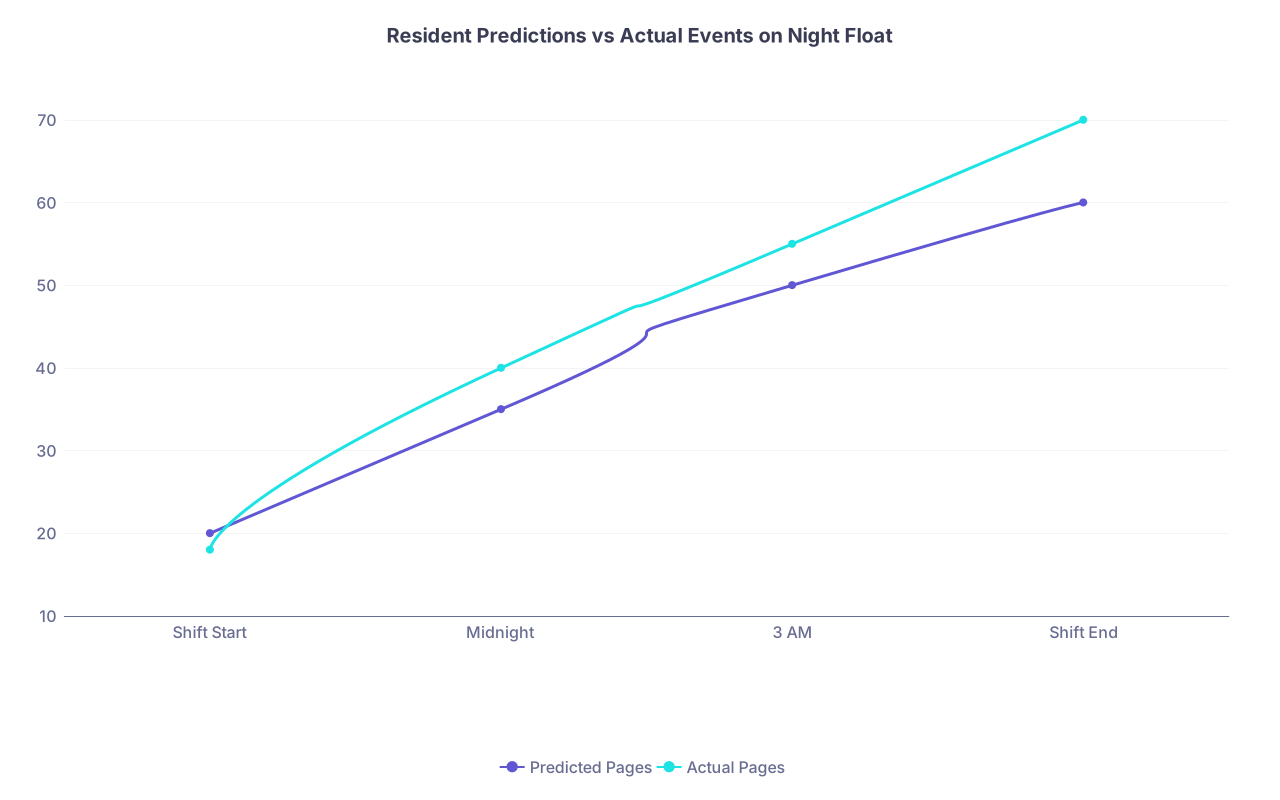
| Category | Predicted Pages | Actual Pages |
|---|---|---|
| Shift Start | 20 | 18 |
| Midnight | 35 | 40 |
| 3 AM | 50 | 55 |
| Shift End | 60 | 70 |
When someone “wins,” the prize is nothing but mock glory and maybe an extra cookie from the nurses’ station. But it turns an otherwise brutal night into something with a shared narrative arc.
5.3 The Sacred Snack Break
At some point, the pages slow for a precious 7–12 minutes. This is when you see peak night float culture.
- Shared snacks appear: leftover pizza from day conference, nurse-brought cookies, the suspicious granola bar that has lived in someone’s bag since intern orientation.
- People drop anecdotes rapid‑fire: worst code story, best “patient thought I was a med student” line, weirdest admitting diagnosis abbreviation.
- Everyone laughs a little too hard at jokes that would barely register at noon.
This is not optional frivolity. It is literally how burnout gets delayed. Snack-fueled comedy is a survival tool.

6. Dark Humor, Ethics, and the Line You Do Not Cross
We have to be honest: night float humor can get dark. Not PG‑13 dark. ICU dark.
There is a reason:
You are seeing human suffering at bizarre hours, with minimal support, while your circadian rhythm is being beaten with a stick. If you strip the humor away entirely, you get resentment, depersonalization, or pure emotional collapse.
That said, good night float culture has rules. Most of them unspoken.
Lines that seasoned residents typically hold:
Laugh at the system, not the suffering.
Jokes about the absurdity of 14 redundant clicks to renew a DVT prophylaxis order? Fair. Jokes about a family’s grief? Not acceptable.Self‑deprecation is always safer than external sarcasm.
“I have typed ‘monitor for now’ so many times that my EMR may auto‑fill it on my tombstone” is fine.
“This patient is so annoying” is lazy and corrosive.No punching down.
Nurses, RTs, CNAs, junior trainees, families — they are not your targets. The real enemy is usually documentation rules, billing artifacts, nonsense metrics, and poorly designed workflows masquerading as “safety.”
The best night float crews police each other subtly. You will hear:
- “Yeah, that one is not funny.”
- “Dude, that family is going through hell; do not drag them into the joke.”
- Or the powerful silent version: nobody laughs, and the person who crossed the line notices.
Healthy night float culture uses comedy to keep people humane, not to erode their empathy.
7. Night Float vs Other Rotations: Why the Humor Feels Unique
The comedy patterns on night float are not the same as, say, the ED, ICU, or day inpatient.
Let me compare them cleanly.
| Setting | Typical Humor Style | Main Target of Jokes |
|---|---|---|
| Day Inpatient | Mild sarcasm, process jokes | Rounds, documentation, consultants |
| ICU | Very dark, technical, insider | Pathophysiology, futility, devices |
| ED | Chaotic, story-based, rapid-fire | Volume, triage, bizarre presentations |
| Night Float | Absurdist, self-deprecating, pager-driven | System quirks, timing, miscommunication |
Night float is uniquely:
Pager‑centric: Everything is reactive. You rarely initiate. You respond. So much of the humor is about the mismatch between urgency and reality.
Low-attending density: Social filters loosen. People are more honest. The jokes become more candid and less polished.
Continuity‑lite: You often experience just a snapshot of a patient’s story. That partial view makes certain contradictions (goals of care vs orders, consultant recommendations vs primary team reality) stand out more starkly, which makes them ripe for commentary.
Circadian-poisoned: Sleep deprivation lowers inhibition and increases the sense of surrealism. Stuff that would be merely annoying at 10 am becomes absurd enough to be funny at 3 am.
That mix does not really exist in any other environment.
8. Technology, Future of Medicine, and the Death (or Evolution) of Night Float Comedy
Let us talk about the future. Because medicine is changing, and night float humor will either mutate or die out in certain forms.
8.1 AI Triage and Smart Paging
We are already seeing early experiments:
- Smart paging systems that categorize urgency.
- AI-driven “nurse call” triage assistants that suggest when something can wait or be handled by protocols.
- EMR-integrated bots that recommend order sets for frequent problems.
In theory, that means:
- Fewer “STAT melatonin” pages.
- More structured handoffs where the cross-cover resident gets real context.
- Some pages auto‑answered by standing orders or protocol suggestions.
What does that do to the comedy?
- It kills some of the highest‑yield jokes — the unnecessary, overblown STAT calls — but only if the systems are actually good.
- New jokes will appear about the AI itself: “The bot suggested a CT PE for toe pain again,” etc.

| Step | Description |
|---|---|
| Step 1 | Patient Issue |
| Step 2 | Protocol / Standing Order |
| Step 3 | Nurse Calls Resident |
| Step 4 | Code / Rapid Response |
| Step 5 | Resident Evaluates |
| Step 6 | Document and Plan |
| Step 7 | AI Triage |
The focal point of humor may slowly shift from “ridiculous pages” to “ridiculous AI suggestions” or “this algorithm clearly never worked a night shift.”
8.2 Remote Monitoring and Virtual Cross-Cover
Another trend: remote telemetry monitoring, “hospital at home,” and virtual cross-cover physicians.
Imagine:
- Centralized night float service covering multiple hospitals via telemedicine.
- Remote physicians triaging calls, reviewing vitals and labs on large dashboards, sending local staff to the bedside when truly needed.
The culture changes:
- Less shared physical misery. Harder to bond over the bad coffee when you are not in the same room.
- More text‑based and meme‑based humor in group chats and Slack channels instead of out-loud jokes in the workroom.
Humor becomes:
- Screenshotting absurd EMR recommendations.
- Posting “pager haiku” in group chats.
- Roasting the latency of the video call when a nurse is trying to show you the patient’s rash with a camera that refuses to focus.
I suspect we will lose some of the visceral, shared-in-person chaos, but we will gain a new flavor: “remote-control doctor” comedy, with its own mishaps and glitches.
8.3 Structured Work-Hour Protections
There is a legitimate move to improve night coverage:
- More nocturnist attendings
- Nurse practitioners and PAs dedicated to nights
- Caps on cross-cover list sizes
- Built-in protected nap blocks in some experimental systems
These are good. They should exist. But they will absolutely change the vibe.
If nights become:
- Better staffed
- Less chaotic
- More supervised
Then the role of night float humor as a coping mechanism may soften. People who are not exhausted and desperate tend to be less funny, but also much less broken. Which is a trade most sane people are willing to make.
The comedy that remains will probably be:
- Gentler
- Less dark
- More focused on stupid bureaucracy than existential despair
That is not a bad future.
9. Why This Comedy Culture Actually Matters
Someone might argue: “Who cares what residents joke about at night? As long as they do their job.”
Wrong. The humor tells you how people are really doing.
You know a toxic night float environment instantly:
- Jokes are mean, punching down at patients, nurses, or each other.
- No one intervenes when someone crosses a line.
- Laughter has a sharp, bitter edge, and no one looks lighter afterward. The room just gets more tense.
You also know a healthy team:
- People roast the system together, not each other.
- After a rough code or a bad outcome, there is space for both serious debrief and a few understated, shared jokes that acknowledge how hard that was.
- New interns are gently trained in where the humor boundaries are.
I have seen this play out:
One intern cracks a joke about “the frequent flyer in 512” that veers into mocking their social situation. The senior quietly says, “No, that guy has had a rough life; our job is not to laugh at that,” and then shifts the target of the next joke to the 14-step order set for an IV fluid bolus. Culture corrected in 8 seconds, no grand lecture necessary.
Night float comedy is not a side quest. It is one of the most accurate barometers of team culture and emotional health.

10. If You Are Heading into Night Float Soon
A few direct, practical points to carry with you:
- You are allowed to find things funny. Even during serious work. That does not make you unprofessional.
- Aim your jokes at systems, workflows, and yourself, not at vulnerable people.
- Use the workroom as a pressure valve. Step away from the bedside, then decompress with your crew.
- If something starts to feel less “funny” and more “I am actually furious or numb,” that is a warning sign, not a badge of toughness.
- Pay attention to the seniors who joke in a way that leaves everyone feeling lighter, not darker. Copy them shamelessly.
With a bit of luck, you will start collecting your own “you are not going to believe this page” stories. When you tell them right, they become part of that strange, resilient culture that has kept residents semi-sane through thousands of fluorescent-lit nights.