
It is 03:17 in the ICU. The vent alarms have finally quieted down after a chaotic reintubation. Someone just cracked a one-liner about “adding ‘professional CPR participant’ to the patient’s problem list,” and the whole team snorts, then goes right back to charting. If you recorded that joke and played it at a community picnic, you would be escorted out. Up here? It barely registers as “mild.”
That gap—the distance between “what’s funny in the ICU” and “what’s acceptable in normal human society”—is what we are talking about.
Let me break this down specifically. ICU humor has rules. They are not written, but they are tight, enforced by culture, timing, hierarchy, trauma, and proximity to suffering. If you are new to high-acuity care and you do not understand those rules, you will either (a) be horrified by your colleagues, (b) say something that makes everyone freeze, or (c) both.
This is your crash course.
1. Why ICU Humor Is So Weird (And Why It Exists At All)
Start with this: the ICU is emotionally non-normal. You cannot bring “normal” emotional processing into a place where you code three patients in a shift, deliver a death notification, titrate ten drips, and argue with three subspecialties about goals of care.
Normal coping breaks. People crack.
Humor in the ICU typically serves four specific purposes:
- Pressure relief
- Boundary drawing
- Team bonding
- Cognitive distancing
Let me walk through each, clinically, not philosophically.
Pressure relief: the mental safety valve
Staff in high-acuity units see:
- Multi-organ failure in 30-year-olds
- Prolonged deaths that drag out for weeks
- Families fracturing under stress
- Errors and near-misses they replay at 02:00 for years
You cannot “mindfulness” your way out of that, shift after shift. So your brain finds shortcuts. A sharp, dark joke in the workroom after a traumatic event is basically a localized decompression. A controlled burn.
Without it, people either numb out completely or burn out fast. I have watched very “sensitive,” humor-averse trainees white-knuckle it for a few months and then abruptly switch specialties or leave clinical work altogether. They underestimate how much an occasional ugly laugh keeps the grimness from eating you alive.
Boundary drawing: “us” versus chaos
The ICU runs on team identity. “We” keep critically ill patients alive when other areas cannot. Humor becomes one of the ways you mark the line between “us in here” and “the chaos out there.”
That is why you will hear recurring bits about:
- Certain consulting services (“Cardiology will sign off before their coffee gets cold”)
- Specific kinds of notes (“The 3-page daily nephro manifesto”)
- Chronic complainers, frequent flyers, “ICU vacationers” who come in on BiPAP three times a month
On the surface, some of this sounds mean. Underneath, it is group shorthand: we understand this environment, we know these patterns, we survive this absurdity together.
Team bonding: shared language under stress
Humor is also a form of micro-check-in. If a nurse can still throw a sarcastic comment at you after a brutal intubation, you know they are not completely shut down. If your senior can still make a dry aside about your note while walking toward the next code, you know they are mentally online.
There is a reason most ICUs have a small library of running jokes that every nurse, RT, and resident knows by week two. You are not just working together—you are surviving a bizarre ecosystem together. Inside jokes are glue.
Cognitive distancing: laughing at the horror so you can keep moving
This is the piece that outsiders misjudge. ICU humor gets dark because the situation is dark. That darkness lets clinicians create just enough distance to function.
Example: after pronouncing a patient who arrested unexpectedly for the second time that week, someone mutters quietly in the workroom, “Well, at least they waited for day shift change. That was polite.” That is not because they do not care. It is because they care so much that staring straight at the horror all day would crush them.
The key: this kind of humor has to be aimed at the absurdity of medicine, not the dignity of the person dying. That line matters.
2. The Unwritten Rules: What You Can Joke About (And What You Cannot)
Contrary to what it might look like on first glance, ICU humor is not anything-goes. It is heavily rule-bound. People who break those rules do not last long, or they become the person everyone avoids post-call.
Let’s separate this into “green light,” “yellow light,” and “absolutely-not.”

Green light targets (relatively safe)
These are the classic, socially accepted ICU humor domains:
- Yourself
- Your own mistakes (non-harmful, already debriefed)
- The system’s dysfunction
- Call schedules and sleep deprivation
- Bureaucracy and documentation madness
Examples:
- “If I open one more prior auth fax during a code, I’m going to add it to the ACLS algorithm.”
- After a senior catches your non-harmful medication typo: “Perfect, I almost gave him 10 milligrams of levophed. New vasopressor trial.”
You are often punching up or inward, not down. It is safer and signals humility.
Yellow light: content that depends on timing, company, and tone
A lot of ICU humor lives here. It can work or it can blow up in your face.
Topics include:
- Gallows humor about death
- Jokes about frequent flyers / non-adherent patients
- Commentary on futile care and unrealistic expectations
- Sarcasm about other specialties
What decides if it is acceptable?
- Location: workroom versus bedside
- Audience: peers versus families versus students
- Emotional state: raw moment versus decompression period
- Power differential: attending joking down vs intern joking up vs nurse joking about the team
Wrong-time example: Immediately after withdrawing care, junior resident mutters, “One less chart to write,” as family is walking by. That is career-limiting, and also just cruel.
Right-time example: Later, in the staff room after a clear, compassionate family meeting, the team decompresses:
“Family wanted everything done until they heard that meant ‘everything except living forever’”
Tone is exhaustion and frustration with unrealistic expectations about medicine, not mockery of the specific grieving family.
Red line: absolutely-not topics
Here is where I am going to be explicit. There are things you do not joke about in the ICU. Not “be careful.” Not “read the room.” Just don’t.
- Specific patient’s suffering, appearance, disability
- Religion, race, gender identity, sexual orientation
- Socioeconomic status or immigration status as punchline
- Sexual jokes about staff while working (the “locker room ICU” guy is always a problem)
- Malicious mocking of a family’s grief, confusion, or cultural practices
- Any comment that undermines consent, assault, or abuse
This is not “woke policing.” It is professionalism, ethics, and also basic survival. One recorded out-of-pocket joke, one staff member who reports you, and you can have formal complaints, wellness investigations, or worse.
I have seen a senior resident make a flippant comment about an intoxicated patient’s cultural practice. He thought he was being edgy. Overnight nurse documented it, reported it. That resident spent months in remediation and never fully recovered their reputation in the unit.
3. Who Gets To Joke? Hierarchy And Permissions
Another non-obvious piece: the same joke lands very differently depending on who says it.
Attendings and seniors: their jokes set the tone of the unit
When an intensivist makes a dark comment, everyone reads it as a signal.
- If they habitually mock families, residents will quietly follow
- If their jokes are self-deprecating and system-directed, the unit humor culture tends to be healthier
Example difference:
- Bad: Attending post-call in front of team, re: a poor family’s request for “more time”: “They want more time; we’re giving them more organ failure.” That kind of line stains the air.
- Better: In the workroom: “We are very good at prolonging the process of dying. Sometimes I feel more like a mechanic than a physician.” Still dark, but the target is the structure of ICU medicine.
Bottom line: senior folks do not just get more leeway. They carry more responsibility. Their humor licenses or curbs everyone else’s.
Nurses, RTs, and other core staff: the true cultural barometers
If you want to know where the humor line really is in your ICU, watch the nurses and RTs.
They are there more hours, they see more of the families, they hold more of the emotional weight. Their tolerance for particular jokes is your best guide.
If the ICU nurses do not laugh, or they fall silent, you have probably crossed a line. If they are the ones initiating a gallows comment after a code and everyone exhales, that is usually “safe” internal culture.
Critical rule for physicians and residents: do not escalate darker than the nurses. If they are keeping it light, do not be the edgy hero.
Trainees and new staff: you are on probation
Interns, new nurses, travelers—your humor license is limited early on, even if no one tells you that out loud.
The unit has not mapped your judgment yet. They do not know your baseline:
- Are you actually compassionate or just cynical?
- Do you show up for codes?
- Do you sit with families for hard conversations?
Until people see that side of you, a dark joke looks like cruelty, not coping.
So the practical rule is simple: keep your humor directed at yourself, the EMR, and vague “medicine is absurd” topics for the first couple months. Let the unit invite you into the darker shared jokes, not the other way around.
4. Context Is Everything: Where, When, And Around Whom
Same sentence. Different context. Completely different impact.
The map of ICU humor “zones”
Here is a rough taxonomy of ICU spaces and how “hot” your humor can be:
| Location | Humor Intensity Allowed | Notes |
|---|---|---|
| Bedside (patient/family) | Minimal, gentle only | Supportive, never dark |
| Hallway near rooms | Very light, neutral | Conversations easily overheard |
| Workroom with closed door | Moderate to dark | Main decompression zone |
| Public areas (elevator, café) | Neutral, professional | You represent the hospital |
| Charting area near nurses | Light to moderate | Families often walk by |
This is not theoretical. Families hear more than you think. Sound travels bizarrely well at 2 am in a quiet unit. A side comment in what you thought was a private alcove ends up being the one sentence a daughter remembers when she thinks about her father’s death.
Timing: there is a before and an after
Three time phases matter:
- Active crisis (code running, intubation in process, severe desat)
- Immediate aftermath (first 10–15 minutes post-event)
- Later debrief / long after (end of shift, night float handoff)
Dark humor belongs, if anywhere, in zone 3.
During the code itself: you keep it tight. The only “humor” that surfaces is very task-focused (“I will buy coffee for whoever finds the pulse first”) and even then, only within a mature, stable team that knows each other.
Immediate aftermath is dangerous territory. Emotions are raw. People are replaying actions, grieving, doubting themselves. This is where glib comments can do real psychological damage.
Safer behavior in that window:
- Simple validation: “That was rough.”
- Factual recap: “We did two rounds of epi, no response, time of death 14:32.”
- Silence.
Later—when people have settled, when you are in the workroom, when someone sighs and says, “Okay, I need a terrible joke or I am going to cry”—that is where gallows humor can actually function as relief instead of avoidance.
5. Typical ICU Humor Themes (And What They Reveal)
If you listen for a week, you will hear the same patterns. ICU comedy is actually pretty predictable.
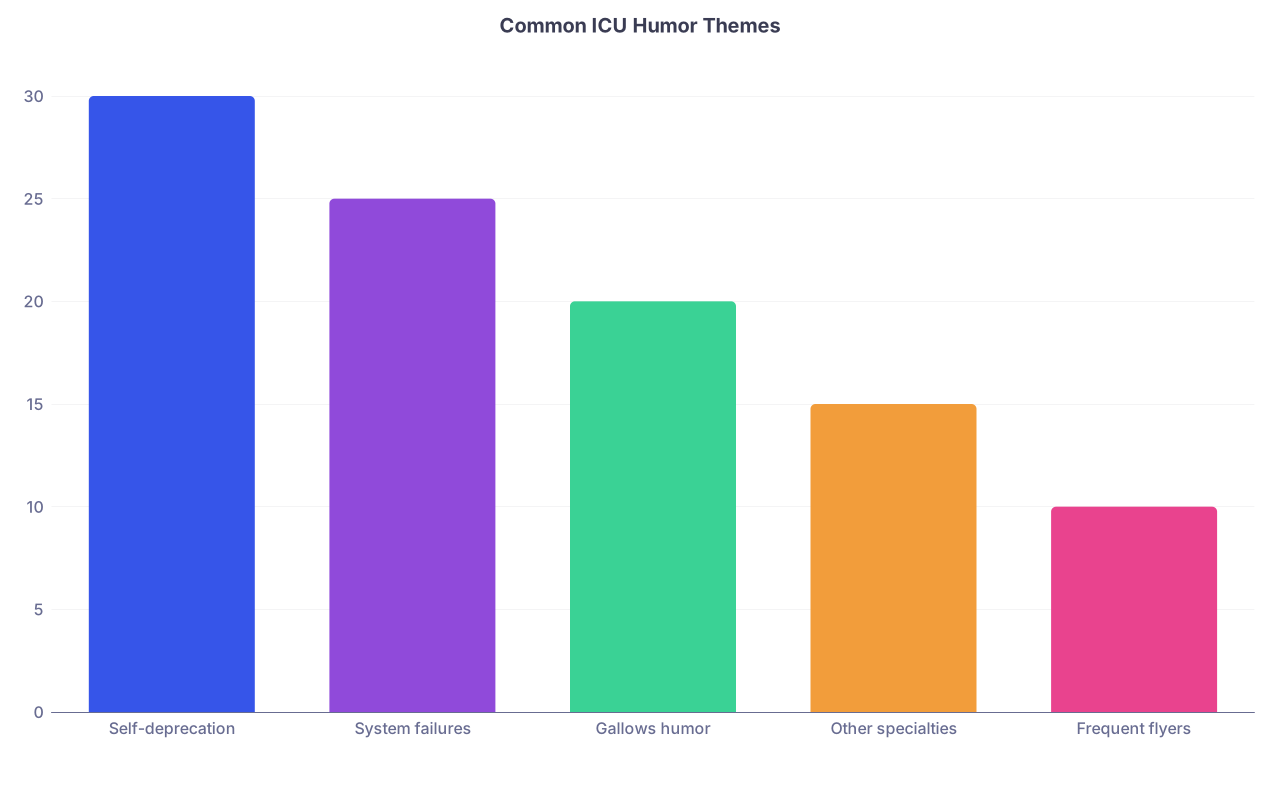
| Category | Value |
|---|---|
| Self-deprecation | 30 |
| System failures | 25 |
| Gallows humor | 20 |
| Other specialties | 15 |
| Frequent flyers | 10 |
1. Self-deprecation and competence
This one is universal. The attending who jokes about their aging back during proning. The intern who calls their own signout “a cry for help formatted in bullet points.”
Why it works:
- Signals humility, not arrogance
- Reminds the team that perfection is impossible
- Reduces hierarchy tension
Bad version: “I have no idea what I’m doing, haha.” That worries people. Good version: “I wrote three different ventilator plans for this guy before deciding on the most standard one.”
2. System and bureaucracy absurdity
ICU folks have an endless supply here:
- EMR alerts that fire in the middle of a code
- Mandatory trainings that ignore real-world workflow
- Bed management insisting on transfers while a patient is actively unstable
Example: “Good news, bed control wants to know if our code blue will vacate the bed in time for their noon transfer.” People laugh because that tension between patient care and system metrics is brutally real.
This theme is safe, cathartic, and often points to actual QI needs.
3. Gallows humor about death and futility
The classic high-acuity dark stuff.
Formats:
- Jokes about how long we can keep organs going
- “The vent is doing fine, shame about the rest of them”
- Comments about how “ICU care” can become warmed, monitored suffering
When used among seasoned staff who have already demonstrated compassion, this can be psychologically protective. When used by someone who seems detached and cruel, it becomes moral injury fuel for others.
4. Specialty stereotypes and consult jokes
ICU humor about other services is basically professional gossip with a punchline.
Examples:
- Surgery: “He is stable enough for the OR but not stable enough for a family meeting.”
- Cardiology: “They said the EF is 15%, but they would like us to ‘optimize’ before they see.”
- Neurology: “Neuro examined him and concluded he is sick.”
These jokes are rarely neutral; they carry frustration about real behavior patterns. Overdone, they poison collaboration. Sparingly used, among insiders, they ventilate annoyance.
5. Frequent flyers and non-adherence
Here is the tricky one: comments about patients who return over and over with COPD exacerbations from smoking, uncontrolled DKA from skipping insulin, alcohol withdrawal, etc.
Healthy version: acknowledging complex social determinants, addiction, and limited outpatient support.
Unhealthy version: pure contempt.
Look at the actual language. “Our COPD guy is back, the system failed him again” versus “He won his punch card—10th admission gets a free intubation.” The second might get a laugh. It also makes the medical student quietly wonder if you see the patient as human at all.
6. When ICU Humor Goes Too Far: Real Consequences
This is not just a vibe issue. Bad humor in the ICU can cause actual harm.
Moral injury internally
If one person’s coping mechanism violates another’s ethical boundaries, you get moral injury.
Classic scenario: A nurse feels a bond with a long-stay patient. After the patient dies, a resident cracks an edgy joke about “finally getting that bed back.” Nurse goes home feeling complicit in something ugly, even though she said nothing.
Over time, repeated exposures like that contribute to burnout much more than people admit. They erode the sense that you are part of a fundamentally decent team.
Trust erosion within the team
Once someone has crossed a major line, colleagues do not un-hear it. You can be the smartest resident in the hospital, but if you made one vile joke about a vulnerable patient population, there will always be people who simply do not trust you fully again.
They might still work with you. They will not confide in you or seek your help for emotionally heavy cases.
Formal complaints and institutional fallout
Modern medicine is wired with microphones: patients’ families, other services, nurses, students, RTs. Any one of them can report unprofessional behavior. Hospitals are under real pressure to address such reports.
One badly timed joke about, say, an intoxicated patient’s religion, overheard by a student, can show up in:
- Evaluations
- Professionalism referrals
- HR investigations
- Even social media if someone writes an anonymous post
You do not want to be the “example” case in the next professionalism lecture.
7. Practical Rules For Surviving ICU Humor As A Trainee Or New Staff
You want concrete guidance? Here it is.
Rule 1: Start at “PG-13” and let the team move you
For your first 1–2 months:
- Jokes about your own fatigue, your own clumsiness: fine
- Jokes about EMR, bureaucracy: fine
- Any joke that depends on the patient’s suffering for the punchline: skip it
Listen more than you talk. Map who jokes, about what, and when.
Rule 2: Never joke at the bedside. Ever.
I am blunt on this one. Do not joke at the bedside, even if it is about the EMR or your own misery. Families and patients will either misinterpret, feel excluded, or feel dismissed.
If a family tries to make a light comment, you can respond warmly. But do not join in with gallows humor. They are in a different emotional universe.
Rule 3: Aim humor upward or inward, not downward
This is the ethical rule of thumb:
- Upward: system, leadership, bureaucracy, your own training stage
- Lateral: yourself and peers
- Downward: vulnerable patients, families, marginalized groups – off limits
If the butt of the joke has less power than you, assume it is a bad idea.
Rule 4: Match, do not one-up
If the attending makes a dry black-humor comment, your job is not to out-edgy them. At most, you match tone gently. Preferably, you keep it slightly lighter.
New people get burned by thinking, “Oh, we are allowed to say anything here.” No. The attending might have 15 years of demonstrated compassion behind that one dark quip. You do not.
Rule 5: Watch for the silent reaction
Pay attention after a joke lands. Not just to the laughers. To the quiet ones.
If someone goes quiet, looks uncomfortable, or leaves the room, that is not your cue to double down. It is a cue to log that as a boundary.
A mature move in a small group: “Sorry, that came out wrong,” or, “Yeah, that was darker than I meant.” No long self-justification. Just a quick reset.
8. The Future Of ICU Humor: Where This Is Going
You are not practicing in 1995. Several trends are tightening the screws on what flies in high-acuity humor.
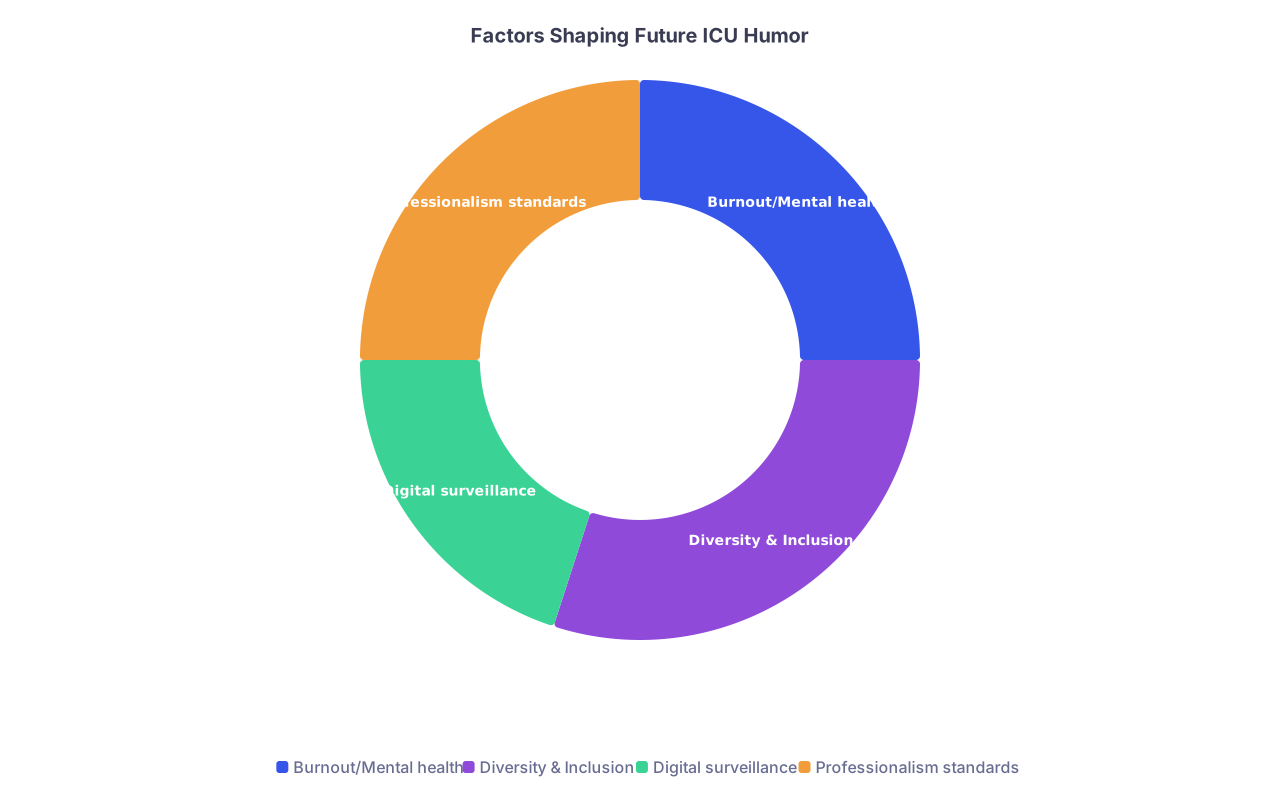
| Category | Value |
|---|---|
| Burnout/Mental health | 25 |
| Diversity & Inclusion | 30 |
| Digital surveillance | 20 |
| Professionalism standards | 25 |
Increased focus on burnout and mental health
Programs are finally admitting that ICU work breaks people. Along with that comes increased attention to coping mechanisms. Dark humor is being discussed openly in wellness curricula.
Outcome: more nuanced thinking. Not “gallows humor is bad,” but “which kinds help, which kinds harm, and for whom?” I expect you will see more formal teaching about this, not just whispered side advice.
Diversity, equity, and inclusion
ICUs are more diverse than they used to be—staff and patients. What a mostly-homogeneous group could once say to each other “safely” fell apart the moment people with different life experiences joined the team.
If your joke relies on stereotypes, cultural shortcuts, or anything that assumes shared background, it is likely doomed. That is not censorship. That is working in a pluralistic environment.
Digital surveillance and permanent records
The era of “closed door, no one will ever know” is over. Phones record. Hallways have cameras. Charts document unprofessional comments if someone is angry enough.
So the practical bar is higher. The default needs to be: “If someone recorded this and played it out of context, would I still stand by it as human and professional?” If the answer is no, do not say it.
Rising professionalism expectations from patients and society
Patients Google your hospital. They read reviews. They write op-eds. They talk about their loved ones’ ICU stays on Reddit.
That does not mean “never express emotion at work.” It does mean that the defense of “It was just a joke” carries much less weight when your work is funded, scrutinized, and judged by the public.
9. So How Do You Laugh And Still Sleep At Night?
Let’s be practical.
You can keep humor in the ICU and keep your conscience, if you stick to a few core anchors:
- Maintain obvious, demonstrable compassion in your actions. Humor should never be the most salient thing about you.
- Use humor to connect, not to control. A joke that helps a colleague breathe after a code is serving a purpose. One that shuts down a trainee’s feelings is just cruelty with a punchline.
- Be willing to apologize. You will misjudge sometimes. If someone tells you a line crossed a boundary, believe them.
And ask yourself occasionally: “If I were the patient hearing this, or the family member who just lost someone, what would I think of the people making this joke?” If the imagined answer makes you queasy, good. That is your moral compass kicking in.
Key Takeaways
- ICU humor exists because constant exposure to death, futility, and system absurdity would crush people without some kind of pressure release.
- The only sustainable version targets yourself and the system, stays away from vulnerable patients and families, respects context, and follows the lead of seasoned, compassionate staff.
- As expectations around professionalism, diversity, and mental health increase, the future of ICU humor will be less about “Can we joke?” and more about “Can we use humor in ways that keep us human without dehumanizing anyone else?”