The funniest moments in medicine never happen at the comedy show. They happen at 06:12, in a hallway that smells like chlorhexidine and burnt coffee, while you are trying not to yawn in front of a vascular surgeon.
Let me break this down specifically: rounds, handoffs, and sign-out are structurally humorless. They are rigid, hierarchical, time-pressured, and saturated with cognitive load. And yet that is exactly where the best micro‑humor lives. The tiny, rapid-fire, sub‑second interactions that keep teams sane and, frankly, keep errors at bay.
You do not survive residency on resilience. You survive on one‑liners between patients 4 and 5.
Why Humor Clusters Around Rounds, Handoffs, and Sign-Out
Humor in medicine is not random. It clusters where three forces collide:
- High stakes
- High structure
- High repetition
Rounds, handoffs, and sign-out are the perfect storm. You are saying some version of the same sentence 50 times a day. Everyone is tired. The social script is strict: be concise, be deferential, be “professional.”
So your brain starts looking for ventilation points. Micro‑breaks. That shows up as:
- One dry remark about “Mr. 1.2 sodium correction per hour”
- An attending’s deadpan when the EHR crashes
- A senior’s running joke about the “magical 24 hours of IV antibiotics”
You get these tiny pressure valves because you cannot run a twelve‑hour day on pure cortisol. The trick is recognizing the structure of these micro‑moments so you can use them well—and not get yourself reported to GME.
| Context | Time Pressure | Hierarchy | Repetition Level |
|---|---|---|---|
| Rounds | High | Very High | Very High |
| Handoffs | Medium | Medium | High |
| Sign-out | High | Medium | High |
| Family meetings | Medium | High | Low |
| Procedures | Variable | High | Medium |
Humor is densest where routine is densest. Because repetition begs for variation.
Rounds: Deadpan, Callbacks, and the Art of the Side Comment
Rounds are theater. Tight blocking, fixed lines, predictable characters. That predictability is exactly what makes small jokes land so hard.
The structure of a typical micro-joke on rounds
Look at a simple medicine ward team:
- Attending
- Senior resident
- 2–3 interns
- 1–3 students
- Maybe a pharmacist, maybe a case manager, one or two nurses drifting in and out
Everyone knows the script:
- “This is a 64-year-old male with a history of…”
- “Overnight events include…”
- “Exam unchanged from prior…”
The micro‑humor sneaks into the negative space around that structure. Three main places:
- Before entering the room
- While walking between rooms
- Immediately after leaving the room
Inside the room, the stakes for perceived “professionalism” go way up. Outside, the hierarchy relaxes by 10–15%.
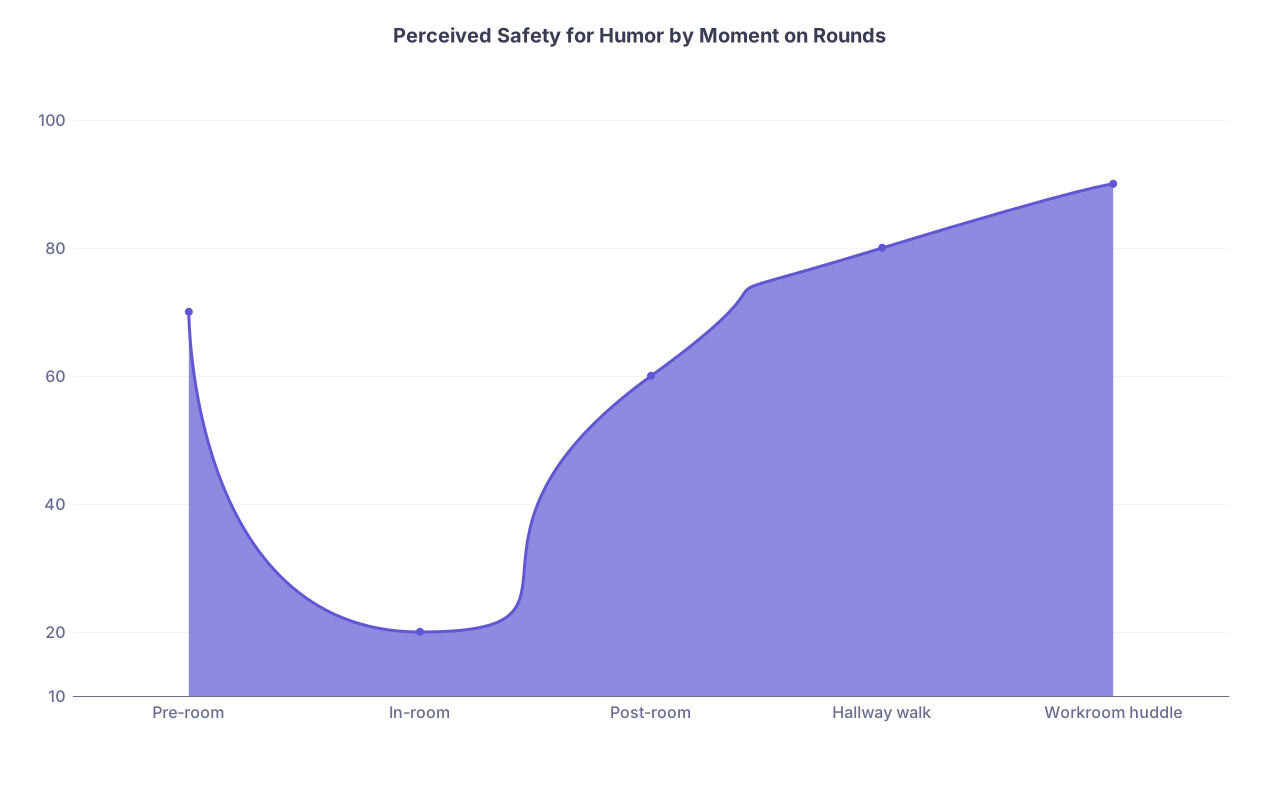
| Category | Value |
|---|---|
| Pre-room | 70 |
| In-room | 20 |
| Post-room | 60 |
| Hallway walk | 80 |
| Workroom huddle | 90 |
I have watched residents who are absolutely silent at the bedside turn into sharp, dry comics the second the door closes. Same person. Different social rules.
Example: the “one-sentence diagnosis” gag
Classic attending move on teaching rounds:
Student: “This is a 57-year-old female with a history of hypertension, type 2 diabetes, chronic kidney dis—”
Attending: “Hold up. One sentence. What is she doing in our hospital bed and not her own?”
You see the pattern: disruption of expected structure, framed as playful but instructive. The humor gives the feedback teeth without making it purely hostile. Done well, the student laughs, then actually tightens their summary.
Done poorly—sarcastic tone, shaming in front of nursing—it feels like bullying. Same words, different delivery.
Micro-humor genres you see on rounds
Let me be specific. You will see:
Deadpan exaggeration:
“We will absolutely get that MRI… as soon as radiology forgives us for the STAT ankle we ordered on the wrong side.”EHR sarcasm:
“The computer says her potassium is 3.8 and that she is a 94-year-old male who delivered twins yesterday. I trust both equally.”Callback jokes:
Day 1: Senior jokingly calls the most stable patient “our ICU candidate.”
Day 3: Same patient still here. Attending: “How is our ICU candidate?” Intern: “Actively refusing ICU by refusing to get sick.”Running nicknames for phenomena, not people:
“He has VIP syndrome” (very important person behavior, clinically stable but demanding).
“Her labs have descended into the ‘just-follow-up’ zone.”
Notice what is off limits when people know what they are doing: direct mockery of patients’ bodies, culture, language, or trauma. The target is always system absurdity, EHR nonsense, or predictable pathophysiology.
Why rounds humor improves cognition
This is not just vibes. There is a cognitive logic.
Rounds are one of the highest working-memory load tasks in the hospital:
- You are holding 12–20 patient narratives
- Medication lists
- Pending studies
- Overnight events
- Action items
Micro‑humor functions as a reset. A 2‑second “funny” jolts attention, clears the slate, and resets focus before the next H&P. You see this when an attending uses a quick joke right before quizzing someone on the next patient’s problem list. It snaps people awake.
The residents who are smartest about this do not aim jokes at juniors. They use jokes to diffuse their own frustration with:
- Bed availability
- Consult services that have not called back
- The 19th “chart check” note of the day
That is the difference between sharp and toxic.
Handoffs: Dark Humor, Pattern Recognition, and Boundary Lines
Handoffs are risk zones. They are also where the darkest humor shows up, because:
- You are usually with peers, not attendings
- You are staring at a list of everything that might go wrong tonight
- Everyone’s coffee is doing the heavy lifting
Anatomy of a handoff micro-moment
Typical internal medicine evening sign‑out, intern to night float:
- Structured format (IPASS, SIGNOUT, SBAR, whatever your institution pushes)
- You read the template, then you add color in real time
- Most jokes live in that “color” layer
Example:
Template text: “Active issues: GI bleed, Hgb 7.1, transfusing 1u PRBC.”
Spoken: “He is on his third endoscopy this admission. GI is committed to personally scoping every lumen he has.”
Is that medically relevant? No. Does it encode a mental image so the night float actually remembers “this is the recurrent GIB guy with the 3 prior scopes”? Yes. That is the point.
Where dark humor creeps in
Here is the line people dance around: using humor to cope with recurring tragedy.
- The fifth “frequent flyer” with opioid use disorder
- The third “bounce-back CHF” who cannot get meds covered
- Yet another code blue on the same unit
I have heard this a hundred times in workrooms:
Night float: “Anyone I should be scared of?”
Day intern: “The 24-year-old with lupus on 3 pressors. Everyone else is just garden variety disaster.”
It is grim. It is also a way of signalling: pay special attention here. The joke rides on real risk stratification.
The boundary problem is obvious: once you normalize half-mocking commentary about how “doomed” someone is, it is easy to drift into contempt. That is when medical humor stops being a coping tool and starts rotting your empathy.
The teams that handle this well have unspoken rules:
- You can make fun of the system
- You can make fun of the EHR
- You can make fun of your own sleep deprivation
- You do not make fun of patients’ suffering
Everyone slips. The good seniors call it gently: “Hey, let’s not go there,” then move on.
Humor as a memory hook in handoff
There is also a very practical dimension: humor makes information sticky.
Think of the last time you sat through a deadly 30‑minute sign‑out where every patient sounded identical. You remember nothing. Then think of the one time:
- “Mr. Smith: the 18‑page discharge summary in human form”
- “Ms. Lopez is the one whose creatinine is on a personal journey to the center of the Earth”
You remember those. Because your brain files them as stories, not bullet points.
Used carefully, that helps patient safety. Stupid jokes are easier to recall at 3 a.m. than “bed 12, CKD4, baseline Cr 2.8 now 3.2, trend Q8H.”
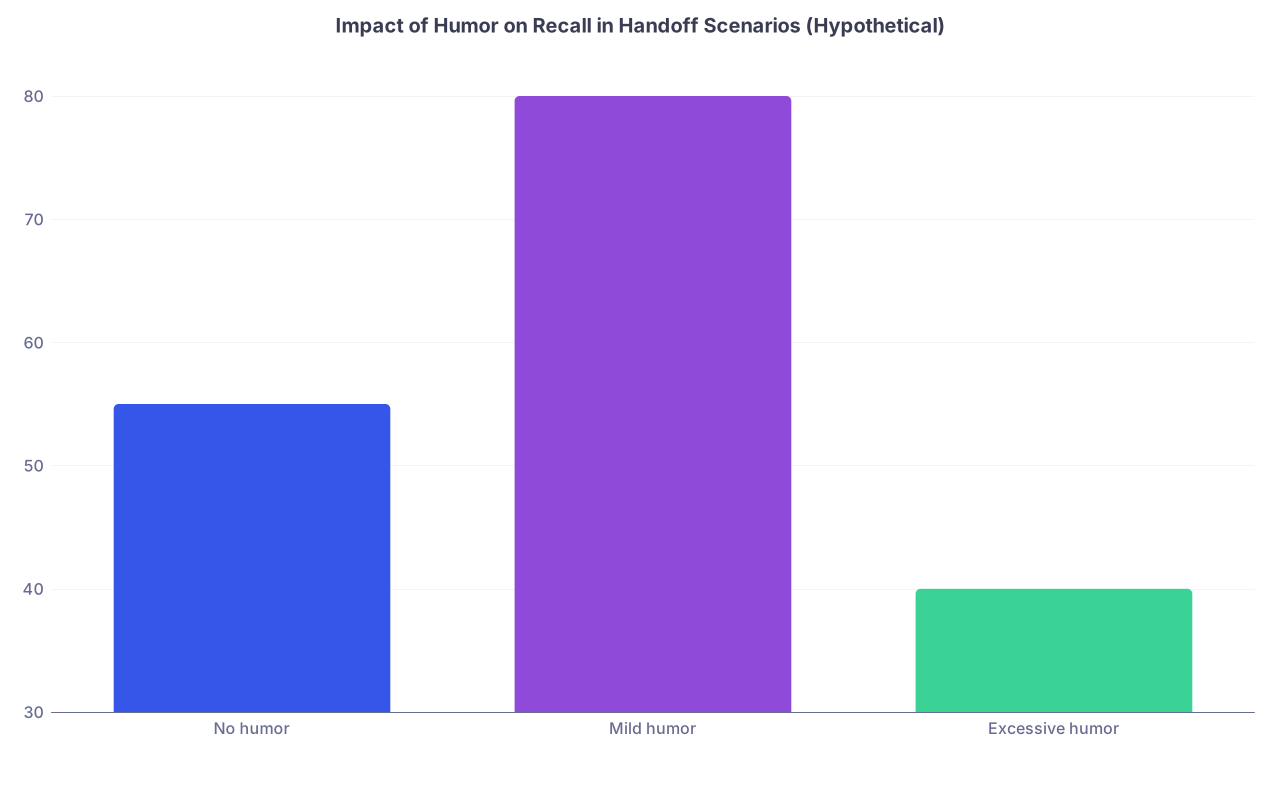
| Category | Value |
|---|---|
| No humor | 55 |
| Mild humor | 80 |
| Excessive humor | 40 |
Moderate, targeted humor? Best retention. None or chaos-level? You lose people.
Sign-Out at the End of Shift: Exhaustion Comedy and “We Survived” Energy
End‑of‑day sign‑out is a different beast. The energy shifts from anticipatory to retrospective. The jokes change, too.
The three emotional tones at sign-out
By PGY-2, you can smell the vibe walking into the workroom for sign‑out:
- “Everything caught fire”: The group trauma-bond sign‑out
- “It was fine”: Low‑key, functional, almost no joking
- “Bizarre but not catastrophic”: Prime micro‑humor ground
The third category is where you get lines like:
- “I did more phone calls for home oxygen than actual medicine.”
- “The ED admitted someone to us whose only problem is needing a primary care doctor.”
- “If you open Bed 14’s chart, please ignore the 17 incomplete progress notes. They are my cry for help.”
Many of these are really about reclaiming control. Sign‑out is the boundary ritual between clinical chaos and going home. Humor at that edge says: “I survived this, and I am still a person.”
Micro-humor that helps the night team
The best sign‑out jokes are actually tiny clinical annotations in disguise:
“He says he will leave AMA if he does not get a sandwich. For the record, he has said this every two hours since admission.”
Translation: do not panic about every AMA threat; this is baseline.“She will page you about her pain meds as soon as you sit down. I recommend sitting down in someone else’s chart room.”
Translation: be proactive with pain management and expectations.
These are pattern flags. They warn you about behavioral dynamics that will absolutely dominate your night if you are blindsided.
Then there is the pathological version: “Do not go in there, she is crazy.” That is not a micro‑joke. That is bias, and it poisons care. You see high‑functioning teams edit that language out over time.
The Micro-Formats of Humor: What Actually Comes Out of People’s Mouths
Let me get concrete. When I say “micro‑moments,” I am talking about specific formats that repeat across hospitals.
1. The “predictable question” pre‑joke
On rounds:
Senior (before entering a room): “This is the patient where Dr. X will ask you what the fractional excretion of sodium is. Just mentally prepare your kidneys.”
The joke is actually orientation. It tells the student, “Here is what matters on this patient,” couched in humor about pimping.
2. The “muted aside” during EHR lag
You have 5 seconds of awkward silence while the EHR spins.
Intern: “Epic is deciding if it will allow us to see the vitals today.”
Attending: brief smirk, everyone relaxes.
Trivial? No. Those little asides keep the room human when everyone is dead on their feet.
3. The “exaggerated formality” gag
Sign-out:
“Mr. Jones has personally reviewed and declined all modern diuretic therapy. He is profoundly committed to his edema.”
Ridiculous phrasing, real content: he is nonadherent with diuretics, do not expect miracles.
4. The “running tally” meta-joke
Trauma call:
“Congratulations, that was your third negative pan‑scan today. You are eligible for a free CT contrast allergy.”
Keeps count of absurdity. Also narrows in on a systems issue (over‑imaging) without a lecture.
Where This Goes Next: AI, Remote Rounds, and Humor in the Future Hospital
You wanted “future of medicine.” Fine. Let us talk about what happens when half of this gets mediated by screens and algorithms.
Tele-rounds are already here: attendings on iPads, half the team on Zoom from clinic, half in the hospital. The classic hallway whisper jokes? Gone or heavily reduced. Everyone is “on” the whole time, and side‑channels are slacks and group texts.
What changes:
- Less spontaneous in‑person side comments
- More private back‑channel humor in resident group chats
- More recorded spaces (Zoom calls that live on servers) which raises the stakes of saying anything borderline
That pushes humor into:
- Memes about the EHR downtime
- Screenshots of absurd consult notes
- GIFs for “radiology finally read the stat CT from 12 hours ago”
You already know this if you are a current trainee. The problem is obvious: text has no tone. Dark humor that lands in person looks horrific in a screenshot forwarded out of context.
AI scribes and auto-handoff tools
Now add AI into the mix:
- Auto‑generated progress notes
- Auto‑summarized sign‑out lists
- NLP systems flagging “risky language” or “unprofessional phrases”
You are going to see conflict between:
- The very human need to inject a little levity into sign‑out
- Institutional pressures to sanitize the medical record and potentially even communications that feel “discoverable”
I would bet money on this: you will start to see EHRs that algorithmically scrub or flag “informal” commentary in handoff fields. The space for humor will migrate even further into informal chat channels, which are often less secure and less visible to seniors who might otherwise keep the culture from drifting too far.
That is not automatically good or bad. But it is real.

| Step | Description |
|---|---|
| Step 1 | Current Rounds |
| Step 2 | In person side comments |
| Step 3 | Workroom debriefs |
| Step 4 | Current Handoffs |
| Step 5 | Spoken annotations |
| Step 6 | Handoff document jokes |
| Step 7 | Future Rounds Remote |
| Step 8 | Group chat comments |
| Step 9 | Muted Zoom reactions |
| Step 10 | Future Handoffs AI assisted |
| Step 11 | Structured auto text |
| Step 12 | Backchannel peer chats |
Under AI‑assisted workflows, the micro‑humor will not vanish. It will become harder for attendings and program leadership to see, shape, or correct. That is a problem if you care about boundary setting.
The likely equilibrium
Where this ends up is probably:
- Clinical documentation becomes more sterilized, less room for overt humor in actual notes and structured handoff fields.
- In‑person micro‑moments remain on bedside rounds and sign‑out for those physically present.
- Digital humor lives in ephemeral channels (encrypted apps, disappearing messages), which are less educationally useful and more prone to misinterpretation.
The smart systems will intentionally build safe, human spaces back in:
- Brief unrecorded huddles before or after formal virtual rounds.
- Protected debrief periods after codes, with explicit, senior‑modeled use of non‑cruel humor.
- Formal teaching on what “good” medical humor looks like versus corrosive sarcasm.
If you do not do that, you get the worst version: humor pushed entirely underground, where it festers instead of ventilating.
How to Use Humor Without Being That Resident Everyone Complains About
Let me be blunt. There is a category of resident who “jokes” constantly and thinks they are the fun one. They are not. They are noise.
A few hard rules if you want to be good at micro‑humor and not a problem:
Punch up or sideways, never down.
Mock the EHR, the call schedule, the ridiculous prior auth. Do not mock patients’ bodies, accents, or psychiatric diagnoses.Read the room.
If your attending is in “get it done” mode on post‑call rounds, do not improv a tight five about sodium levels.Never let the joke replace the clinical content.
“He is the guy with the wild potassium” is useless. “He is the guy whose potassium went from 2.8 to 6.1 in 12 hours because we were too enthusiastic with replacement” is a story that teaches and sticks.Treat students as participants, not targets.
Jokes that humiliate students for not knowing things are lazy. Jokes that include them (“We all answered that wrong as interns”) are protective.If someone looks stung, you went too far.
You do not get to insist “it was just a joke.” In a tight, high‑stress environment, psychological safety is not optional.
This is not about political correctness. It is about whether your team wants to be in a cramped workroom with you at 2:45 a.m.
The Quiet Truth: Humor Is Part of Clinical Skill
Rounds, handoffs, and sign-out are not just data throughput tasks. They are moments where you:
- Encode complex information
- Maintain team attention
- Buffer emotional strain
Micro‑humor is one of the tools for doing that well. It is not fluff. It is part of how high‑performing teams function under pressure.
The residents who are genuinely good at this share three traits:
- They know their patients cold. The joke is decoration, not substitute.
- They are self‑aware about where the line is. You rarely hear them complain about “everyone being too sensitive” because they are tracking reactions in real time.
- They use humor to build, not burn. The intern who screws up and gets a light, wry “we have all done that with lasix at 2 a.m.” from their senior will remember the teaching point better—and feel safer escalating the next time.
You can practice this. As you go through your next week of rounds and sign‑outs, watch for:
- Where do seniors inject a one‑liner right before a complicated teaching point?
- When do attendings allow a little levity, and when do they clamp down?
- How do you feel after different people joke—more relaxed and focused, or more tense and on guard?
Use that data. Steal the good moves. Kill the bad ones.
Because at the end of the day, the funniest line is not “medicine is so dark and twisted.” The funniest line is the one that keeps your team awake, keeps the night float remembering which patient is which, and keeps you all just human enough to come back tomorrow.
Three things to carry out of this
- The best humor in medicine lives in micro‑moments—between rooms on rounds, at the edge of handoff, in the 15 seconds before or after a case—not in big, performative speeches.
- Good clinical humor is targeted at systems and situations, not at patients’ suffering or colleagues’ insecurities; it clarifies and encodes information rather than obscuring it.
- As medicine leans into remote workflows and AI‑mediated documentation, you will have to be deliberate about preserving healthy, in‑person, and human spaces for this kind of micro‑humor—or you will lose one of the quiet tools that makes the work bearable.