
Only about 62% of medical students say they feel their anatomy lab humor is understood as “normal coping” rather than “being inappropriate or disrespectful” by peers and faculty.
That gap is the problem.
You and I both know anatomy lab humor is everywhere. The whispered one‑liners. The dark jokes in the locker room. The “you had to be there” story from the first dissection day that somehow still gets told on rounds three years later.
The question is not whether humor happens. It is:
- When is it healthy coping?
- When does it cross a line into disrespect?
- How do you set boundaries in a room that literally contains human donors?
Let me break this down specifically.
Why Anatomy Lab Pushes People Toward Dark Humor
Here is the blunt truth: Anatomy lab is one of the strangest psychological environments in all of medical training.
You walk in as an early M1 with minimal clinical exposure and within minutes you are:
- Confronted with death. Not theoretical, not on a slide. A real human body.
- Flooded with sensory overload: smell, visual details, sounds of saws and scissors.
- Expected to function: identify structures, use scalpels, answer pimp questions.
For many students, the emotional equation looks like this:
Unease + fear of looking weak + task pressure = humor
You see this especially in the first weeks:
Someone cracks a joke about “finding a snack” when they find adipose. Someone else calls their tank “Team Ortho” because of how aggressively they are cutting through fascia. Nervous laughter happens because silence feels heavier than the joke.
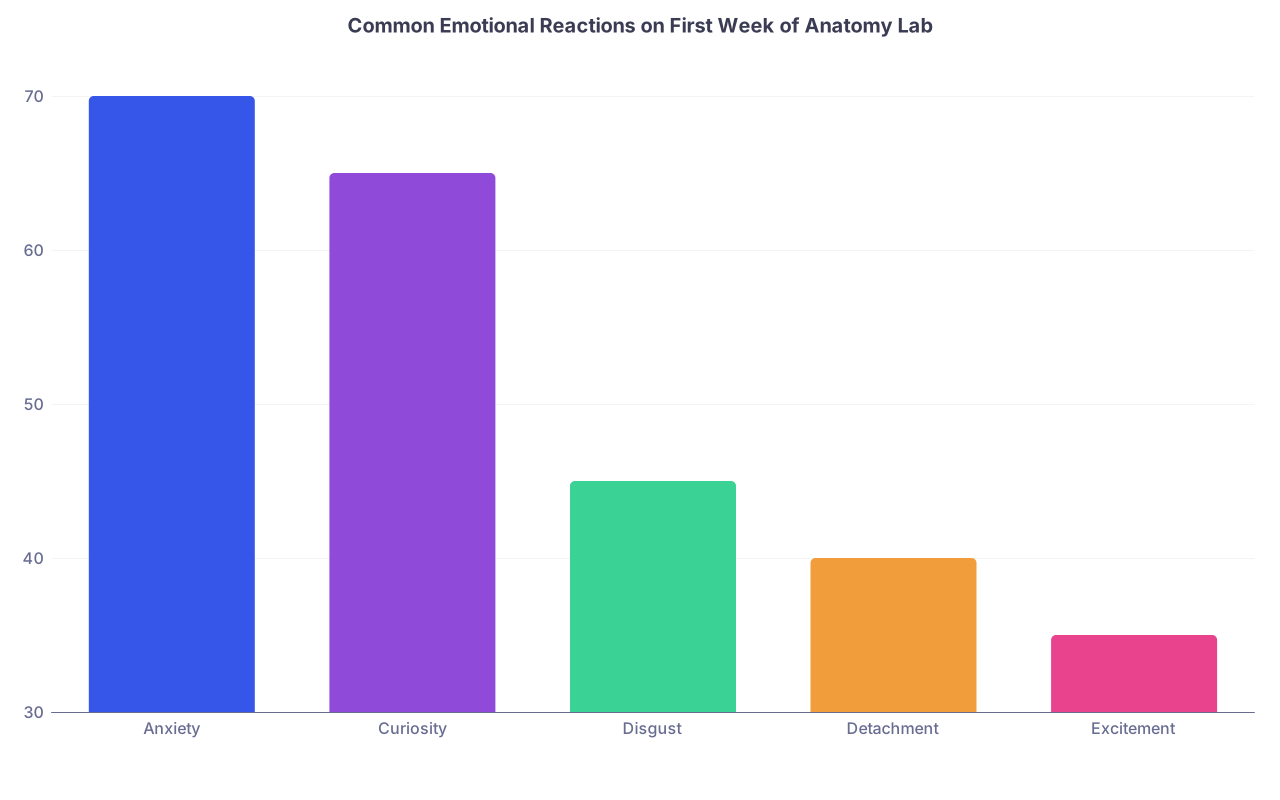
| Category | Value |
|---|---|
| Anxiety | 70 |
| Curiosity | 65 |
| Disgust | 45 |
| Detachment | 40 |
| Excitement | 35 |
Most of that is not malicious. It is defense. If you have sat in enough debrief groups, you hear the same phrases:
- “If I stop joking I will start crying.”
- “It feels less real if I keep it light.”
- “I am not sure how else to handle it.”
The mistake schools make is pretending humor will not happen and treating any dark joke as moral failure. That is naïve.
The real work is teaching students:
- What kinds of humor help you process.
- What kinds start to chip away at respect for the donor.
- How to recognize when a peer is not laughing for the same reasons you are.
The Three Types of Anatomy Lab Humor (And Which One Gets You in Trouble)
Not all anatomy lab humor is created equal. I tend to divide it into three buckets.
1. Task‑focused, “nerdy” humor (generally fine)
These are jokes that orbit the work itself, your own incompetence, and the ridiculousness of learning medicine.
Examples I have heard more times than I can count:
- “I finally found the recurrent laryngeal nerve… please tell ENT I am hireable now.”
- “Who knew I would relate so deeply to the greater omentum just draping over my problems.”
- “If USMLE wants this artery, they need to come find it themselves.”
Key features:
- Punchline is you, the content, or medicine as a system.
- No objectification of the donor.
- No mocking of disease, body shape, age, or identity of the donor.
This kind of humor often decreases anxiety, builds group rapport, and actually enhances learning. You laugh, you remember the structure. Harmless when used thoughtfully.
2. Coping/detachment humor (borderline, context‑dependent)
This is the nervous, slightly darker tone that shows up early on:
- Naming the tank “the morgue squad.”
- “At least our donor is being more cooperative than some clinic patients.”
- “Well, they are not going to complain about my suturing.”
Here, intent is coping. But impact can get messy.
If everyone in the group feels some emotional distance but still retains implicit respect, fine. The danger is when repetition normalizes seeing the donor as a prop, not a person.
You know it has drifted too far when:
- People talk about “the body” instead of “our donor” or “this person.”
- There is eye‑rolling when someone suggests a moment of silence or thanks.
- Jokes about “disassembling” or “breaking” parts feel casual rather than uneasy.
Coping humor is like fentanyl: powerful in small controlled doses, destructive when used freely without monitoring.
3. Dehumanizing or mocking humor (not acceptable)
Let me be blunt. This stuff is wrong, and programs are justified in disciplining it:
- Jokes about the donor’s body type, genitalia, or perceived gender.
- Mocking prior illness (“Guess the smoker did not win this time.”)
- Using the donor’s body for “pranks” or staged photos.
- Nicknaming donors with derogatory or sexual names.
This crosses from coping into cruelty. And it is not a gray zone.
You should assume two things:
- Someone in your group has a family member who died in a similar way.
- Someone in your group is watching to see what kind of physician you are becoming.
Putting a surgical glove on the donor’s hand and joking they are “high‑fiving” the class is not edgy. It is childish. I have seen those photos derail residency applications when they leak.
Boundaries: What Respect for Donors Actually Looks Like
A lot of schools just say “be respectful in the lab” and leave it at that. Vagueness is useless. You need specifics.
Here is what clear boundaries actually look like in a well‑run lab.
Language and naming
Good practice:
- Refer to them as “our donor” or “this individual/person.”
- If the program gives a donor ID or first name (with consent from the family), use it respectfully.
- Avoid language that makes the donor a “thing” (the cadaver, the body, the specimen) as your default.
Bad practice:
- Nicknames based on appearance, pathology, or stereotypes.
- Reducing a whole person to a diagnosis (“the aneurysm table”).
Students roll their eyes at this, but language shapes perception. If you repeatedly call someone “the specimen,” your brain will treat them like one.
Physical treatment of the body
Respect is physical, not just verbal.
Non‑negotiables:
- Covering the donor when not actively dissecting the area.
- No unnecessary manipulation for entertainment.
- No posing, no props, no photo ops.
- Gentle instrument use, even when no one is watching.
Technical sloppiness with the donor often correlates with later sloppiness on patients. I have watched attendings quietly clock the students who treat the donor like a “practice carcass” and mentally file it away.
Documentation and photography
This is where people get reckless.
Basic rules you should live by:
- No personal photos or videos in the lab. None. Even if “no face is shown.”
- If the school has an official photography policy for educational images, use only that pathway.
- Never post anything from the lab on social media, even if you think it is anonymous.
I have seen “anonymous” anatomy lab pictures show up in group chats two years later with students’ names attached by metadata. Those stories do not end well.
| Violation Type | Typical Consequence |
|---|---|
| Casual demeaning nicknames | Verbal warning, professionalism note |
| Mocking donor pathology | Formal professionalism report |
| Unauthorized photos | Disciplinary hearing |
| Posting on social media | Suspension or dismissal risk |
| Physical pranks with donor | Immediate removal from lab |
Using Humor as a Healthy Coping Tool (Not a Weapon)
You do not need to become stone‑faced to be “respectful.” You just need to be strategic.
Aim jokes at yourself or the system
Examples that pass my stress‑test:
- “I have discovered a new structure: the I‑Have‑No‑Idea‑What‑This‑Is ligament.”
- “Anatomy has confirmed my only six‑pack is in the vending machine.”
- “Somewhere, the person who named the obturator nerve is laughing at us.”
Here the donor is never the punchline. You, your confusion, or the absurdity of medicine is.
Keep the darkest humor private and upward
There is a difference between the line you draw in public and the line you draw with one trusted friend after lab.
If you need to say something very dark just to blow off steam:
- Do it away from the lab.
- Do it with someone you trust who shares your context.
- Make sure it is clearly about your discomfort, not mockery of the person who donated.
Faculty also use dark humor. The healthier ones do it in a way that is clearly self‑deprecating or targeted at the healthcare system, not at patients or donors. Watch carefully who you choose to emulate.
Name the discomfort out loud
One of the most powerful “jokes” I have heard in lab was blunt honesty:
A student looked at the table, visibly shaken, and said:
“Okay, I am just going to admit I am freaking out a little bit and pretending I am not.”
Everyone laughed. Because they were all doing the same thing.
Sometimes the real relief comes not from a punchline, but from saying the quiet part out loud.
Group Dynamics: When Someone Else Crosses the Line
You will not always be the one telling the joke. Sometimes you will be the one standing there thinking, “Seriously?”
Let us be specific about what you can do.
Low‑intensity violations (awkward, mildly off, probably unintentional)
Example:
Someone says, “Well at least our donor did not need their legs anymore.”
Options:
- The look: A quick pause and neutral stare can be enough. Humor feeds on social reinforcement. If no one laughs, it dies quickly.
- The redirect: “Yeah… anyway, do you see the nerve branching here?”
- Light mirror: “I know we are all coping, but let’s not roast the person who donated their body.”
You do not need a sermon, just a nudge.
Clear boundary crossing (mocking, demeaning, repeated behavior)
Example:
Student repeatedly makes jokes about the donor’s prior illness or body.
That deserves direct feedback. One model that works:
“Hey, I get that this is intense and everyone is trying to cope, but those jokes about [X] feel pretty disrespectful to the donor. Can we cut that out?”
If you do not feel safe saying that, at least speak to a TA, lab director, or faculty member afterward. Reporting does not automatically mean someone gets “ruined.” Often it triggers a quiet conversation and professionalism note. That is how culture shifts.

| Step | Description |
|---|---|
| Step 1 | Hear questionable joke |
| Step 2 | No laugh or eye contact |
| Step 3 | Redirect back to task |
| Step 4 | Simple verbal nudge |
| Step 5 | Speak to person privately |
| Step 6 | Inform TA or faculty |
| Step 7 | Monitor and support group tone |
| Step 8 | Severity |
| Step 9 | Still continues |
Institutional Responsibility: Schools Cannot Outsource This to “Professionalism”
If your anatomy course introduction was: “This is a solemn space. Be respectful. Ok, here is the brachial plexus,” your school skipped steps.
Strong programs do three things:
Explicit pre‑lab framing
They explain donor selection, consent, and family involvement.
They share a donor letter or ceremony video.
They discuss exactly what humor and behavior are out of bounds with examples.Built‑in reflection points
Short debrief sessions. Not touchy‑feely marathons. Just 20–30 minutes where someone says: “How is everyone doing? What has surprised you? Any lines you have seen crossed?”Visible consequences for violations
Not witch‑hunts. Just consistent follow‑through.
When students see a clear response to a serious boundary violation, it sends one message: “We actually mean what we said about respect.”
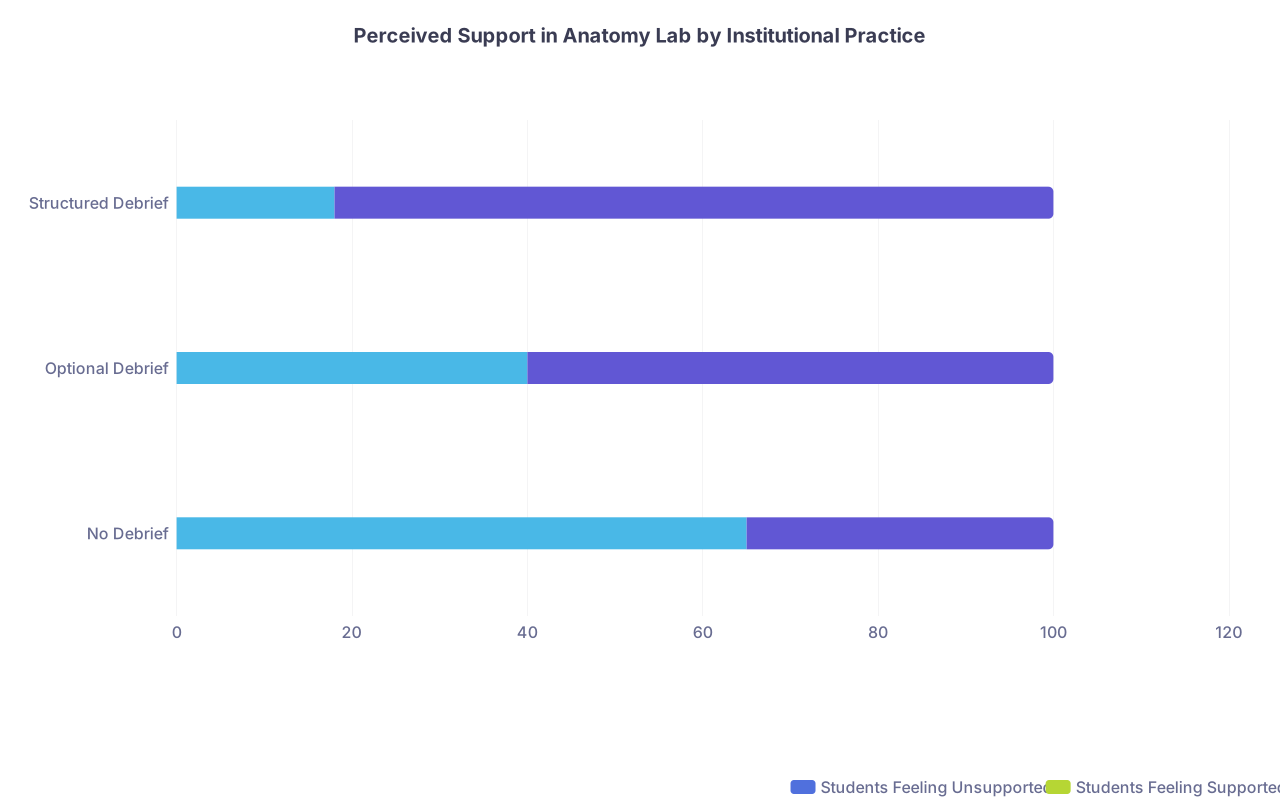
| Category | Students Feeling Unsupported | Students Feeling Supported |
|---|---|---|
| No Debrief | 65 | 35 |
| Optional Debrief | 40 | 60 |
| Structured Debrief | 18 | 82 |
If your school is weak on this, you can still push for better:
- Ask for a brief debrief after the first dissection week.
- Ask faculty to clarify the humor boundary in concrete terms.
- Suggest a donor ceremony or letter reading if it does not exist.
I have seen single cohorts change the tone of anatomy lab for the classes behind them by refusing to treat donors as “just part of the furniture.”
Balancing Humor With Ritual and Gratitude
If humor is one coping pillar, ritual is another. Most programs that get this right combine both.
Common, high‑value rituals:
Opening ceremony:
Some schools invite donor families (with consent) to speak about why their relative donated. You see students go quieter instantly. It becomes very difficult to make flippant jokes later once you have heard “my mother wanted you to learn from her.”Moment of silence at start of lab:
Thirty seconds. Hands at your sides. No phones. Just a conscious pause before uncovering the table. Not dramatic. Very grounding.End‑of‑course ceremony:
Students reading letters of thanks, sometimes musical performances, sometimes faculty reflections. Some schools then invite any donor families who wish to attend. It connects the dots: you did not just dissect tissue; you learned from a person.
These rituals do not ban humor. They frame it.
You can absolutely have a day where you joke about “being personally victimized by the pelvic cavity” and still walk into the ceremony at the end of the block, stand up straight, and say “thank you” internally to whoever is on your table.

How This Follows You Out of the Lab
Here is the part many M1s do not fully grasp: your anatomy lab habits show up later. Clinically. Socially. Professionally.
Patterns I have seen:
The student who constantly makes jokes at the donor’s expense?
Often becomes the resident who cracks jokes about “train wreck patients” loud enough for families in the hallway to hear.The student who reflexively speaks up when someone crosses a line?
Often becomes the resident who stops a surgeon from making a graphic joke in front of a conscious patient.The student who practices small rituals of respect?
Often becomes the physician who pauses before a procedure and explains it properly, even when the schedule is tight.
You are not just carving out muscle planes in lab. You are carving out your professional reflexes.
So use anatomy for what it really is: a training ground not just for your hands, but for your humor, your boundaries, and your respect for the humans who let you learn this in the first place.
Quick Recap: The Essentials
- Humor in anatomy lab is normal, but not all humor is equal. Aim jokes at yourself or the system, never at the donor.
- Respect is concrete: language, physical handling, no photos, and zero tolerance for dehumanizing or mocking behavior.
- How you joke and how you intervene in lab foreshadows the physician you will become. Treat donors as the first patients who ever trusted you.
FAQ (Exactly 5 Questions)
1. Is any dark humor in anatomy lab automatically unprofessional?
No. Dark humor is common under stress. The key distinction is target and impact. If the joke targets your own anxiety or the absurdities of medicine and everyone present understands the intent, it can function as coping. When the target becomes the donor’s body, pathology, or identity, it crosses into disrespect and unprofessionalism.
2. What should I do if my whole tank seems comfortable with jokes that make me uneasy?
Start small. You can quietly withdraw your laughter, redirect the conversation back to the task, or say something simple like, “Can we not joke about them like that?” If it continues or escalates, speak to a TA, course director, or student affairs dean. You are not being “over‑sensitive”; you are defending the person who donated their body so you could learn.
3. Is it ever acceptable to take a photo in the anatomy lab if no face or identifying marks are shown?
In almost all programs, no. Institutional policies are usually explicit: no personal photography in the lab, regardless of identifiability. Even “harmless” images can be misused, leak, or be misinterpreted by the public or by donor families. If there is a legitimate educational need for images, those are taken and stored under controlled institutional protocols, not on personal devices.
4. How do I cope if humor does not help me and I just feel disturbed by the lab?
You are not alone. Some students do not find humor effective or appropriate for themselves. Alternatives include brief reflective writing after lab, talking with a trusted classmate, attending any offered debrief groups, or speaking privately with a counselor or student health professional. Using ritual—like a mental “thank you” to the donor at the start and end of each session—can also help anchor you without joking.
5. Do donor families really care how we act in the lab if they never see it?
Yes, and you should act as if they are watching, because sometimes they effectively are. Families who choose donation often imagine their loved one being treated as a teacher, not an object. Many institutions share general descriptions of how donors are honored and handled. Your behavior contributes directly to whether those descriptions are honest. Respect in unseen spaces is the core of professional integrity.